
Engineers have long struggled with the invisible poison trailing behind every modern combustion engine. Nitric oxide, a stubborn byproduct of high-heat ignition, pours out of industrial boilers and vehicle tailpipes, contributing to a global health crisis that hits urban centres the hardest. While research indicates that transitioning to renewable power generation could slash air pollution health costs by 80 percent by mid-century, the fuels powering our current infrastructure still rely on complex aftertreatment systems to keep the air breathable.
Traditional catalytic converters and selective catalytic reduction units offer a partial shield, but they carry a glaring weakness: they require immense heat to function. This creates a dangerous window of vulnerability known as the cold-start phase, where pollutants slip through untreated because the exhaust hasn’t reached its light-off temperature. Addressing this “cold exhaust gap” is no longer just a chemical curiosity; it is a fundamental requirement for protecting urban health infrastructure and meeting modern ambient air quality standards through effective cold-start emissions reduction.
Scientific proof of room-temperature nitric oxide conversion offers a glimpse into a new era of environmental engineering. Low-temperature NOx control could evolve from a theoretical goal into a practical reality, fundamentally shifting how we approach industrial boilers and vehicle emissions.

Key Facts Regarding Room-Temperature Nitric Oxide Removal
Scientific research into room-temperature nitric oxide removal has uncovered several critical mechanisms that distinguish this pathway from traditional aftertreatment. Examining the molecular behaviour of NO in a controlled environment allows for a better understanding of the potential for future low-temperature NOx control applications.
- This chemical process converts nitric oxide (NO) directly into harmless nitrogen gas (N₂) while remaining at room temperature in an aqueous environment.
- The system uses an iron-based porphyrin complex held inside a cyclodextrin cavity that acts as a supramolecular heme mimic.
- The chemistry runs in an acidic aqueous glycine buffer at a pH around 3 rather than at hundreds of degrees Celsius.
- Nitrogen gas bubbles appear within minutes under those laboratory conditions, confirming that reactive nitrogen is being stitched back into stable N₂..
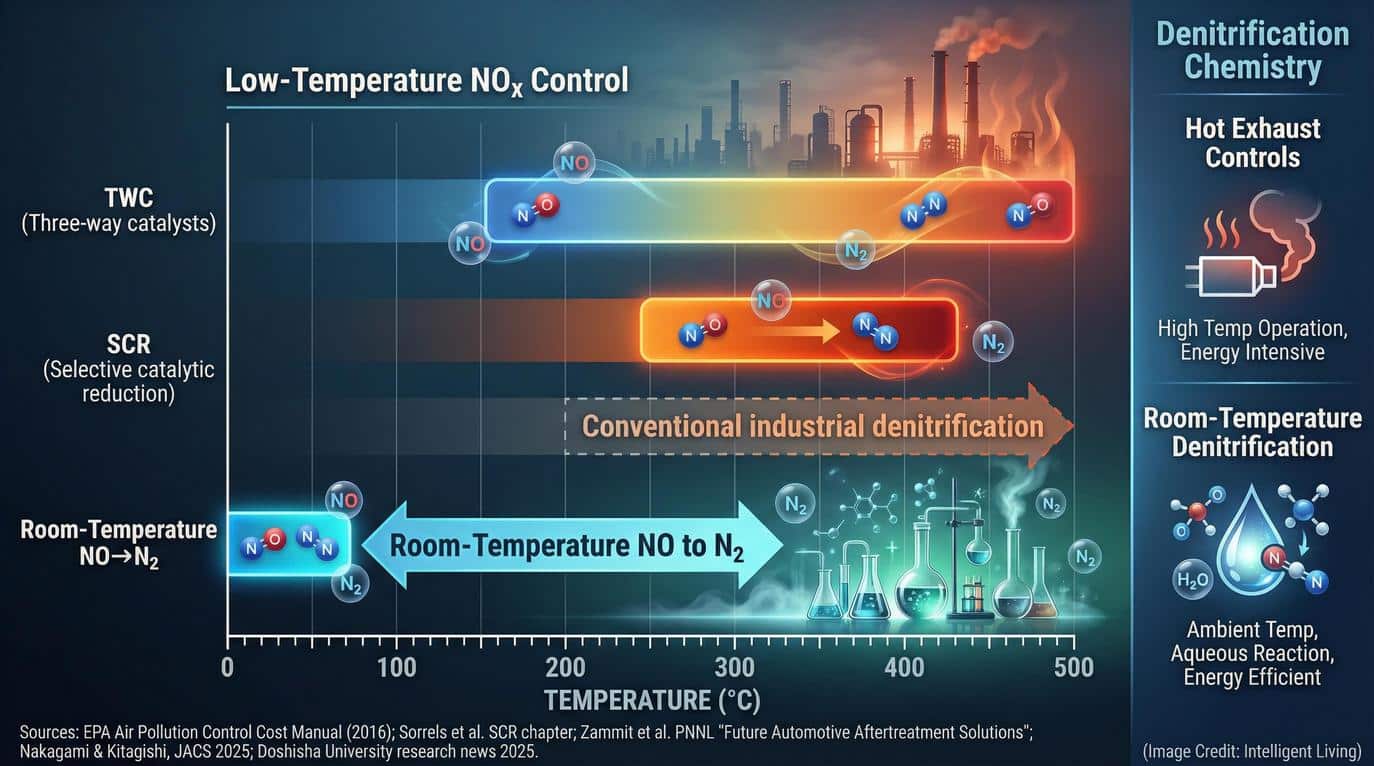
- Current selective catalytic reduction systems that clean up NOx on industrial stacks typically operate best at several hundred degrees Celsius.
- Conventional three-way catalysts installed on gasoline vehicles usually need exhaust temperatures well above 150 degrees Celsius before they efficiently reduce NOx.
The transition away from purely heat-driven models may soon allow engineers to find new ways to minimize the cold exhaust gap that persists in modern transport.
Technical Challenges of the Cold Exhaust Gap in NOx Control
Most of the devices that clean nitrogen oxides from exhaust are designed around a simple assumption that gases will be hot. In vehicles, catalytic converters sit close to the engine so that they can warm up quickly and begin reducing NOx, carbon monoxide, and unburned hydrocarbons. These systems have a temperature threshold, sometimes called light-off, below which reactions proceed too slowly to remove much pollution.
On industrial stacks and large engines, operators often rely on selective catalytic reduction, which injects ammonia or urea into exhaust and passes the mixture over a catalyst to turn NOx into nitrogen and water. Performance depends strongly on temperature. If the exhaust is too cool, the reactions slow down, and unreacted ammonia can pass through. If it is too hot, other unwanted reactions can take over.
Operational Temperature Thresholds for Selective Catalytic Reduction
According to official technical documentation on selective catalytic reduction temperature windows, many commercial SCR systems are tuned to operate best between roughly 250 and 427 degrees Celsius. Systems facing cooler exhaust streams often require additional burners or heat exchangers to maintain this temperature band. This necessity inevitably increases both the cost and complexity of industrial operations.
On the transportation side, data suggests that three-way catalysts require temperatures exceeding 150 degrees Celsius to effectively reduce NOx, underlining how much extra nitrogen oxide slips through during the first minutes of driving. A room-temperature chemistry could someday help bridge this cold exhaust gap if adapted beyond its current laboratory form.
Supramolecular Breakthroughs in Nitric Oxide to Nitrogen Gas Conversion
At the core of this reaction is nitric oxide—a colourless gas built from single atoms of nitrogen and oxygen. It typically emerges as the initial byproduct of high-flame combustion, forged when atmospheric nitrogen meets extreme heat. In the atmosphere, it can later oxidise into nitrogen dioxide and participate in the formation of ozone and fine particles.
Researchers built a synthetic system that imitates the iron centre found in natural heme proteins such as haemoglobin. By placing an iron porphyrin complex inside a cyclodextrin dimer, they ensured the metal sits in a well-defined molecular cavity.
The structural design behaves like a tiny pocket that can latch onto nitric oxide in water. This precise molecular environment is what allows the chemical transformation to take place without external heat. Under strongly acidic conditions in a glycine buffer at about pH 3, the iron porphyrin binds nitric oxide and then converts it into nitrogen gas. This landmark chemistry, which details successful nitric oxide to nitrogen conversion at ambient temperatures, demonstrates how iron porphyrins can bind and neutralise reactive gases in water.
Analytical Verification of Molecular Nitrogen Formation
To ensure the accuracy of their findings, the research team employed a suite of high-precision analytical tools:
- Direct detection of nitrogen gas bubbles in the aqueous phase.
- Isotopic labelling to track the path of nitrogen atoms.
- Nuclear magnetic resonance (NMR) measurements to observe molecular shifts.
- Advanced computational modelling to verify the reaction energetics.
Comprehensive checks confirmed that nitric oxide was indeed being transformed into N₂ in solution at room temperature. The verification provides a stable foundation for future industrial boiler exhaust treatment concepts.
Molecular Mechanisms of Room-Temperature Nitric Oxide Conversion
The mechanism hinges on the iron-nitric oxide complex created the moment NO latches onto the synthetic heme centre. In the reported system, glycine in the acidic buffer plays more than a passive role in setting pH. The amino acid behaves as a nucleophile, which means it donates electron density into the iron-bound nitric oxide unit during a key step in the reaction.
That nucleophilic attack provides the right conditions for two nitrogen atoms to link together directly on the iron centre. Building a new nitrogen-to-nitrogen bond directly around the metal allows the system to facilitate the formation of stable molecular nitrogen gas. The proposed pathway passes through a diazo-type intermediate, which then undergoes hydrolysis so that N₂ can leave and an alpha-hydroxy acid byproduct remains in solution.
In everyday language, the reaction uses a cleverly designed iron environment and a simple amino acid to grab nitric oxide out of the liquid and stitch two nitrogen atoms back together so they can leave as stable nitrogen gas. This chemical shift effectively renders a reactive pollutant into the same inert nitrogen that already constitutes the vast majority of our atmosphere.

Solubility Barriers in Industrial Nitric Oxide Capture Systems
One stubborn practical hurdle divides the nitric oxide found in hot exhaust from the room-temperature chemistry observed in the lab. Because nitric oxide resists dissolving easily in water, its low solubility strictly limits how much NO an aqueous system can trap from a passing gas stream before hitting saturation.
Limitations of Conventional Flue Gas Desulfurisation
Research highlighting why wet flue gas desulphurization systems struggle with nitric oxide solubility notes that scrubbers designed for sulphur dioxide are far less effective at dealing with NO. Engineers have experimented with oxidising nitric oxide into more soluble forms or adding strong oxidants and catalysts to promote absorption, but those methods can be chemically intense or expensive.
Further investigations confirm that nitric oxide requires oxidation into more soluble species before it can be absorbed efficiently in liquid systems, underlining the complexity of industrial designs. The performance of dry systems can change if exhaust composition or temperature drifts away from design targets.
Impact of Exhaust Gas Recirculation on NOx Output
Analyses of how removing exhaust gas recirculation hardware increases NOx emissions show that even small changes to flow paths and combustion conditions can sharply raise nitrogen oxide output.
Neutralising NO without high-temperature catalysts suggests there may be more options for turning it into harmless N₂ once it enters a liquid phase. Against that background, a room-temperature aqueous reaction that directly converts nitric oxide into nitrogen gas looks attractive.
Implementation Pathways for Low-Temperature NOx Control Technologies
Any real-world application of this reaction would need to start from where the chemistry already works. Current research reveals the system as an acidic, water-based solution stabilised by a specially designed iron complex and a glycine buffer, which differs significantly from the emissions control and aftertreatment hardware used in modern engines. The early implementation might favour wet capture systems rather than trying to graft it directly onto a dry catalytic converter.
One possibility would be an exhaust treatment stage in which a portion of the gas stream is brought into intimate contact with an aqueous phase that contains an immobilised or easily recoverable version of the iron porphyrin cyclodextrin complex. Dissolving nitric oxide into the liquid could then follow the same pathway observed in the laboratory and emerge as nitrogen gas.
Engineering Requirements for Large-Scale Deployment
Even in that best-case scenario, several engineering questions would need answers. Designers would first have to prove that gas-to-liquid mass transfer remains efficient enough for high-volume use. Engineers must also guarantee that the iron complex maintains its stability over thousands of hours of rigorous operation. Finally, researchers must confirm that common exhaust components—such as oxygen, sulphur, and particulate matter—do not poison the chemistry.
A more speculative path would be to adapt the underlying mechanism to solid supports or hybrid materials that work directly in the gas-phase exhaust without an aqueous bulk phase. Doing so would likely require redesigning the molecular environment that currently depends on water and strong acidity. The gas-phase version would also have to withstand temperature swings and mechanical stress inside pipes or mufflers.

Identifying Global NOx Sources and Indicator Pollutant Escape Routes
Nitrogen oxides don’t emerge in a vacuum; they constitute the inescapable fallout of high-heat combustion. When air and fuel are compressed and ignited in engines, the nitrogen that normally behaves as an inert background gas can react at high temperatures with oxygen to form nitric oxide. In power plants, industrial boilers, and cement kilns, similar chemistry takes place wherever flames and hot gases meet.
The Role Of Nitrogen Dioxide as An Indicator Pollutant
Public health data identifying vehicles and power plants as primary nitrogen dioxide sources clarifies how these gases cycle between each other and participate in the formation of ozone and smog.
Nitrogen dioxide, in particular, serves as the primary nitrogen oxide indicator pollutant in ambient air standards. Measuring accurately is easier with NO₂, and it remains more directly linked to adverse health effects compared to other nitrogen species.
Urban Emission Profiles and Human Health Impacts
Real-world emissions do not come from a single type of machine. Urban traffic mixes cold starts, stop-and-go driving, and heavy-duty diesel trucks that produce complex exhaust streams containing soot, NOx, carbon monoxide, and volatile organic compounds. Reporting on how diesel exhaust can disrupt human brain function even after short exposures highlights how these gases and particles travel deep into the body.
Rapid shifts in human activity and policy demonstrate that nitrogen dioxide levels can drop significantly in a very short timeframe. During the early months of the COVID-19 pandemic, satellite observations recorded a significant decline in nitrogen dioxide pollution over the northeastern United States, illustrating how traffic reductions yield cleaner air. The responsiveness is encouraging because it shows that every step taken to tighten control over escape sources can yield measurable benefits.

The Bigger Picture: Clean Air as Health Infrastructure
Behind the engineering lies a public health reality, with data linking childhood asthma clusters to nitrogen dioxide hotspots. Nitrogen dioxide, in particular, irritates airways and makes respiratory conditions worse, while the ozone and fine particles that form in polluted air have been tied to cardiovascular disease and other chronic illnesses, alongside evidence that long-term traffic pollution exposure increases dementia risk in older adults.
Quantifying Premature Mortality Risks from Gaseous Pollutants
A global assessment linking outdoor air pollution to millions of premature deaths annually explains how fine particles and gaseous pollutants combine to raise risks of heart attacks, strokes, lung cancer, and respiratory infections. The statistics are sobering because they translate incremental changes in pollutant concentrations into very real differences in life expectancy.
Air Pollution Impacts on Cognitive Health and Mental Well-being
The burden is not limited to physical health. Investigations into cognitive health include alarming data suggesting fossil fuel pollution kills ten thousand people daily worldwide. Some studies even suggest that breathing heavily polluted urban air damages lungs as severely as smoking a pack of cigarettes a day.
Urban exposure studies have also found that chronic nitrogen dioxide exposure raises the risk of schizophrenia and other mental health disorders. There is further evidence connecting chronic urban air pollution to anxiety and depression, illustrating the profound impact of air quality on the human mind. Improvements in controlling nitrogen oxides and other pollutants directly foster healthier cities, lower healthcare costs, and a significantly better quality of life for urban populations.
What Needs to Be Proven Next
Scaling Bench-Scale Reactions for Industrial Volume
Before this reaction can influence how regulators and engineers think about nitrogen oxide control, several layers of evidence will be required. Laboratory groups will need to replicate the chemistry in independent experiments and demonstrate that it scales beyond small vials. Verification must include proof that the reaction maintains its high efficiency even as larger volumes of nitric oxide pass through the system.
Testing Chemical Stability Against Realistic Exhaust Mixtures
Researchers must also subject the system to the chaos of real exhaust. Beyond nitric oxide, tailpipes spew a complex cocktail of nitrogen dioxide, carbon dioxide, water vapour, and metallic traces. These side reactions could compete with the desired nitrogen-forming pathway or degrade the iron complex more quickly than anticipated. The degradation remains a significant barrier to the long-term reliability of supramolecular heme mimics in active service.
Long-Term Catalyst Durability and Economic Viability
Durability and cost are equally important. Industrial catalysts are expected to run for years, not weeks, and to do so without constant replacement. The molecular building blocks in this reaction would need to be synthesised at scale, supported in robust materials, and integrated into treatment units that can be serviced without excessive downtime.
Final pilot demonstrations at real point sources would prove the technology’s worth. The projects would show whether room-temperature chemistry can handle fluctuating exhaust flows, varying fuel qualities, and regulatory performance tests that measure grams of NOx emitted per unit of energy or product.
Future Directions for Low-Temperature NOx Control and Room-Temperature Removal
The ability to facilitate nitric oxide to nitrogen gas conversion without the typical fire-and-brimstone temperatures of traditional catalysts marks a significant milestone in environmental chemistry. Leveraging a supramolecular cyclodextrin cavity to stabilise an iron-based porphyrin complex has allowed scientists to prove that the chemical bonds of NO can be dismantled within a simple liquid phase. While the transition from a laboratory glycine buffer to a heavy-duty diesel exhaust system involves significant engineering challenges, the proof of concept provides a roadmap for eliminating the toxic “blind spots” that currently exist during engine warm-up and low-load industrial cycles.
Progress in this field underscores the evolving definition of clean air as a piece of essential health infrastructure. As we look toward integrating these room-temperature pathways with existing wet flue gas scrubbers or hybrid materials, the goal remains clear: reducing the impact of nitrogen dioxide on vulnerable populations. Every advancement in how to remove nitrogen oxides at room temperature brings us closer to a future where breathing the air in a major city doesn’t come with a hidden cost to life expectancy.
Policy shifts can also trigger immediate improvements, ensuring that nitrogen dioxide reductions in central London following stricter traffic measures are supported by robust technical solutions. Simultaneously, the large-scale adoption of electric vehicles offers another pillar of reduction, with data suggesting electric vehicle adoption could prevent hundreds of thousands of premature deaths while saving billions in healthcare costs annually.
Essential FAQ: Low-Temperature NOx Control and Supramolecular Chemistry
Why do Catalytic Converters Need High Heat to Work?
Most common catalysts require a specific thermal threshold, known as light-off, to trigger the necessary chemical reduction of exhaust pollutants. Without reaching temperatures typically above 150 to 250 degrees Celsius, the reaction rates are too sluggish to prevent nitrogen oxides from escaping into the atmosphere.
What is The Difference Between NO and NO₂ in Air Pollution?
Nitric oxide (NO) is often the primary nitrogen oxide formed during combustion, while nitrogen dioxide (NO₂) is its more reactive atmospheric successor. Regulators track both as NOx, but NO₂ is frequently used as the primary nitrogen oxide indicator pollutant due to its direct links to respiratory inflammation.
Can Nitric Oxide Be Turned into Nitrogen Gas at Room Temperature?
Yes, recent laboratory research has shown that using an iron-based porphyrin complex inside a cyclodextrin cavity allows nitric oxide to be converted into harmless nitrogen gas (N₂) at room temperature within an acidic aqueous solution.
How do Cars Clean Nitrogen Oxides when The Engine Is Cold?
Currently, they don’t do it very well. Most vehicles rely on the rapid heating of the catalytic converter to begin cold-start emissions reduction, but until that heat is reached, a significant portion of the NOx passes through the exhaust system untreated.
Does this Chemistry Impact Industrial Boiler Exhaust Treatment?
Adapting these reactions to existing wet flue gas desulfurisation systems would allow industrial plants to neutralise NOx without the massive energy costs associated with reheating exhaust for traditional SCR units.


