
Innovation is often described as a breakthrough moment. A new patent. A new lab discovery. A new prototype unveiled on stage. Chinese national high-speed scaling efforts prove that lasting breakthroughs rarely emerge through isolated discoveries. Repetition, deployment, feedback, and relentless iteration drive successful industrial evolution.
Mastering this high-speed scaling loop is essential for nations aiming to accelerate clean energy transitions. A recent industrial cycle acceleration explores this transition in detail. For the robotics case, see how the Chinese robot scale-up mirrors this deployment flywheel. It highlights how China utilizes scale and regulatory coordination to accelerate its industrial cycle.
Bypassing a sole focus on research labs, China builds systems that move technologies rapidly from pilot projects to mass deployment. Real-world use generates learning and cost reductions at extraordinary speed. High-speed scaling in China has reshaped industries from solar power to electric vehicles and high-speed rail.
Large-scale infrastructure is not simply about capacity. Renewable energy projects at scale, such as China’s 1-GW HG14 offshore solar farm and the country’s expanding hydrogen pipeline network, show the same pattern. Industrial capability emerges when infrastructure becomes a learning platform and a source of data.
Nations do not necessarily need to copy specific political systems to benefit from these insights. Deployment itself functions as research and development. Rapid project scaling allows engineers to gather real-world performance data faster. Supply chain refinement occurs sooner. Manufacturing lines adjust in months rather than years. Costs fall not because of a single invention, but because thousands of small improvements accumulate across the system.
Modernizing infrastructure and accelerating clean energy requires mastering this deployment dynamic in an increasingly competitive world.
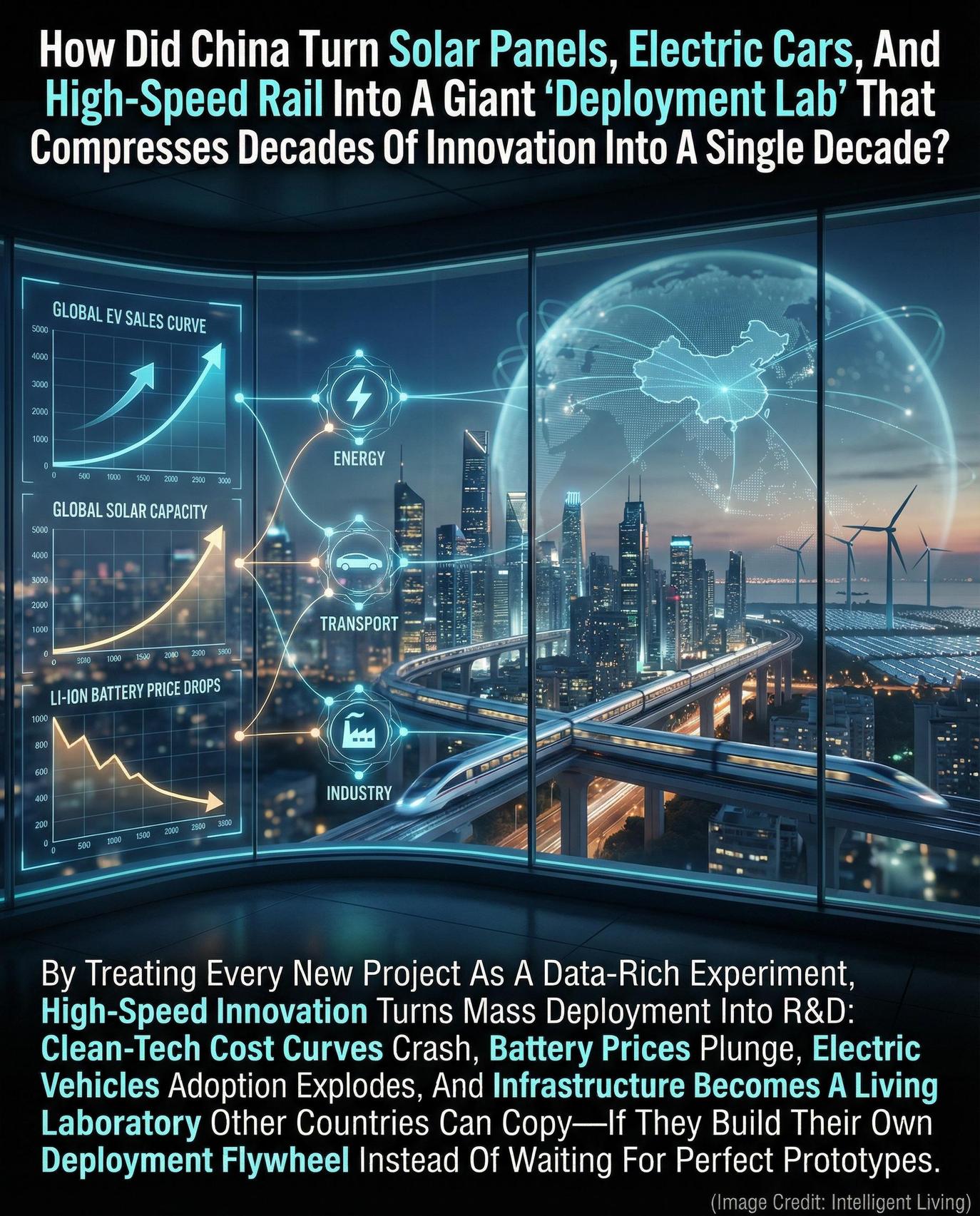
Quantifying the Impact: Core Metrics of China’s Industrial Acceleration
- Global electric vehicle sales exceeded 17 million in 2024. Over 11 million of those vehicles were sold in China, where electric mobility adoption accounted for nearly half of all new car sales that year.
- Global battery demand surpassed 1 terawatt-hour in 2024. Average battery pack prices for electric vehicles fell below 100 dollars per kilowatt-hour, a psychological and economic threshold indicating mass-market competitiveness, based on an IEA commentary on the battery industry’s new phase.
- Total solar photovoltaic capacity surpassed 2.2 terawatts by the end of 2024, with more than 600 gigawatts added in that year alone as solar market expansion accelerated worldwide.
- Photovoltaic production infrastructure investment totaling more than $50 billion has supported photovoltaic production infrastructure growth since 2011.
- The International Union of Railways reports nearly 56,000 kilometers of high-speed rail lines in operation worldwide, while China’s operational high-speed rail network has surpassed 50,000 kilometers.
- The International Monetary Fund working paper estimates the equivalent fiscal cost of China’s industrial policy measures at roughly 4.4 percent of GDP in 2023, illustrating the scale of support behind industrial acceleration.
Signals of a systemic approach are visible across these figures rather than isolated achievements.

Systems of Speed: The Structural Mechanics of High-Speed Innovation
High-Speed Innovation Isn’t a Slogan; It’s a System
The “high-speed” label fits because China embeds velocity into project financing, permitting, and market connectivity. The system no longer treats industrial research as a static endpoint. Instead, it ensures that technologies move quickly from laboratories into targeted environments:
- Dynamic demonstration zones
- Public procurement programs
- National infrastructure corridors
Accelerating Technologies through Demonstration Zones
Innovation remains anchored in practical application rather than theoretical study. Structural speed now extends into dozens of advanced manufacturing leadership domains, not just traditional factories.
Leveraging Operational Data for Systemic Refinement
Research and development still matter. OECD data on R&D spending shows China’s R&D spending outpacing many advanced economies. Each deployment wave generates operational data on performance, grid integration, and maintenance.
Strategic Feedback Loops: Turning Operational Data Into Efficiency
Operational momentum allows suppliers to refine components while planners update critical standards and codes. Continuous accumulation of small improvements drives steep learning curves across the industry. Solar photovoltaics, batteries, and electric vehicles see cost declines and reliability gains because thousands of incremental changes are absorbed into the system. Global international intellectual property activity reflects this dynamic, with firms like Huawei ranking among the most active international patent filers.
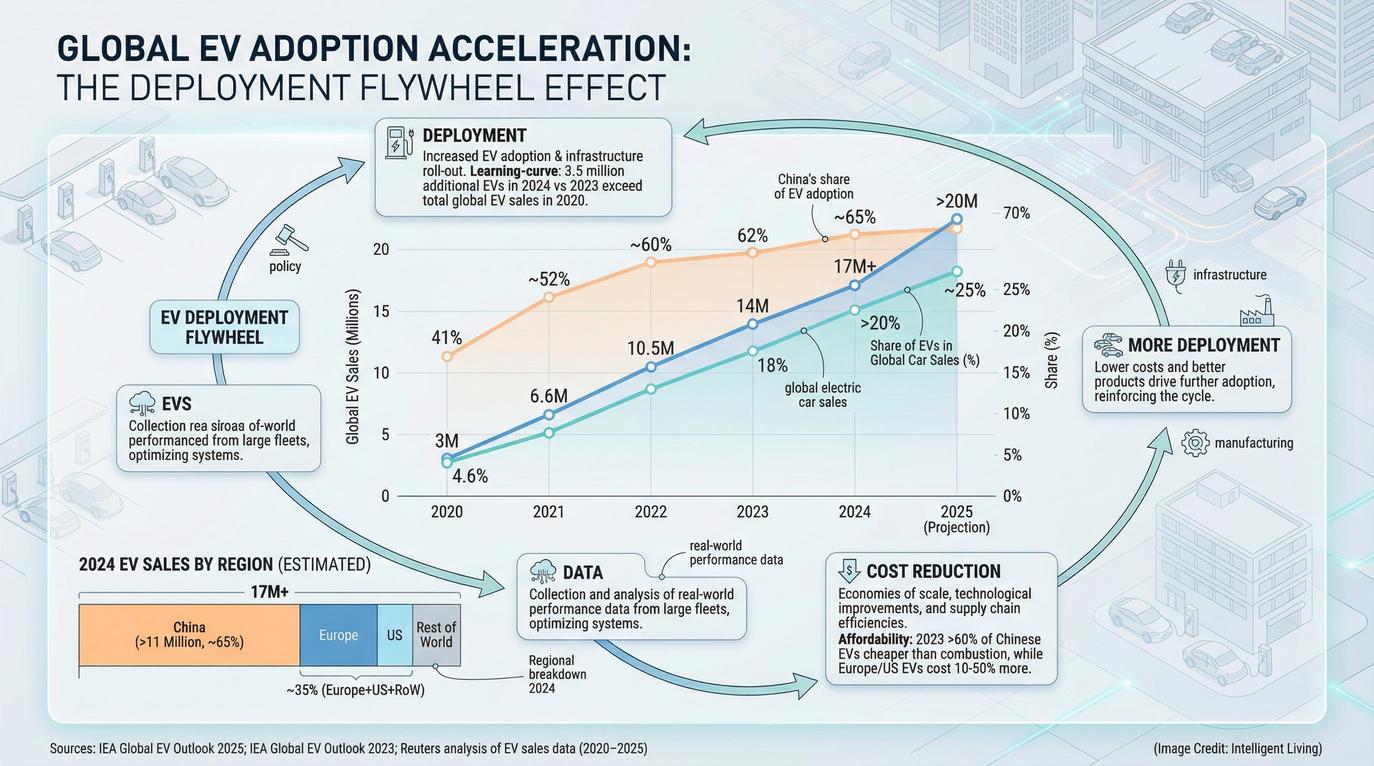
The Deployment Flywheel: How Scale Compresses the Innovation Cycle
The deployment flywheel is the mechanism that turns scale into faster innovation. Market stability begins with a coordinated effort between the public and private sectors:
- Governmental Support: Providing policy certainty through industrial plans, financing channels, and infrastructure commitments.
- Corporate Response: Firms building the necessary factories, supply chains, and project pipelines.
Capturing High-Frequency Performance Data at Scale
Coordinated loops ensure that the deployment-led innovation cycle remains uninterrupted by market volatility. Millions of electric vehicles on the road generate performance data on batteries, drivetrains, and charging networks. Utility-scale solar projects generate insights into marine foundations, grid stability, and maintenance cycles. Expanding hydrogen pipelines reveal how materials behave under long-term operating pressure.
Milestone Metrics: Achieving Cost Parity in Battery Storage
As production scales, suppliers negotiate better input prices, manufacturing processes become more efficient, and standardization reduces variability. Battery pack prices falling below 100 dollars per kilowatt-hour mark a milestone that brings electric vehicles closer to cost parity with conventional cars. Profits and state-backed financing then drive reinvestment into next-generation improvements, from solid-state battery chemistry to advanced semiconductor design.
Scale matters for rapid iteration within the deployment flywheel. With more than 11 million electric vehicles sold in China in 2024, the country benefits from a faster feedback loop than smaller markets. Design flaws surface quickly; fixes are implemented at factory scale, and each production run improves on the last. High-speed rail shows the same pattern: upwards of 50,000 kilometers of operational lines turn the national network into a laboratory for signaling systems, track technology, and rolling stock.
Policymakers must exercise regulatory agility to harness this amplification without letting errors scale unchecked.

Clean-Tech Cost Curves and Infrastructure Serve as Innovation Platforms
The Clean-Tech Cost Curve: Solar, Batteries, and EVs as the Measurable Proof
Clean technology in China provides the clearest measurement of the deployment flywheel’s industrial impact.
Solar Manufacturing: Dominance through Vertical Integration
Solar power offers the clearest illustration. Global photovoltaic capacity surpassed 2.2 terawatts by the end of 2024. China’s industrial acceleration has secured a dominant share of manufacturing across key solar supply chain stages. In areas like polysilicon, wafers, and modules, this concentration exceeds 80 percent.
Factory scaling drove equipment improvements and input cost declines, pushing a steady downward trajectory in prices that continues to drive energy transition impact globally.
Battery Economics: Improving Density and Safety through Scale
Batteries follow a similar pattern. Global demand exceeded 1 terawatt-hour in 2024. Expanding manufacturing capacity to multiple terawatt-hours annually allowed learning-by-doing to improve energy density, safety, and cost efficiency. The sub-100-dollar-per-kilowatt-hour battery pack milestone reflects cumulative incremental gains. solid-state battery research in China leverages this massive manufacturing and deployment base.
EVs: Ripple Effects Across Charging and Grid Infrastructure
Electric vehicles convert these upstream gains into visible consumer outcomes. With electric cars representing nearly half of new vehicle sales in China in 2024, scale effects ripple across charging infrastructure, grid management, and urban planning. Domestic demand supports domestic suppliers, which in turn refine their technologies and lower costs further.
Accelerated capacity expansion occasionally triggers overcapacity. Consequently, policymakers in other regions are experimenting with a circular battery economy to reduce waste and secure supply chains.

Infrastructure as an Innovation Platform: High-Speed Rail as the Archetype
If clean technology shows the economic side of high-speed scaling, China’s high-speed rail shows the structural side. Rail infrastructure combines civil engineering, materials science, signaling software, and logistics into one system.
High-Density Testing Under Diverse Operational Conditions
Nearly 56,000 kilometers of high-speed rail lines are in operation worldwide, and China’s network alone accounts for upwards of 50,000 kilometers.
Extensive infrastructure density ensures that real-world testing reaches far beyond isolated pilot routes. High-frequency deployment allows for:
- Performance testing across thousands of kilometers of varied terrain.
- Rapid refinement of track systems as vibration data accumulates.
- Signaling technology optimization in response to increased network density.
- Standards evolution driven by repeated operational feedback.
Exporting Engineering Competence and Systems Integration
Suppliers gain experience that can be exported to other projects. Standards evolve through repeated deployment rather than theoretical modeling alone. Energy system pilots demonstrate these same dynamics where waste-heat power blocks are refined through real grid-connected operation.
Renewable projects and advanced chip initiatives show how materials science and power systems feed one another. Nations do not necessarily require 50,000 kilometers of rail to benefit from this model. Large, coordinated projects serve as national laboratories for engineering competence and systems integration.

Risk and Regulation: The Fiscal Realities of Industrial Policy Scaling
The Integrity Ledger: What this Speed Costs and Why it Matters
High-speed industrial infrastructure deployment delivers cost declines and industrial capability, but it also concentrates risk.
Quantifying Misallocation Risks in Industrial Subsidies
Fiscal support manifests through several distinct channels:
- Direct industrial subsidies
- Targeted tax incentives
- Strategic land support
- Subsidized credit programs
Massive intervention can accelerate specific sectors. However, it also introduces misallocation risks if capital flows toward favored industries without sufficient market discipline. Intense industrial acceleration frequently provokes trade friction when global annual capacity exceeds demand.
Navigating Grid Bottlenecks and Interconnection Queues
Grid stability challenges also emerge as renewable capacity expands. Effective infrastructure modernization must keep pace with generation growth to avoid delays and curtailment. Similar tensions appear in regional coal transition analysis and the strain rapid industrial growth can place on energy systems.
Managing Trade Frictions and Geopolitical Supply Chain Shifts
Intense industrial acceleration frequently provokes trade friction. Strategic geopolitical shifts and global supply chains interact with the innovation flywheel, particularly as critical mineral breakthroughs shift where raw materials for clean technologies are extracted.
The Policy Stack Behind “Regulatory Agility”
Regulatory agility is not a slogan; it is a set of concrete tools that either discipline or amplify this speed.
The “Regulatory Agility” stack consists of four primary instruments:
- Permitting Speed: Projects move through review with clear timelines and accountability, reflecting earlier agency coordination.
- Strategic Procurement: Public agencies commit to specific outcomes to reduce uncertainty for manufacturers.
- Financing Architecture: State-backed banks and targeted credit programs lower the cost of capital for strategic sectors.
- Standards and Demonstration Zones: Pilot regions allow new technologies to operate under real conditions before national expansion.
Coordination reduces friction between invention and deployment. The Net-Zero Industry Act seeks to streamline permitting and strengthen domestic clean technology manufacturing. While structures differ, the underlying principle of reducing friction between invention and deployment remains consistent across global markets.
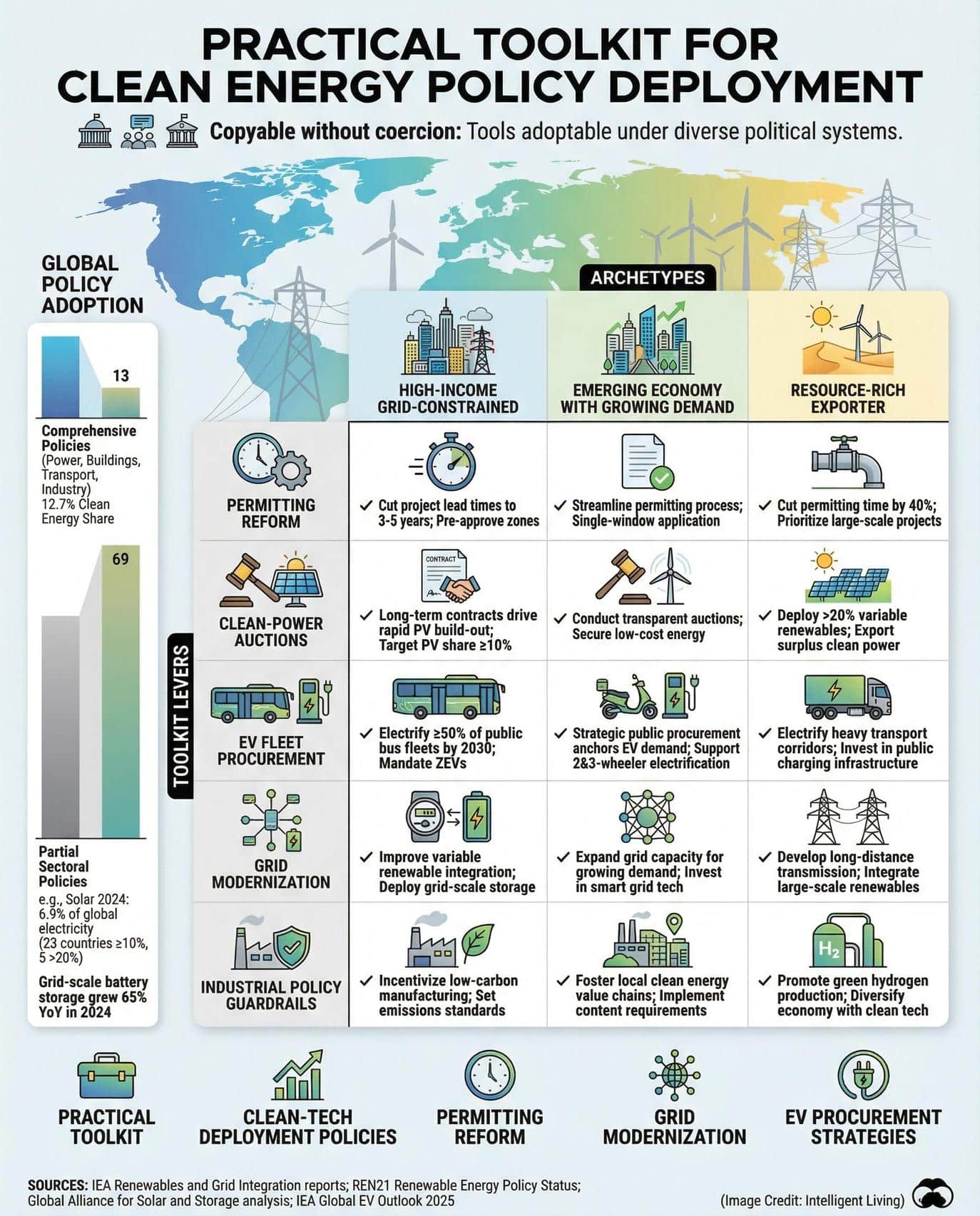
Copyable Without Coercion: A Practical Toolkit for Faster, Cleaner Innovation
The most useful lessons from Chinese infrastructure growth are those that can be adopted out of its own borders. Countries do not need to replicate political systems to replicate better coordination.
The practical toolkit for faster innovation includes several key levers:
- Infrastructure Synchronization: Align grid expansion with generation growth to prevent generation bottlenecks.
- Strategic Procurement: Use long-term purchase agreements for clean power to create predictable demand signals.
- Permitting Efficiency: Shorten review timelines while maintaining transparency and digital review systems.
- Deployment Bridges: Fund pilot programs that prioritize measurable performance data and clear pathways to scale.
Planners in many markets use modern energy distribution networks to manage variable renewables more effectively. National infrastructure serves as a primary competence builder for domestic expertise. Projects such as hydrogen infrastructure clusters cultivate domestic expertise that supports future industries. Integrated city systems apply this same logic, optimizing energy design, data centers, and urban systems together.
China’s High-Speed Innovation Lessons: What The World Should Take Seriously
China’s recent trajectory shows that innovation can be accelerated when deployment, financing, and industrial policy operate in alignment. Electric vehicles, solar panels, and battery systems did not become globally competitive through isolated laboratory breakthroughs alone. China’s evolving economic operating system reveals how this same loop now funds projects across the Global South.
Competitive advantages emerged because large domestic markets and coordinated investment compressed the time between prototype and mass adoption.
The measurable results are visible in falling clean energy costs and expanding infrastructure networks. Fiscal exposure and industrial success coexist as dual realities.
Innovation speed is often determined less by invention and more by execution. When execution is systematized, learning accelerates. The world’s next phase of clean energy and infrastructure transformation will reward countries that understand that distinction.

China Innovation Model FAQ: Scaling, Industrial Policy, and Clean Tech Deployment
How does the China innovation model accelerate clean-tech cost curves?
Massive domestic demand allows manufacturers to achieve economies of scale rapidly, using real-world operational data to refine components and reduce waste. This constant feedback loop drives down prices for batteries and solar PV modules.
What role does regulatory agility play in high-speed scaling?
It streamlines permitting and creates predictable timelines for large-scale projects. By coordinating agencies early, the system reduces the friction that typically slows the transition from laboratory prototype to mass deployment.
Why is infrastructure considered a deployment-led innovation platform?
Large projects like high-speed rail networks provide a living laboratory for testing signaling software and materials under varied conditions. This allows engineering standards to evolve through repeated use rather than theory alone.
Can high-speed industrial acceleration coexist with market discipline?
It requires a careful balance to avoid overcapacity. While policy support lowers the cost of capital, maintaining competitiveness relies on firms surviving price pressures and meeting international quality standards.
What is the biggest hurdle for global supply chain dominance in clean energy?
Grid stability and interconnection delays often bottleneck progress. Successful scaling requires aligning transmission upgrades with generation growth to ensure that new capacity can actually reach the market.


