
In a child’s academic journey, kindergarten serves as a significant turning point. At this stage, children begin to acquire essential skills that lay the groundwork for their future learning. A key question arises: what actually occurs in kindergarten? What elements comprise the curriculum, and how do they contribute to a child’s emotional, social, and cognitive growth?
This article explores what parents can expect from a typical kindergarten program, highlighting the crucial role these early years play in child development. Understanding the main features of the kindergarten curriculum can provide valuable insights into how this foundational education shapes a child’s abilities and prepares them for the subsequent stages of their educational experience.
Transition to Formal Learning
Kindergarten serves as a foundational step into formal education rather than merely an entertaining introduction. This structured environment prepares children for the more rigorous academic demands of first grade and beyond. The curriculum is thoughtfully designed to be developmentally appropriate, allowing children to thrive at their current level of ability.
Typically, kindergarteners range in age from five to six years. At this stage, students actively engage with essential concepts while simultaneously enhancing their ability to navigate relationships and everyday routines. This balance fosters both academic learning and social-emotional development, ensuring a holistic approach to early childhood education.

Core Academic Subjects in Kindergarten
While kindergarten may appear straightforward in comparison to later educational years, the curriculum is meticulously crafted to introduce essential academic subjects that will form the foundation for future learning. Typically, these subjects include:
1. Language and Literacy
Development of language and literacy abilities takes the front stage in kindergarten. Among these are:
- Phonemic Awareness: Young children pick up the ability to identify and alter the sounds in words. This ability is developed in spoken language using rhymes, mixing, and segmenting sounds.
- Letter Recognition: Children start to identify and write both lowercase and uppercase letters. Essential for early reading abilities, they also pick up the related noises.
- Basic Reading: Early reading abilities are introduced in kindergarten by sight words and basic novels. Kids start to recognise everyday words and feel more comfortable reading short lines.
- Writing: Children are urged at this level to write their names, basic words, and brief sentences. They also work on correct letter form and pencil grip.
2. Mathematics
Basic ideas taught in kindergarten arithmetic will help kids in later years. Important areas of attention consist of:
- Number Sense: Knowing numbers, counting from one to one hundred, and spotting number trends.
- Basic Addition and Subtraction: Usually, within ten, kindergarteners learn to add and subtract little amounts by using items or drawings to symbolize mathematical ideas.
- Shapes and Geometry: Children start to see patterns and spatial relationships as they are exposed to simple forms including circles, squares, and triangles.
- Measurement and Comparisons: Through hands-on projects, comparing objects to grasp ideas like “more” or “less,” kindergarteners learn about size, weight, and volume.
3. Science
Kindergarten science is essentially about inquiry and discovery. The intention is to inspire amazement and inquiry about the natural world. Topics might be:
- Plants and Animals: Children study living things, how plants develop, and animal traits.
- Weather and Seasons: Children’s observation and discussion of the surroundings will benefit from the introduction of fundamental ideas of weather patterns and seasonal variations.
- Physical Properties: Through hands-on activities, children can investigate the characteristics of various materials—solid, liquid, gas—as well as object motion or change.
4. Social Studies
Kindergarten social studies classes centre on guiding students toward their place in society and the earth. Usually, the curriculum consists of:
- Community Helpers: Kids learn about the jobs that people in their town have, like teachers, doctors, and firefighters, and how those jobs make society work.
- Family and Traditions: Discussions about families, cultural customs, and holidays could be part of lessons to foster respect for variety.
- Basic Geography: Simple maps let kindergarteners learn about land, water, and other geographical phenomena.
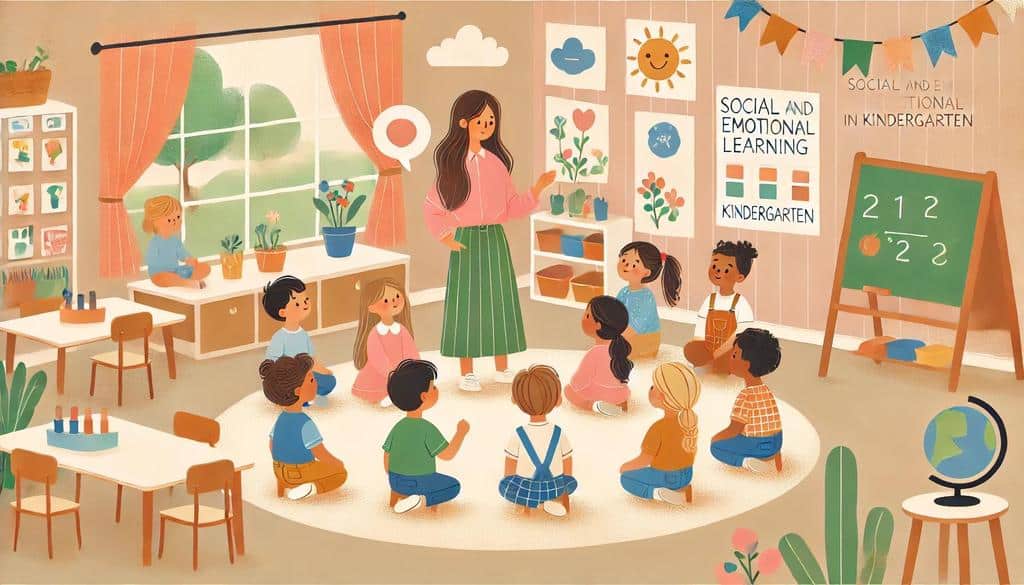
Social and Emotional Learning in Kindergarten
In addition to academic learning, kindergarten plays a crucial role in developing a child’s social and emotional skills. Mastery of these abilities is essential for success both in the classroom and in life. The typical components of the kindergarten program include:
1. Building Relationships
Kindergarten classrooms are meant to promote student engagement. Group projects, cooperative play, and class discussions teach kids how to:
- Share and take turns.
- Listen to others and express their thoughts.
- Work cooperatively with peers.
Having these abilities is essential for forming connections and grasping the idea of collaboration.
2. Developing Emotional Awareness
Kindergarten often marks a child’s initial experience of spending extended periods away from home. During this time, children develop skills related to emotional regulation and navigating new experiences. Teachers facilitate activities designed to help children recognise and articulate their emotions. Additionally, children begin learning techniques for managing their feelings, including strategies to calm down when angry and to handle frustration in a constructive manner.
3. Responsibility and Independence
Kindergarten encourages the development of independence and personal accountability in young learners. Children are taught responsibility through simple school chores, which include managing their personal belongings and cleaning up after activities. Additionally, they learn to make informed choices, follow directions, and effectively organise their time while completing various tasks.
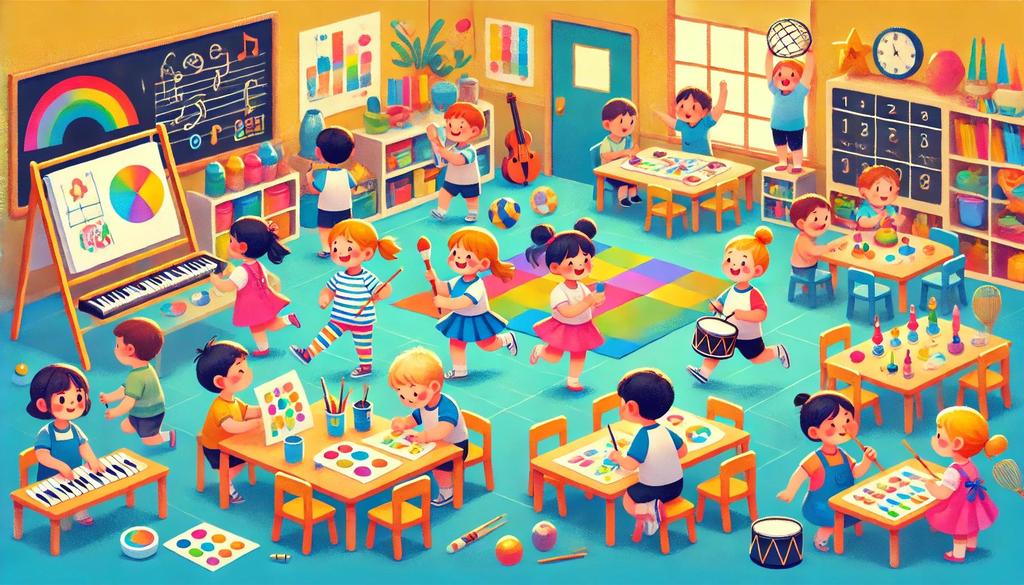
Art, Music, and Physical Education
Although the kindergarten curriculum mostly consists of academic courses and social-emotional learning, schools also stress creative and physical development via means:
- Art: Kindergarteners’ inventiveness, fine motor abilities, and knowledge of shapes and colours all benefit from art. Painting, drawing, and crafts are among the activities that fit the academic concepts under instruction.
- Music: Kindergarten music classes develop literacy as well as imagination. Children’s auditory abilities and memory benefit from learning about rhythm, singing, and simple musical instruments.
- Physical Education: For young students, being active is important. Gross motor skills, like running, jumping, and standing, are what kindergarten physical education is all about. Free play is important for a child’s physical and mental health, and they can do it during playtime and exercise.

Set the Foundation for Future Learning
Kindergarten represents a vital year for children, as it provides the opportunity to acquire essential cognitive, social, and emotional skills necessary for their educational journey. This stage serves not merely as an introduction to school but as a foundation for future learning. During this year, children develop skills in reading, writing, counting, and forming friendships. These abilities establish a strong basis for their future success.
Enrolling a child in a quality kindergarten, like those by St Kilda kindergarten, can profoundly influence their early development. The effectiveness of this critical year largely depends on the collaboration of parents, educators, and the children themselves. Together, they create a rich and enjoyable learning environment that fosters curiosity and growth, setting the stage for a lifetime of learning and achievement.


