
When you think about what influences the sense of ‘who you are,’ what comes to mind? For most, it is believed to be things like your interactions with others, what you do, and childhood experiences. Well, now a research team from the Brain, Body, and Self Laboratory is saying your body also impacts your sense of self.
But how does your body affect the way you think about your personality? That’s precisely what the researchers questioned when they embarked on a study involving a fun experiment where friends “swapped bodies” using virtual reality. Amusingly enough, the perceptual illusion altered the participants’ beliefs about their personalities to become more in line with the opinion about their friends’ personalities.
First author Pawel Tacikowski, a postdoctoral Karolinska Institutet in Sweden researcher at, said:
As a child, I liked to imagine what it would be like to one day wake up in someone else’s body. Many kids probably have those fantasies, and I guess I’ve never grown out of it — I just turned it into my job.
Body swapping is not a domain reserved for science fiction movies anymore.
The Study
The team, led by Henrik Ehrsson, outfitted pairs of friends with virtual reality goggles that showed a first-person perspective of the other person’s body in real-time. The illusion was enhanced with simultaneous touches so the participant could also feel what they saw in the goggles.
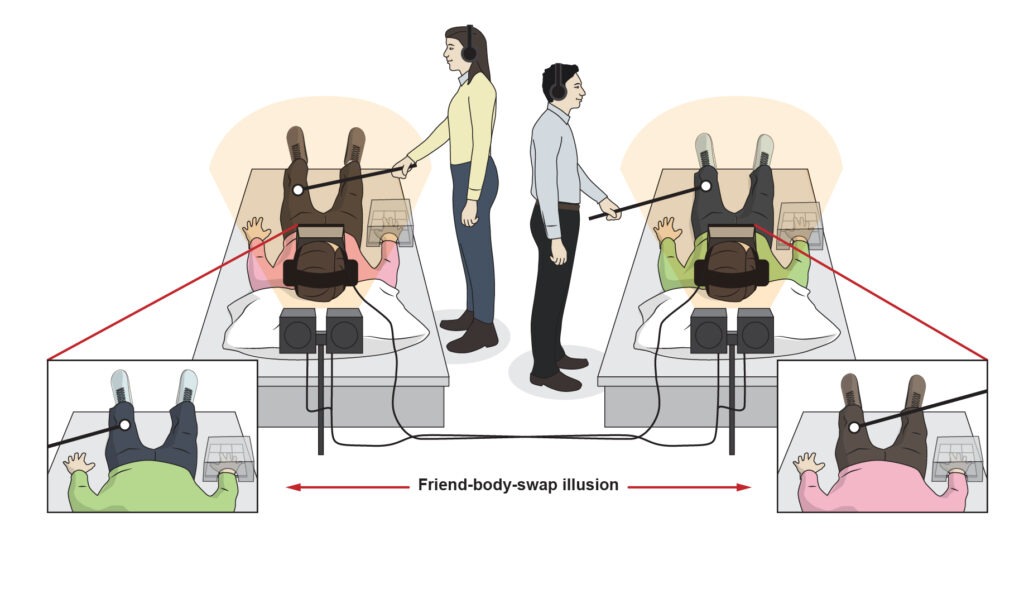
The Results
After only a brief moment, the participants’ self-perception changed. The researchers know this because, before the body swap, everyone took a survey where they rated their friends on traits such as cheerfulness, confidence, independence, and talkativeness.

The team used this first rating as a baseline and had the participants do the survey again while in their friends’ body, but rating themselves. Compared to the baseline, they were more apt to place themselves as more akin to the friend whose body they were in. The adjustment of self-conception was found to be related to the strength of illusory ownership of the friend’s body.
Memory And More
Furthermore, the illusion even impacted memory. The participants also took memory tests because the initial results suggested that the close tie between our physical and phycological sense of self may involve other functions – like memory. And it did; the participants’ memory became impaired.
Tacikowski said:
There is a well-established finding that people are better at remembering things that are related to themselves. So, we thought if we interfered with one’s self-representation during the illusion, that should generally decrease their memory performance.
The findings suggest that when our mental self-concept doesn’t match our physical self, our memory suffers. However, the participants who embraced their friend’s body more fully their own (the ones that rated themselves most similarly to their friend in the personality survey) performed better on the memory tests. Those that felt disconnected from their bodies performed worse. Therefore, when a person’s mental and physical self-representations align, and there is less “self-incoherence,” they should remember things better.
Tacikowski said:
We show that the self-concept has the potential to change really quickly, which brings us to some potentially interesting practical implications. People who suffer from depression often have very rigid and negative beliefs about themselves that can be devastating to their everyday functioning. If you change this illusion slightly, it could potentially make those beliefs less rigid and less negative.
Now, my mind is occupied with the question of how this behavioral effect works — what the brain mechanism is. Then, we can use this model for more specific clinical applications to possibly develop better treatments.
This research could have beneficial implications for depersonalization disorder and other psychiatric disorders like depression. So, the next phase of the study will involve investigating into more detail how the sense of self is constructed across the psychological and bodily levels.
Maybe someday they can apply body illusions to treat disorders such as anorexia, which causes people to see themselves as fat when they’re actually skinny. A separate study found that chronic pain was reduced by nearly 40% by inducing body illusions in chronic pain patients.


