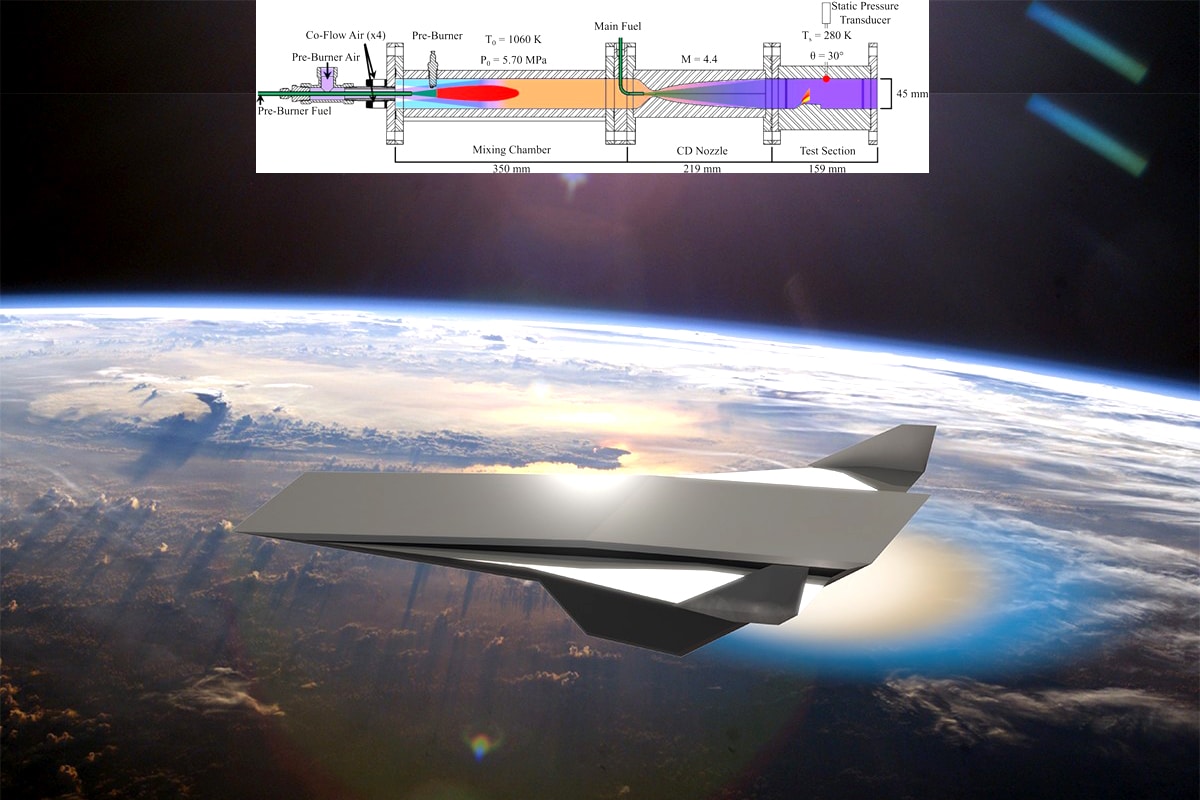
Engineers at the University of Central Florida have been developing an oblique wave detonation engine that harnesses a sustained, trapped explosion’s raw power. Now, they say they’ve succeeded in firing up the machine, trapping and stabilizing a fixed-in-place sustained detonation within the engine’s chamber for the first time, channeling its extreme power into thrusts.
The technology could pave the way for hypersonic flight, propelling an aircraft between 6 to 17 times the speed of sound (Mach 6-17, or over 4,600 to 13,000 miles per hour). It would beat the scramjet as the fastest hypersonic propulsion method (the current record-holder) and secure application in space and air travel. A jet plane with such engines could travel from Los Angeles to New York in less than 30 minutes.
Study co-author Kareem Ahmed, who is an associate professor in the Department of Mechanical and Aerospace Engineering at UCF, said:
There is an intensifying international effort to develop robust propulsion systems for hypersonic and supersonic flight that would allow flight through our atmosphere at very high speeds and also allow efficient entry and exit from planetary atmospheres. The discovery of stabilizing a detonation — the most powerful form of intense reaction and energy release — has the potential to revolutionize hypersonic propulsion and energy systems.
The technology even improves jet propulsion engine efficiency. It generates more power while using less fuel compared to traditional propulsion engines. Therefore, using one would lighten the fuel load, reducing emissions and cost. So, not only does it enable faster air travel, but if used in rockets for space missions, it would make them lighter and able to travel farther. It’ll also enable spaceplanes to fly themselves right up into orbit without needing to strap themselves to rocket boosters.

The UCF team named their 3.3-foot-long experimental prototype the High-Enthalpy Hypersonic Reacting Facility (HyperReact, for short). In the demonstration, they sustained the detonation for around three seconds (until the fuel ran out). Usually, a burst only lasts a matter of micro-or milliseconds. This was enough to prove that HyperReact works, and they can move on to the next phase of research.
Ahmed said:
This is the first time a detonation is stabilized experimentally. We are finally able to hold the detonation in space in oblique detonation form. It’s almost like freezing an intense explosion in physical space.


If the researchers successfully advanced this technology, it could be implemented into air and space travel in the coming decades.
As New Atlas points out, there will likely be some significant complications to national security and the global nuclear power balance. Noting that the research is partly funded by the Air Force Office of Scientific Research, these engines are obviously a matter of military interest.