
5G is the latest speed upgrade to wireless networks. While it is becoming more widespread, It’s still so new that it’s nonexistent in many places. Nevertheless, researchers are already preparing the next generation of communication technology: 6G. Engineers at LG and Fraunhofer-Gesellschaft have recently demonstrated 6G transmission across a new distance record.
Once 6G is eventually deployed worldwide, the main benefits over 5G will be quicker data transfer rates and reduced latencies. At its peak, 6G data rates should be 50 times faster than 5G, while latency is expected to drop to around 10% of 5G’s. These substantial boosts will be aided by a broader bandwidth of frequencies in use as 6G expands beyond 100 GHz into the currently unexploited terahertz (THz) spectrum.
In recent tests, LG and Fraunhofer-Gesellschaft team successfully beamed 6G signals between two buildings over 100 m (328 ft), smashing the previous distance record of only 15 m (49 ft), set by Samsung on June 16, 2021.
One of 6G’s major downfalls is that it has a short range. To address this, the team tested several systems to enhance that signal. Finally, they used a power amplifier to transmit a stable signal with frequencies between 155 and 175 GHz at a 15 dBm power level. In addition, adaptive beamforming technology assists in aiming the signal in the receiver’s direction, while high-gain antenna switching combines the output of multiple amplifiers and sends them towards specific antennas.
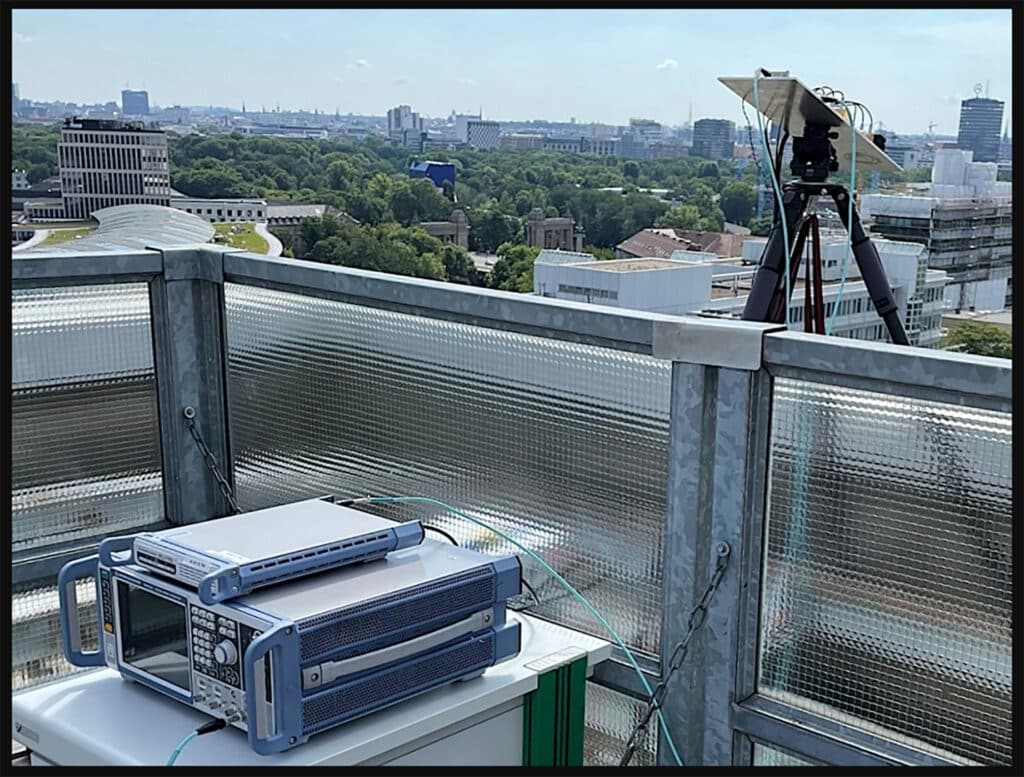
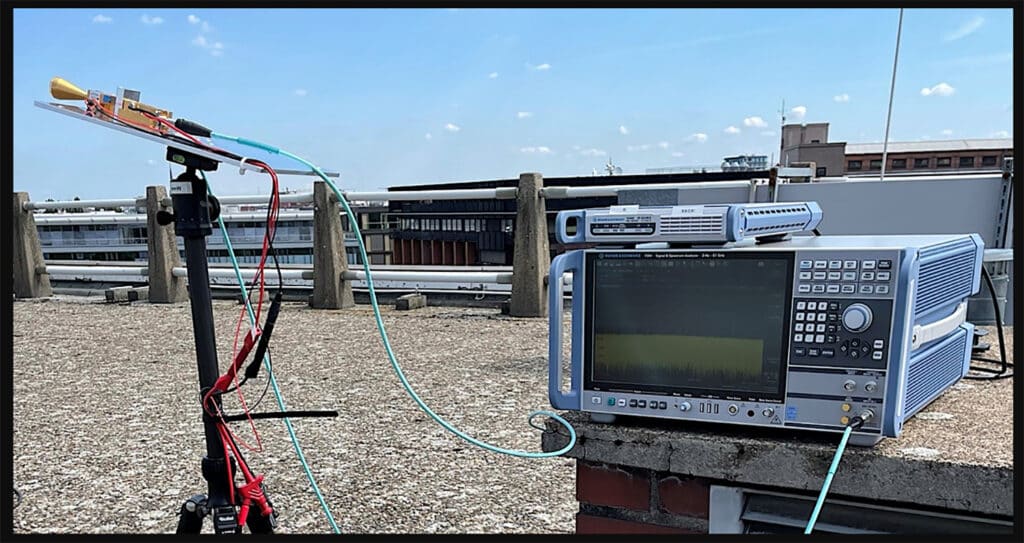
Dr. I.P. Park, the president and CTO of LG Electronics, said:
The success of this test demonstrates that we are ever closer to the successful application of the terahertz radio communication spectrum in the upcoming 6G era.
Last year, scientists from Singapore’s Nanyang Technological University and Japan’s Osaka University built an ultra-high-speed THz wireless chip for 6G. The tiny silicon chip was made with rows of triangular holes and small triangles pointing opposite to larger triangles. The design made it, so light waves were “topologically protected,” and the chip could transmit THz waves error-free.
While researchers are still working on the technology, they claim it’ll be 100 times faster than 5G – fast enough to stream 4K high-def video in real-time and download 142 hours of Netflix in a second. However, 6G isn’t expected to be commercialized until about 2029, so hold on to your 5G phones. In the meantime, researchers will continue to run more of these kinds of tests.


