
Intel and Cornell University scientists are collaborating on Nature Machine Intelligence research. They are building mathematical algorithms for neuromorphic computing chips that “apply the principles of computation found in biological brains to computer architectures.” In this specific study, the chip, called a Loihi processor, has been taught smell with researchers’ guidance, rapidly learning neural representations of ten different odors.
One of the senior research scientists in Intel Labs’ neuromorphic computing group, Nabil Imam, who has a doctorate in neuromorphic computing, explains about working with olfactory neurophysiologists at Cornell University, “My friends at Cornell study the biological olfactory system in animals and measure the electrical activity in their brains as they smell odors. On the basis of these circuit diagrams and electrical pulses, we derived a set of algorithms and configured them on neuromorphic silicon, specifically our Loihi test chip.”
To understand how the mechanism works, it helps to first know how the sense of smell works. When you take a whiff of something, the molecules stimulate olfactory (smelling) cells in your nose—which then send signals to your brain’s olfactory system. There, electrical pulses within an interconnected collection of neurons generate the sensation of smell. All of this happens instantaneously. The networks of neurons create impressions specific to the object. Every sense, memory, and emotion you feel has a distinct neural network that computes in a particular way, which is how you can tell things apart. As for the sense of smell, there are around 450 different types of olfactory receptors that help you distinguish between over a trillion scents that there are in the world.
You can imagine how complicated the system is and how big of a challenge it is for scientists to replicate it in machinery to give computers the ability to smell! That’s why the efforts by the Intel and Cornell researchers to grant artificial intelligence the ability to understand olfactory data are impressive. The field has since advanced further, with AI models now predicting how humans perceive complex scent mixtures.
The team trained Loihi to detect distinct odors in complex mixtures by giving the processor access to data from 72 chemical sensors. The sensors were sitting in a wind tunnel as ten different odors, including acetone, ammonia, and methane, were blown through.
The researchers explain in a press release, “The sensors’ responses to each scent were transmitted to Loihi, where silicon circuits mimicked the circuitry of the brain underlying the sense of smell. The chip rapidly learned neural representations of each of the 10 smells, including acetone, ammonia, and methane, and identified them even in the presence of strong background interferents.”
This system works differently than how some smoke detectors can sense certain odors because those devices can only identify specific molecules. Loihi, on the other hand, can take the smell feat a step further by learning and categorizing scent molecules in intelligent ways.
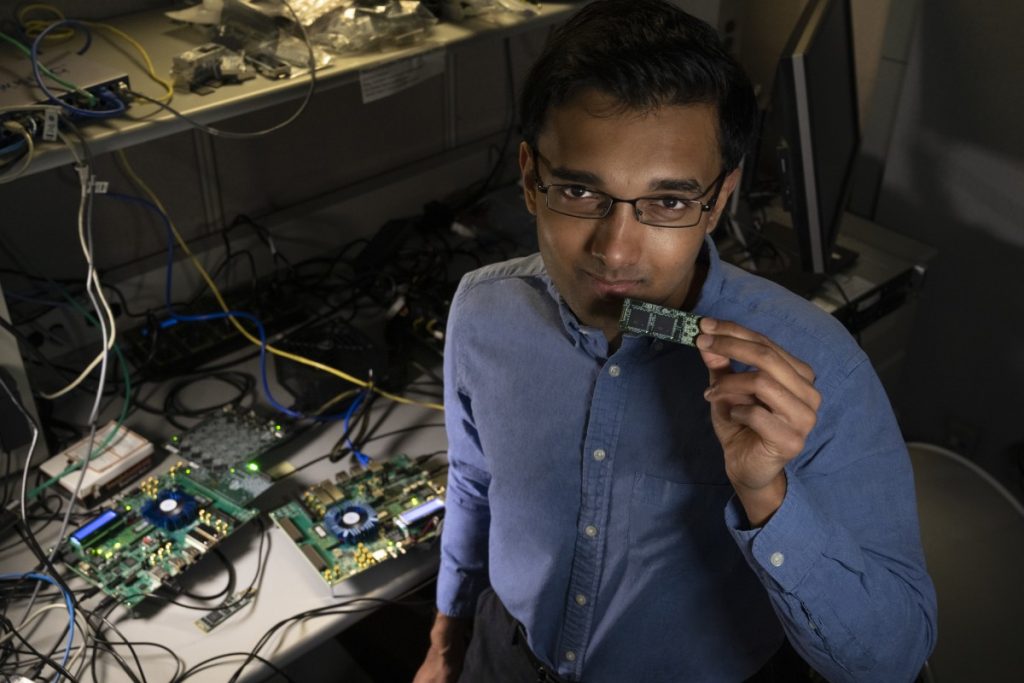
Imam said, “My next step is to generalize this approach to a wider range of problems—from sensory scene analysis (understanding the relationships between objects you observe) to abstract problems like planning and decision-making. Understanding how the brain’s neural circuits solve these complex computational problems will provide important clues for designing efficient and robust machine intelligence. These are challenges in olfactory signal recognition that we’re working on and that we hope to solve in the next couple of years before this becomes a product that can solve real-world problems beyond the experimental ones we have demonstrated in the lab. [My work is a] prime example of contemporary research taking place at the crossroads of neuroscience and artificial intelligence.”
Imam sees potential in robots equipped with neuromorphic chips for many life-saving tasks, like the detection of disease, dangerous chemicals, and explosives, drugs, and contraband, as well as for practical purposes like the identification and classification of wines or to help with quality control in factories.

The team of Intel neuromorphic researchers has also recently built a data center rack-mounted system using Loihi processors. Pohoili Springs, as it is called, is the company’s most extensive neuromorphic computing system developed to date—integrating 768 Loihi neuromorphic research chips inside a chassis the size of five standard servers. It provides the computational capacity of 100 million neurons, which puts it to par with the computing power of the brain of a small mammal.


