American researchers transformed a real dead spider into robotic grippers. Rice University graduate student Faye Yap, a mechanical engineering graduate student, had the idea after spotting a dead curled-up spider in the hallway. She began to consider whether it may work as a robotic component.
At Rice University in Texas, a team led by assistant professor Daniel Preston and graduate student Faye Yap set out to determine if they could manually induce similar movements in dead wolf spiders. As a result, the team has named this field of research “necrobotics.”
While it may sound (and look) creepy, turning dead spiders into mechanical grippers could have practical advantages. For example, spider legs can gently grasp large or small, delicate, and irregularly shaped objects without damaging them.
Spiders move their legs using hydraulic pressure, unlike mammals, who carry their limbs by extending and contracting opposing muscles. More specifically, they possess a “prosoma” or hydraulic chamber close to their head, which sends blood into the legs as it contracts, causing the legs to stretch. The legs re-close after the pressure is relieved.
Faye Yap said: “They only have flexor muscles, which allow their legs to curl in, and they extend them outward by hydraulic pressure.”
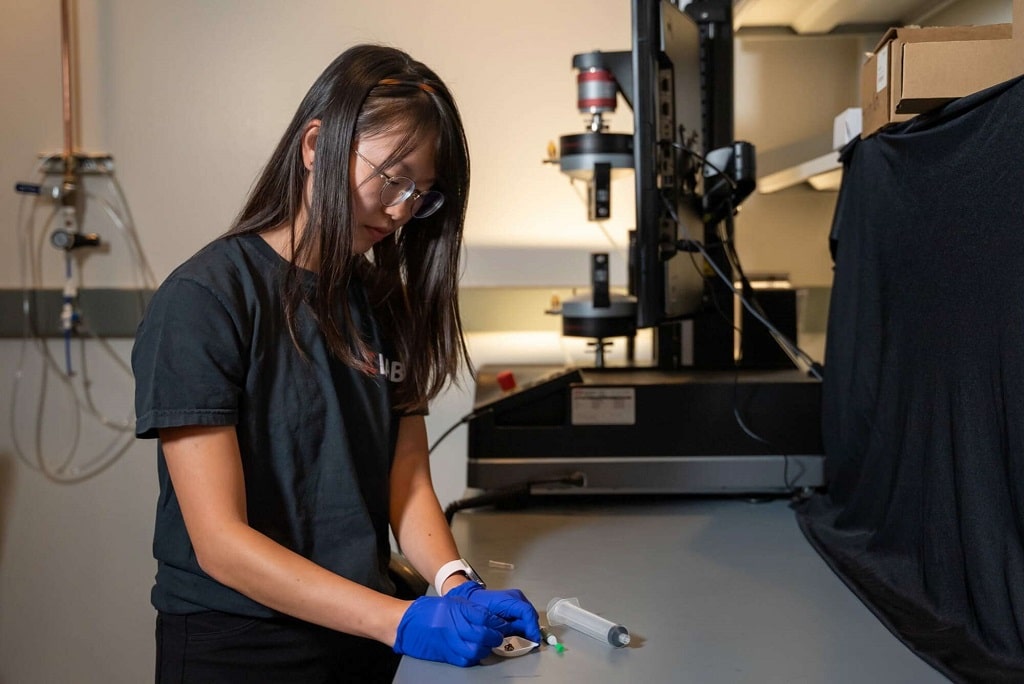
The procedure begins with the team putting a needle into the deceased spider’s prosoma chamber. A dab of superglue is then applied at the insertion point to hold the needle in place. After that, a small amount of air is injected into the chamber using a syringe connected to that needle, which opens the legs. The legs close when air is sucked back into the chamber.

After conducting experiments, the scientists found that the spider gripper can lift more than 130% of the spider’s body weight. The tests also revealed that a spider carcass could withstand roughly 1,000 opening and closing rounds before the tissues deteriorate. “We think that’s related to issues with dehydration of the joints. We think we can overcome that by applying polymeric coatings,” Preston said.
The authors stated: “Humans have relied on biotic materials – non-living materials derived from living organisms – since their early ancestors wore animal hides as clothing and used bones for tools.”
Aside from being a creepy topic of scientific investigation, these necrobotic grippers might be helpful in some delicate situations.

Preston explained:
“There are a lot of pick-and-place tasks we could look into, repetitive tasks like sorting or moving objects around at these small scales, and maybe even things like the assembly of microelectronics. Also, the spiders themselves are biodegradable. So we’re not introducing a big waste stream, which can be a problem with more traditional components.”
Another work led by Preston recently resulted in creating a pneumatic “extra limb” powered by the wearer’s footsteps.
Watch the team manipulate a dead spider’s legs with a puff of air to serve as grabbers in the video below.
The paper titled Necrobotics: Biotic Materials as Ready-to-Use Actuators was published in the journal Advanced Science.