
A pair of clever scientists from Germany’s University of Hohenheim have come up with a plan to slow global rising temperatures through large-scale reforestation. They claim, that large scale plantations in deserts could change atmospheric circulation and bring more rain.
It should have been obvious a long time ago, that to offset the carbon dioxide we are releasing into the atmosphere all we have to do is mass plant forests everywhere. There has already been a widely publicized paper that ran the numbers and they believe that there is plenty of land available to make it happen. Actually, some countries have already started doing this, but their incentives are local. Nevertheless, they are still making a difference globally in the end.
Unfortunately, most of the best lands are being consumed by the demands of agriculture to supply the growing populations with food. That’s why Dr. Oliver Branch and Professor Volker Wulfmeyer have decided to apply carbon-storing plantations onto more marginal lands, particularly deserts and their surroundings. Although this does raise the question of how the trees will get enough water, some temporary solutions include underground water sources and near cities urban wastewater but these are a small part of the answer.

Some studies have shown that changes to land use can alter rainfall patterns while rainforests that have enormous precipitation are due to the forest that it lies in. Usually, these studies have focused primarily on continental-scale effects. Branch and Wulfmeyer, on the other hand, modeled in the Proceedings of the National Academy of Sciences, whether a plantation that measured only 100 square kilometers (38 square miles) would change rainfall patterns within it and its neighboring surroundings.
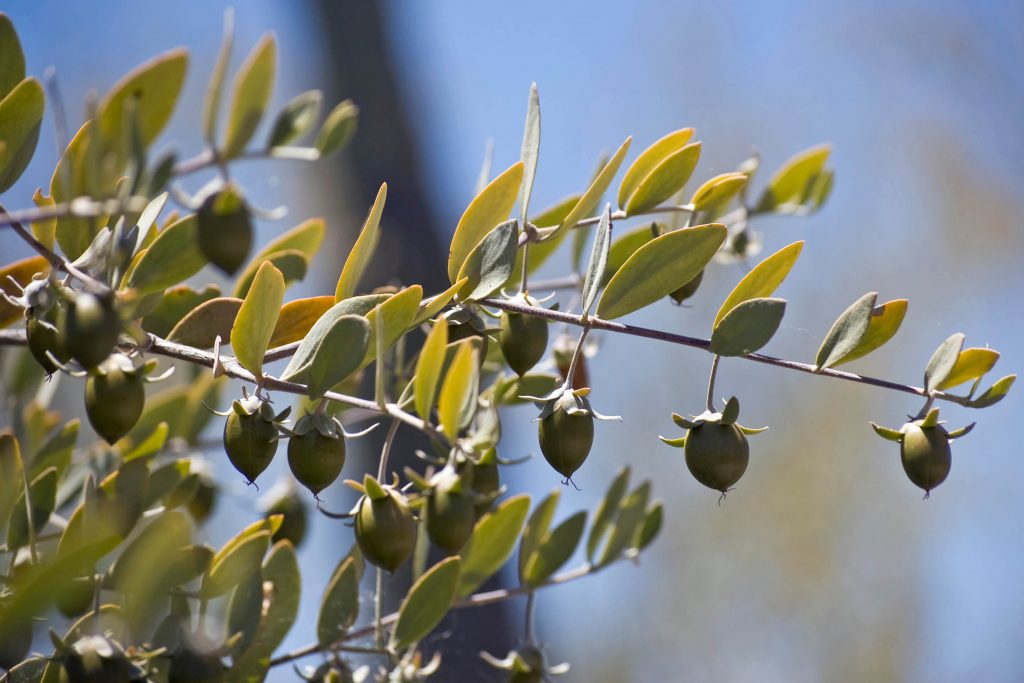
The locations in which they chose to experiment were two deserts, one in Oman and the other in Israel (extending a little into Egypt). They used a weather-forecasting system to model the effects of applying a jojoba plantation in each location. They specifically used jojoba because it has a remarkable capacity to draw carbon dioxide from the atmosphere in very hot and dry areas, so much so that it has been known to be a climate stabilizer.
Jojoba is darker than the soil that surrounds it, reducing the quantity of light reflected. The plant forms rain because it releases aerosol particles that water vapor condenses around. Its roughness interrupts the wind. The local climate would change in so many ways, with a plantation filled with these plants.
In both of these locations, Branch and Wulfmeyer’s paper showed that rainfall would increase a decent amount. This approach varies with location conditions, and its effectiveness might not be helpful everywhere. However, some critics argue that if governments select the sites for mega-forestry projects carefully, and provide low-resolution maps of the parts of the world that would see the largest rainfall increases if planted in this way, that it could work everywhere.


