
Data-driven insights validate the viral $140,000 figure while highlighting a deeper structural shift in the American poverty line. Viral reports suggest families now require six figures to maintain basic stability, a sentiment that resonates with those earning traditionally high salaries while remaining financially squeezed. Economic debates recently questioned if $140,000 has become the new poverty line following viral coverage of families struggling to keep pace with basic costs. Sentiment regarding this gap is echoed by professionals crafting a first-person essay about financial whiplash while navigating the divide between high earnings and market-rate expenses.
Bridging this financial divide requires a financial resilience stack that prioritizes immediate cash stabilization before pursuing aggressive growth. The stack targets high-impact outcomes like skill marketing and micro-business formation over generic advice. Success depends on an ordered methodology that eliminates financial leaks before attempting to scale long-term wealth.
Real-world survival budgets vary across different ZIP codes, yet the systemic pressure remains a shared national struggle. Current figures show that housing, healthcare, and childcare costs act as the primary anchors in this modern poverty trap. Recognizing where federal benchmarks fall short allows households to construct a personalized roadmap for how to escape poverty in America and secure a permanent financial foundation. Navigating this landscape requires understanding the specific metrics that define modern survival.
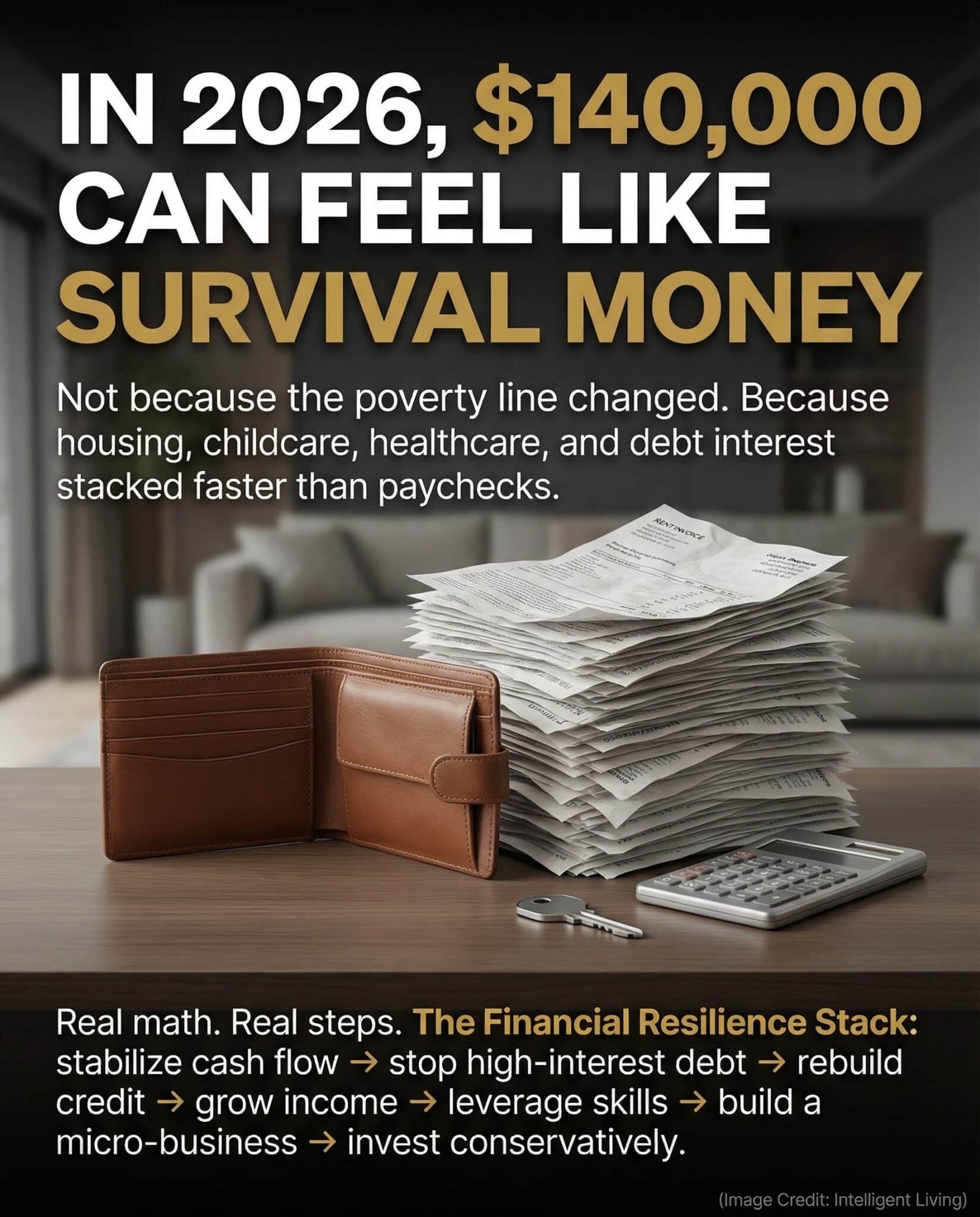
Analyzing Economic Realities and the $140,000 Survival Benchmark
- Official poverty thresholds and national income measures ignore local price volatility, creating a disconnect between income and actual survival costs.
- Households frequently exceed federal poverty thresholds yet still lack the capital required for housing, childcare, and medical costs.
- Local survival budgets vary widely. Some counties have basic needs totals that approach or exceed the six-figure mark.
- Shelter and medical costs remain stubborn drivers in the Consumer Price Index releases, which is why budgeting often feels like running uphill.
- Implementing legal, practical strategies reduces monthly pressure and strengthens long-term financial resilience.
The Modern American Poverty Line: Why Six Figures Feels Like Survival
Rather than replacing official definitions, $140,000 represents a ‘make-ends-meet’ budget for families facing market-rate housing, childcare, and healthcare without subsidies. Federal benchmarks still matter, but they were not built to mirror every local price shock.
Cost-of-Living Lenses and Local Essentials
Evaluating why a six-figure salary feels like a survival budget requires looking through three distinct cost-of-living lenses. These benchmarks prove that federal averages fail to capture local price volatility in high-demand regions.
- Living Wage Metrics: The MIT Living Wage Calculator methodology creates a county-level essentials basket that frequently exceeds federal poverty lines.
- ALICE Research: United Way’s ALICE methodology for calculating household survival budgets defines a specific threshold for workers who remain unable to cover fundamental costs.
Regional Price Parities and Market-Rate Barriers
Significant rent gaps appear in the BEA’s Regional Price Parities and HUD’s Fair Market Rents. Childcare alone can rival a second rent payment, and Child Care Aware’s price and supply data shows just how high those annual costs can run.
Using these tools helps households identify the specific ‘cost of living’ anchors holding them back. Understanding these metrics is the first step toward building a tailored financial exit strategy.
The $140,000 figure serves as shorthand for how quickly shelter, childcare, and medical costs accumulate in high-demand ZIP codes rather than representing an official federal poverty line.
One single parent in a high-cost neighborhood secured a job paying above the local median, only to find that rising childcare and commuting costs effectively neutralized the raise. The experience illustrates why headline income numbers alone are not the full story.
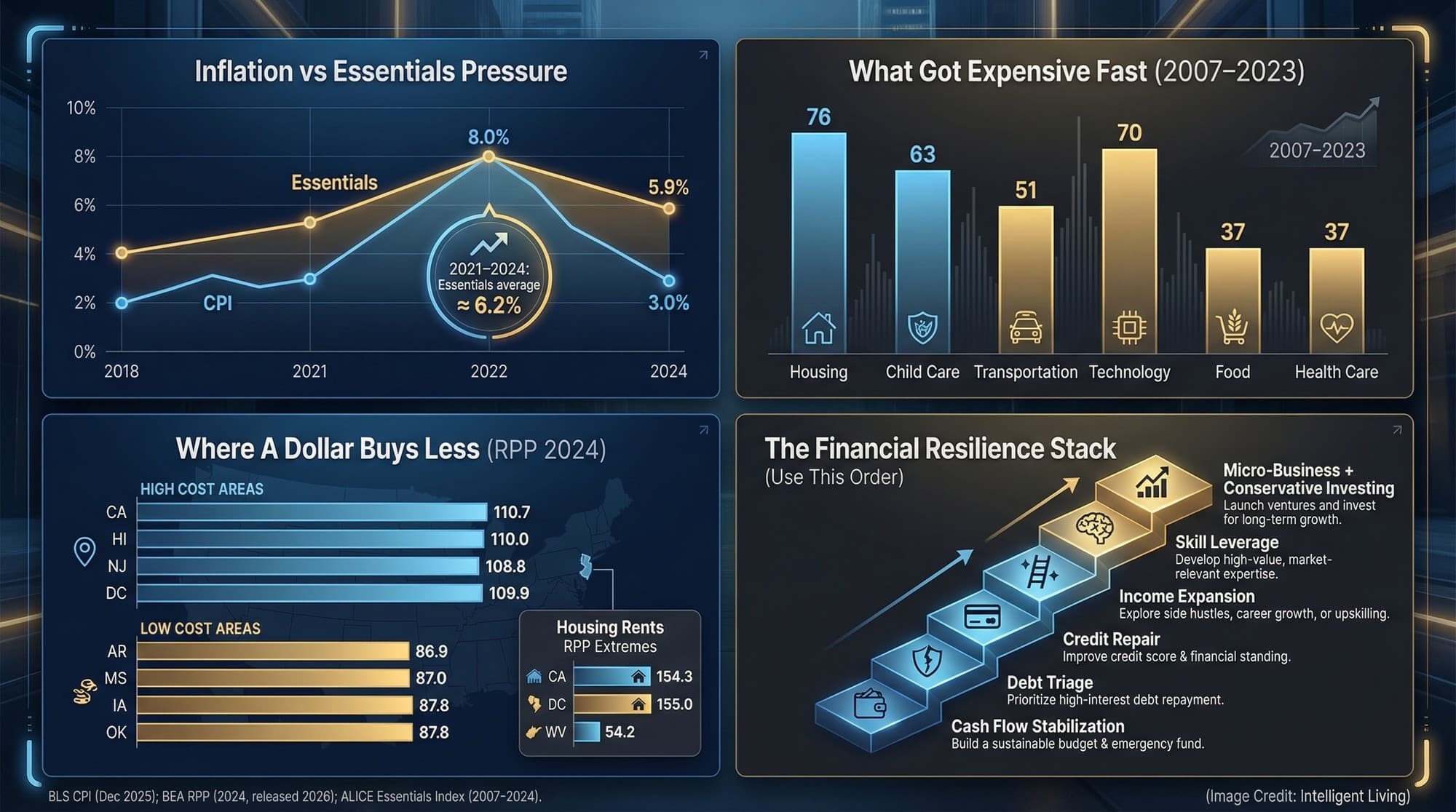
The Strategic Roadmap: Implementing the Financial Resilience Stack
The Resilience Stack is a stepwise approach. Each rung creates the conditions for the next one to work.
- Baseline Budgeting and Cash Stabilization
- Debt Inventory and Interest Triage
- Credit Repair and Reputation Building
- Income Expansion via Gig Work and Skill Marketing
- Micro-Business Formation With Realistic Funding Options
- Beginner Investing and Scam Avoidance
Stability requires stopping the bleed; without addressing high-interest debt and unexpected bills, new income is quickly absorbed by emergencies.
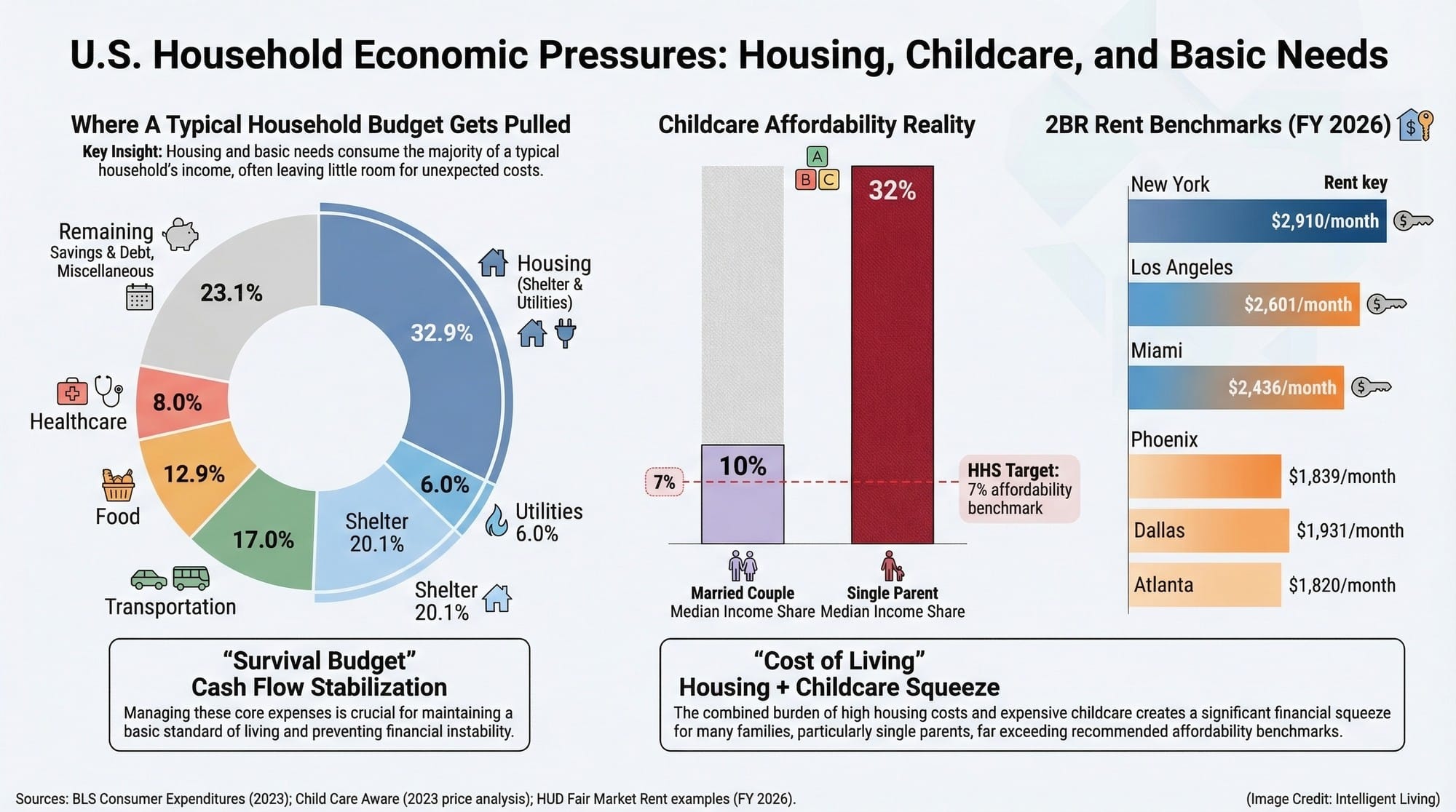
Step 1: Cash Flow Stabilization and Baseline Survival Budgeting
Calculating the Baseline Survival Budget from Lowest-Income Months
Identify your lowest-income month from the past year to define essential expenses, establishing a realistic survival budget for unstable times.
Preparing for sudden income shifts is critical. Implementing practical steps to safeguard finances during unexpected work halts prevents late fees, missed payments, and a spiral into expensive short-term borrowing.
Separating Recurring Obligations through a Dual-Account Strategy
Divide funds between recurring bills and daily living, automating payments to safeguard your credit and avoid late fees. Maintaining dual accounts prevents a single high-earning week from being mistaken for a permanent income increase.
Allocating Funds for Fixed Housing and Essential Utility Costs
Shelter, utilities, healthcare, and transportation are the primary drivers of household fragility. Housing specifically dominates most budgets, as seen in the BLS consumer expenditures breakdown. Utilities also impact stability; adopting simple winter energy-saving moves reduces costs without compromising comfort.
Immediate Spending Reductions without Long-Term Financial Fragility
Cut subscriptions, negotiate telecom plans, and adopt meal planning to reduce spending without sacrificing quality of life. Small, repeatable wins compound into months of breathing room.
Maintaining a baseline budget is simpler when using systems designed for managing irregular income as a freelancer or gig worker while planning for lean months.
Digital coupons and store-app stacking can also reduce staples, and the best results come from repeating a system rather than chasing random discounts. Sustainable savings habits strengthen when applying specific strategies for couponing in a harsh economy while planning for leaner months.
Pooling a predictable portion of monthly income makes purchasing sale items easier, reducing weekly grocery pressure and freeing time for secondary income opportunities.
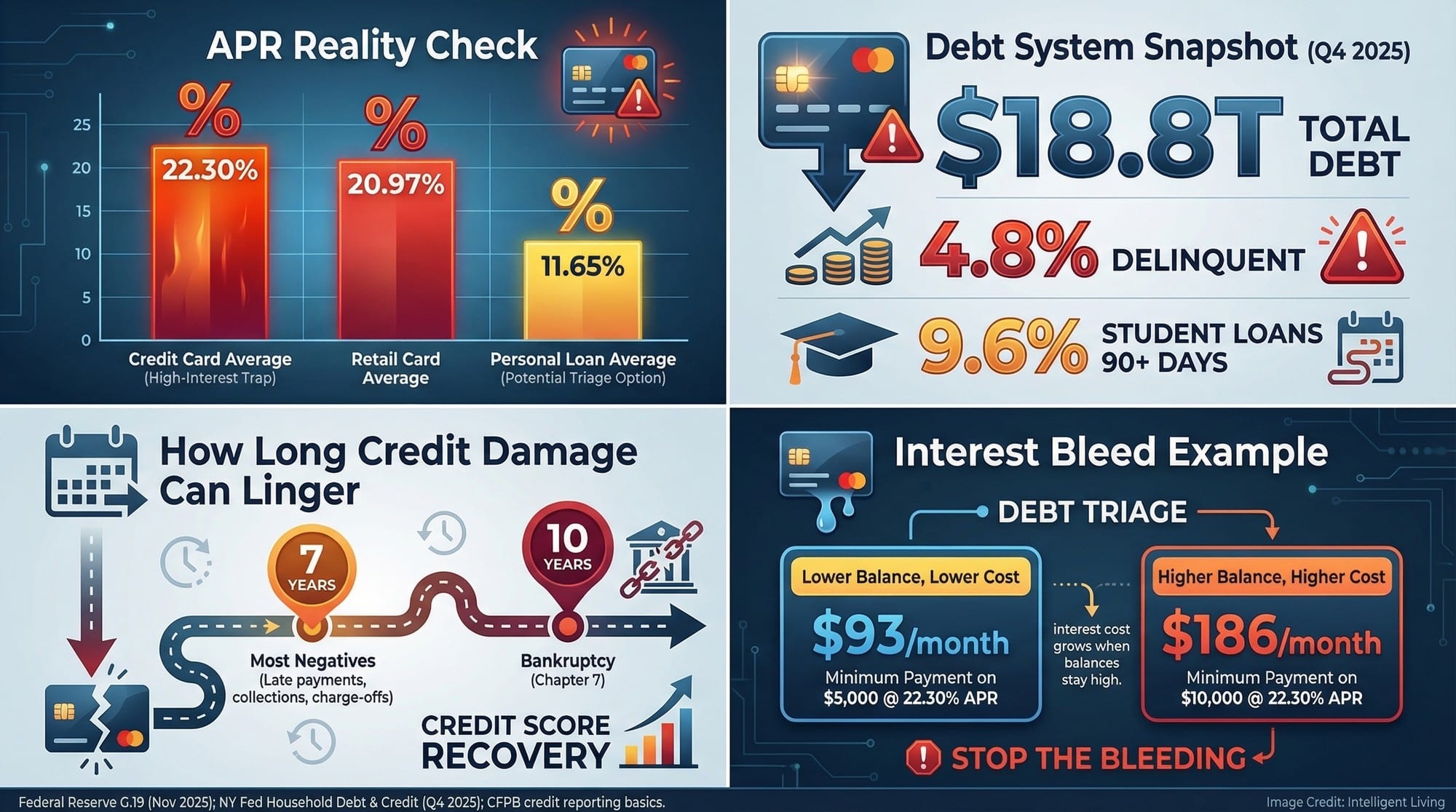
Step 2: Debt Inventory Triage and High-Interest Liability Reduction
Cataloging Total Liabilities and Minimum Payment Obligations
List every debt, the outstanding balance, the interest rate, and the minimum payment. This inventory is the operating map for any repayment strategy.
Selecting Effective Debt Snowball or Avalanche Methodologies
Selecting a repayment strategy depends on whether you value psychological wins or mathematical efficiency. Two proven methods dominate the financial landscape:
- Debt Snowball: Pay off the smallest balances first to build immediate psychological momentum.
- Debt Avalanche: Prioritize the highest interest rates first to minimize the total amount of interest paid over time.
Both methods are effective when followed consistently. Aligning debt repayment with your personal financial goals ensures long-term commitment to the process. Combining creditor negotiations with consistent repayment schedules provides concrete ways to begin getting out of debt while protecting your remaining income.
Evading Predatory Lending Cycles and High-Fee Installment Traps
Payday loans and high-fee installment products can offer quick relief but often increase long-term costs. Fees and rollovers transform one-time emergencies into permanent financial drains; breaking the payday loan cycle is as critical as resolving the principal balance.
Engaging Accredited Credit Counseling for Advanced Collection Issues
If collections, lawsuits, or court garnishments are already active, seek low-cost legal or accredited credit counseling immediately. Properly vetted programs can negotiate lower payments and stop collection calls. Qualified households often benefit from a free debt management program that consolidates monthly payments and lowers interest rates through transparent, nonprofit guidance.
Engaging a nonprofit credit counselor resulted in a negotiated lower interest rate and a single payment schedule, significantly reducing one reader’s monthly stress.
Step 3: Credit Reputation Recovery and Strategic Score Optimization
Auditing Official Credit Reports for Inaccuracies and Disputes
You can request free credit reports through the federally authorized credit report website and review them for errors. Resolving inaccuracies requires following the official CFPB steps to dispute an error on your credit report.
Maximizing Credit Utilization Ratios and Payment History Consistency
- On-time payments are the largest factor to protect and build upon. Set reminders or automatic payments.
- Keep credit card utilization low by paying down balances and not closing long-standing accounts that help the average age of credit.
- Limit hard inquiries and new credit applications unless necessary.
Use Secured Cards and Credit-Builder Loans When Appropriate
Secured cards and small, properly reported credit-builder loans provide an on-time payment history that can raise scores in months. Choose products from reputable institutions only. Building the financial resilience stack requires managing score fluctuations driven by timing, inquiries, and utilization changes. Understanding how personal loans can impact your credit score helps you manage these variables effectively.
Identifying Illegal Credit Repair Tactics and Upfront Fee Scams
Avoid companies that promise instant fixes, require upfront fees to repair credit, or ask you to pay to remove accurate negative information. Legitimate credit recovery steps are typically free or low-cost, requiring consistent time rather than upfront fees. The Federal Trade Commission warns that illegal credit repair scams often promise to remove accurate information, which is one of the fastest ways to spot a rip-off.
Rebuilding credit after medical debt involves using secured cards for six months and paying the balance each cycle to achieve measurable score gains without third-party fees.

Step 4: Leveraging the Gig Economy for Immediate Income Expansion
Prioritizing Skill-Based Freelancing Over Time-Intensive Errands
Not all side work is equal. Prioritize gigs that add skills, client relationships, or portfolio items you can use to raise rates later. Time-based errands offer immediate cash but rarely scale into higher income brackets. Freelance and independent contracting now represent a significant sector of the American workforce. BLS data shows that 7.4% of workers are classified as contractors in the latest contingent and alternative employment arrangements supplement.
Maintaining Business Records and Separate Professional Accounts
Open a separate account, track business expenses, and keep clear records. Doing so saves time at tax time and creates a clean financial picture for future lending or formal business moves.
Managing Quarterly Estimated Payments and Self-Employment Liabilities
Gig income is taxable. The IRS explains how to manage taxes for your gig work, including recordkeeping and estimated payments.
Comparing Net Take-Home Pay Across Freelance Marketplaces
Platform choice affects pay, fees, and scheduling. Compare net pay after fees and taxes, rather than headline rates, and be mindful of platform rules and insurance gaps. Reframing app-based work as a strategic gig economy side hustle ensures that workers protect their time and maximize net take-home pay.
Converting weekend freelance work into a steady client base requires consistent delivery, active referral requests, and meticulous expense tracking.
Step 5: High-Value Skill Marketing and Professional Proof Assets
Synthesizing Marketable Technical Abilities and Soft Skills
Existing skills often serve as the foundation for marketable services when reframed through a professional lens. Synthesizing your marketable abilities into a sellable stack clarifies your professional value, providing a direct path to higher rates. This approach helps you explain value to a client or employer in a single sentence.
Technology and digital literacy matter alongside basic business habits like punctuality and clear communication. The World Economic Forum’s skills outlook emphasizes why adaptability is a top-tier asset. Adopting and building a personal brand on social media makes your professional proof more accessible and trustworthy. Trust often comes down to consistency, authenticity, and clarity, which sits at the core of self-representation and personal branding in the digital age.
Creating Quantitative Case Summaries and Portfolio Proof Assets
Build proof fast. Create two short proof assets you can show in a single email or one link: a one-page portfolio and a single case summary that quantifies a result. Use plain, measurable language, for example, reduced client ad spend by 22% while increasing conversions 9%. Proof shortens sales cycles and gives you leverage when negotiating price.
Scaling Service Rates Based on Documented Client Success
Initial service pricing should focus on acquiring repeat customers and establishing professional proof quickly. After three repeat clients and one documented outcome, raise your price in increments. Track how long tasks take; you want to replace low-value hours with higher-value work over time.
Repositioning a portfolio piece as a quantitative case study allows professionals to shift from hourly billing to packaged offerings, often doubling effective rates within months.
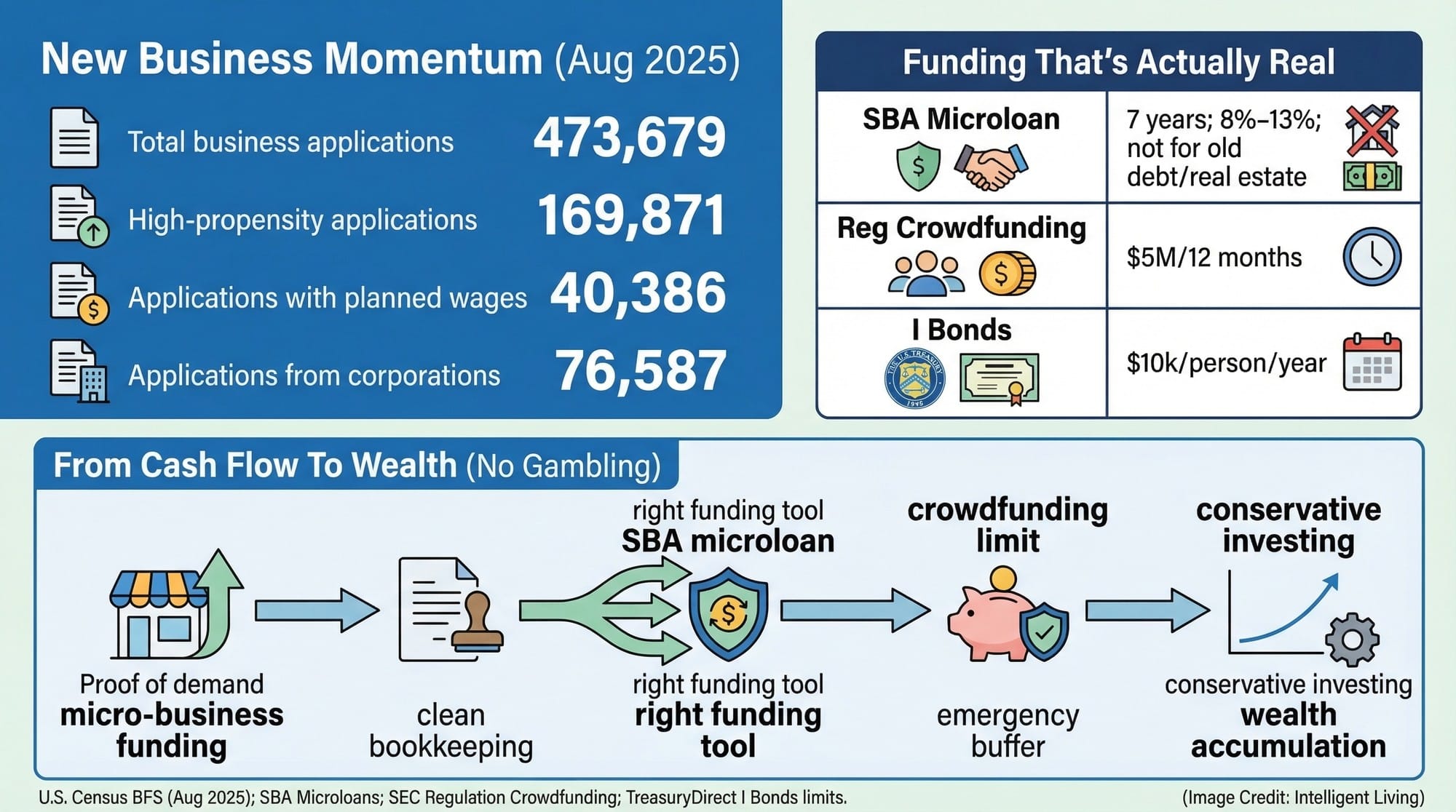
Step 6: Formalizing Micro-Business Structures and Validated Funding
Validating Niche Market Demand Before Operational Expansion
Micro-businesses succeed by providing repeatable offers to clearly identified, niche audiences. Test a single offer for six weeks before expanding. Keep initial expenses small and document every transaction and expense from day one so you always have the records required for simple lending or tax filings.
Forming LLC Entities to Limit Personal Financial Liability
Once revenue stabilizes, forming an LLC to improve credibility and limit liability becomes a critical step in the financial resilience stack. Formal structures can protect personal assets and make it easier to open business accounts.
Navigating SBA Microloans and Community Development Capital
- SBA Microloans: Small loans that can provide working capital for equipment or inventory; the program has limitations and is not a quick cash fix. The SBA microloan program outlines caps and eligible uses.
- Community Development Financial Institutions: Local lenders that specialize in small, community-oriented loans and technical assistance, supported by the Treasury’s CDFI Fund.
- Regulation Crowdfunding: For some businesses, raising capital through a registered crowdfunding portal is a legal path to gather small investments from many backers, with guardrails summarized in the SEC’s Regulation Crowdfunding rules.
Selecting the right capital source protects your business equity from high-cost debt traps. Small firms often find that financing is available but carries unfavorable terms. This trend is highlighted in the Federal Reserve’s Small Business Credit Survey report on employer firms. High interest rates often accompany the convenience of quick-approval business credit lines, making thorough term comparisons vital for sustainable growth.
Suspicious funding products requiring immediate upfront fees often signal predatory lending; always request a written term sheet for professional review. Avoid high-cost merchant cash advances and predatory lender offers.
Retaining every receipt and customer contact allows market vendors to provide the proof of demand required for local CDFI capital loans.
Step 7: Long-Term Wealth Accumulation and Conservative Investing
Securing Emergency Cash Reserves Prior to Market Entry
Securing a short emergency buffer and resolving high-interest debt are essential prerequisites within the financial resilience stack prior to market entry. Investing while carrying high-interest obligations is usually a net loss.
Diversifying Risk through Index Funds and Broad-Market ETFs
Index funds and ETFs spread risk across broad markets while minimizing management fees. These tools are the primary starting points for beginners. For a deeper dive, the beginners’ guide to asset allocation, diversification, and rebalancing provides a plain-language foundation for long-term growth. Fees matter because they compound against you, and the plain-language definition of what an index fund is makes it easier to spot products that charge too much for too little.
Use Safe, Low-Complexity Tools for Early Steps
Treasury Series I Savings Bonds have rate, limit, and redemption rules that make them easier to understand than many complex yield products. Keep retirement accounts in mind and prioritize employer matches if they are available, and use the IRS summary of 2026 401(k) and IRA contribution limits when you plan automation. Alternative asset investing requires a deep understanding of the role of a custodian for self-directed IRAs to ensure regulatory compliance and asset security.
Automating small monthly contributions into low-cost index funds proves that consistent habits outweigh market timing for long-term wealth. Aggressive sales tactics and promises of guaranteed safety are frequent signs of a gold IRA scam that beginners must learn to identify before committing capital.

Strategic Resources and Implementation Roadmap for Financial Recovery
Don’t Leave Free Money on the Table (Taxes and Credits)
The Earned Income Tax Credit and the Child Tax Credit can make an immediate, legal difference for households with children or modest earnings.
Keep clear records of income, childcare expenses, and dependent information. Proper documentation speeds tax filing, prevents mistakes, and ensures you receive credits you qualify for.
Self-employed earners must track expenses and set aside funds for quarterly taxes; diligent bookkeeping preserves eligibility for tax credits while securing your financial roadmap.
Reviewing how FDIC insurance applies to common account setups ensures emergency cash remains protected in US banks.
Actionable Milestones: The 7-Day, 30-Day, and 6-Month Roadmap
7 Days
- Pull free credit reports and snapshot balances.
- Create a baseline budget derived from your worst month.
- Cancel or pause one recurring subscription.
- Set up a separate account for bills if you do gig work.
30 Days
- Establish a two-account cash flow system and automate one payment.
- Start a secured card or credit-builder loan if you need tradeline activity.
- Begin a single gig or side offer focused on a transferable skill.
- Contact a local nonprofit credit counselor if collections are active.
6 Months
- Reach a small emergency buffer equal to one to two weeks of essential expenses.
- Document three repeat clients or sales and produce one measurable case study.
- Apply for an SBA microloan or local CDFI only when you have three months of revenue documentation.
- Start an automated contribution to a retirement account, even a small amount.

Finalizing the Financial Resilience Stack: From Survival to Momentum
Viral discussions surrounding the American poverty line emphasize the legitimate financial hurdles facing modern families. Actual costs for shelter and medical care frequently outpace median wages, trapping households between federal thresholds and practical survival limits. Sustainable progress requires a disciplined approach that transforms modest, repeatable actions into permanent financial stability.
Financial freedom begins by identifying high-interest leaks and marketing existing professional skills. Sustainable progress follows when you utilize trusted funding pathways for micro-businesses and automate investment strategies. Adhering to the financial resilience stack provides a definitive path for how to escape poverty in America without relying on luck.
Lasting wealth is built through consistent daily habits and a refusal to let unexpected emergencies dictate your future path. Incremental wins in debt management and budgeting eventually scale into significant capital reserves. Adhere to the order of the stack, protect your momentum, and transform current financial survival into a legacy of wealth.
Essential FAQ for Financial Stability and Real Math
Is $140,000 the new American poverty line?
Statistically, no. Federal measures are lower. However, $140,000 reflects a realistic ‘make-ends-meet’ budget in high-cost regions where basics are expensive.
What is the best way to get a free credit report?
Use the federally authorized credit report website to pull your data. Check for errors that suppress your score.
Do I have to pay taxes on gig income?
Yes. Self-employment income is taxable. Track business expenses to reduce liability and make quarterly estimated payments.
How do I start a micro-business with no money?
Leverage ‘sellable stacks’ of existing skills. Use digital platforms to find clients and build proof before seeking funding.
Where can I find a local living wage calculator?
The MIT Living Wage Calculator offers county-specific data. Use it to identify the survival gap in your specific area.


