
IXI’s prototype autofocus glasses address the mechanical lag of aging vision: the moment an eye shifts from a digital screen to a distant street sign, the natural lens often fails to adapt. This delay in focal response defines the daily experience of presbyopia.
This persistent visual friction characterizes presbyopia, elevating autofocus prescription glasses to a functional necessity.
Common clinical approaches for presbyopia treatment typically involve reading glasses, progressives, or contact lenses, making the promise of a single adaptive pair highly attractive.
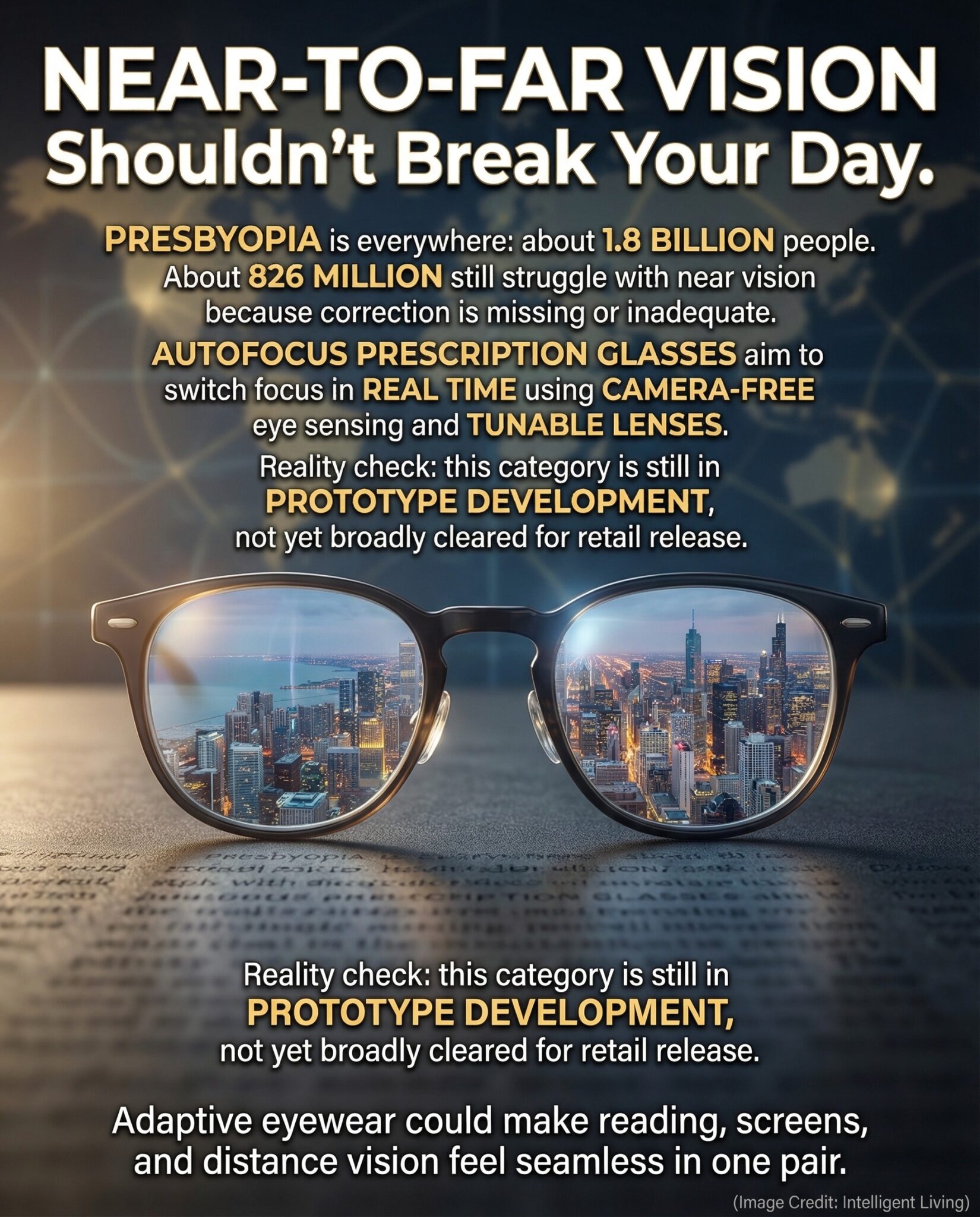
The Global Challenge of Age-Related Vision Loss
Essential Technical Specs: Adaptive Eyewear and Device Status
- Device Class: Adaptive eyewear prototype for presbyopia-style near-vision support.
- Current Development Status: Technical reports indicate the system remains in the prototyping phase and has not yet cleared the CE marking requirements necessary to signal compliance with EU product safety standards. Market entry remains pending while the eyewear remains in development, according to the latest IXI product status reports.
- Core Mechanism (High Level): First, eye-tracking sensors detect when the eyes converge for near-distance focus. Then, an electrically tunable layer shifts the optical power in real time.
- Why it Matters: Adults over age 40 typically begin experiencing near-vision blur due to natural ocular changes. Global estimates place the population affected by presbyopia at approximately 1.8 billion, a figure projected to exceed 2.1 billion by 2030 due to aging demographics.
The Global Impact of Presbyopia and Aging Vision Needs
Presbyopia is the age-related loss of near-focusing ability that typically becomes noticeable after age 45 and often keeps progressing through the 50s and beyond. Stiffening of the internal ocular lens causes close-up text to blur at standard reading distances. Users typically compensate for this loss of focus by physically distancing objects, a behavior change that becomes an immediate and tiring daily negotiation.
Addressing Near-Vision Impairment at Scale
The global impact is extensive. The World Health Organization identifies presbyopia as a significant cause of near-vision impairment, affecting hundreds of millions who have no or inadequate near correction.
Automating the focus shift reduces the constant physical recalibration required of professionals who toggle between digital displays, physical documents, and environmental navigation. Daily interactions frequently highlight these visual limitations. For example, a parent helping with homework must rapidly shift focus between a worksheet and a child across the room. Delayed focus recovery disrupts the natural rhythm of these transitions.
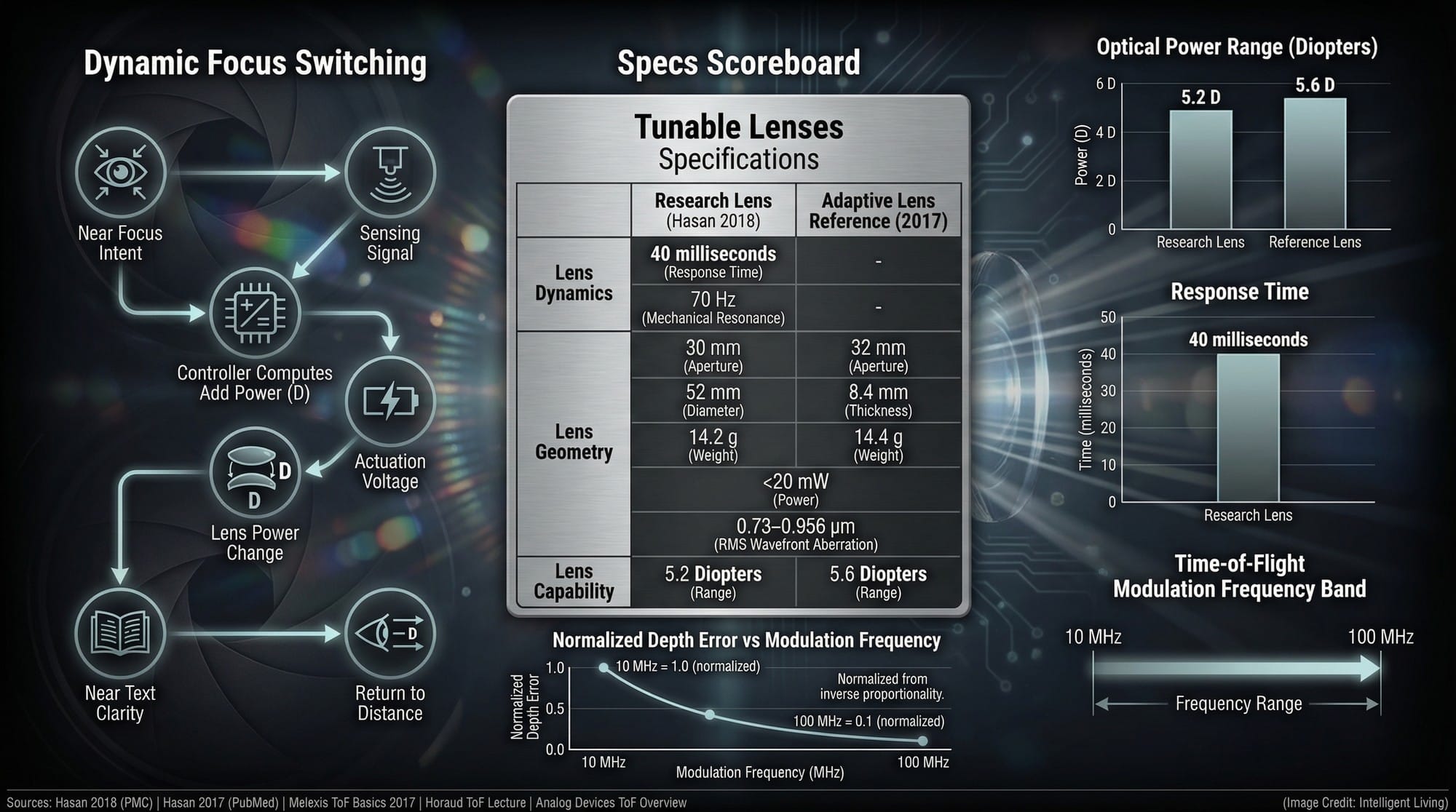
Innovative Solutions for Dynamic Focus Switching
The Big Idea: Glasses that Refocus like a Phone Camera
Autofocus glasses operate on the principle of active optics, mirroring the automated sharpening found in digital cameras. Traditional multifocals rely on fixed zones that the wearer must learn to “find” with head position and gaze angle. Adaptive eyewear tries to reverse that relationship by making the optics do the work.
Transitioning From Fixed Zones to Active Optics
Functional clarity is the primary advantage. Wearers avoid the need to keep readers in every room or struggle with the ‘sweet spot’ in a progressive lens corridor. Instead, the user gains clearer near vision exactly when needed, returning to distance correction the moment their gaze lifts. Precision in these focus shifts matters due to the inherent limitations of static multifocal designs:
- Traditional progressive lenses rely on a seamless increase in magnification mapped across fixed zones.
- Users must physically align their gaze within a narrow lens ‘corridor’ to find clarity.
- These requirements often force unnatural head positions, leading to chronic neck tension and restricted peripheral fields.
Adaptive eyewear aims to remove these physical constraints by making the optics responsive to the user’s intent. DIY home repairs highlight the necessity of seamless focus switching, such as when reading tiny part numbers before aligning a piece across a workshop.
IXI Engineering: Cameraless Eye Tracking and Tunable Lenses
Cameraless Eye-Tracking Sensors and Gaze Detection
Independent reporting describes IXI’s approach as camera-free eye tracking that uses tiny emitters and sensors around the frame. Opting for cameraless eye tracking to detect focus shifts reduces privacy concerns, computation overhead, and power draw.
Research supported by technical funding ensures that a camera-free gaze approach fits the ergonomic constraints of daily wear while staying visually discreet. User adoption hinges on aesthetic neutrality; adaptive eyewear must provide automated correction without compromising the profile of traditional frames.
Voltage-Controlled Liquid Crystal Layers and Optical Power
Upon detecting near-focus intent, the system triggers a rapid shift in optical power. The IXI lens stack incorporates a voltage-controlled liquid crystal layer that increases optical power for close work, then returns to the distance state.
Recent reviews of electrically tunable lenses discuss their broader applications as compact, low-mechanism components for smart vision. Liquid-crystal-based focusing remains a primary engineering pathway for achieving high field uniformity. However, the success of this architecture depends heavily on managing the power requirements of the liquid crystal layer.
Battery Runtime and Latency Performance Benchmarks
Battery longevity, transition latency, and optical aberrations serve as the primary constraints for commercial viability. Functional performance is measured by how effectively the technology facilitates active tasks. User satisfaction depends on whether these focus transitions occur without perceptible delay, such as when a cook glances between a recipe and a stove.
Runtime, prescription range, and long-term comfort remain open questions until final regulatory documentation is published.
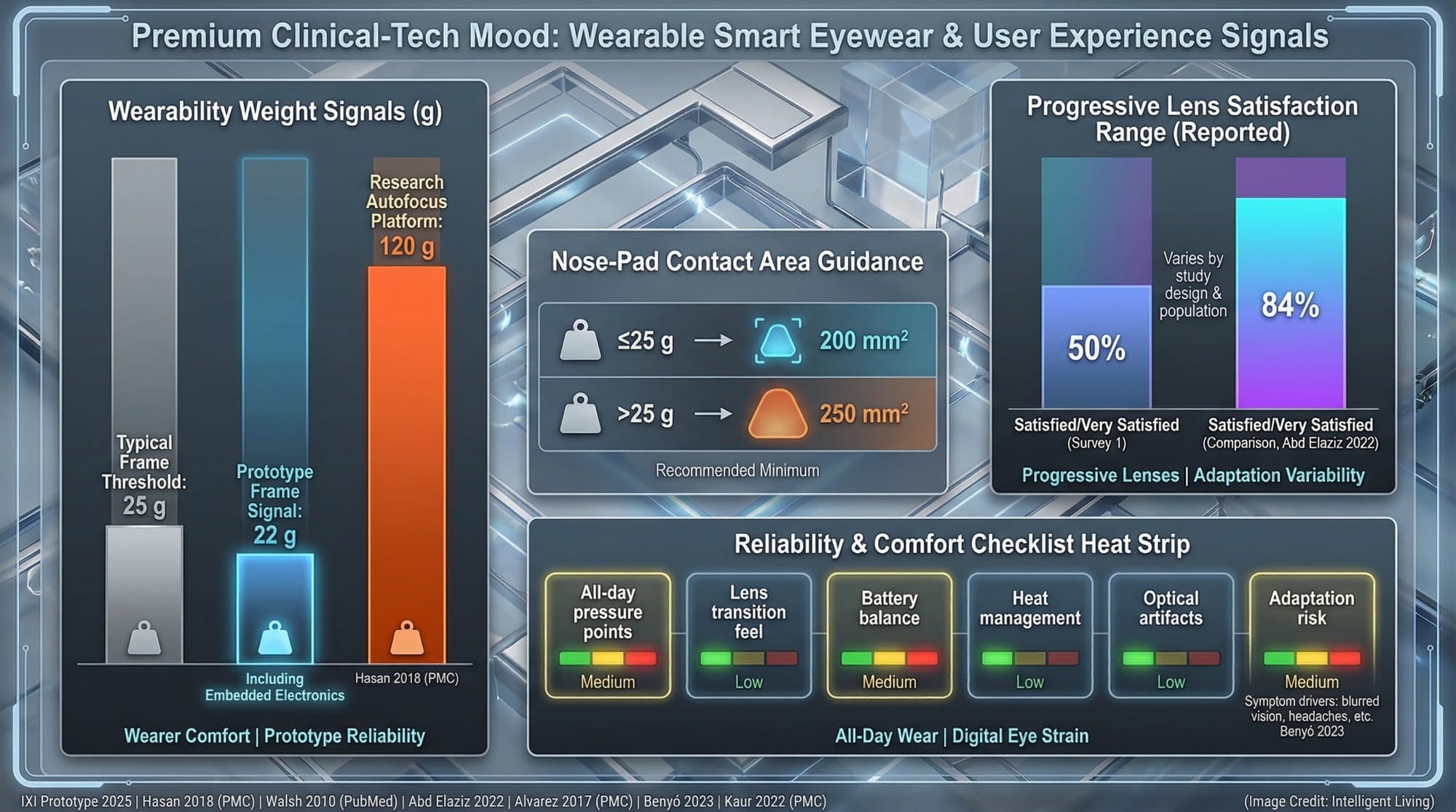
Evaluating Prototype Reliability and Wearer Comfort
Current Reliability Assessment: Prototypes, Trials, and Launch Hurdles
Verified Prototype Milestones and Field Study Data
IXI has demonstrated functional prototypes designed for everyday wearability and aesthetic subtlety. Recent large-scale field studies of autofocus glasses involved hundreds of participants to test ergonomic resilience across multiple locations.
The Unknowns That Will Decide Whether It Replaces Readers and Progressives
Commercial viability depends on resolving several fundamental engineering challenges. While lab benchmarks show promise, the transition to consumer-ready hardware involves answering critical questions about long-term use.
- Regulatory milestones remain the primary gatekeeper, as the lack of a current CE mark leaves market release timelines uncertain.
- Prescription limitations are a factor, specifically regarding how well liquid crystal layers handle complex astigmatism correction or high multifocal needs.
- Hardware durability, specifically battery runtime and total frame weight, will dictate whether the technology is viable for 16-hour daily wear.
- Neural adaptation varies between users; proving that electronic lenses reduce the ‘swimming’ effect of progressives is essential for broad adoption.
Validating these elements in diverse environments will determine if autofocus glasses can truly replace legacy optics. Users often find that once they stop tilting their heads to ‘find the lens,’ neck tension decreases significantly.
Why Comfort and “Normal Frames” May Decide Adoption
Prototype milestones now focus heavily on weight and fit. A recently unveiled 22 gram smart eyewear prototype emphasizes lightweight ergonomics as a core design target.
Engineering Lightweight Frames for 24-Hour Wear
Professional users typically favor neutral frame designs that blend with everyday attire. Lightweight frames are often found in mixed-material glasses that balance structural durability with wearer comfort. These details are similar to the methods optometrists use to match lenses to specific daily routines and frames.
Adoption logic rests on ergonomic transparency. Professional eyewear users prioritize frames that remain unnoticeable throughout 16-hour wear cycles rather than novelty technical features.
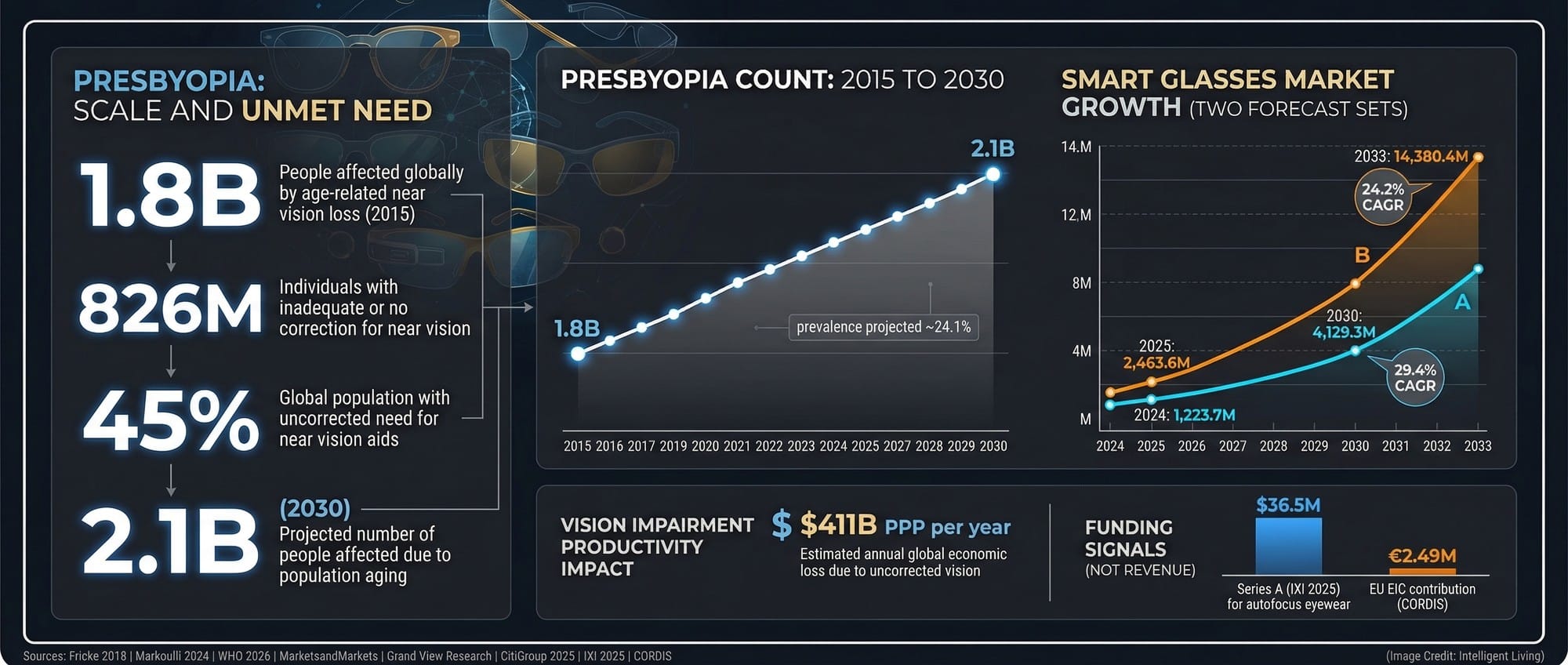
Market Trajectory and the Future of Vision Technology
Market Entry Signals: Funding Rounds and Manufacturing Partnerships
Market signals suggest serious technical ambition. A recent Series A funding round dedicated to adaptive vision development secured support from high-profile investors like the Alexa Fund to scale operations.
Scaling Production through Technical Partnerships
Efforts to line up manufacturing capacity are expanding through a strategic manufacturing partnership intended to accelerate market entry. The recent acquisition of Finnsusp’s lens operations reflects this focus on scale.
Institutional support is also verified by the CORDIS project database, which tracks the underlying technology of smart lens research. In parallel, the broader 2026 smart glasses trend is normalizing frames that integrate advanced correction, while functional smart eyewear becomes more common in professional environments.
This Isn’t a Solo Race: Other Autofocus Paths Are Emerging
Autofocus eyewear is not a single-company story. Different teams are testing various methods for depth sensing and optical adjustment.
Time-of-Flight Depth Sensing Alternatives
Alternative designs prioritize object distance over eye convergence using the principle of time-of-flight depth sensing, where phase shifts infer object distance within compact hardware.
Fresnel Liquid Crystal Architectures
This diversification reflects a broader industry shift. Competitors like Elcyo’s autofocal lenses utilize concentric Fresnel lens geometry to maintain optical power without increasing lens thickness. Eye care innovation now emphasizes a fusion of hardware and biology, including emerging eye care technologies like bionic implants and gene therapy.
Navigating the Transition to Adaptive Eyewear
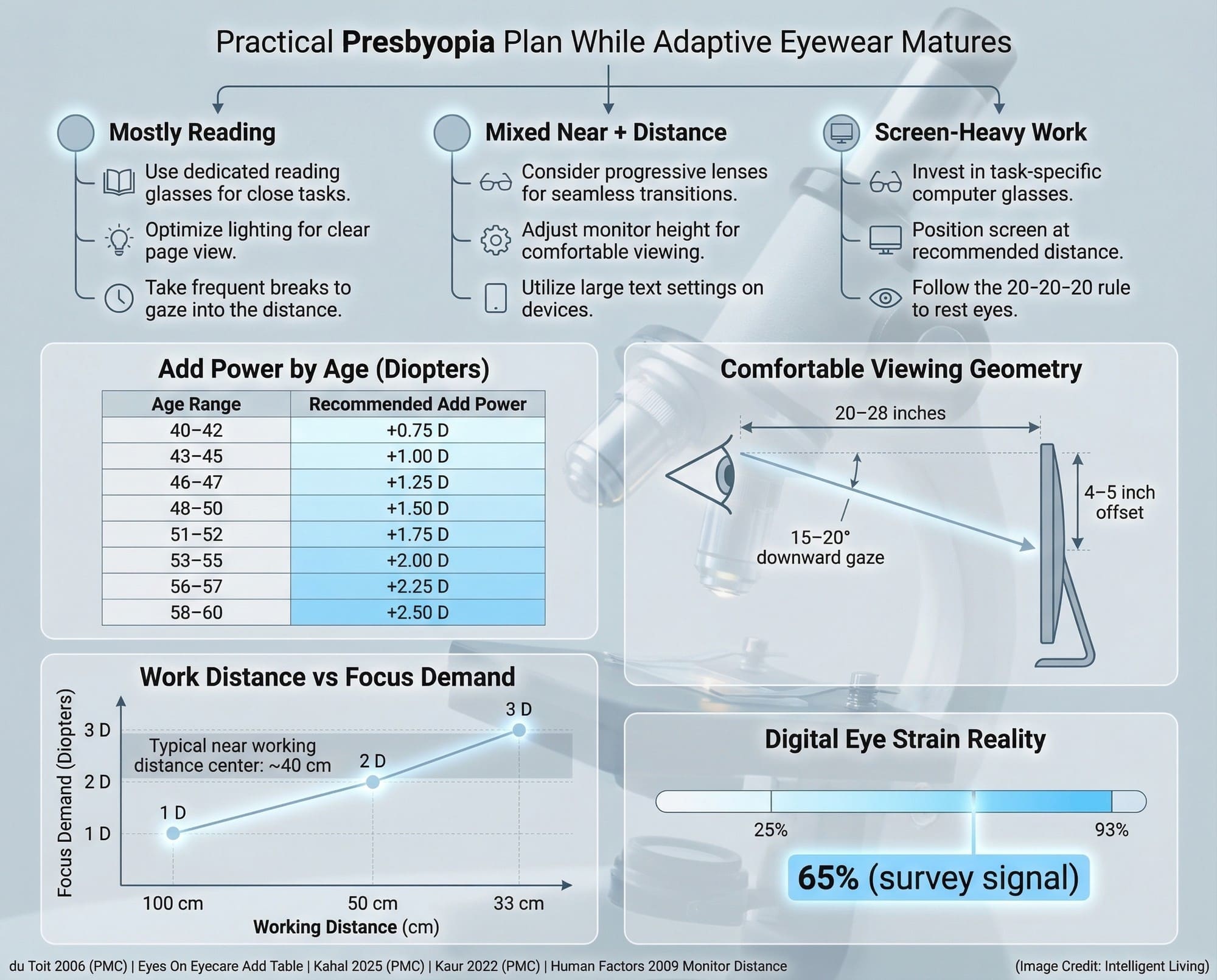
Strategic Vision Care: Managing Presbyopia During Technical Development
Proactive strategies can bridge the gap between today’s readers and tomorrow’s smart optics.
- Schedule comprehensive eye exams to identify underlying health risks and ensure your current prescription is accurate.
- Minor ergonomic adjustments like proper monitor positioning can significantly reduce the mechanical strain that exacerbates presbyopia symptoms.
- Implement proactive blue light management and consistent screen breaks to lower daily fatigue.
- Evaluate options like presbyopia eye drops, which temporarily enhance depth of focus for close work.
- Support long-term lens resilience through dietary choices such as lutein and omega-3s.
- Reduce cognitive load by limiting total screen time throughout the work day.
- Study the clinical effectiveness of blue light glasses to determine if they match your specific strain symptoms.
- Correct common habits that cause eye strain, such as reduced blinking or working in poor lighting.
Schedule regular consultations to ensure these dietary and ergonomic choices align with your specific vision profile. Proactive management ensures your ocular health remains stable enough to benefit from future hardware releases. Frequent loss of reading glasses remains a primary driver for adaptive eyewear adoption. Users who currently juggle multiple pairs of readers often find that a single, stable all-day solution significantly reduces daily frustration.
Conclusion: Strategic Shifts in the Adaptive Eyewear Market
Autofocus prescription glasses represent a high-stakes attempt to solve a practical problem at a global scale. As millions struggle with the dual burden of near and distance vision failure, the shift toward adaptive eyewear offers a path to seamless clarity. While IXI’s approach is technically plausible and well-funded, the ultimate success of these smart glasses for reading depends on how invisible the technology feels during a standard workday.
Regulatory milestones and real-world comfort will decide the transition to broad retail availability. Future users will judge these adaptive vision correction tools not by their specs, but by whether they can forget they are wearing them. Until then, exploring existing non-surgical vision treatments remains the most reliable strategy for navigating aging vision.
Frequently Asked Questions: Autofocus Glasses Explained
How do autofocus glasses compare to progressive lenses?
These devices aim to eliminate the ‘fixed corridor’ of traditional multifocals, which traditionally rely on multiple vision zones within a single lens. By using real-time vision adjustment, they provide a wider field of view for near tasks without the head-tilting required by progressives.
When will IXI autofocus glasses be available for purchase?
They are currently in the development phase. Market release in Europe requires the mandatory conformity assessment for medical devices required for a broad retail launch, a step the company has not yet finalized.
Is it safe to drive with adaptive eyewear?
Safety depends on the reliability of the near-to-far focus switching. Drivers should use caution with any early-stage optical technology until it is explicitly cleared for high-speed transit use.
Can autofocus prescription glasses correct astigmatism?
Early designs focus primarily on the spherical power needed for presbyopia. Whether these lenses can accommodate complex astigmatism correction remains a key technical hurdle for future models.
What is the best way to prepare for smart glasses for reading?
Keep your eye exams current and document which daily tasks cause the most strain. This data helps clinicians determine if electronic prescription glasses are a viable fit for your specific lifestyle.


