
You are sitting in a dimly lit restaurant, squinting at the menu. The text is a blur. You reach for your reading glasses, only to realize you left them at home. For the roughly 128 million American adults living with presbyopia, this scenario is painfully familiar. The question of whether eye drops can replace reading glasses has moved from headline hype to clinical reality. But a new class of FDA-approved eye drops is changing the conversation, offering a pharmacological alternative to reading glasses that works in minutes and lasts for hours.
Presbyopia, the age-related loss of near focusing ability, typically begins around age 45 and affects nearly 90% of adults over that threshold. Until recently, the only options were reading glasses, bifocals, or surgical procedures. Now, four FDA-approved eye drops are available in the United States, with more in the pipeline.
What Is Presbyopia and Why Does It Happen?
Presbyopia is a natural, progressive condition that occurs as the lens inside the eye gradually loses its flexibility. When you are young, the lens is soft and pliable. A small muscle called the ciliary muscle contracts and relaxes, changing the shape of the lens to focus on objects at different distances.
Starting around age 45, the lens begins to harden. The ciliary muscle can still contract, but the rigid lens no longer changes shape effectively. The result is a gradual inability to focus on close objects. Distance vision typically remains unaffected.
The condition is nearly universal. An estimated 1.8 billion people worldwide were presbyopic in 2015, projected to reach 2.1 billion by 2030. In the United States, approximately 128 million adults are affected.
How Do Presbyopia Eye Drops Work?
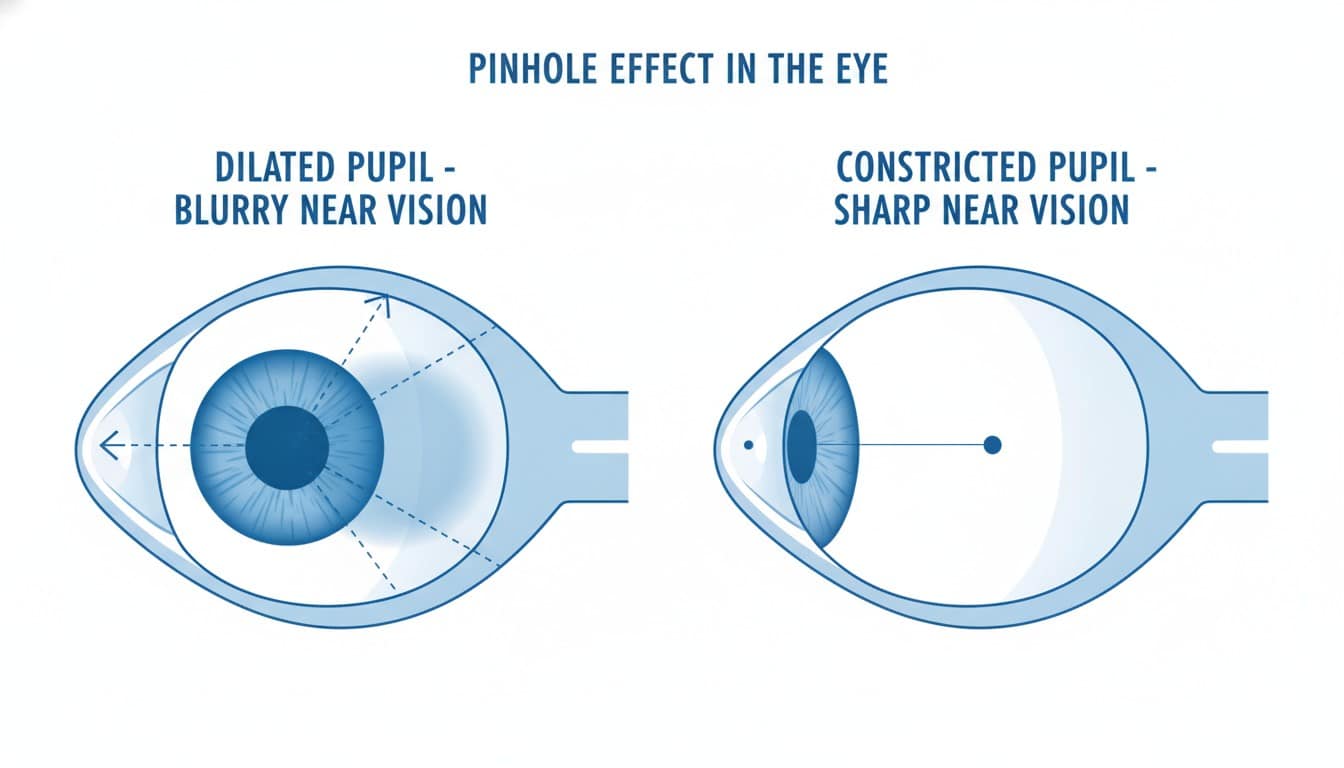
All currently approved presbyopia eye drops work through miosis, the constriction of the pupil. When the pupil shrinks to approximately 2 millimeters, it creates the “pinhole effect,” the same principle behind squinting to read fine print.
Different drops use different active ingredients:
- Pilocarpine (Vuity, Qlosi): A cholinergic agonist that directly stimulates the ciliary muscle and constricts the pupil
- Aceclidine (VIZZ): A pupil-selective agent that targets the iris sphincter more precisely
- Carbachol + brimonidine (YUVEZZI): A dual-agent approach where carbachol constricts the pupil while brimonidine prevents dilation
FDA-Approved Presbyopia Eye Drops

| Product | Active Ingredient | Approved | Onset | Duration | Price |
|---|---|---|---|---|---|
| Vuity | Pilocarpine 1.25% | Oct 2021 | 15 min | 6-10 hours | ~80/bottle |
| Qlosi | Pilocarpine 0.4% | Oct 2023 | 20 min | Up to 8 hours | ~79/30 vials |
| VIZZ | Aceclidine 1.44% | Jul 2025 | 30 min | Up to 10 hours | ~79/25 doses |
| YUVEZZI | Carbachol 2.75% + Brimonidine 0.1% | Jan 2026 | 30 min | 8-10 hours | Expected Q2 2026 |
All four drops are prescription-only and classified as lifestyle medications, meaning insurance coverage is limited.
Vuity: The Pioneer
The first FDA-approved presbyopia drop uses pilocarpine 1.25% with AbbVie’s pHast technology. In clinical trials, approximately one in three patients gained three or more lines on a near-vision chart at three hours.
VIZZ: The Newcomer
Approved in July 2025, VIZZ is the first aceclidine-based drop. In CLARITY trials, 71% of patients achieved three or more lines of improvement within 30 minutes. It became widely available by late 2025.
YUVEZZI: The Combination Approach
Approved in January 2026, YUVEZZI is the first dual-agent drop, as detailed in the FDA prescribing information. In BRIO trials with 800+ patients, it achieved three or more lines of improvement over 8 hours. The BRIO II study monitored 72,000+ treatment days, the longest safety study for presbyopia drops.
VIZZ vs. Vuity: Key Differences
Mechanism: Vuity uses broad pilocarpine; VIZZ uses selective aceclidine.
Duration: VIZZ lasts up to 10 hours once daily; Vuity may need a second dose.
Onset: Vuity works in 15 minutes; VIZZ takes 30 minutes.
Preservative-free: VIZZ is preservative-free; Vuity contains BAK.
Cost Considerations
At roughly $80 per month ($960+ annually), these drops cost significantly more than $10-$30 reading glasses. However, for those who find glasses inconvenient, the cost may be justified.
Side Effects and Safety
Common side effects include headache (5-16%), eye irritation (5-20%), and dim vision. Serious but rare: retinal detachment risk exists for those with pre-existing retinal conditions.
Who should NOT use these drops:
- Patients with retinal detachment history
- Severe high myopia
- Active eye inflammation
The Pipeline: What’s Coming
Nyxol (Phentolamine 0.75%)
An alpha-blocker under FDA review with PDUFA date October 17, 2026. It would be the first non-miotic presbyopia treatment.
Experimental Light-Activated Eye Drops
In August 2026, IBEC researchers published findings on photoswitchable drugs that restored light perception in blind mice via eye drops, without gene therapy or implants. While years from human trials, this represents a potential paradigm shift.
Pilocarpine + Diclofenac Combination
A 766-patient study presented at ESCRS showed this combination improved near vision for up to two years, with diclofenac reducing pilocarpine’s discomfort.
Frequently Asked Questions
Do presbyopia eye drops work?
Yes. All four FDA-approved drops showed statistically significant improvement in clinical trials, with most patients gaining 2-3 lines on near-vision charts.
Are they available over the counter?
No. All require a prescription and comprehensive eye exam.
Can they replace reading glasses entirely?
They significantly reduce dependence but don’t eliminate it. The effect is temporary (6-10 hours) and some tasks may still require glasses.
Are they available outside the US?
Currently US-only. Tenpoint has Asia Pacific licensing deals for YUVEZZI, but no timeline for Europe or Latin America.
The Bottom Line
Presbyopia eye drops represent a genuine shift in managing age-related near vision loss. With four FDA-approved options and more in the pipeline, patients have unprecedented choices. While not a perfect replacement for reading glasses, they offer meaningful improvement for millions who find glasses inconvenient. Consult an eye care professional to determine if these drops are right for you.


