
Cutting through the dense haze of traditional engine research, scientists are revisiting a decades-old breakthrough: water-in-diesel emulsion (WiDE). This low-cost strategy offers a practical pathway to reduce nitrogen oxides and particulate pollution without requiring a total fleet overhaul. The mechanism transforms water from a potential engine contaminant into a critical catalyst for cleaner combustion physics and measurable fuel efficiency gains.
Recent research into water-in-diesel emissions impacts has pushed the idea back into the spotlight. While the initial concept appears straightforward, the operational reality centers on the intricacies of formulation quality and rigorous duty-cycle requirements. By understanding how tiny water droplets interact with fuel under pressure, we can better appreciate why this ‘hack’ remains a cornerstone of diesel pollution reduction research.
From backup generators to remote agricultural equipment, WiDE technology serves as a vital transitionary bridge. It tackles the dual challenge of soot pollution and NOx levels while maintaining the reliability that legacy diesel systems provide in demanding environments.
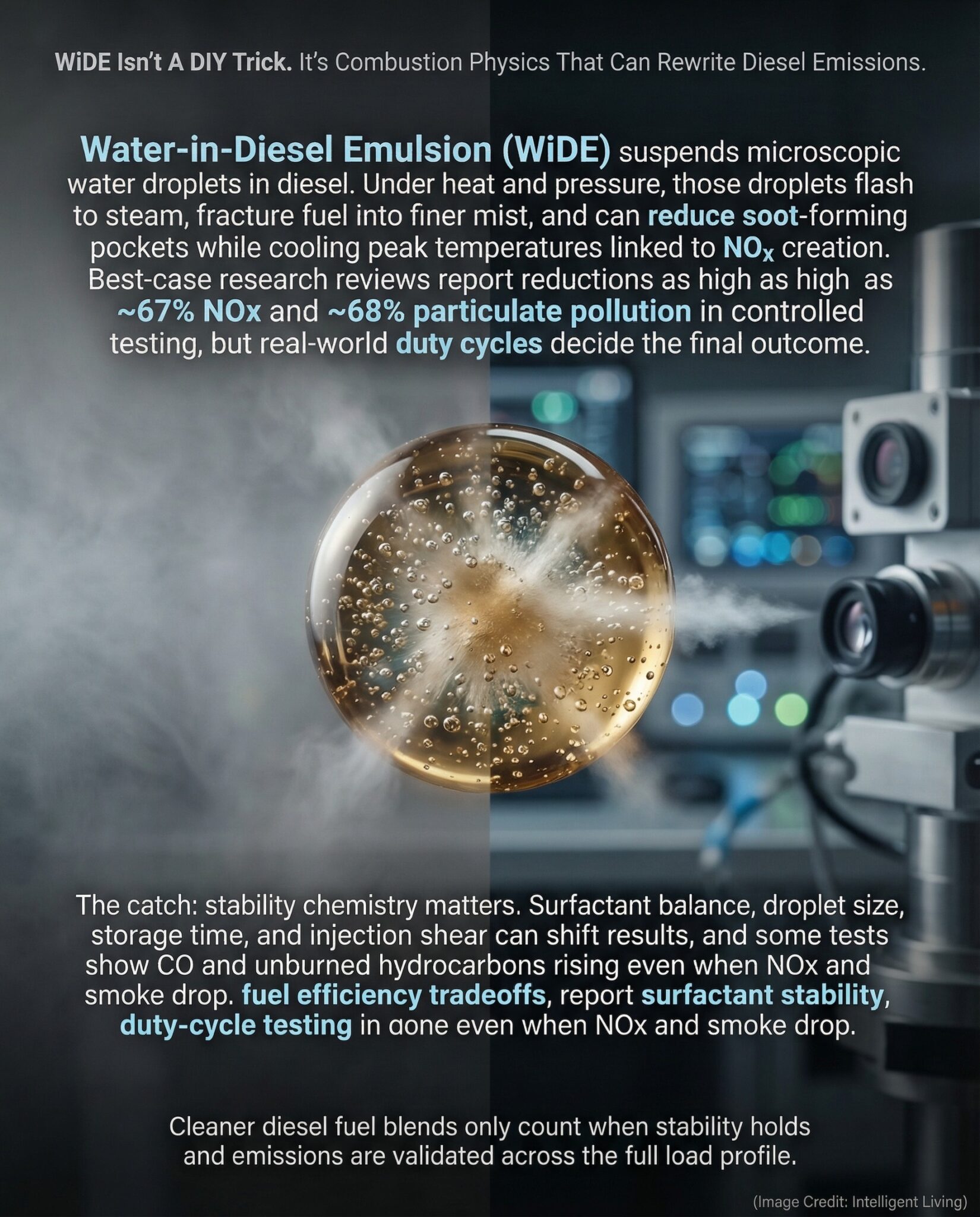
Emissions Profile: WiDE Performance and Tradeoff Metrics
Quick Facts: Water-in-Diesel Emulsion Performance, Emissions, and Tradeoffs
- What it is: The process involves dispersing microscopic water droplets within diesel fuel, utilizing specialized surfactants to maintain a stable emulsion.
- Reported gains: Across studies collected in one open-access review, researchers report significant reductions, reaching 67% lower NOx and 68% lower particulate matter in best-case tests, especially under controlled conditions.
- Efficiency effects: Engine testing frequently records incremental increases in brake thermal efficiency, though results fluctuate based on specific load parameters and blend compositions.
- Tradeoffs: Under certain loads and blends, carbon monoxide and unburned hydrocarbons can increase, and particle counts can rise at low load.
- Practical gating factors: Key operational constraints include maintaining long-term emulsion stability, selecting appropriate surfactants, and monitoring component durability over extended duty cycles.
Understanding the Water-in-Diesel Approach
Formulation Mechanisms and Surfactant Interaction
Water-in-diesel emulsions consist of microscopic water droplets suspended throughout diesel fuel via a small amount of surfactant. Specialized surfactants prevent the droplets from coalescing, ensuring the mixed fuel behaves as a single fluid during both storage and high-pressure injection.
Optimal engine performance requires precise control over droplet size distribution, specialized surfactant chemistry, and meticulous fuel management from the mixing stage to final injection.
Practical Observations in Technical Settings
A technician-level snapshot illustrates why these chemical properties matter in a practical setting. In small test-bed garages, a properly emulsified blend produces a visibly finer injector mist. Consequently, the opaque particulate plumes typically observed during cold starts or transient load changes appear significantly reduced in density. The observation validates the core hypothesis behind WiDE: superior atomization and mixing shift how cleanly diesel burns.
Technical note: Mixing technique matters. Poorly chosen additives can separate quickly or leave deposits, and real-world handling can be rougher than controlled lab conditions.

Combustion Dynamics: The Science Behind Emission Reduction
Why WiDE Cuts Pollution: Micro-Explosion Explained Simply
Triggering Secondary Atomization
The emissions benefits inherent to WiDE technology stem from two primary combustion phenomena that work in tandem to optimize the engine’s thermal profile.
- Secondary Atomization: Tiny water droplets trigger a micro-explosion effect during injection.
- Vaporization Fracture: As water droplets absorb heat, they fracture neighboring fuel droplets into smaller particles.
- Enhanced Air-Fuel Mixing: This process creates a finer mist that integrates with air more completely.
Thermal NOx Suppression via Peak Temperature Reduction
Utilizing these dual mechanisms, operators can achieve a more uniform combustion cycle that leaves fewer soot-forming pockets within the engine. Thermal suppression occurs as the vaporization process absorbs substantial energy, effectively lowering peak combustion temperatures. The lower thermal threshold slows the specific chemical pathways that form thermal NOx. As a result, the engine produces less nitrogen oxide during the most intense moments of the combustion cycle.
A fine spray analogy illustrates this mechanism with greater clarity. A mist spreads liquid into far more surface area than a pour, which helps coverage become more uniform. Inside a diesel engine, a better-dispersed fuel cloud can burn more completely, leaving fewer soot-forming pockets.
One reason real engines vary is that the fuel gets “worked” as it passes through injection hardware. Experiments show injector shear can shift droplet-size distribution and delay the onset of micro-explosions, changing how and when secondary atomization happens.
Empirical Analysis: Research Findings and Engine Performance Data
Data indicating maximum reductions for NOx and particulate matter typically represent peak experimental values rather than a guaranteed baseline for standard engine operation. For example, controlled engine-generator testing has reported measurable brake thermal efficiency gains alongside NO reductions.
However, these same studies document that CO, HC, and particle-number behavior can move in the wrong direction under certain low-load conditions during generator-style operation. Consequently, validating environmental gains requires precise duty-cycle mapping to account for varying engine loads.
Primary Experimental Ranges and Emission Observations
Another major variable is water percentage. Statistical evaluation across blends such as E2, E5, E8, and E10 shows there can be a sweet spot where added water improves thermal efficiency and reduces NOx, while higher water fractions can reduce heating value and shift pollutant patterns. One such analysis argues that E5 can be a strong compromise option for some engines and loads.
- NOx and particulate matter: Best-case reductions in controlled tests can reach the high tens of percent, but the spread across studies is wide.
- Efficiency: Brake thermal efficiency gains are often modest and highly load-dependent.
- Other pollutants: CO and unburned hydrocarbons can rise in some regimes, especially when combustion temperature drops or mixing is imperfect.
A practical way to think about the data is that WiDE changes combustion behavior. When the new combustion behavior matches the engine’s duty cycle, results can look impressive, and when it does not, the tradeoffs show up quickly.
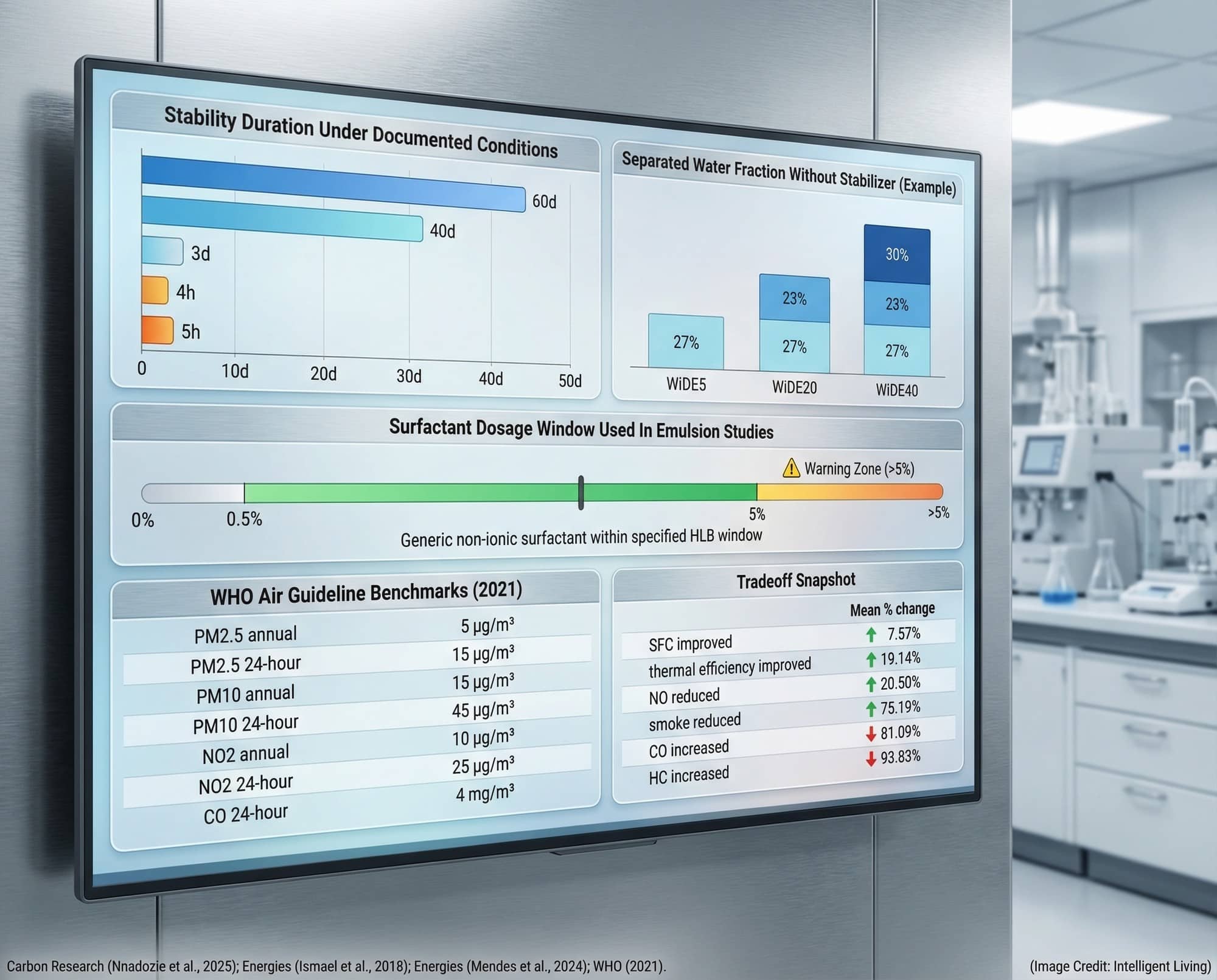
Industrial Standards: Formulation Stability and Health Safety
Chemical Stability: Formulation Challenges and Quality Control Standards
Stability Variables and Lab Protocols
Far from a simple additive, WiDE presents a fundamentally complex formulation challenge. Long-term stability depends on the surfactant package, droplet size distribution, mixing method, and environmental storage conditions. In one specific lab protocol, 10% water-in-diesel emulsions stayed stable for about four weeks under a specific surfactant and high-speed mixing method.
While certain blends maintain integrity under laboratory conditions, they often face degradation when exposed to the unpredictable variables of field operation. A fleet-workshop moment illustrates the point. A manager running a small pilot may find that a batch made in a compact mixer behaves differently from a larger batch blended with different shear energy. The performance gap underscores the critical role of chemical precision and rigorous process control.
Operational Best Practices: Storage, Transport, and Handling
Material compatibility remains a critical open question. Water contact can accelerate corrosion pathways unless mitigated, necessitating long-run durability studies for injectors, pumps, and fuel lines to ensure reliability over thousands of hours.
Because WiDE performance depends on droplet size and stability, transport and storage protocols are paramount. Fuel batches may require controlled agitation before dispensing, and storage tanks must be inspected regularly for signs of separation that could lead to inconsistent fueling.
Compliance Standards: Regulatory and Safety Protocols
Established regulatory frameworks now provide clear pathways for achieving sustained diesel emission reductions. Changing fuel formulations can affect compliance testing and engine warranties. Larger-scale pilots typically need standardized blending protocols, emissions testing that covers the full duty cycle, and clear accountability for batch quality.
Public Health Impact: Mitigating the Risks of Diesel Engine Exhaust
Respiratory Risks and Carcinogenic Classifications
Nitrogen oxides and particulate matter are far more than abstract chemistry terms. In everyday urban environments, NOx and particulate matter can damage respiratory airways and contribute to chronic conditions like asthma, heart disease, and lung disease. The critical health impact is precisely why modern diesel-emissions strategies prioritize the reduction of both pollutants.
Diesel engine exhaust is also a serious public-health concern. IARC classifies diesel engine exhaust as carcinogenic to humans, with “Group 1” used to indicate the strongest category of evidence.
Community Mitigation and Nature-Based Interventions
The lived experience is often simpler than the chemistry. When a generator runs near a school pickup line or a loading dock sits beside apartments, people experience the physical impact of the smell and haze, regardless of their familiarity with chemical terminology. That is part of the reason nature-based strategies like tree-hedge barriers planted near schools effectively reduce traffic-related pollution exposure.
Small-scale street-canyon interventions such as moss-wall filtration units designed to capture roadside NO2 and particulate pollution are being deployed to capture roadside NO2 and particulate pollution. Longer-term monitoring can also show whether interventions add up. NASA satellite work has tracked declines in nitrogen pollution globally as policy and technology shift.

Global Roadmap: Energy Transition and Future Deployment
Strategic Pathways: WiDE Technology in the Global Energy Transition
Near-Term Mitigation for Legacy Infrastructure
WiDE can be understood as a near-term mitigation option rather than a final solution. It may make the most sense in sectors and geographies where diesel engines will remain in service for many years, such as backup generators, remote agricultural equipment, and some heavy-duty applications with long life cycles.
At the policy level, the Diesel Emissions Reduction Act funding program supports projects that cut diesel pollution through retrofits, replacements, and related strategies. In parallel, EPA maintains a verified set of retrofit and fuel-saving options used in clean-diesel projects that target pollutants like PM and NOx.
The Parallel Shift to Electrification
At the technology level, the transition is happening in parallel. Urban freight is being redesigned around quieter, cleaner vehicles, including purpose-built electric delivery trucks designed for inner-city routes.
Industry-wide forecasts now track the rapid scaling of fleets, including the deployment of thousands of electric work trucks across U.S. roads. In some regions, early deployments also include programs to electrify school bus fleets and reduce street-level exhaust exposure.
Deployment Roadmap: Research Priorities for Large-Scale Integration
Transitioning from laboratory success to reliable field deployment requires a systematic approach to technical validation. Addressing the following research priorities will ensure that WiDE technology can scale effectively:
- Duty-Cycle Trials: Standardized testing must span the full range of operating loads, from idle to maximum capacity, to map shifting pollutant patterns.
- Durability Studies: Long-run evaluations of fuel-system components and aftertreatment hardware are necessary to detect signs of wear or corrosion.
- Formulation Standardization: Defining specific surfactant classes and blending protocols will ensure stability within existing fuel supply chains.
- Quality Assurance Protocols: Rigorous methods for batch testing, storage inspection, and dispensing are vital for maintaining emulsion integrity.
Standardized Testing and Durability Protocols
Establishing these rigorous standards allows fleet managers to move beyond experimental pilots toward dependable, high-performance emissions reductions. The maintenance perspective on this variability is direct. If a fuel blend performs perfectly on Monday but degrades by Thursday, the fleet manager is facing a reliability crisis.
NOx control is being attacked from multiple angles at once. One line of work explores a room-temperature reaction that converts nitric oxide into nitrogen gas under specific conditions. Materials researchers have tested concepts such as graphene-titania composites designed to reduce atmospheric NOx on exposed surfaces. Such approaches do not replace the need for cleaner engines, but they illustrate the increasingly multifaceted nature of the innovation landscape.

Summary Findings: The Practical Reality of Water-Diesel Emulsions
Water-in-diesel emulsions offer a scientifically plausible way to reduce NOx and particulate pollution in diesel combustion. The best-case numbers are compelling, and the underlying combustion mechanisms make physical sense. At the same time, formulation stability, duty-cycle sensitivity, and potential tradeoffs in CO, HC, and particle number mean this is not a plug-and-play fix for every engine.
For fleets and institutions looking for near-term wins, the safest path is staged pilots with strict blending standards and emissions measurements that cover the full operating range. Even the idea’s history deserves context. Early engine research already reported meaningful emissions changes when testing steady-flow water-in-diesel combustion as a way to validate emissions claims.
Technical FAQ: Addressing Performance and Stability Concerns
Is Home-Mixed Water-in-Diesel Safe?
No. Creating stable WiDE requires precise surfactant chemistry. Amateur blends risk engine damage and provide poor emissions outcomes.
Does WiDE Work in Every Diesel Engine?
Performance outcomes fluctuate based on engine type and duty cycle, meaning laboratory bench results rarely mirror field conditions exactly.
Can Emulsions Replace SCR or Particulate Filters?
No. WiDE complements these systems but cannot replace certified emissions control technology legally or technically.
Why Do CO and Hydrocarbon Levels Sometimes Rise?
Lower peak temperatures can occasionally disrupt full combustion. This results in localized pockets where CO and unburned hydrocarbons remain.
What Are the Best Pilot Use Cases for WiDE?
Backup generators and remote agricultural equipment are ideal. These settings allow for controlled monitoring of emulsion stability and durability.


