
Step into a local cafe in 2026, and you’ll likely notice a striking shift: nearly everyone in the room is wearing smart glasses. These devices have transitioned from niche tech novelties into essential daily tools, performing real-time language translation and discreet media capture as seamlessly as wireless earbuds.
The data confirms that smart eyewear is no longer a futuristic projection; it is a live transformation of how we navigate our professional and social environments. Massive production surges by industry leaders like Meta and Samsung, alongside new entries from Snap and Xiaomi, are driving this rapid shift into the mainstream. Maturing hardware and a new sense of social normalization have turned these wearables into the next primary interface for the AI age.
By merging sophisticated AI assistants with stylish, lightweight frames, the industry has finally solved the comfort and aesthetic hurdles that previously stalled mainstream growth.
The Rapid Ubiquity of Smart Glasses in 2026
Key Market Statistics for the 2026 Smart Eyewear Era
- Meta has already achieved a significant milestone with 2 million Ray-Ban smart eyewear units sold since their late 2023 release.
- Manufacturers are aiming for a 10 million annual production target by the end of 2026, bolstered by strategic plans to double production capacity to meet rising demand.
- The market saw 110% year-over-year growth in global smart glasses shipments during H1 2025, according to Counterpoint Research.
- Xiaomi launched its Mijia Smart Audio Glasses in Europe for around €179.99, normalizing everyday wear.
- Snap formed a dedicated smart glasses subsidiary to rival Meta.
- Qualcomm released its Snapdragon AR1 Gen 1 platform, designed exclusively for smart glasses.
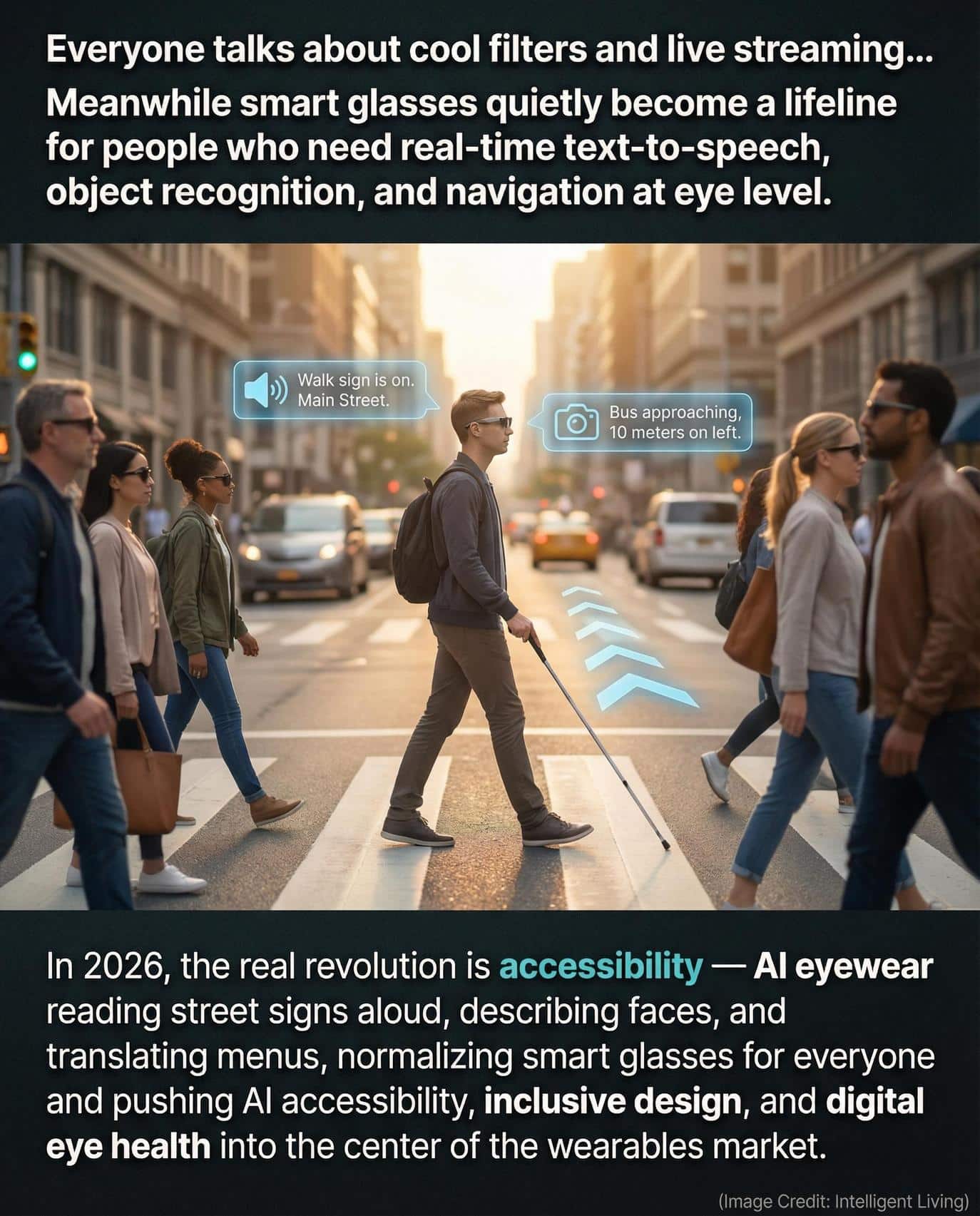
- Assistive smart glasses are transforming accessibility for blind and low-vision users.
The Data Says 2026 Is the Breakout Year
Market metrics highlight a massive surge in adoption: smart glasses are moving far beyond early-adopter circles and into the hands of the general public.
Market research firm Counterpoint reported a 110% year-over-year increase in global smart glasses shipments during the first half of 2025, with Meta capturing about 73% of the market.
Production Targets and Consumer Adoption Metrics
Growth at this scale echoes the explosive trajectory seen during the early smartwatch era. This momentum signals a permanent shift in long-term consumer habits. Reporting from Reuters indicates that Meta and its manufacturing partner, EssilorLuxottica, have reportedly sold over 2 million pairs of Ray-Ban Meta smart glasses since their launch in late 2023. Production capacity is expected to hit 10 million units annually by the end of 2026, with talks of doubling output to meet skyrocketing demand. These metrics reflect a decisive move away from niche curiosity toward full-scale consumer adoption.
Leading technology firms are aggressively funding the next generation of vision-based wearables. These investments focus on integrating AI with immersive AR platforms to improve user experience.
- Snap is developing hardware that prioritizes AR-based social filters.
- Samsung is leveraging its mobile ecosystem to integrate glasses with Galaxy devices.
- HTC is focusing on open AI platforms to attract a diverse developer base.
Each new product launch reinforces a larger societal shift. We are entering an era where checking your face-based display becomes as routine as checking a smartphone screen.
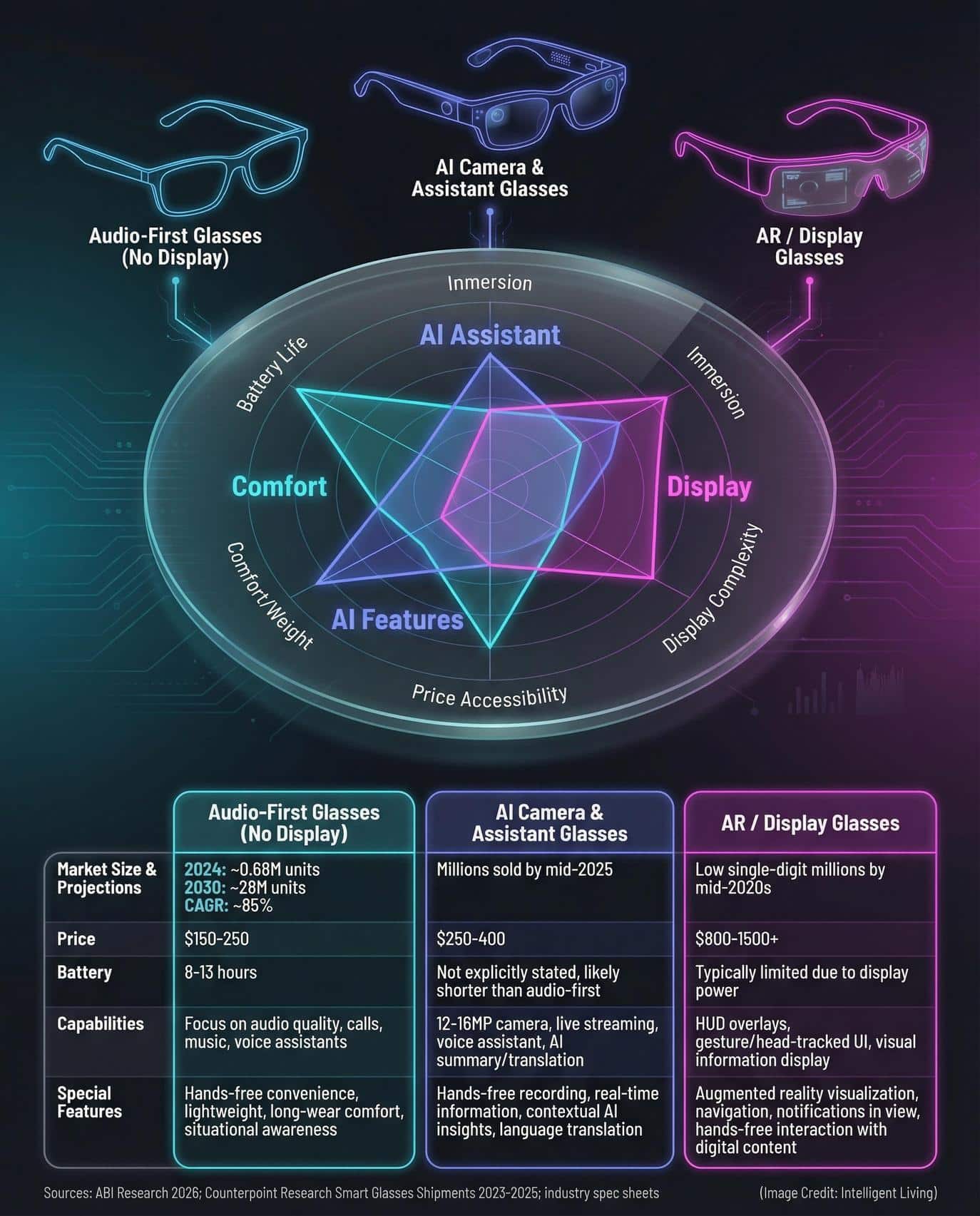
Smart Glasses Are Now Three Different Products (And that’s Why they Spread)
AI Camera and Assistant Glasses
These are the smart glasses that most people picture first—think Ray-Ban Meta or Solos AirGo V2. They allow users to take photos, stream video, and interact with voice assistants like Meta AI or Google Assistant.
The combination of built-in cameras, microphones, and cloud connectivity enables real-time object recognition, translation, and voice interaction. Unlike the stark utility of early prototypes, these modern iterations prioritize high-end aesthetics, effectively removing the visual stigma once associated with wearable tech.
Audio-First Smart Glasses: The Earbuds Replacement
The second category is the most underestimated: audio-first glasses. These look like regular eyewear but feature open-ear speakers and microphones for hands-free calls, music, and voice commands.
Xiaomi’s Mijia Smart Audio Glasses, launched in Spain for around €179.99, prioritize utility and battery longevity:
- 13 hours of continuous audio playback.
- 9 hours of talk time for hands-free communication.
- Water-resistant design suitable for all-weather use.
This approach normalizes smart eyewear as a functional, everyday accessory rather than a tech experiment, stripping away the complexity of cameras or displays.
AR and Display Glasses: The Future Frontier
The third type brings us closer to true augmented reality, leveraging the same spatial computing advances currently enhancing social interaction through augmented reality in professional and educational settings. Companies like Samsung and Snap are developing lightweight display-enabled smart glasses capable of projecting navigation, notifications, or translation overlays directly into the wearer’s field of view.
Qualcomm’s Snapdragon AR1 Gen 1 chipset makes this possible, offering power-efficient image processing and on-device AI that eliminates the need for bulky external processors. While AR eyewear remains in its foundational phase, its presence in 2026 marks the beginning of a profound, long-term shift in human-computer interaction.
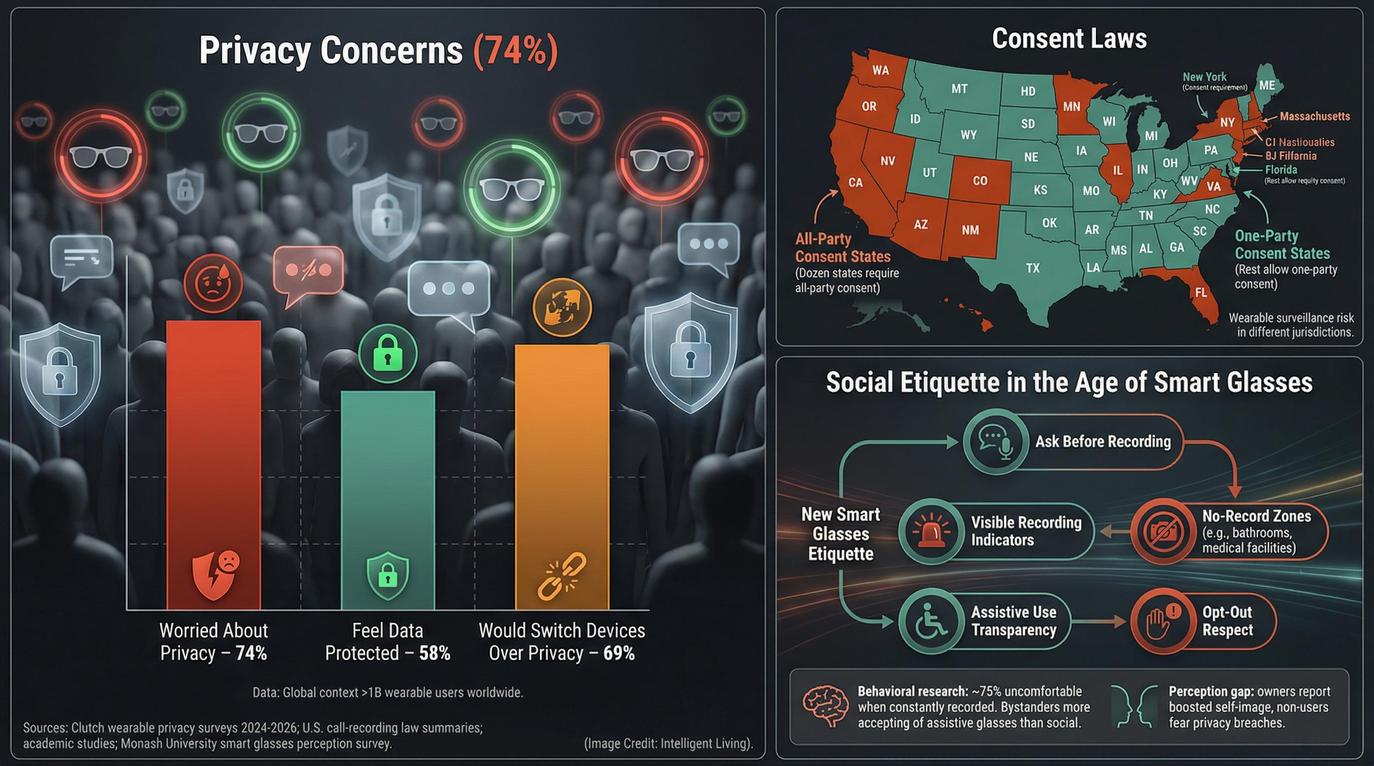
The Real Disruption is Social: Privacy, Consent, and the New Etiquette
As with any technology that blurs public and private spaces, smart glasses raise complex social and ethical questions. When nearly everyone can record or live-translate conversations, how do we maintain personal privacy and social trust?
Legal frameworks regarding recording consent vary significantly across international borders, creating a complex patchwork of compliance for global users. In the United States, for example, some states require only one party to consent to recording, while others require all parties to agree.
Navigating Ethical Boundaries in Public Spaces
This legal inconsistency means that etiquette and transparency are just as important as regulation. This cultural shift incorporates advanced data encryption protocols for AI-driven hardware to fortify personal privacy. Developers are introducing features like physical recording indicators and secure privacy modes; however, these technical fixes often fail to soothe the deeper anxieties surrounding constant surveillance.
Society is now grappling with the ethical balance between technical capability and the preservation of communal trust. Smart glasses make it easy to capture and share moments, but they also force society to redefine boundaries in workplaces, schools, and public spaces. As we learned from smartphones and social media, technology adoption always outpaces etiquette—and 2026 will likely serve as the pivot point where we begin defining the communal norms for a world integrated with ubiquitous AI vision.
Empowering Users: How Accessibility Drives Mainstream Smart Glasses Adoption
One of the strongest forces pushing smart glasses toward mainstream acceptance is accessibility. For people with low vision or blindness, AI-powered eyewear such as the Envision Ally Solos has become a lifeline. These devices demonstrate the potential of AI-driven assistive eyewear for the visually impaired to restore independence by identifying objects and recognizing faces. They transform what was once assistive hardware into a natural, empowering experience.
While the accessibility movement fulfills a critical social need, it simultaneously serves to normalize head-worn technology for the broader population. When people see smart glasses helping others live more independently, the devices gain legitimacy and social acceptance, utilizing the same wearable health sensors used to monitor senior wellness. The same way closed captions made screens more inclusive for all, assistive smart glasses are making head-worn tech feel less invasive and more purposeful. Hearing access follows a similar path, and the models that make it possible are getting small enough to fit: lightweight speaker diarization running on-device can label who is speaking in a live caption feed.
Health Monitoring and Digital Wellness Integrations
Smart glasses are also branching into health and wellness applications, from monitoring posture and alertness to mitigating digital eye strain. These features reinforce broader shifts in vision technology, where AI, gene therapy, and bionic implants are redefining eye care. As they merge with broader health tech trends, these wearables become less about novelty and more about everyday utility.

Hardware Milestones: Why 2026 Solves the Technical Limits of Early Wearables
A decade ago, early adopters dismissed smart glasses as bulky, expensive, and socially awkward. Today’s devices are a different story. The hardware has finally caught up with the ambition. The release of Qualcomm’s Snapdragon AR1 Gen 1 marks a major leap forward, enabling glasses to process images and audio on-device without relying entirely on a smartphone. This means smoother performance, better privacy, and longer battery life.
Technical Convergence and Miniaturization
Miniaturization has been the primary catalyst for this shift. Manufacturers have achieved several critical engineering milestones to fit desktop-level processing into lightweight frames:
- Micro-LED displays that offer high brightness with minimal power draw.
- Efficient image sensors capable of high-fidelity capture without overheating.
- Compact high-density batteries that support all-day operation.
Breakthroughs in power efficiency and AI co-processors have enabled devices that can translate languages, recognize faces, and manage notifications in real time.
These frames showcase the merging of luxury fashion and high-tech wearables that now defines mainstream style. It’s this technical convergence that separates 2026 from 2013. Now, Meta, Samsung, and Xiaomi are delivering refinement in a landscape that also reflects growing awareness of digital eye strain and tips for reducing blue light exposure. Simply put, the platform has finally reached a state of industrial and functional maturity.
Market Competition: Price Compression and the Rise of Global AR Brands
Just as smartphones became affordable through manufacturing scale, smart glasses are now riding the same curve. Xiaomi’s Mijia Smart Audio Glasses are a prime example, and coverage of their European launch describes open-ear audio, lightweight frames, and a €179.99 price point. That midrange positioning shows that advanced features don’t have to come at a luxury cost. Analysts expect several models under $200 by 2027, especially from Asian and European brands.
Global Market Entrants and Innovation Strategies
Market innovation is accelerating as major players introduce specialized hardware to capture consumer interest. This competitive pressure is driving significant price reductions across the industry.
- Snap and HTC are pushing boundaries in AR interaction by utilizing open AI platform strategies to foster a more flexible developer ecosystem.
- Samsung is preparing display-rich AR glasses for a late 2026 release.
- Meta and EssilorLuxottica continue to scale production to meet mass-market demand.
The entry of these global brands ensures that advanced features move quickly into more accessible price tiers. New models such as Solos AirGo V2 smart glasses with live streaming power show how camera and AI features are rapidly moving into accessible price tiers. This diversification benefits consumers, pushing features like high-fidelity audio, multi-day battery life, and AI-assisted transcription into lower price tiers. Global entrants also bring regional design variations, broadening appeal across markets.
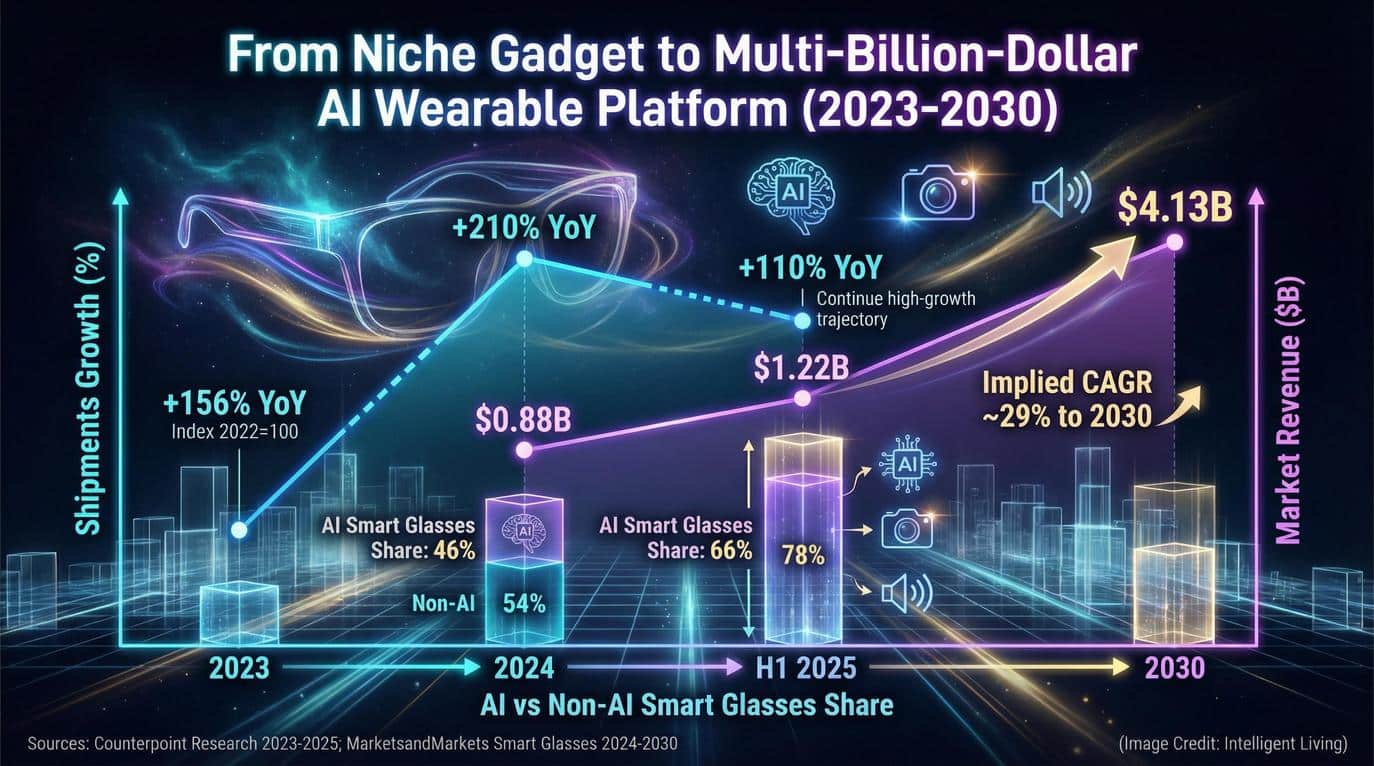
Strategic Ecosystems: The Hidden Force Shaping Smart Glasses Success
In 2026, the race isn’t just about hardware—it’s about ecosystems. Meta integrates its glasses with Instagram, Facebook, and WhatsApp, reflecting a strategic shift toward AI and smart glasses; Samsung links its wearables with the Galaxy ecosystem; and Snap ties its devices into AR filters and creator tools. These software ecosystems determine how useful and sticky each product becomes.
The companies that win will be those that make smart glasses feel indispensable. Success in this market follows the successful integration of AI within smart home systems to create a unified user experience. The future of wearables is being defined not by who builds the best frames, but by who delivers the most integrated experience.
Daily Interaction: Integrating Smart Eyewear into Your 2026 Routine
Personal adoption aside, these devices will soon become a permanent fixture in shared public and professional spaces. Co-workers may use them for quick note-taking, travelers for translation, and students for accessibility.
Just as smartwatches blurred lines between convenience and surveillance, smart glasses will redefine what ‘being connected’ looks like. These devices heighten awareness of the unintended consequences of ubiquitous artificial intelligence in our personal lives globally.
Successful integration depends on mindful adoption, where users actively set boundaries—such as disabling cameras in private spaces and limiting AI interruptions during face-to-face conversations. For many, these glasses will enhance productivity and safety. For others, they’ll demand new etiquette and privacy awareness.
Either way, smart glasses are reshaping daily interaction and digital well-being, extending trends we already see with smart eyewear that brings balance to digital life. The question isn’t whether they’ll catch on; it’s how gracefully we’ll adapt.

The Evolving Landscape of Smart Glasses 2026 and Beyond
The trajectory of wearable technology indicates a permanent shift toward head-worn computing that prioritizes context and convenience. As AI assistants become more intuitive, these glasses will function as a secondary set of eyes, identifying objects and providing navigation without the friction of a handheld screen. This evolution represents a fundamental recalibration of how our biological senses and digital data streams interact.
Refining this balance between innovation and privacy remains the primary challenge for developers and users alike. The successful integration of these tools into daily life depends on establishing a new set of social etiquettes that respect communal spaces while embracing technical efficiency. As we look past 2026, smart eyewear will likely stand as the definitive bridge between human perception and the vast capabilities of ubiquitous AI.
Essential Insights into AI Smart Glasses and Wearable Tech
Are smart glasses 2026 models replacing smartphones?
Not entirely. These devices serve as a high-utility extension of your smartphone, handling audio, quick captures, and notifications while your phone manages heavy processing in your pocket.
How do Ray-Ban Meta glasses ensure recording privacy?
Most leading models use visible LED indicators that signal when a camera is active, alongside software safeguards that prevent recording if the indicator is obscured.
Can I get prescription lenses for smart audio glasses?
Yes. Most manufacturers, including Xiaomi and Meta, partner with optical specialists to offer high-quality prescription lenses that fit seamlessly into smart frames.
What is the typical battery life for AR glasses?
Modern AR eyewear generally offers between 4 and 6 hours of active display use, while audio-first models can last up to 14 hours on a single charge.
Are there affordable smart glasses under $200?
Market competition has driven prices down significantly, with brands like Xiaomi offering robust audio-first models for approximately €180, making the tech accessible to broader audiences.


