
Many companies believe that flying taxi services in large cities could become a reality as soon as the next decade. Such services would use a multi-modal operation including, in the air (flying) and on the road (driving). One of those such companies is luxury carmaker Audi.
Dr. Bernd Martens, Audi board member for sourcing and IT, and president of the Audi subsidiary Italdesign said:
“Flying taxis are on the way. We at Audi are convinced of that. More and more people are moving to cities. and more and more people will be mobile thanks to automation. In future senior citizens, children, and people without a driver’s license will want to use convenient robot taxis. If we succeed in making a smart allocation of traffic between roads and airspace, people and cities can benefit in equal measure.”
To be ready for this new era of transportation, Audi, Airbus, and Italdesign have joined forces to create an all-electric flying car concept. The recently presented a 1:4 scale prototype of ’‘Pop.Up Next’ – a hybrid vehicle that blends a self-driving car and passenger drone – at drone week in Amsterdam. An earlier version of the concept had been presented previously at the Geneva auto show.
The 1:4 scale prototype’s first public test flight saw the flight module accurately place a passenger capsule on the ground module. It then also successfully drove away from the test grounds autonomously. Audi is currently conducting further tests of this project in South America in cooperation with the Airbus subsidiary Voom.
‘Pop.Up Next’


“Creativity is needed where new mobility concepts for cities and people’s diverse needs are concerned. Pop.Up Next is an ambitious vision that could permanently change our urban life in the future.” – Dr. Martens

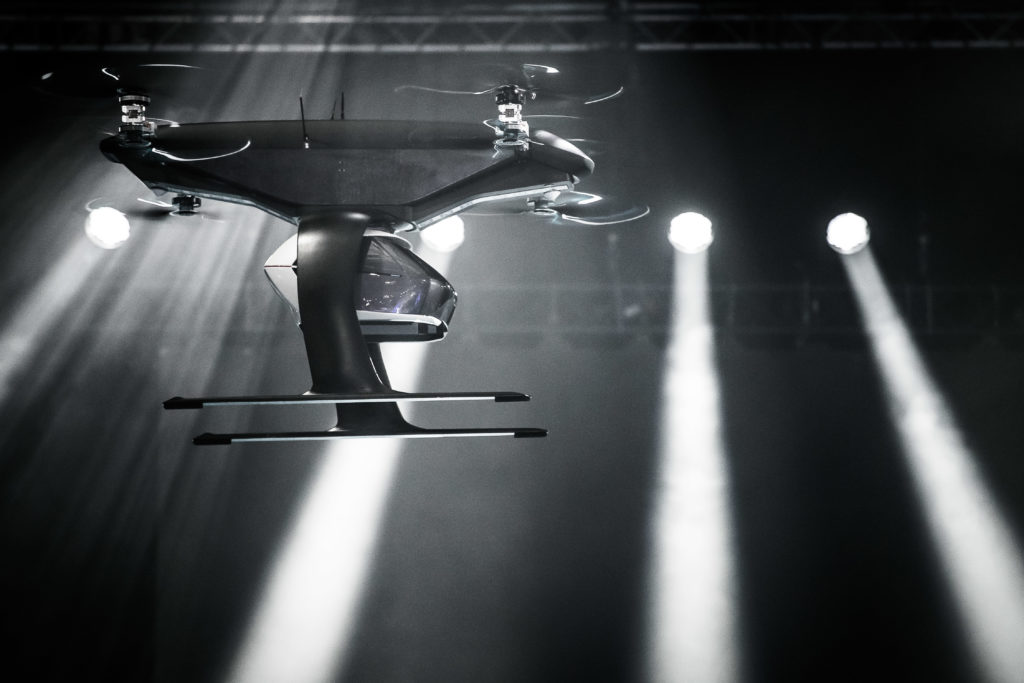
Part-drone, part-self-driving electric car, the design of the vehicle is composed of three separate parts: a four-rotor drone, a two-seater capsule (pod) for passengers, and an electric vehicle frame.
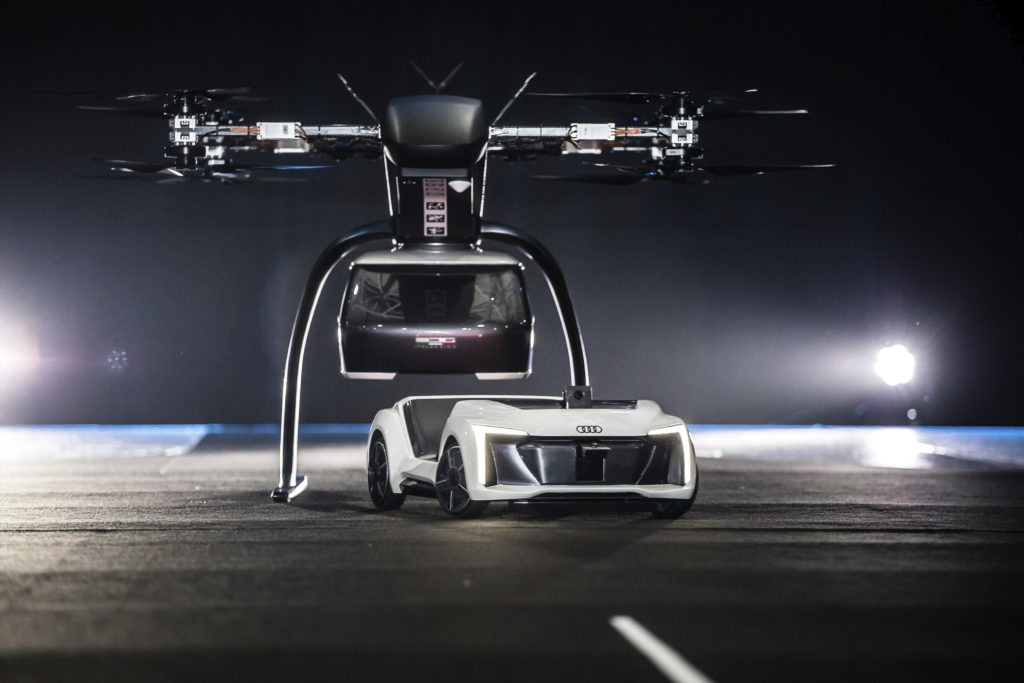

How it works: The drone autonomously flies the pod to a location, placing it on an electric vehicle frame. Then it detaches from the pod and flies away. The pod attaches to the electric vehicle frame and becomes an autonomous car, continuing the journey to transport its passengers by land.


The dominant feature of the cabin (pod) interior is a 49-inch screen which engages humans and machine through speech and facial recognition, eye-tracking, and touch functions.

The Future Is Flight
They don’t expect a system such as this to take flight for another seven to ten years. However, Audi and other companies continue to explore the possibilities of this kind of end-to-end service.
“In the future, flying taxis will appeal to a wide range of city dwellers. With Pop.Up Next we are simultaneously exploring the boundaries of what is technically possible. The next step is for a full-size prototype to fly and drive.” – Dr. Martens


