
The three subjects to get most news coverage in recent years include:
- The plastic pollution crisis (starring microplastics) in our rivers and oceans
- People being displaced from homes due to the refugee crisis or severe weather catastrophes
- The financial crisis (including the severity of illicit money transfers to offshore tax havens by the world’s greediest and wealthiest people)
While all this is most unpleasant, something good came out of it: the United Plastic Nation concept was born.
What is the United Plastic Nation?
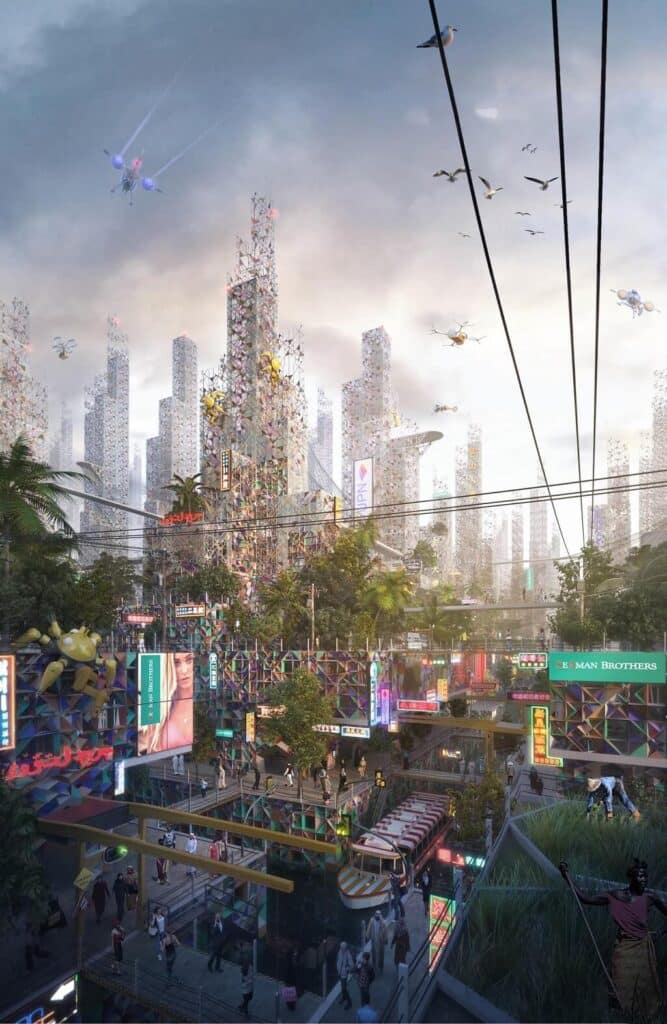
United Plastic Nation was an open competition initiated by the LA+ Magazine. It called for designers to imagine a 1km. sq. island, dedicated to any use or program desired and placed anywhere in the world. The only requirement is that the solution should employ the tools of architecture to address some of the world’s most pressing issues. The objective was to create something positive of ignorance, greed, and violence, not merely generate a superstructure fantasy on a tropical paradise.
So, taking the big news topics of the era as inspiration, this imaginary island would thus turn ocean waste into a promised land, refugees into citizens, and tax criminals into social investors. And that’s exactly what the winning competitor did.
Australia-based studio Freischärler (founded by Bjøern Muendner and Noël Schardt) programmed their island as the antipode–an ever-growing structure built out of ocean plastic that slowly transverses the globe as it gets carried around by the currents. It would be a safe haven for all the displaced people and a channel for the world’s wealthiest to funnel their money where it could do some good.
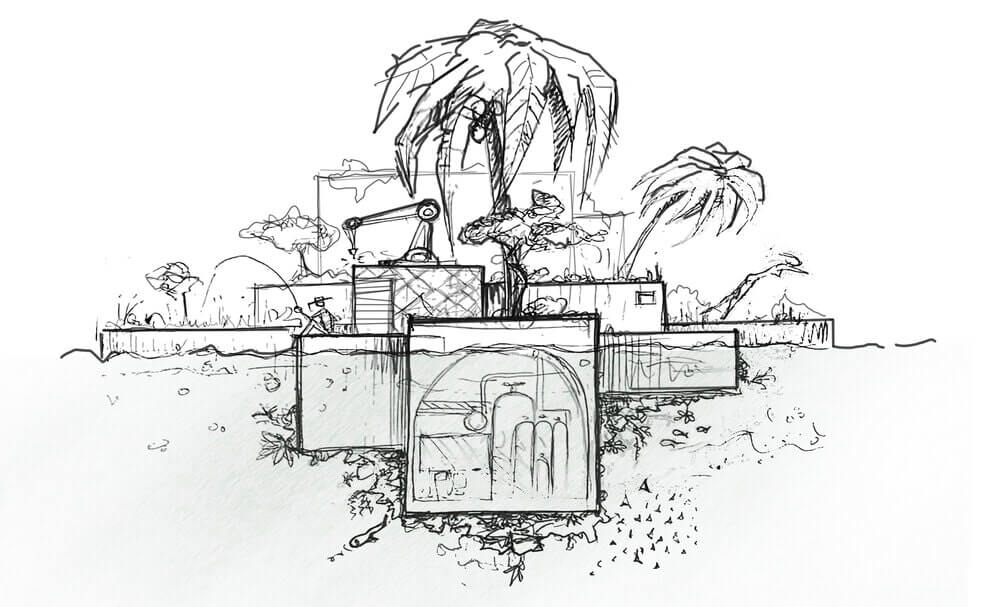
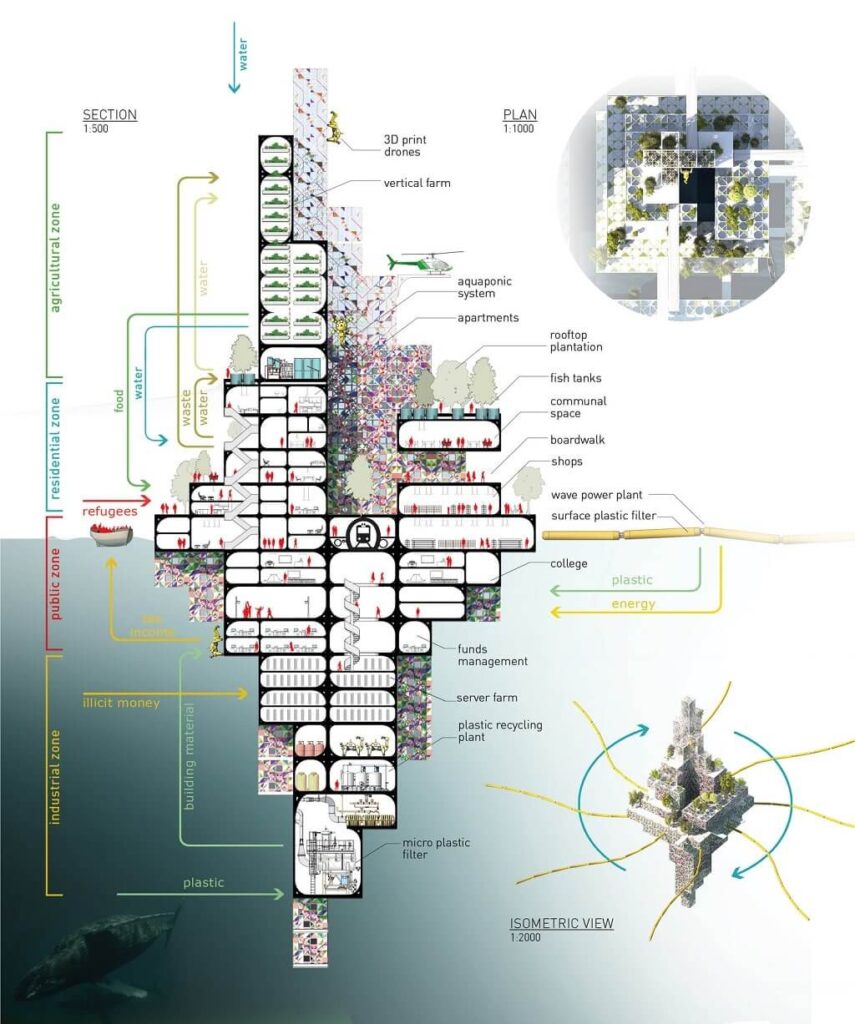
They called their floating island city the united plastic nation. The self-sufficient structure uses 3D printers, recycled plastic collected from the ocean, and swarms of robotic drones as builders. The citizens grow food in vertical aquaponic farms, energy is produced by sun and waves, and the solid and water waste is recycled through closed-loop systems.
The project also questions the concept of the nation-state because it is borderless, and anyone can become a citizen. Instead, it is a “country” part of all continents, a society of urban nomads that don’t move from city to city but move with their city from country to country.

The project brief reads:
“While growing, the island passes by all continents and collects its colonists. It links regions of poverty and despair with regions of wealth and prosperity. It occupies the space in between physically as well as on a socioeconomic level, thus providing a haven for those who had to run from despair and don’t have any access to prosperity. The gravity of the crisis demands fast growth. When the first district has reached its capacity at 100,000 inhabitants, more islands are built. At this stage, the UPN becomes attractive not only to those without a choice but also to those who seek opportunities. Ultimately a global network of floating cities circles the oceans.”
The enormity of the current crises – and we’re talking just the ones addressed by the United Plastic Nation – is astounding. Presently, around 65 million people are displaced from war, roughly equivalent to the UK’s population. In addition, oceans contain an estimated 100 million tons of plastic. Every year, it adds 8 million tons, or 1000 Eiffel Towers, to the mass. Another concern is the massive amount of money – estimated at two trillion dollars – taken from government budgets and cannot be used to tackle these and other global crises. That’s an amount greater than the world’s largest economy can produce in a year, or 1.15 times the US GDP. Shocking figures, but a confirmation that drastic action is required and that the United Plastic Nation notion is plausible.
However, the overall point is to illustrate the size of the planetary problems we generate as humans, not so much the idea of a floating plastic mega-metropolis. At the same time, the premise proves that we have the knowledge and the means to overcome these problems.
But ethical concerns revolving around such an idea are still pressing. Do we wish to undercut international law? Isn’t tax dodging exacerbating the crisis? Are we establishing an offshore refugee ghetto of garbage? We must eventually decide whether we want to live in a world where the United Plastic Nation is the best solution to our problems – if it truly is too late to clean up our created disaster. Because despite the cleverness of the project, it may only be a rapid cure (a Band-Aid, so to speak) to our global issues.
Thus, this concept is meant to contribute to a public debate, not something to be taken literally and implemented. The creators of the competition consider the idea a polemic. Ultimately, they seek to spark discussion. More crucially, to promote optimism, a good attitude, and creative thinking.
The idea of a United Plastic Nation does raise important questions about the future of cities and how they would need to evolve to support an overcrowded and unsustainable planet. It is an exciting and thought-provoking project for sure.


