
Two new projects to be built that debuted within days of each other are pushing offshore floating solar promise closer to commercial reality. They are expected to go online within the next two years. They are:
- Oil and gas major Equinor teamed up with Moss Maritime to develop an offshore floating solar trial off the Norwegian island of Frøya. This project was announced first.
- Norwegian firm Ocean Sun secured European Union funding to trial its innovative floating PV system. It will work with the offshore wind specialist Fred Olsen to test a 250-kilowatt solar system off Gran Canaria in the Atlantic Ocean.
Børge Bjørneklett, Ocean Sun CEO, told Green Tech Media:
The aim of the Canary Islands project is partly a research and development effort to test its technology in tough marine conditions, but it is geared to pave the way for commercial rollout. Fred Olsen has great plans for commercialization and offers the opportunity to deploy offshore floating solar at the sort of scale needed to make it competitive.
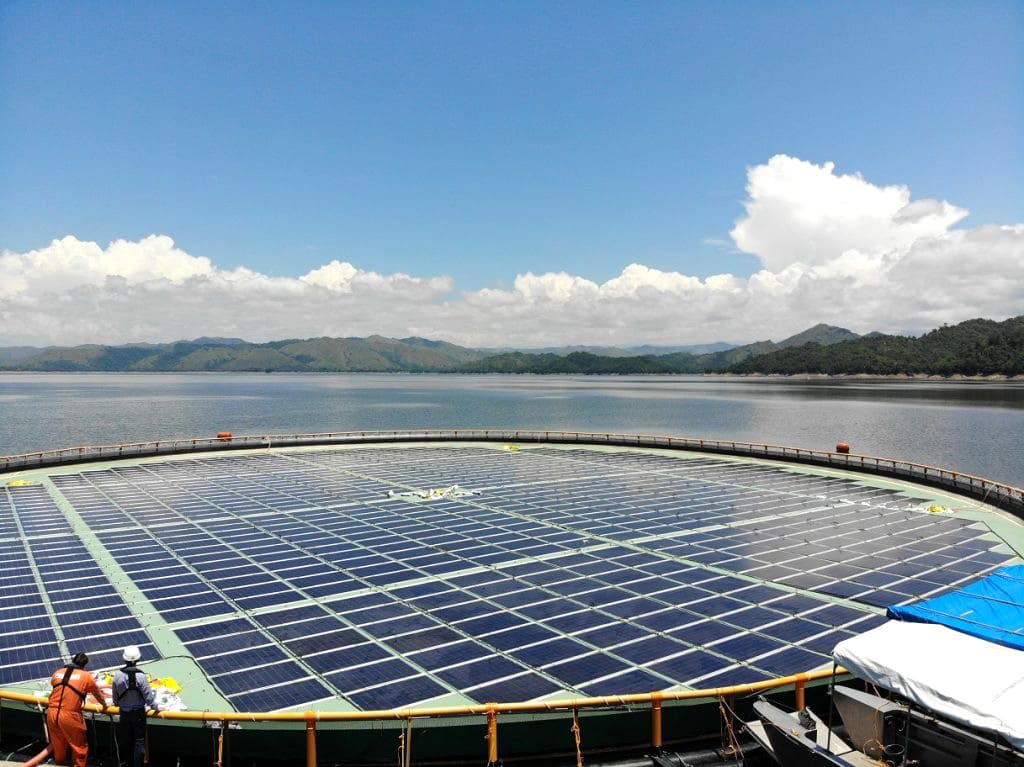
In addition to these two commercial-scale endeavors, major utility Statkraft – one of Europe’s largest hydropower operators – bought four 500-kilowatt Ocean Sun systems in March 2019. They are being installed on a reservoir in Albania and will operate as a demonstration project once online.

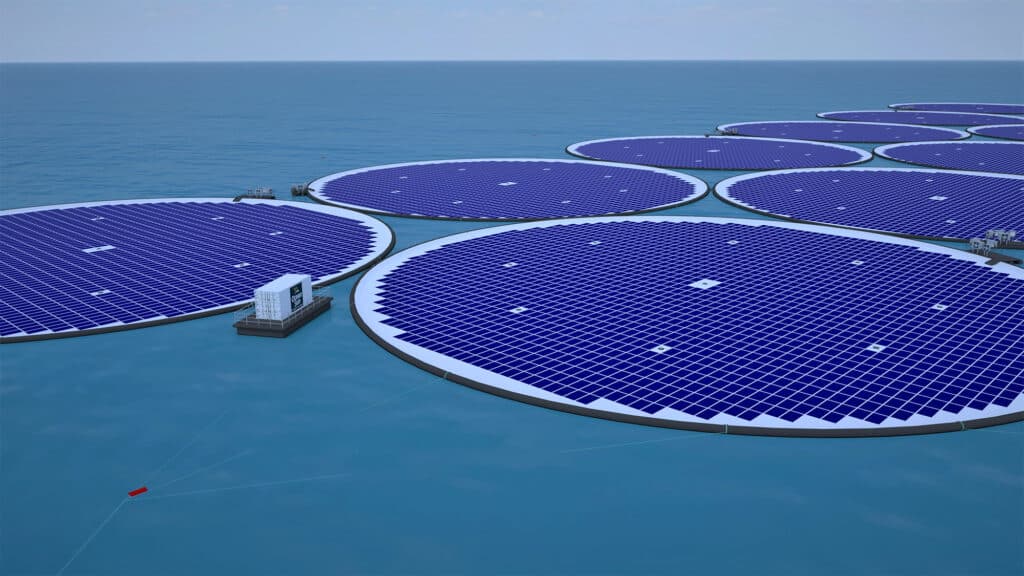
Ocean Sun’s proprietary floating technology is designed for deployment at sea where high waves and storms present significant challenges to human-made structures – especially ones that are to operate over a prolonged period profitably.
The system is made of a flexible membrane (pad) on which the PV modules rest. This pad can ride the swell and dull the impact of large waves. The company reduced the air gap between modules and water level to give the pad these capabilities. According to Bjørneklett, it’s what makes the Ocean Sun’s unique design more robust than other floating solar systems. This claim will be proven during the Gran Canaria trial, where the system will face Atlantic waves up to 10 meters high.
And there’s an added advantage to the modules being closer to the water. A cooling effect occurs, increasing yield by about 5% (compared to systems where modules sit higher above the water).

Bjørneklett said near-shore applications hold the most significant potential because the connection costs are reduced with proximity to land. Also, near regions where land is limited or where a less visually intrusive solution is desired (solar panels floating on the water are nearly invisible compared with offshore wind turbines).
He suggested that places like the Maldives would benefit most from an offshore floating solar plant. The islands are a tourist hotspot, meaning their power consumption is very high. They rely on dated diesel generators, which are polluting and costly because the fuel has to be shipped in from abroad. He said:
Those places are ideal for floating solar power because they have excellent irradiation. And this is where we can make a big impact on the CO2 emission reductions because those [current] power sources are among the least efficient, and you have to ship the fuel way out in the Indian Ocean.
Rolf Benjamin Johansen, the director of floating solar at Fred Olsen Renewables, thinks similarly. He said:
Offshore solar makes sense anywhere in the world where land is scarce, seawater is plentiful, and the solar resources are suitable.
That’s pretty big potential. Even appropriate freshwater bodies, currently the main focus for floating PV deployments, are a relatively scarce resource in many countries, making near-shore sites a natural next step for floating technology. And there are so many places in the world where you can do that. Asia and Southern Europe are among the first places Fred Olsen Renewables is considering for commercial deployment.
These few commercial-scale trials bring fresh momentum to a floating solar subset that is still nearly untapped, despite the limitless deployment opportunities worldwide. If they (and any other offshore floating solar technologies underway) prove fruitful, the potential applications are plentiful.


