
The battle against COVID-19 has called to action an army of paramedics, healthcare workers, medical researchers, drug makers and many more to the front line of a global pandemic. A team of researchers from MIT have also taken up arms and decided to join the fight against SARS-CoV-2.
The MIT researchers began as any would, studying the spikes SARS-CoV-2 uses as a weapon for binding to human cells, the ACE2 receptor. This is the very key that the virus uses to unlock the door into our cells. Finding a way to disrupt that key from being used on us is the answer to blocking the infection entirely. One such way to do this is by offering the virus a different door their key gets stuck inside of, one that doesn’t even belong to our own body. That’s right, we can offer SARS-CoV-2 a distraction or a blockage, and many researchers are trying a very similar route.

Their study preprint on bioRxiv describes a potential for peptide-based binders delivered intravenously to patients. An MIT associate professor of chemistry, the lead researcher Brad Pentelute states,
We have a lead compound that we really want to explore, because it does, in fact, interact with a viral protein in the way that we predicted it to interact, so it has a chance of inhibiting viral entry into a host cell
A postdoc in Pentelute’s lab, Genwei Zhang, performed advanced computer simulations on the very interactions between the ACE2 receptor in humans and the virus’ receptor binding domain. Through these simulations alone Zhang was able to discover it attaches to an area of ACE2 forming a structure called an alpha helix. Commenting on this discovery, Zhang says,
This kind of simulation can give us views of how atoms and biomolecules interact with each other, and which parts are essential for this interaction… Molecular dynamics helps us narrow down particular regions that we want to focus on to develop therapeutics.
The Pentelute Lab at MIT is well equipped to study these kinds of matters. In 2017 the lab developed a technology which offers ‘a fully automated flow-based approach for accelerated peptide synthesis.’ With this device they were able to quickly build the ACE2 alpha helix they found from scratch, a 23 amino acid peptide. To build a 50 amino acid peptide, using this machine, doesn’t even require a full hour. Pentelute comments on the importance of the technology’s speed:
We’ve built these platforms for really rapid turnaround, so I think that’s why we’re at this point right now… It’s because we have these tools we’ve built up at MIT over the years.
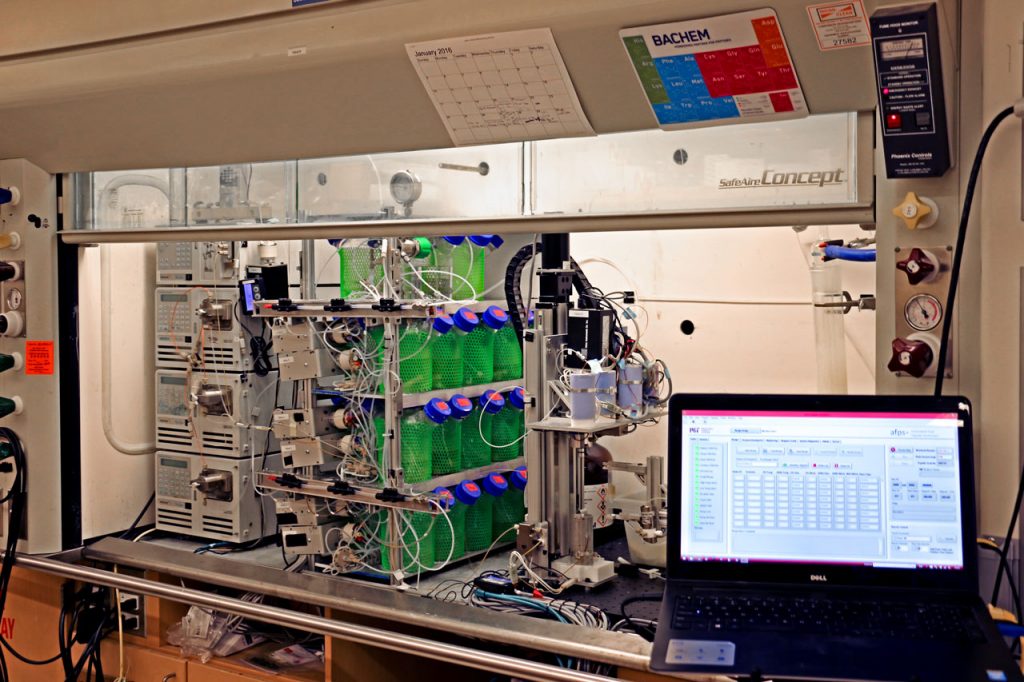
The search is only just beginning for MIT, they hope to find at least 100 different variants of the peptide to study from. Though the lockdown to protect us from the virus has reduced all of our workforce, MIT has special permission for a small team to continue working on this research at the lab. With continued research, the team at MIT may find multiple peptides that block SARS-CoV-2.
We have confidence that we know exactly where this molecule is interacting, and we can use that information to further guide refinement, so that we can hopefully get a higher affinity and more potency to block viral entry in cells
There is a lot of research being performed around the world which hopes to unlock the secrets of defeating the spikes of SARS-CoV-2. One international team of researchers has recently found potential with human recombinant soluble angiotensin-converting enzyme 2 (hrsACE2). Another is attempting phage therapy using the empty shell of a harmless flu virus to block the new SARS virus. The effort is on and science is leading the way.


