
Scientists from Russia and the Czech Republic have developed a 2D material made of platinum, gold, and chromium that generates hydrogen molecules to provide another green tool to help tackle the global energy challenge. The device can produce hydrogen from salt, fresh, and polluted water by exposure to infrared sunlight. Hydrogen is the basis of alternative energy, so finding a green way to produce it is critical.
The team responsible for the invention includes researchers from Tomsk Polytechnic University, the Jan Evangelista Purkyne University in Ústí nad Labem, and the University of Chemistry and Technology in Prague.
Olga Guselnikova, study author and a researcher of the TPU Research School of Chemistry & Applied Biomedical Sciences, said:
Hydrogen is an alternative source of energy. Thus, the development of hydrogen technologies can become a solution to the global energy challenge. However, there are a number of issues to solve. In particular, scientists are still searching for efficient and green methods to produce hydrogen. One of the main methods is to decompose water by exposure to sunlight. There is a lot of water on our planet, but only a few methods suitable for salt or polluted water. In addition, few use the infrared spectrum, which is 43% of all sunlight.
The 1-micrometer thick material is made up of three layers. The lowest layer is a film of gold, above that is a 10-nanometer film of platinum, and the top layer is a film of metal-organic frameworks of organic molecules and chromium compounds.
Olga said:
During the experiments, we watered material and sealed the container to take periodic gas samples to determine the amount of hydrogen. Infrared light caused the excitation of plasmon resonance on the sample surface. Hot electrons generated on the gold film were transferred to the platinum layer. These electrons initiated the reduction of protons at the interface with the organic layer. If electrons reach the catalytic centers of metal-organic frameworks, the latter was also used to reduce protons and obtain hydrogen.
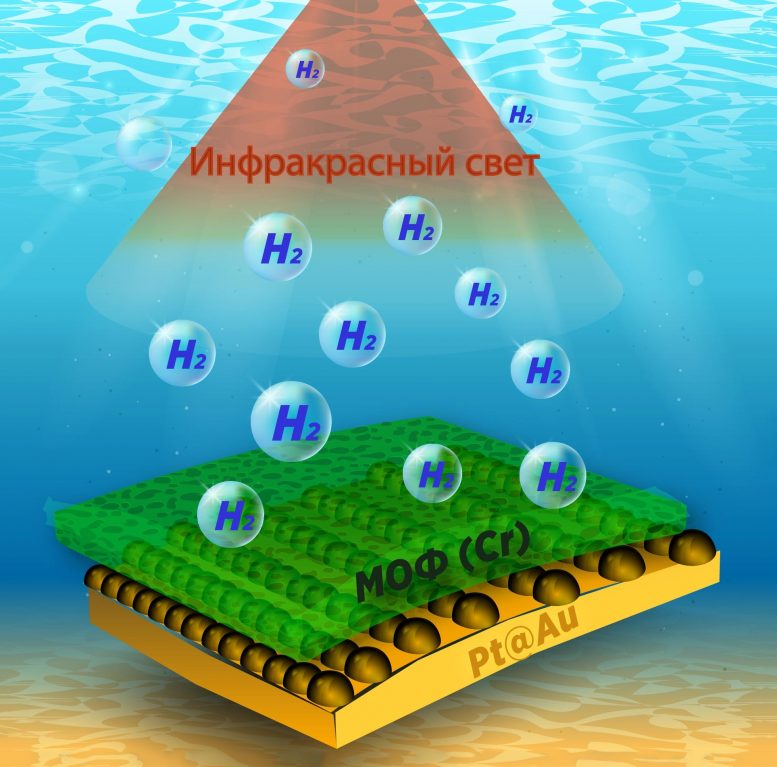
The team demonstrated through experiments that 100 square centimeters of the material can produce 1 liter of hydrogen in two hours, which is one of the highest rates ever recorded for 2D materials.
Olga continued:
I this case, the metal-organic frame also acted as a filter. It filtered impurities and passed already purified water without impurities to the metal layer. It is very important, because, although there is a lot of water on Earth, its main volume is either salt or polluted water. Thereby, we should be ready to work with this kind of water.
Speculating on how to improve the material, Olga concluded:
The material already demonstrates a certain absorption in the visible light spectrum, but its efficiency is slightly lower than in the infrared spectrum. After improvement, it will be possible to say that the material works with 93% of the spectral volume of sunlight.
The next phase of their research will focus on improving the material by making it efficient for both infrared and visible spectra so that it can perform with 93% of the spectral volume of sunlight.


