
Shortly, there will be a massive expansion of the Internet of Things (IoT). Millions of products used in smart greenhouses, public spaces, and homes will be brought online. These items are low-energy-consuming devices. There will be so many that having to replace all their batteries constantly would be absurd and extremely inconvenient. For this reason, all over the world, researchers are busy finding ways to harness the energy from elements around us—primarily artificial light. Their work has brought us flexible power generators for indoor settings. The same idea is now being applied 10 meters underwater, where wide-bandgap perovskite cells harvest dim blue-green light to power ocean sensors without batteries.

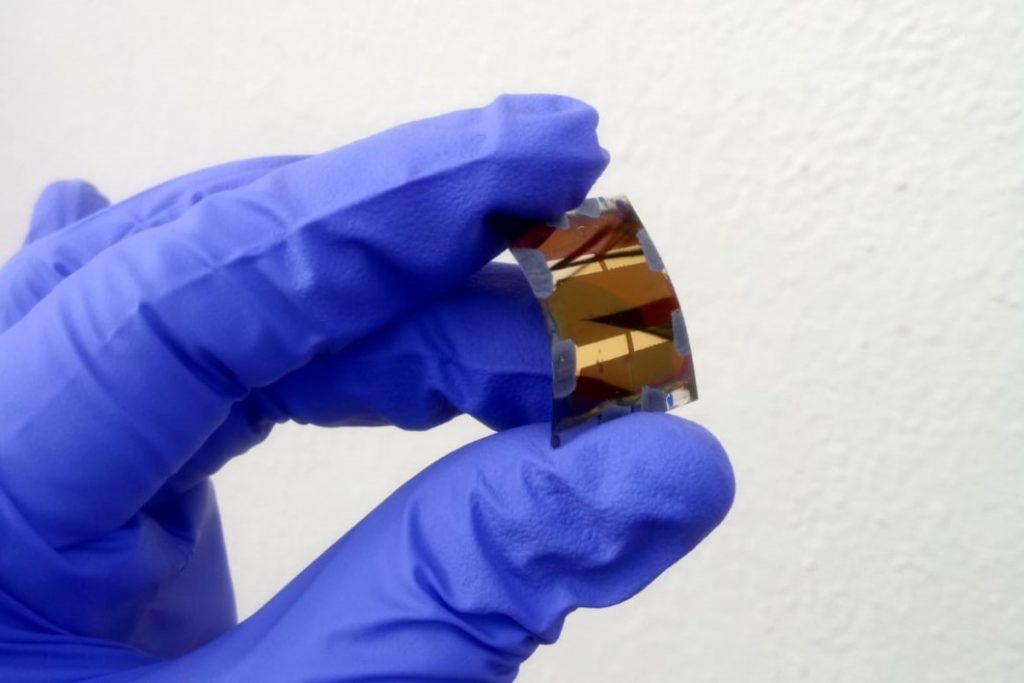
Last year a team of Swedish and Chinese scientists reported the development of organic indoor solar cells. Since then, there have been further developments of photovoltaics that can harness indoor lighting. Recently, an international team created perovskite photovoltaics on roll-to-roll coated ultra-thin glass. The technology is autonomous, small, convenient, economical, and can provide seamless integration of sensors into ambient environments.
Most interior lighting shines at between 100 and 500 lux, while the sun shines at about 110,000 lux. That’s why the technology will only be able to power very low-energy devices. Nevertheless, the world will soon be filled with them, and they’ll all work best with a renewable power source.
The team that created the flexible perovskite photovoltaics tested them under LED illumination and found them to be the most efficient of all flexible and curvable indoor photovoltaic cell technologies made yet. Under 200 lux, they had an efficiency of 20.6%, and under 400 lux, 22.6%. Furthermore, the manufacturing method can easily be scaled up so the cells should be cheap to produce in bulk.

Yet another team from Uppsala University, led by Marina Freitag, assistant professor at the Department of Chemistry, developed a new type of dye-sensitized solar cells that can harvest light from indoor lamps. It is based on a copper-complex electrolyte and has been found to outperform conventional silicon and solar cells made from exotic materials.
Freitag said, “Knowing the spectra of these light sources makes it possible to tune special dyes to absorb indoor light. While generating large amounts of energy, these indoor photovoltaics also maintain a high voltage under low light, which is important to power IoT devices. Ambient light harvesters provide a new generation of self-powered and smart IoT devices powered by an energy source that is largely untapped. The combination of high efficiency and low cost with non-toxic materials for indoor photovoltaics is of paramount importance to IoT sustainability.”
Very soon, everything from environmental information to human-machine and machine-machine communications will likely be facilitated by billions of IoT devices that are self-powered by indoor solar cells. Advances in sensors that run without wires or batteries will further enhance the coming wave of autonomous systems and robotics currently in development. Furthermore, by combining the cells with automated learning and artificial intelligence, they’ll be able to reduce energy consumption and improve general living conditions. The future is very bright!


