
A team from Germany’s Fraunhofer Institute and the UK’s Durham University have developed what they claim to be the world’s first manufactured non-cuttable material. The material, named Proteus, is only 15% the density of steel, which makes it a perfect candidate for indestructible bike locks and lightweight armor.
The creation of the Proteus design was inspired by the hard, fracture-resistant aragonite shells of mollusks and the tight, cellular skin of a grapefruit. Proteus contains ceramic spheres in a cellular aluminum structure that halts drills and angle grinders by producing destructive vibrations that dull any cutting tools used against it.
Here’s what happens when an attempt at cutting the material is made:
- A drill bit or angle grinder will cut through the outer layer of the Proteus plate.
- Once it reaches the embedded ceramic spheres, it begins to vibrate aggressively.
- These vibrations will dull the tool’s sharp edges.
- Then, fine particles of ceramic dust will start to fill up gaps in the matrix-like structure of the metal.
- These particles cause it to become harder the faster you drill or grind “due to interatomic forces between the ceramic grains,” and “the force and energy of the disc or the drill are turned back on itself, and it is weakened and destroyed by its own attack.”
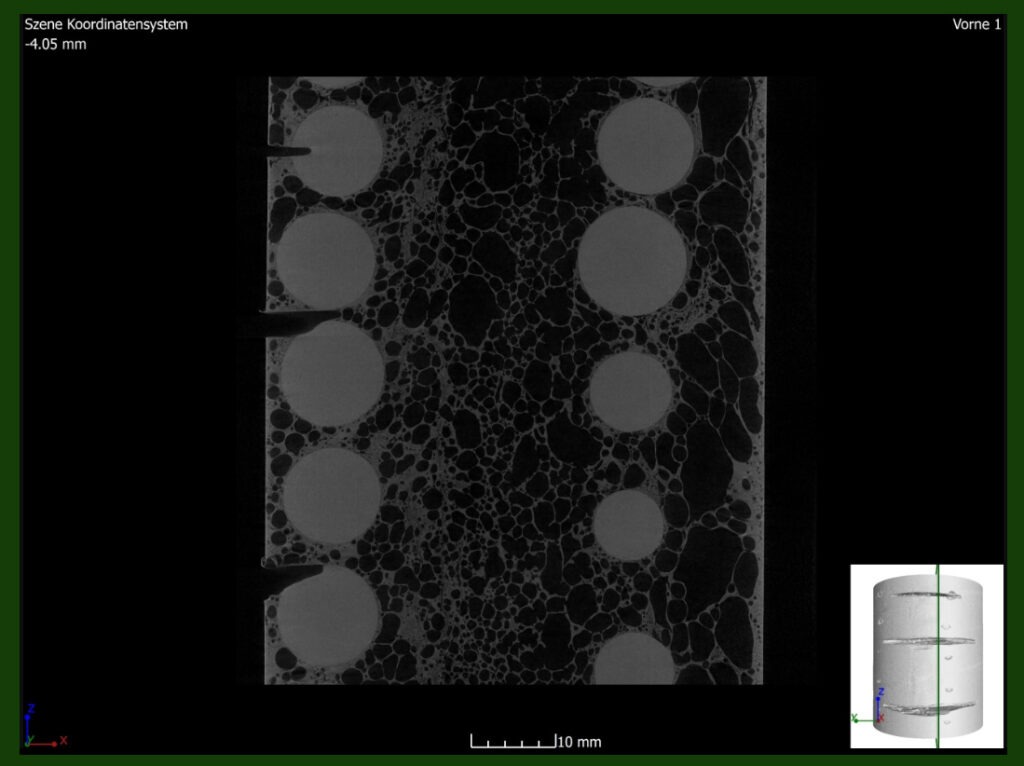
Proteus is also effective against high-pressure water jet cutters because the spherical shape of the ceramic bits widens the water jet, considerably slowing down its cutting speed. “Essentially cutting our material is like cutting through jelly filled with nuggets. If you get through the jelly, you hit the nuggets, and the material will vibrate in such a way that it destroys the cutting disc or drill bit,” said Stefan Szyniszewski, the lead author of the study, which was published on July 20 in the journal Scientific Reports.
Szyniszewski added, “The ceramics embedded in this flexible material are also made of very fine particles that stiffen and resist the angle grinder or drill when you’re cutting at speed in the same way that a sandbag would resist and stop a bullet at high speed. This material could have lots of useful and exciting applications in the security and safety industries. In fact, we are not aware of any other manufactured non-cuttable material in existence as of now.”
Proteus’s potential goes beyond bike locks and lightweight armor. It can be used to make any kind of protective equipment that shields against people using cutting tools. The material is currently patent-pending, and the team plans to partner with manufacturers to bring it into the market.
Researchers are now exploring the opposite end of the stiffness spectrum too. A 2026 study in Nature Communications used an acoustic tractor beam to remotely retune the stiffness of a metamaterial, making the same structure soft in one region and stiff in another using nothing but sound pulses from outside.


