
Rolls-Royce will be collaborating with the UK Space Agency to make nuclear-powered space exploration a reality. Planetary scientists and nuclear engineers will put their minds together to explore the possibility of using nuclear power – a more plentiful energy source – for farther faster space travel.
Dave Gordon, the Senior Vice President of Rolls-Royce’s defense division, said:
We are excited to be working with the UK Space Agency on this pioneering project to define future nuclear power technologies for space. We believe there is a real niche UK capability in this area, and this initiative can build on the strong UK nuclear network and supply chain. We look forward to developing this and other exciting space projects in the future as we continue to develop the power to protect our planet, secure our world, and explore our Universe.
Nuclear propulsion involves channeling the tremendous energy released when atoms split to accelerate propellants rapidly. The partnership hopes that they’ll succeed in building atomic propulsion engines and completely revolutionize space travel.
Such an engine could be twice as effective as the chemical engines powering rockets today. Meaning, a spacecraft would reach Mars in only three to four months instead of six to eight.
On top of saving time, the shorter period in space would be better for the astronauts’ health since they’d be exposed to less harmful cosmic radiation. And they wouldn’t have to take as many consumables.
Dr. Graham Turnock, the UK Space Agency’s chief executive, said:
Space nuclear power and propulsion is a game-changing concept that could unlock future deep-space missions that take us to Mars and beyond. This study will help us understand the exciting potential of atomic-powered spacecraft, and whether this nascent technology could help us travel further and faster through space than ever before.
Rolls-Royce’s nuclear propulsion technology has been used for six decades already to power the Royal Navy’s submarine fleet. Meanwhile, the company is currently working on having several small modular nuclear reactors built on land to help the UK sustainably meet its rising electricity demand.
Amanda Solloway, the UK Science Minister, said:
As we build back better from the pandemic, it is partnerships like this between business, industry, and government that will help to create jobs and bring forward pioneering innovations that will advance UK spaceflight. Nuclear power presents transformative possibilities for space exploration, and this innovative study with Rolls-Royce could help to propel our next generation of astronauts into space faster and for longer, significantly increasing our knowledge of the Universe.
Nuclear systems in space have already proven themselves with the Voyager 2 probe – which is still operating after 44 years from billions of miles away.
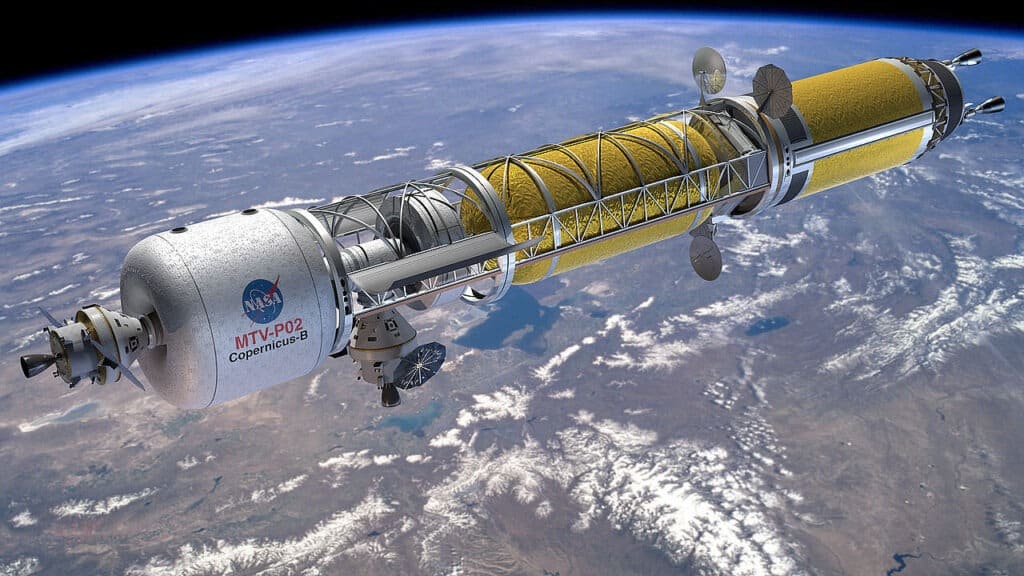
The concept of nuclear propulsion existed since the 1950s when the United States attempted to develop atomic spacecraft technology, so Britain’s plan to build a nuclear spacecraft isn’t the first. However, after a couple of decades of testing rockets propelled by small atomic bombs in the Nevada desert didn’t work out, they canceled the program. But late last year, NASA’s nuclear developments were permitted to advance by the United States government. So, the country’s back in the game.


