
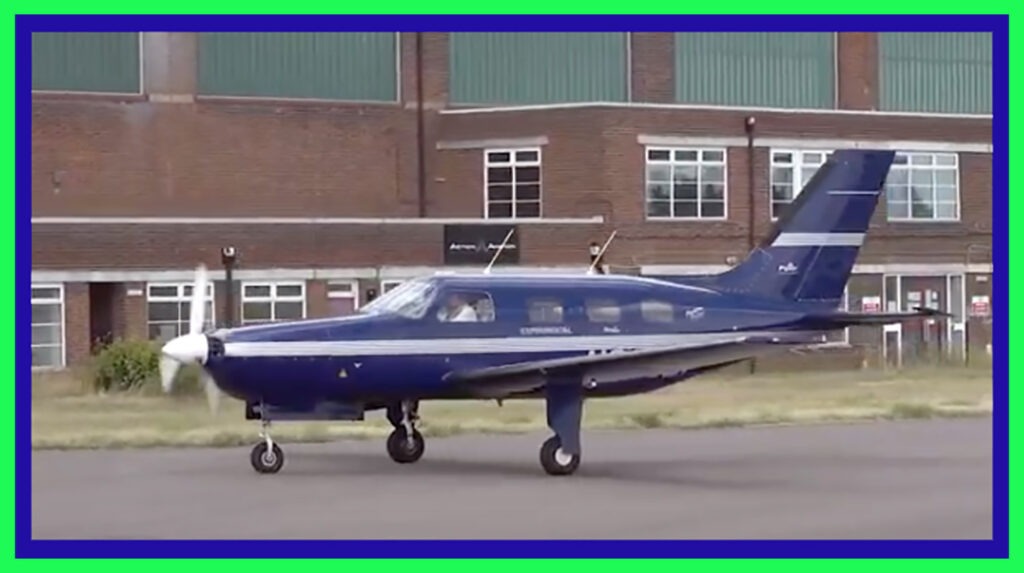
On June 22, ZeroAvia’s electric Piper M350 piston-single took off from Cranfield Airport for a test run. The six-seat hydrogen-electric-powered aircraft is claimed to be the UK’s “first electric-powered flight of a commercial-scale aircraft” and is Europe’s largest zero-emission aircraft. Soon, the plane will go on another test run of 300nm (560km) off the Orkney Islands, an archipelago on the northeastern coast of Scotland.
The M350 flight trials are part of the UK’s £2.7 million ($3.3 million) government-funded HyFlyer project, backed by Aerospace Technology Institute programs and Innovate UK. The initiative aims to swap out fossil fuel engines in medium-sized propeller-driven airplanes (owned by local airline companies) with zero-emission propulsion systems.
ZeroAvia replaced the M350’s Lycoming piston engine with a powertrain, including hydrogen fuel cells, hydrogen gas storage, and electric motors. Within three years, ZeroAvia aims to have a 10- to 20-seat commercial hydrogen-electric aircraft “ready for take-off on 500nm regional flights,” by showing powertrain technology can replace fossil fuel engines. By the end of the decade, a 50- to 100-seat zero-carbon aircraft could be ready, while a 200-passenger, powered by hydrogen fuel cell technology could be complete by 2040.
Batteries can be cumbersome and expensive. That’s why hydrogen fuel cells are more appropriate for zero-carbon flights, which in turn, makes them more viable for commercial operations at a large scale in a short timeframe.
Val Miftakhov, the CEO and founder of ZeroAvia, describes the new flight as “the latest in a series of milestones that moves the possibility of zero-emission flight closer to reality.”
Miftakhov adds:
We all want the aviation industry to come back after the pandemic on a firm footing to be able to move to a net-zero future, with a green recovery. That will not be possible without realistic, commercial options for zero-emission flight, something we will bring to the market as early as 2023.
The company has obtained provisional US Federal Aviation Administration certification for its research platform in the US, where it has been flight-testing the hydrogen-electric powertrain since last year.


