
Valproate has carried a stark pregnancy warning for years, yet many families still ask the same urgent questions in search engines and doctors’ offices: Why is this medication considered so dangerous during pregnancy? What actually happens inside the developing brain? If you are managing epilepsy or bipolar disorder, these stakes are deeply personal. You might be asking, “Is there a safe seizure medicine for pregnancy?” while searching for clarity amidst the noise. While these scientific findings avoid panic, they deliver a clear reality. For expectant parents, this new evidence offers a sobering look at how certain medications affect development.
Research into the cellular mechanism of valproate-induced birth defects provides critical answers for families and clinicians. Exposure to valproate during early growth phases forces critical embryonic cells into “cellular senescence”—a biological shutdown where cells permanently stop dividing. In plain terms, some of the very cells meant to build the brain and spinal cord appear to hit a biological stop signal at a critical moment.
Managing a condition like epilepsy or bipolar disorder makes these scientific findings feel deeply personal. Imagine being stabilised on a medication, only to discover you are pregnant and find yourself searching for urgent safety details.
While the data avoids alarmism, global health authorities deliver a clear warning: prenatal exposure significantly increases the risk of major birth defects and neurodevelopmental challenges.
Now, laboratory evidence clarifies why that risk exists.

Key Facts on Valproate Pregnancy Risks and Developmental Disorders
Based on data from global regulators and large-scale studies, these facts outline the autism and developmental delay risks linked to prenatal valproate exposure. This population-level data provides the necessary context for the newly discovered ‘cell stop’ mechanism.
- Valproate, also known as valproic acid or sodium valproate, is used to treat epilepsy, bipolar disorder, and sometimes migraine prevention.
- Health authorities report that prenatal exposure is associated with a roughly 10 per cent risk of major birth defects and a substantial risk of developmental disorders.
- Large population studies and meta-analyses of prenatal valproate exposure link gestational exposure to increased rates of autism spectrum disorder and attention-deficit hyperactivity disorder.
- Recent research into neuroepithelial cell senescence indicates that valproate directly disrupts the formation of the early nervous system.
- Regulators require strict pregnancy prevention programme rules for people who can become pregnant while taking valproate.
These risks explain why sodium valproate requires more caution than many other seizure medications. The primary concern centres on avoidable exposure during the most sensitive windows of foetal growth.
Recent laboratory breakthroughs now clarify exactly how this risk unfolds in the developing brain.

Cellular Senescence: Disrupting Neuroepithelial Cells in Early Foetal Brain Formation
Recent laboratory evidence regarding valproate-induced embryonic senescence examines how the medication disrupts early brain formation. Researchers used mouse embryos and human brain organoids, which are miniature three‐dimensional tissue models grown in the laboratory to mimic aspects of early brain formation. In the study titled “Valproic Acid Induces Ectopic Senescence in Neuroepithelial Cells”, investigators observed that valproate exposure caused neuroepithelial cells to enter cellular senescence.
Neuroepithelial cells are early stem‐like cells that multiply rapidly to form the brain and spinal cord. When these cells stop dividing too soon, the pool of building blocks for the central nervous system shrinks. Investigators pinpointed the p19Arf pathway as the primary driver behind this cellular shutdown, directly linking valproate to gene activity that restricts brain growth.
Cellular senescence, discussed in a review of senescence in embryonic development, is not simply cell death. It is a biological state in which a cell remains alive but no longer divides. Biologically, this mirrors a construction site where workers abruptly stop, leaving the structural blueprint incomplete at a critical stage.
If these cells stop dividing prematurely, the essential ‘building blocks’ for the central nervous system diminish, potentially impacting long-term brain health if the foetus is taken to full term.
The researchers also noted that removing p19Arf in experimental models reduced certain effects such as microcephaly, a smaller-than-expected head size, but other abnormalities persisted. This suggests that valproate’s impact likely involves multiple pathways.
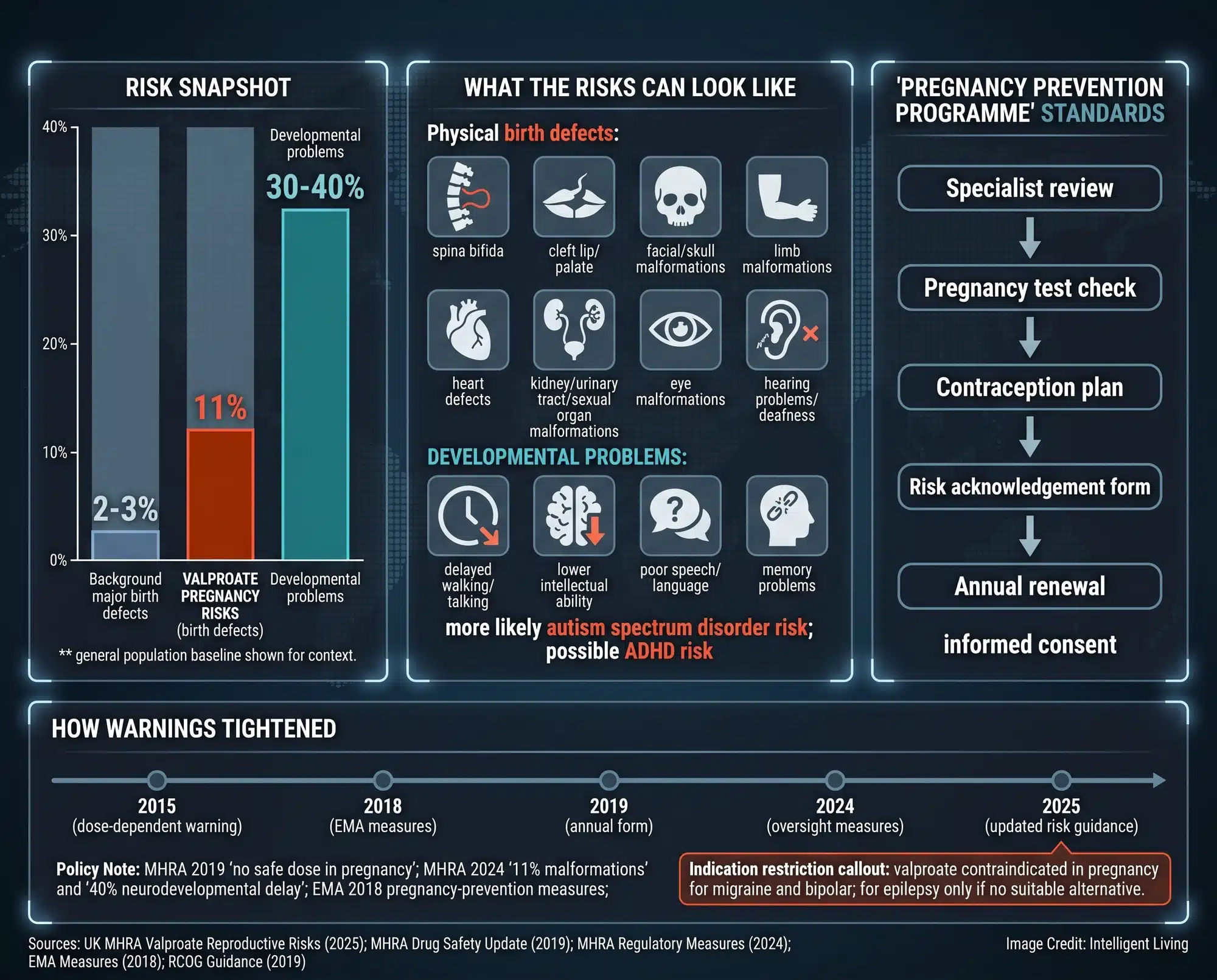
Global Safety Warnings and Valproate Pregnancy Prevention Programme Standards
Regulators documented the risks of sodium valproate birth defects long before researchers identified this specific cellular mechanism. The UK’s valproate reproductive risks guidance reports that around 1 in 9 babies exposed during pregnancy may develop major birth defects, while up to 30 to 40 per cent may experience developmental problems.
In Europe, pregnancy-prevention measures for valproate strengthened restrictions in 2018. These programmes mandate regular pregnancy testing, informed consent, and consideration of alternative treatments.
Extensive population-based evidence consistently validates these safety concerns. A Danish cohort study published in JAMA found that prenatal exposure to valproate was associated with a significantly increased risk of autism spectrum disorder. More recent systematic reviews report elevated risks of both autism and attention‐deficit hyperactivity disorder after gestational exposure.
Searching for safe treatment options during pregnancy can be an overwhelming experience. As you compare various risks, keep these consistent findings in mind:
- Consistent evidence confirms an increased risk from prenatal valproate exposure.
- Similar safety concerns arise regarding paracetamol and childhood behaviour questions.
- Standardised clinical warnings for valproic acid emphasise that any treatment modifications must be supervised.
Ultimately, balancing health requires professional oversight, as uncontrolled seizures or severe mood episodes also pose significant threats.

Advancing Neurology Guidance and Safer Seizure Medicine Research
Discovering this cellular stop signal changes how researchers approach drug safety. By pinpointing how a medication disrupts embryonic growth, scientists can more effectively develop and test safer alternatives.
- More Targeted Drug Development: Understanding the senescence pathway may guide pharmaceutical research toward seizure medications that do not trigger cellular shutdown.
- Improved Laboratory Screening: Brain organoid models, outlined in a research summary of the organoid-and-mouse approach, could become part of earlier safety testing.
- Clearer Patient Counselling: Clinicians can provide more detailed guidance by explaining the specific cellular stop signal that disrupts foetal development.
- Stronger Public Health Messaging: Mechanistic clarity supports existing pregnancy prevention programmes and may improve adherence.
- Advancing our biological understanding and screening protocols is the most effective way to minimise preventable harm in the future.
Better screening and clearer biology can eventually reduce preventable harm. Until that day, the most protective step is early, supervised planning with clinicians who can weigh seizure control, mood stability, and pregnancy safety together.

Protecting Health: Clinical Guidance on Valproate and Autism Risk
News about how valproate disrupts development can be difficult to process. Despite these new laboratory insights, the clinical advice for families remains the same: sodium valproate provides effective treatment but demands proactive safety management during pregnancy. Scientists now understand how valproate triggers a cellular stop signal in the foetal brain. This discovery clarifies why following a strict pregnancy prevention programme is vital for your safety.
Consult your neurologist immediately if you are pregnant or planning a family while taking this medication. It is vital to weigh seizure control against the potential long-term effects of prenatal valproate exposure. Clinical guidance remains the priority, yet you can also support your body by focusing on prenatal care, proper nutrition, and consuming natural sources of folate to help foster healthy foetal development. Taking early action, such as maintaining prenatal health and nutrition habits, significantly improves the likelihood of a healthy pregnancy and a positive outcome for your family.
Is Valproate Safe During Pregnancy? FAQs and Safety Answers
What is valproate used for?
Valproate (sodium valproate/Depakote) is prescribed to treat epilepsy and bipolar disorder and sometimes to prevent migraines.
Why is valproate dangerous during pregnancy?
Health authorities report increased risks of major birth defects and long-term neurodevelopmental disorders due to the drug disrupting early nervous system formation.
Is valproate linked to autism?
Yes. Large population studies show a significantly increased risk of autism spectrum disorder and ADHD among children exposed to valproate in the womb.
What does valproate do to a baby’s brain?
Recent research shows it can trigger “cellular senescence”, causing critical brain-building cells to permanently stop dividing at a vital stage of development.
Is there a safe seizure medicine for pregnancy?
Many alternatives exist, but safety depends on your specific condition. You must consult your doctor to find a treatment that balances seizure control with pregnancy safety.
What should I do if I become pregnant while taking valproate?
Do not stop your medication suddenly, as uncontrolled seizures pose a severe risk. Contact your healthcare provider immediately to develop a safe transition plan.
What are neural tube defects?
These are serious structural issues affecting the brain and spinal cord, such as spina bifida, which occur very early in pregnancy.


