
Is it possible to achieve secure paper packaging seals without relying on synthetic glues or plastic films? Paper bags, food wrappers, and disposable cups often look simple and eco-friendly, but hidden adhesives or thin plastic layers are frequently required to maintain structural integrity. Such specific manufacturing details impact sustainability and long-term recyclability by introducing multi-material composites into the recovery stream. These synthetic binders disrupt recycling streams, degrade recovered fiber quality, and introduce mixed-material waste into systems designed for material purity. The same layer problem shows up in everything from chip bags to paper tube packaging that cuts plastic, where the outer shell hides materials that ultimately decide what can be recovered.
Now a German research team says paper may not need outside glue at all. The Fraunhofer-led PAPURE project is currently refining paper joining without foreign materials to eliminate the need for external binders. This research demonstrates how the sealing paper packaging without adhesives approach fundamentally modifies the material surface to facilitate bonding.
A paper snack bag dropped into a recycling bin can feel like the end of the story until the seam and lining turn it into a sorting headache. This development shifts the conversation from “paper versus plastic” to “what is actually inside the paper.”
Key Sustainable Packaging Facts: Understanding Adhesive-Free Paper Sealing Technology
Laser-based sealing technology maintains paper packaging purity by replacing traditional glue and plastic seams with a precision-controlled, adhesive-free process.
- The PAPURE project utilizes carbon monoxide laser surface modification to achieve 100% adhesive-free bonding in high-volume production.
- Through surface-chemistry modification, the process enables natural cellulose fibers to form secure bonds under targeted heat and pressure.
- The bonding process remains entirely free of synthetic glue or plastic sealing layers.
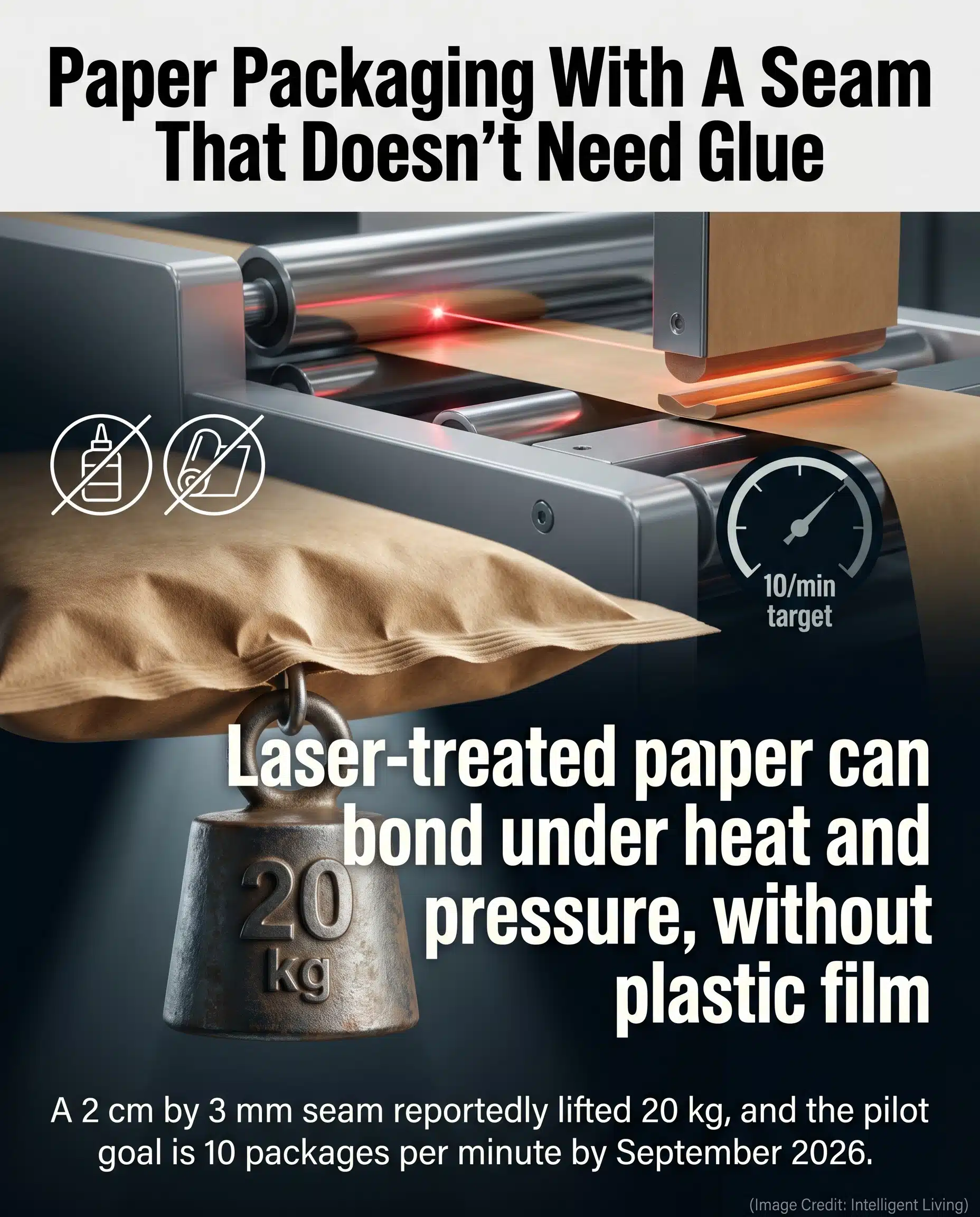
- Fraunhofer reports that a tiny 2-centimeter by 3-millimeter seam can lift 20 kilograms in testing.
- The pilot target is ten packages per minute by September 2026.
- The project involves four Fraunhofer institutes focused on paper analysis, laser processing, sealing systems, and industrial integration.
Instead of treating paper seams as a weak spot patched with extra materials, the PAPURE approach views the seam as a tunable surface chemistry challenge. The development focuses on three primary pillars:
- Engineering the specific hardware for industrial integration.
- Mastering the carbon monoxide laser surface modification chemistry.
- Validating whether adhesive-free paper packaging can maintain global packaging volumes.
These focus areas ensure the technology moves beyond lab samples into real-world factory environments.

How Fraunhofer’s CO Laser Paper Sealing Works
Research Milestones: How the Fraunhofer PAPURE Project Achieves Industrial Integration
The Four Fraunhofer Institutes and Their Roles
Research responsibilities are divided into distinct industrial development tracks:
- Material Analysis: One group evaluates how different paper grades and fiber mixes respond to binder-free sealing.
- Process Refinement: Another team focuses on optimizing laser surface modification parameters.
- Hardware Engineering: Modular sealing units are developed specifically for roll-to-roll packaging integration.
- Production Prototyping: The final demonstrator machine is built for high-volume manufacturing rather than simple lab samples.
Previous studies successfully validated high-strength paper bonding with CO lasers by identifying the formation of meltable reaction products on the fiber surface.
Solving Recycling Contamination: The Invisible Challenge of Multi-Material Packaging Seams
The core problem is easy to miss because the outside of a paper package looks clean. Paper packaging often still needs adhesives or thin plastic layers to create secure seams. Those additions can contaminate the paper recycling stream and reduce recycled-material quality, a pressure point the PAPURE team highlights in its project materials.
Standard takeaway bags used for warm sandwiches highlight the recovery challenge perfectly. Although the paper appears eco-friendly, hidden adhesives or laminated linings often prevent successful recycling.
Scaling this issue across millions of daily packages turns an abstract environmental concern into a significant industrial bottleneck. Multiply that across millions of packages per day, and the recycling challenge becomes less abstract.
What “No Foreign Materials” Really Means
PAPURE’s goal is straightforward: enable paper packaging that can be sealed reliably without introducing foreign materials. Material behavior varies significantly across different grades. Because fillers and coatings dictate how well a seam bonds, the project identifies specific paper types capable of maintaining fiber-to-fiber structural strength without synthetic adhesive layers.

Surface Modification Science: Creating Fiber-to-Fiber Structural Strength Using CO Lasers
Chemical Transformation: Generating Re-Meltable Glycosidic Cleavage Products for Paper Bonding
Fraunhofer’s findings demonstrate how re-meltable glycosidic cleavage products develop on the paper surface, allowing natural fibers to fuse during the final heat-sealing stage.
This research demonstrates how re-meltable glycosidic cleavage products develop on the paper surface, allowing natural fibers to fuse during the final heat-sealing stage.
Heat Sealing without Added Glue or Plastic Film
In simple terms, the laser prepares the paper so it can act like it has its own built-in bonding layer. During a standard heat-sealing step, two treated paper surfaces press together and form a seam without added glue. The aim is not just sticking but controlled seam quality that packaging lines can repeat thousands of times without drift.
What the 20-Kilogram Seam Test Suggests
Fraunhofer reports that a seal just two centimeters long and three millimeters wide can lift 20 kilograms in testing. That result is striking because it implies more than a light tack between fibers. It points to structural bond strength that could matter for pouches, paper cups, and flat bags where seams are the first failure point.
A paper pouch that resists tearing at the seam is a familiar frustration. The difference here is that the same kind of stubborn seam strength is being targeted without a synthetic adhesive layer doing the heavy lifting.

Why Glue-Free Laser Paper Could Matter
Packaging Waste Adds Up Fast
With 79.7 million tons of packaging waste reported by Eurostat in 2023, the scale of the problem is immense. Paper and cardboard currently represent 40.4 percent of this total, while plastic accounts for 19.8 percent. That scale turns small design tweaks into system-level opportunities, especially when paper is already the biggest material share and still carries avoidable complexity in the sealing layer.
Why Seams and Linings Complicate Paper Recycling
Synthetic adhesives and plastic layers often disrupt recycling streams by introducing mixed materials that require complex separation. Transitioning to cleaner paper seams simplifies sorting and pulping, ensuring a higher quality of recovered fiber.
Simplifying material choices is essential because packaging claims that overestimate recyclability often confuse consumers. Consistent, mono-material designs ensure that eco-friendly packaging actually reaches the intended recycling bin.
Complying With Regulation (EU) 2025/40: Why 2026 Recyclability Rules Impact Manufacturers
Regulatory timelines are accelerating the industry’s shift toward circularity.
The new EU framework for sustainable packaging recyclability mandates that all packaging become recyclable in an economically viable way by 2030. These industrial rules entered into force in February 2025 and will apply to all manufacturers beginning August 12, 2026. The Commission also highlights clearer packaging labels and recyclability rules as part of the same shift, which matters when ordinary shoppers are trying to decide what belongs in a bin. For packaging manufacturers, recyclability is increasingly tied to compliance rather than marketing alone.
Where Glue-Free Paper Sealing Could Show Up First
In broader sustainability discussions, what looks like a small change at the seam level can influence supply chains. Accelerating plastic compliance risks in global supply chains are forcing manufacturers to adopt circular material strategies by 2026. Laser-sealed paper could become one more technical pathway for companies trying to simplify material choices without sacrificing performance, especially for fully recoverable paper cup designs and other high-volume items requiring robust seam integrity.
There is also continuity with earlier research. The same shift is visible in high-speed paper wrapping for snack bars, where paper is engineered to handle sealing and shelf-life demands once dominated by plastic films. Fraunhofer has been involved in plastic-free bioactive paper coatings aimed at food packaging that performs like conventional plastic-lined materials without interfering with recycling. This new laser process fits into that same long-term push to help paper packaging do more on its own.

Can Laser-Sealed Paper Packaging Scale in Real Factories
The Big Test is Scaling It
Speed Targets, Quality Control, and Production Reality
Achieving industrial scale is the final hurdle for adhesive-free paper packaging. Current pilot targets aim for scalable adhesive-free paper packaging pilots reaching ten units per minute by late 2026. This rollout includes a demonstrator system equipped with real-time sensors to adjust laser settings instantly.
Integration Into Existing Packaging Lines
Real-world deployment hinges on integrating laser modules into roll-to-roll lines without excessive overhead. Reliable performance across various paper grades and fiber directions is essential, as modern packaging machines prioritize high-speed consistency over all other metrics.
Modifying surface chemistry must be done carefully to avoid compromising material integrity. Teams ensure the paper remains durable and does not become scorched or brittle when subjected to industrial stresses.
What Interpack 2026 Signals
A planned demo during Interpack 2026 in Düsseldorf is one public moment to judge whether the laser and sealing modules can keep pace with industrial expectations. In packaging, demonstrations matter because a working seam at trade-show speed is closer to reality than a single impressive sample.
A production line running thousands of snack pouches per hour sets a harsh standard. If a laser-treated seam can keep pace, hold its strength, and maintain leak-tightness for food packaging, the shift from glue-based to adhesive-free sealing starts to look practical rather than theoretical.
For now, laser-sealed paper packaging remains a development-stage technology. The concept is grounded in test data and institutional research, but widespread commercial use will depend on performance, cost, and regulatory acceptance.
Future Outlook: Can Laser-Sealed Technology Standardize Plastic-Free Paper Packaging?
Cleaner Recycling Starts with Fewer Ingredients
Paper that bonds to itself without glue challenges a quiet assumption about packaging design. If seams can be formed without added plastic or synthetic adhesives, recyclable paper packaging could become structurally simpler and potentially easier to process after use. The accelerating retail adoption of plastic-free paper packaging highlights how often the seam and lining become the make-or-break detail, even when the package looks like “just paper.”
When Everyday Packaging Stops Being a Guessing Game
Laser-based sealing represents a broader shift toward removing hidden contaminants from everyday products. Removing these synthetic layers directly reduces microplastic particles from packaging film while ensuring fiber remains pure.
Pure paper packaging eliminates the confusion of multi-material composites. This change ensures that disposal is no longer a guessing game for the average consumer. In a world where packaging rules are tightening and waste numbers remain high, even a narrow strip of paper sealed differently can signal a broader rethink of how materials are joined, used, and recovered.

Advancing Adhesive-Free Paper Sealing for a Circular Economy
For now, laser-sealed paper packaging remains a development-stage technology, yet its potential impact on household waste is significant. The concept is grounded in test data and institutional research, though widespread commercial use will depend on performance, cost, and regulatory acceptance. Transitioning to plastic-free paper packaging in retail isn’t just about the technology; it’s about making everyday recycling feel like less of a guessing game for families standing over their kitchen bins.
As manufacturing speeds increase, this laser-based approach could redefine how we view the lifecycle of a simple snack pouch. By replacing synthetic glue with fiber-to-fiber structural strength, we move closer to a truly circular economy where paper remains pure fiber. The shift from glue-based to adhesive-free sealing starts to look practical rather than theoretical as industrial-scale adhesive-free paper bonding moves toward real-world factory integration.
FAQ: Understanding Laser-Sealed Paper Packaging and Recycling Impact
Is there a plastic-free way to seal paper bags?
Yes, the Fraunhofer PAPURE project uses carbon monoxide laser surface modification to enable paper to seal to itself without any plastic films or synthetic adhesives.
How does laser-sealed paper help the environment?
It ensures paper packaging stays closer to pure fiber, making the recycling process more efficient and reducing the contamination caused by hidden glue and plastic layers.
What Is the Fraunhofer PAPURE project?
PAPURE is a research initiative involving four German institutes focused on developing “paper joining without foreign materials” to improve global packaging sustainability.
Can paper packaging be sealed without using glue?
Using CO lasers to create re-meltable glycosidic cleavage products on the paper surface allows the material to bond securely under heat and pressure alone.
When will adhesive-free paper packaging be available?
The technology is currently in a pilot phase, with researchers targeting a roll-to-roll demonstrator system capable of producing ten packages per minute by September 2026.


