
A compact electric aircraft motor rated at 750 kilowatts, roughly 1,000 horsepower, now weighs about 94 kilograms, or close to 207 pounds. That blend of output and weight is rare enough to reset expectations in electric aviation, where every extra kilogram can erase a hard-won efficiency gain. Developed by Germany’s Fraunhofer Institute for Integrated Systems and Device Technology IISB, the motor is designed specifically for hybrid electric regional aircraft under the European Union’s AMBER initiative to prove that cleaner propulsion concepts can realistically fit into regional flight operations.
While speed records and fancy prototypes grab the headlines, the real struggle for electric planes is always the same. Engineers have to find a way to get a heavy aircraft off the ground without using an engine that is too bulky or gets too hot to handle.
This specific power-to-weight challenge is the reason this motor matters so much. It addresses the energy storage constraints that usually force a difficult choice between carrying heavy batteries or carrying a usable payload of passengers.

Fraunhofer IISB and the Evolution of Modern Propulsion Architecture
Benchmarking the 750 kW and 1,000 HP Performance Metrics
Engineers at Fraunhofer IISB recently unveiled a high-power-density electric traction motor specifically built for the demands of hybrid electric aircraft.
This initiative is a core part of the Fraunhofer IISB aerospace engineering roadmap. The project focuses on creating repeatable aerospace performance that works in the sky, rather than just showing off simple bench-top output.
According to Fraunhofer IISB’s announcement, the motor delivers 750 kilowatts of rated power while weighing approximately 94 kilograms, landing near 8 kilowatts per kilogram in power density.
This isn’t just a science project stuck in a lab. Fraunhofer built this motor to be manufactured and used in the real world. The team designed it specifically for regional planes—the kind that fly short trips between nearby cities—because those aircraft need an extra burst of strength when they are lifting off and climbing into the sky.
Integrating Megawatt-Class Hardware into the AMBER Hybrid Demonstrator
Europe’s Clean Aviation effort hosts the AMBER initiative, a program designed to slash emissions by merging electrical systems with hydrogen fuel cells and existing engines.
Partner communications often highlight the need to validate hybrid electric technologies using real-world testing environments. This ensures that these complex systems work as promised before they ever touch an actual airframe.
Fraunhofer presented the motor during a coil-winding engineering exhibition, a setting that underscores what the announcement really is: manufacturing-grade propulsion hardware that still needs structured validation.
Parallel Hybrid Systems: Beyond Traditional Battery-Only Limits
In practical terms, this motor is not intended to power a battery-only airplane flying cross-country tomorrow. The propulsion architecture is designed to work within a parallel hybrid system.
Think of this setup like a “tag team” for flight. Instead of asking a battery to do all the work, the plane uses a regular engine and this electric motor together.
- The Electric Motor: Gives the plane a high-torque boost during the hardest parts of the flight, like takeoff.
- The Regular Engine: Keeps the plane moving during long stretches so it doesn’t run out of juice.
It’s like giving a hiker a second set of legs for steep hills rather than trying to replace their whole body.

Technical Specifications: Why Aviation Weight-to-Power Ratios Matter
High-Performance Traction Motor Data and Summary
Before we look at the gears and wires, it helps to answer the two things most people care about: how much power does it have, and how heavy is it? These aren’t just random facts—the weight of an engine decides how far a plane can fly and how many people can sit in the cabin.
The numbers below are the quickest way to answer questions like “how heavy is a 1,000 hp electric aircraft motor” without burying the story in jargon.
- Rated Power: 750 kilowatts, approximately 1,000 horsepower
- Weight: Around 94 kilograms, roughly 207 pounds
- Power Density: About 8 kilowatts per kilogram
- Speed: Up to 21,000 revolutions per minute
- Architecture: Multi-phase hairpin winding design with independent sections for improved fault tolerance
- Cooling: Direct oil spray cooling system for high thermal performance
- Program Context: Developed within the EU AMBER hybrid-electric demonstrator
Every pound matters on a plane because weight changes everything—from how long the runway needs to be to how much your ticket costs. Because this motor is so light, designers don’t have to worry about the engine taking up the entire “weight budget.”
This efficiency leaves more room for extra safety features and more fuel for longer trips. It can even mean adding a few extra seats for passengers on every flight.
One important secret to this motor’s strength is how fast it spins. By reaching 21,000 rpm—way faster than a car engine—this motor can stay small and light while still pumping out a massive amount of power.

Maximizing Airframe Integration and Payload Efficiency
What is Power Density in Electric Aviation?
Power density—calculated as kilowatts per kilogram—measures how much energy a motor generates compared to its mass. Aircraft designers rely on this ratio to decide if a propulsion concept is flight-ready or remains restricted to laboratory testing.
Think of power density like the strict weight limits at an airport check-in counter. Every kilogram saved in the propulsion stack directly translates to more passenger capacity or longer range.
The only difference here is the stakes. Instead of just avoiding baggage fees, this math is about maintaining safety margins and ensuring strong takeoff performance.
How the 8 kW/kg Threshold Impacts Regional Airframe Design
Reaching the 8 kilowatt per kilogram power density benchmark is a critical achievement, as it pushes electric propulsion closer to the weight class aircraft can actually carry while still meeting climb and redundancy needs.
Some technical reporting describes that output as small turboprop-class power, which helps translate the impact. This is not a toy motor scaling up; it is a number that sits in the neighborhood of propulsion levels used in real regional operations.
Future concepts for longer-range 1,000 km electric flights tend to rise or fall on this same delicate balance of weight and energy, as added mass works against efficiency and range.
Benchmarking Against NASA Advanced Electric Machine Standards
NASA’s ongoing research into advanced aircraft propulsion shows that power density is the biggest hurdle for new planes.
If an electric engine isn’t light enough to compete with old-fashioned gas engines, it simply won’t work for regional flight. The hardware must be light enough to allow the plane to stay in the air with a full payload.
Viewed through this lens, a high-density motor solves a major architectural hurdle within a complex aircraft system. While it won’t flip the entire industry to electric overnight, it transforms specific hybrid configurations from theoretical designs into plausible regional solutions.

Electro-Mechanical Engineering: Achieving 1,000 HP Weight Reduction
A 12-phase architecture designed for 21,000 rpm operation is the reason this motor stays small while doing the heavy lifting needed for flight.
Having massive power is only useful if you can keep the engine cool and under control. Without those safety features, the engine would just be a heavy piece of metal that makes the plane harder to fly.
Hairpin Winding Technology and Spatial Optimization
Imagine trying to close a messy, overstuffed junk drawer. If you just toss everything in, the drawer won’t shut. But if you stack everything neatly, you can fit way more inside without making the drawer any bigger. That is exactly what these “hairpin” wires do—they let engineers pack more power-making copper into a tight space so the motor stays small but powerful.
Active Thermal Management via Direct Oil Spray Cooling
High power output creates heat, the silent limiter in most compact electric machines. To counter this, the motor uses a direct oil spray cooling system that pulls thermal energy away from critical areas more effectively than traditional air cooling.
Active thermal management safeguards performance throughout long duty cycles.
By preventing the power degradation common in air-cooled units, this oil spray system keeps the motor running at peak efficiency. This is especially important during high-stress flight phases like takeoff and landing.
NO15 Grade Laminations for Eddy Current Loss Mitigation
The motor incorporates thin electrical steel laminations, often referred to as “NO15 grade material.” Thinner laminations reduce energy losses caused by eddy currents—the small circulating currents that waste energy as heat.
This reduction is critical at high rotational speeds like 21,000 revolutions per minute. Less wasted energy means less heat to remove, which cascades into lighter cooling hardware and more stable performance.
Operational Resilience Through Fault-Tolerant Redundancy
Fraunhofer IISB emphasizes a distributed stator design divided into independent sections so the motor is built around fault tolerance. In aviation, redundancy is not a luxury; it is a requirement.
If one part of the motor breaks, the other three parts keep right on spinning. This means the pilot still has control over the plane, giving them a chance to land safely instead of losing all their power at once. In the sky, having a backup for your backup isn’t just a nice feature—it’s what keeps everyone safe.
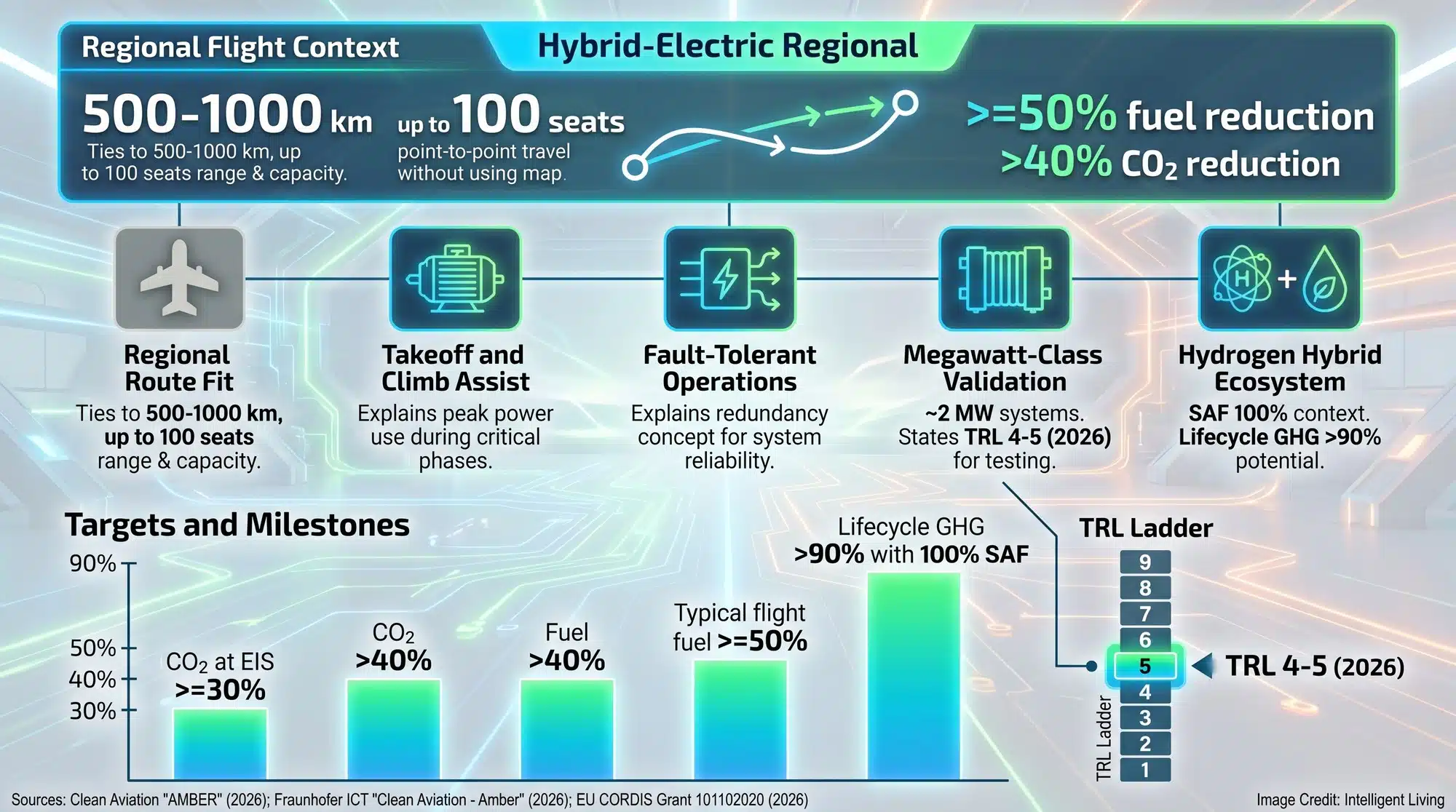
Where This Could Show Up First: Five Practical Impacts
Hybrid electric aviation usually succeeds in the places where the mission is predictable and the performance demands spike at known moments, such as takeoff and climb. That is why near-term applications often point toward regional routes and hybrid configurations rather than battery-only long-distance service.
Evaluating the real-world utility of a 750 kW motor requires looking at specific operational spikes and answering the core question: how will hybrid electric planes use a 750 kW motor? These use cases illustrate how hybrid propulsion shifts from a laboratory concept to a viable regional asset.
- Hybrid Electric Regional Aircraft: The most immediate application lies in hybrid electric regional planes serving shorter routes.
- The AMBER regional aircraft roadmap envisions a system where a turboprop engine is supported by an electric motor and a hydrogen fuel cell.
- This setup targets a significant reduction in mission fuel burn on flights that usually cover just a few hundred kilometers.
- Electric Assist During Takeoff and Climb: Takeoff and climb demand peak power. An electric motor delivering 750 kilowatts can assist a turbine during these critical phases.
- Targeting the takeoff phase addresses the moments when fuel consumption and noise pollution are highest.
- Efficiency gains at the airport gate scale rapidly across high-frequency regional routes.
- This provides a clear path toward decarbonizing aviation infrastructure where it is needed most.
- Improved Redundancy In Future Aircraft Designs: With its multi-section architecture, the motor supports fault-tolerant propulsion concepts.
- As certification pathways evolve, built-in redundancy can influence how power systems are assessed, especially when electric propulsion begins sharing workload with traditional engines.
- The benefit is not just performance; it is operational resilience.
- Pathway To Megawatt Class Testing: Planned validation on a megawatt-scale test bench will serve as the final bridge between laboratory specifications and flight-ready hardware.
- These trials ensure the propulsion system remains dependable across thousands of operating hours.
- Momentum For Hydrogen Hybrid Ecosystems: The motor’s role within a hydrogen fuel cell hybrid architecture strengthens the case for broader hydrogen infrastructure.
- Success in early hydrogen-powered demonstration flights illustrates how motor advances move in tandem with fuel system innovation.
The conversation shifts quickly once a green hydrogen supply chain matures into real export and delivery logistics. This creates a complete ecosystem for sustainable flight.
Transforming Theoretical Progress into Operational Reality
The clearest near-term takeaway is not that flights suddenly become fully electric. It is that hybrid propulsion gains another credible building block, which can reduce fuel use on routes where incremental improvements compound fast.
In aviation, new capability rarely arrives alone. It tends to land as a bundle of hardware, testing data, and certification evidence that builds confidence over time.
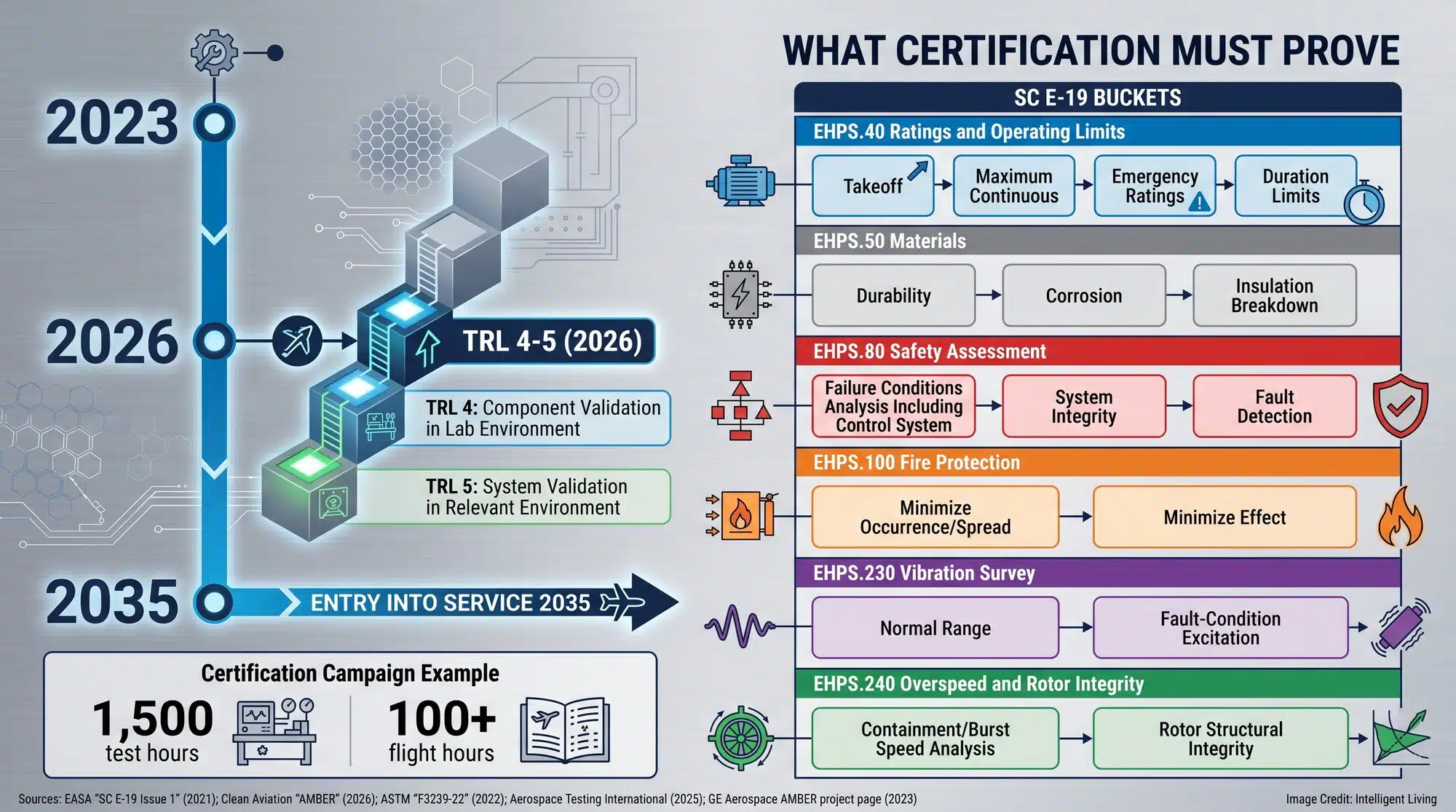
The Certification Roadmap for Hybrid Propulsion Deployment
Aerospace Validation Protocols and Strategic Timelines
Transitioning from Ground Testing to Flight Certification
Just because an engine looks great on paper doesn’t mean it’s ready to carry passengers. This motor is currently in a testing phase.
Engineers still need to prove it works perfectly in the real world. They must complete rigorous trials before they can ever think about letting it fly a regular route with a full cabin.
The EU AMBER project record frames the work as a structured pathway for next-generation regional aircraft, with formal milestones in the mid-2020s. Some partner descriptions also point to a 2035 entry-into-service target as a long-range goal, which is a reminder that aviation timelines are measured in years.
Adhering to Regulatory Rigor and Global Safety Standards
Certification in aviation is rigorous, data-driven, and methodical. The cost of failure is not a recall; it is an accident investigation.
This reality turns even promising propulsion hardware into a long sequence of test campaigns and documentation. Engineers must prove every component remains dependable even under extreme edge cases.
Coordinating Hydrogen and Sustainable Aviation Fuel Infrastructure
The future of zero-emission hydrogen airliners depends heavily on these lightweight motors.
But the motor is only one part of the puzzle. We also need the right fuel, new safety systems, and specialized airports to all be ready at the same time for this coordination to work.
A short regional route might be the first place to prove this coordination, because it limits infrastructure requirements to a smaller network of airports. That makes it easier to build early hydrogen and hybrid capability where it can actually be used.
Future Trends in Sustainable Hybrid Propulsion
This 750 kilowatt electric aircraft motor does not mark the end of fossil fuel aviation overnight. It does represent a measurable shift in what hybrid propulsion systems can realistically deliver in terms of power density, weight, and built-in redundancy.
Sustainable flight stack advancements continue to close the gap between experimental research and daily operational use.
Every breakthrough in motor density moves hybrid flight closer to commercial reality. This progress proves that cleaner skies are achievable through engineering precision.
The near-term story is regional. The long-term story is whether enough of these components, motors, fuel cells, fuels, and certification pathways can line up to make low-emission aviation normal rather than exceptional.
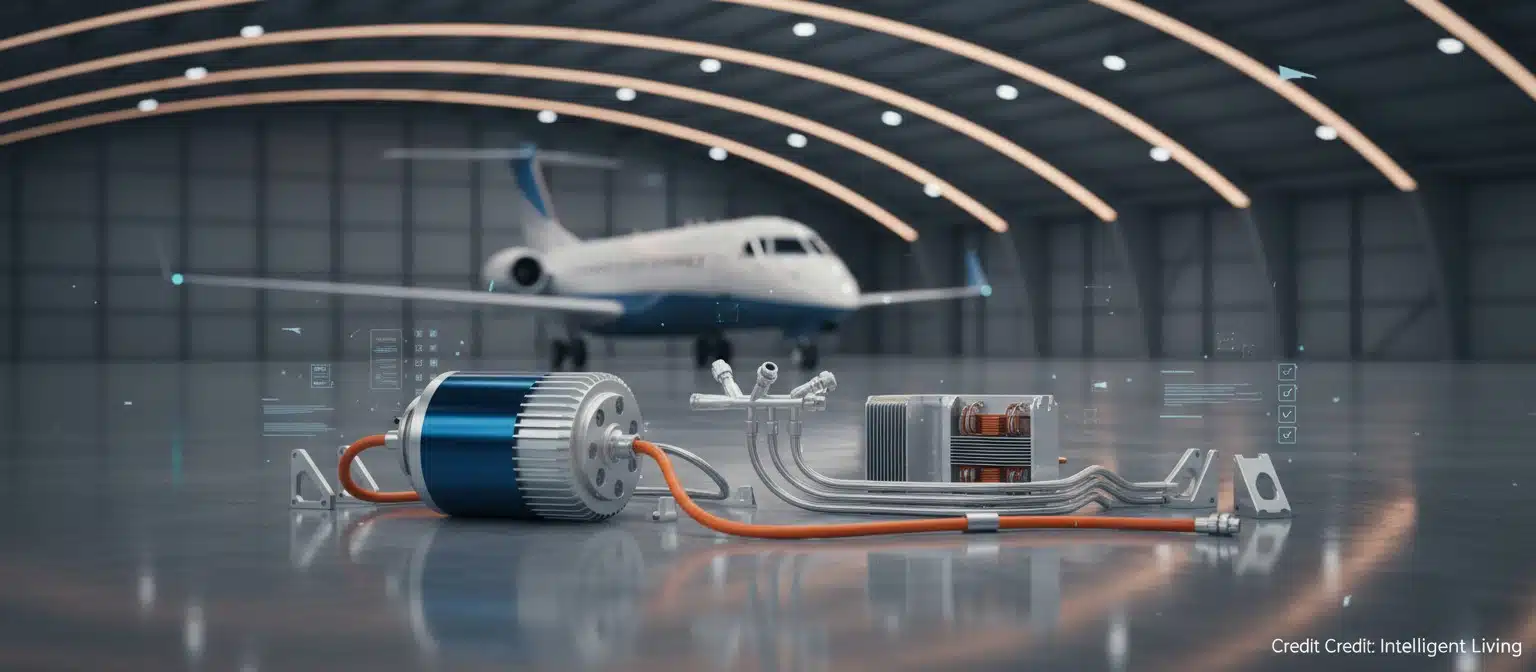
Scaling the Future of Hybrid Electric Propulsion
Hardware integration with hydrogen hybrid infrastructure represents the next major challenge for the industry. Moving validation from the lab to megawatt-scale environments allows engineers to focus on certifying these high-torque systems for safe, daily passenger service.
Regional routes are the ideal proving ground for this coordination. Especially as sustainable aviation fuel logistics move toward auditable, real-world supply chains, high-power-density motors remain the essential building blocks making that future a probability.
Common Questions About Hybrid Electric Aviation Motors
What is the power-to-weight ratio of the 750 kW Fraunhofer motor?
The motor achieves a power density of 8 kilowatts per kilogram. This means it delivers 1,000 horsepower while weighing only 207 pounds, which is significantly lighter than traditional electric motors of similar output.
Why do regional planes use hybrid systems instead of just batteries?
Current battery technology is often too heavy for long-distance flight. Hybrid systems combine electric motors with traditional engines to provide a high-torque boost during takeoff while extending range through liquid fuel or hydrogen fuel cells.
How does direct oil spray cooling improve aircraft motor performance?
Direct oil cooling pulls heat away from the motor’s internal windings much faster than air cooling. This prevents the motor from “throttling” or losing power during heavy use, ensuring it remains dependable throughout the flight.
What makes the AMBER project different from other electric flight tests?
The AMBER initiative focuses on “megawatt-class” hardware that is ready for manufacturing and real-world validation. It aims to prove that these propulsion systems can be certified and integrated into regional aircraft by the mid-2030s.
How does a fault-tolerant motor design increase flight safety?
The motor is divided into four independent sections, each with its own inverter. If one section fails, the others continue to operate, allowing the pilot to maintain control rather than losing all propulsion at once.


