
Chronic back pain has quietly become a global health crisis, affecting over 600 million people according to recent low back pain statistics, and health experts worry that this number could rise to over 840 million by 2050 if trends continue. If you’ve been searching for long-term back pain management options, a recent breakthrough recently revealed a discovery that feels like a massive leap forward: a plant-based nanoparticle system that actually helps damaged spinal discs begin to repair themselves. This research explores “photosynthesis therapy,” using plant-derived components to restore damaged tissue in animal models.
The study, featured in Nature Communications and the South China Morning Post, reveals how microscopic plant elements—when awoken by light—can physically mend the structural integrity of failing spinal discs. By bridging the gap between botany and biology, researchers are finding new ways to combat degenerative disc disease (IVDD) at a cellular level.
You probably know the exact moment your back pain transforms from a nuisance into a full-time burden—like a long commute that ends in stiffening agony. While this science is currently limited to animal testing, understanding how light-activated plant nanoparticles for disc degeneration work helps us separate real medical progress from hype. These “shock absorbers” in your spine are vital for mobility, and keeping them hydrated and functional is the goal of every back pain management plan.
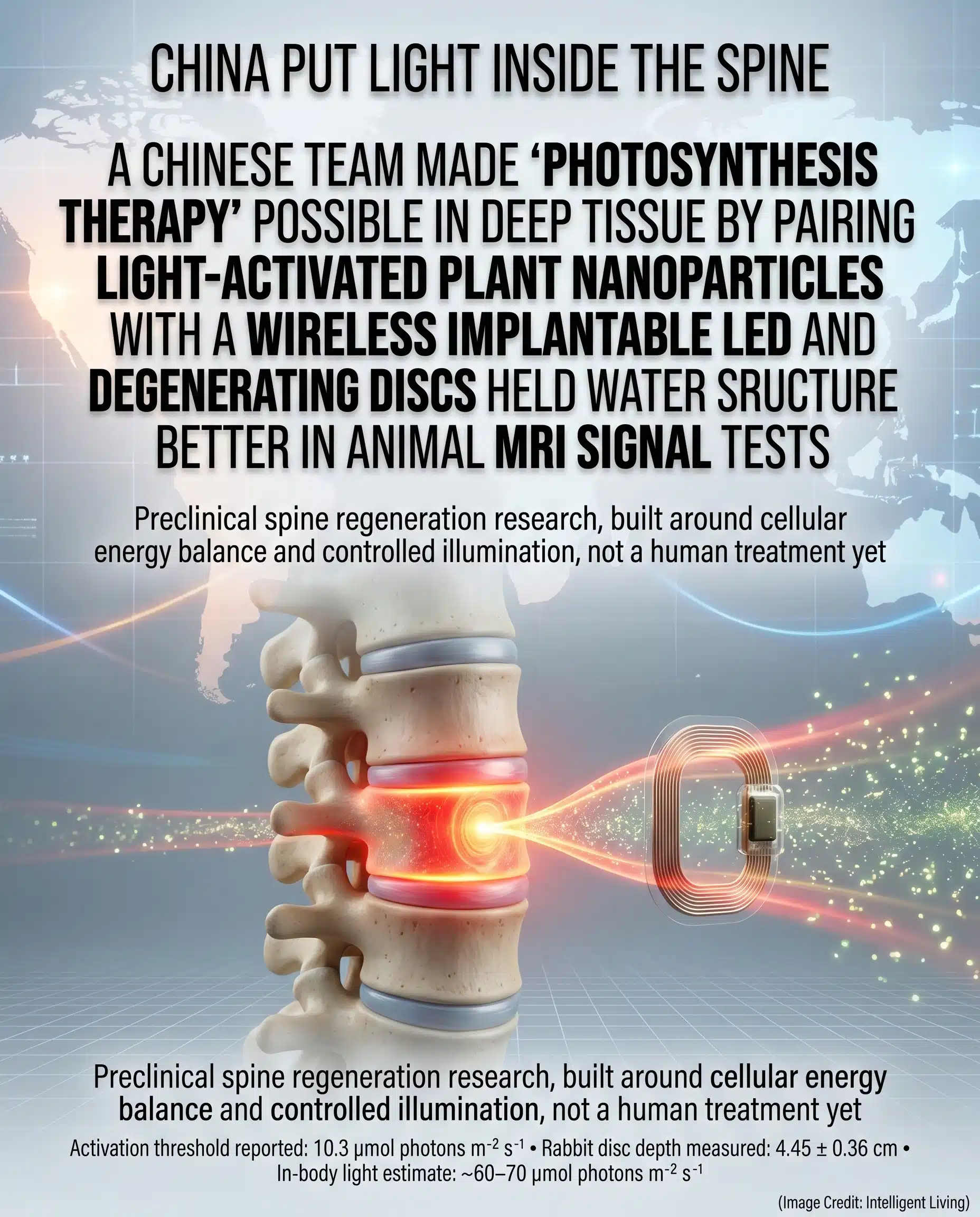
China’s Plant-Based Photosynthesis Therapy for Degenerative Disc Disease
What Happened in China’s New “Photosynthesis Therapy” Study
Understanding IVDD: Why Intervertebral Disc Degeneration Causes Chronic Pain
The study focused heavily on intervertebral disc degeneration research, often shortened to IVDD, which captures that slow and frustrating breakdown of the spine’s natural cushioning system that often keeps people from living their best lives. Your spinal discs act as essential shock absorbers, softening every movement and heavy load that travels between your vertebrae.
A water-rich center known as the nucleus pulposus spreads this pressure, as detailed in intervertebral disc anatomy. Over time, degeneration dries and stiffens this system. Once that cushioning fails, it often triggers the chronic pain, stiffness, and nerve irritation many people live with daily.
The Science of NTUs: Using Plant-Derived Nanothylakoid Units for Cellular Repair
Scientists lead the way by using tiny, plant-based parts called nanothylakoid units (NTUs) to breathe new life into damaged tissue. These microscopic components are harvested directly from the parts of plants that turn light into energy. They build on successful light-driven cellular repair studies to help sick animal cells start working again.
To make sure the body doesn’t reject them, the team gave these particles a special “disguise.” By using a coating made of disc-cell membranes, these membrane-coated nanoparticles can slip into the spine unnoticed, blending in with the surrounding tissue instead of triggering a defensive immune response.
Measurable Results: How Treated Spinal Discs Recovered Structural Integrity
In rat and rabbit models of disc degeneration, the animals received these nanoparticles and were then exposed to controlled light.
Imaging scans and tissue analysis later suggested that treated discs retained significantly better structure. These animals also showed healthier cellular markers than untreated groups, which aligns with how the biology and biomechanics of disc degeneration are tracked in high-level research.
Solving Tissue Penetration: The Role of Wireless Implantable LED Technology
To make light reach deeper tissue in rabbits, the researchers designed a wirelessly powered, implantable LED device. Instead of relying on external light, which fades quickly as it passes through skin and muscle, this small internal light source delivered targeted illumination directly near the damaged disc. That idea rhymes with real-world optoelectronics, including a smartphone-controlled neural implant that uses wireless control and light to stimulate tissue in research settings.
Essential Takeaways: What to Know About Light-Activated Plant Nanomedicine
To keep things clear, let’s look at exactly what this study uncovered. These takeaways answer common questions about the research methods, the specific targets, and why these animal results are making headlines.
- Reported in a March 2026 study describing a light-activated plant nanoparticle system.
- Tested in rat and rabbit models, not in human patients.
- Uses plant-derived nanothylakoid units activated by light.
- Targets cellular stress in intervertebral disc degeneration.
- Includes a proposed wirelessly powered, implantable LED system to reach deep tissue.
Taken together, these facts describe a light-activated nanomedicine concept aimed at disc degeneration rather than a general wellness trend. They also frame the two hardest problems this field keeps running into: getting a therapy into a poorly supplied spinal disc and delivering enough light to activate it safely.

The Biology of Light: Explaining How Photosynthetic Nanoparticles Heal Cells
Most of us know photosynthesis as the way plants turn sunlight into energy. Inside every plant cell, tiny structures called thylakoids do the heavy lifting of capturing light. By shrinking these structures down to a nanoscale size, researchers have figured out how to deliver that same energy-producing power directly into damaged spinal discs.
Once embedded in stressed tissue and triggered by light, these NTUs begin conducting the complex conversation between a cell’s internal structures. By restoring balance to the mitochondria–endoplasmic reticulum contact sites, the treatment helps coordinate vital energy and calcium signals that typically fail during decay.
Under degenerative stress, this cellular coordination often breaks down completely. Researchers noted several key failures:
- Calcium levels become dysregulated and unstable.
- Cell membrane properties shift and lose flexibility.
- Mitochondria struggle to generate energy efficiently.
The study found that light-activated NTUs stepped in to fix these issues. By regulating calcium balance and improving membrane fluidity, the treatment successfully reduced harmful cellular stress markers.
This approach is part of a broader research direction exploring light-driven biological energy systems. A separate 2025 paper highlighted successful heart tissue recovery using these same light-driven methods, proving that scientists everywhere are exploring how light can jumpstart healing when our bodies struggle to do it on their own.

Wireless Implantable Light and Why Back Pain Research is Paying Attention
Delivering Energy to the Spine: The Mechanics of Wireless Implantable LEDs
You might be wondering how light can reach a target buried deep inside your back. It’s the most common question people ask when they hear about this therapy.
Human tissue absorbs and scatters visible light very quickly. Simply shining a flashlight on your lower back won’t deliver energy to a disc buried deep between vertebrae. Most light vanishes long before reaching the gel-like core, which is why a specialized internal lighting strategy was required.
Overcoming Visibility: The Barrier of Light Absorption in Human Tissue
To address this, the researchers tested a wirelessly powered implantable LED device in rabbits. The system relies on energy transfer methods similar to those described in reviews of wireless power transfer techniques for implantable medical devices, where power can be delivered across tissue without hardwired connections. In practice, this often means near-field coils to send energy through skin and muscle to a tiny receiver, carefully designed to stay stable without generating dangerous heat.
Wireless Power Transfer: Enabling Targeted Illumination in Deep Spinal Tissue
Instead of bulky batteries, wireless systems can transmit energy from outside the body to a small implanted receiver. In the study, this enabled controlled illumination directly at the disc site. The hard part is not just turning the light on but setting a dose that activates the nanoparticles while staying within safety margins for surrounding tissue. That engineering direction matches a long-running push toward tiny implantable wireless devices designed to do more inside the body with less hardware and fewer repeat procedures, including concepts as extreme as injectable wireless chips that illustrate how far miniaturization can go.

A New Frontier: Addressing the Global Burden of Low Back Pain Disability
Solving a Global Crisis: The Need for New Chronic Back Pain Management Options
As the primary cause of global disability, low back pain creates a massive demand for new solutions. This widespread burden is why laboratory breakthroughs like these photosynthesis therapy experiments generate such immediate interest in the medical community and beyond. While many cases improve with physical therapy, movement, and conservative care, the WHO guidance on chronic low back pain emphasizes approaches that protect function and avoid unnecessary interventions, even as a condition like degenerative disc disease can become chronic and deeply disruptive.
Navigating Treatment: Comparing SI Joint Injections, Epidurals, and Fusion Surgery
In advanced cases, treatment paths often diverge because pain sources vary. Patients frequently have to weigh complex options:
- Choosing between sacroiliac joint injections versus epidurals for immediate relief.
- Opting for posterior lumbar interbody fusion to gain structural stability.
- Addressing narrowing around nerves, where the specific location of spinal stenosis dictates the symptoms you experience.
Standard surgeries stabilize the spine, but they don’t heal the underlying tissue. This limitation is driving the shift toward biology-first treatments that aim to regrow or repair the disc itself.
Why a Biology-First Approach is Interesting
If light-activated plant nanoparticles can truly influence disc cell health, even partially, they represent a new direction. The approach targets cellular stress and energy regulation rather than simply mechanically stabilizing the spine. That difference is subtle but important.
The Road Ahead: Potential Medical Uses and Challenges for Photosynthetic Therapy
5 Ways Photosynthesis Therapy Could Revolutionize Regenerative Medicine
If these findings are confirmed in human trials, they won’t just change how we treat back pain. This breakthrough could revolutionize light-controlled therapies for any injury where low blood flow makes healing difficult.
Here are five ways this plant-based energy system could reshape the future of medicine:
- Disc Repair Research: It could expand regenerative strategies for intervertebral disc degeneration.
- Light-Activated Therapies: It may accelerate interest in precisely controlled, implant-assisted light treatments, building on what near-infrared light for joint pain is already being studied for in more familiar body areas.
- Organelle-Focused Medicine: Therapies that restore communication between cell structures could gain momentum.
- Hybrid Bio-Plant Systems: More exploration into plant components interacting with animal biology, including experimental lines like chloroplast transplantation into mammalian cells that test cross-kingdom biology.
- Implantable Bioelectronics: Wireless power systems for targeted therapy could become more refined and widely studied.
Navigating the Hype: Current Limitations of Preclinical Animal Research
Not a Human Treatment Yet
The research remains preclinical. No human trials have been conducted. Animal models can reveal whether a concept is biologically plausible, but they cannot capture the full complexity of human pain, aging, and day-to-day mechanical wear.
Safety and Oxidative Stress Questions
Refining the safety profile is the next big challenge. While light triggers healing, it can also spike reactive oxygen species, creating a delicate balancing act for engineers trying to protect sensitive tissue while delivering therapeutic energy.
Separating Lab Implants from Consumer Light Gadgets
It also helps to separate this research from consumer wellness trends. Some forms of red light therapy and photobiomodulation aim to influence cellular activity with specific wavelengths, which helps explain why researchers treat light as a controllable biological input.
The Long Road to Trials
Confirming these results through more testing would give researchers more than just a new tool for spine care. It could completely change how we think about healing parts of the body where low blood flow usually causes recovery to stall. Many promising animal studies never successfully transition into approved clinical treatments.

Integrating Plant Biology: Shaping the Future of Holistic and Clinical Spine Care
Using plant biology to fix animal tissue is a bold new direction for regenerative medicine for chronic low back pain. This early work proves that light-activated NTUs can help heal your cells from the inside out by restoring their natural energy balance. While it isn’t a human cure yet, it offers a new lens on how wireless implantable technology and cellular energy might finally solve the stubborn problem of spinal decay.
Even as we wait for these high-tech treatments, your daily choices still dictate your spine’s future. The health risks of sedentary jobs and daily habits that strain the spine can lead to months of discomfort if left unchecked. Whether through future light therapy or better movement today, protecting your intervertebral disc anatomy is the key to staying mobile as you age.
Revolutionary Back Pain Research: FAQ for Photosynthesis Therapy
What are photosynthetic nanoparticles for back pain?
These are microscopic, plant-derived “nanothylakoid units” designed to enter stressed spinal cells and react to light to trigger healing and energy production.
Can photosynthesis therapy cure human degenerative disc disease?
Not yet. Current breakthroughs have only been successful in preclinical animal studies, though they provide a foundation for future human trials.
How does a wireless implant help with spinal healing?
Since light cannot naturally reach deep spinal tissues, researchers developed a wireless implantable LED to deliver controlled illumination directly to the damaged disc.
Is light-activated disc repair safe for everyone?
Safety for humans hasn’t been established. Scientists are still studying how to manage reactive oxygen species and ensure these nanoparticles don’t cause unwanted immune reactions.
How can I fix my chronic back pain today?
While you wait for lab research to reach clinical trials, focus on movement, ergonomics, and understanding how spinal discs fail to protect your spine.

