
Implantable electronics are not something new. They have been using them already to steady hearts, calm tremors, and heal wounds—but at an inconvenience. The technology involves machines that are large, obtrusive contraptions with batteries and wires. Furthermore, the device requires surgery to implant and often needs replacement. Fortunately, researchers have been coming up with a better, more convenient and comfortable way, that doesn’t involve all of this.
Just recently, the Materials Research Society had a conference where all sorts of professionals got together to talk about their current research and technological advances. At this meeting, a group of biomedical engineers unveiled bioelectronics that can do more in less space, require no batteries, and can even dissolve when no longer needed. Here are a few methods from the meeting that really stood out:
Different People With Different Approaches To Using This Technology
John Rogers
John Rogers is a materials scientist at Northwestern University in Evanston, Illinois. He and his collaborators are working on improving an existing device that surgeons use to stimulate the healing of damaged peripheral nerves in trauma patients.
When a patient undergoes surgery, the doctors stitch severed nerves back together and then provide gentle electrical stimulation by placing electrodes on either side of the repair. The thing is, they can only provide this stimulation for an hour or less because the wounds have to be closed as soon as possible to prevent infection.
Rogers and his team were analyzing this situation and got an idea. A few years ago, they developed a soft flexible, dissolvable electronic material. What if the surgeons could use this material to continue the electric nerve stimulation? They would place it on the stitched-up nerves before closing the wound.
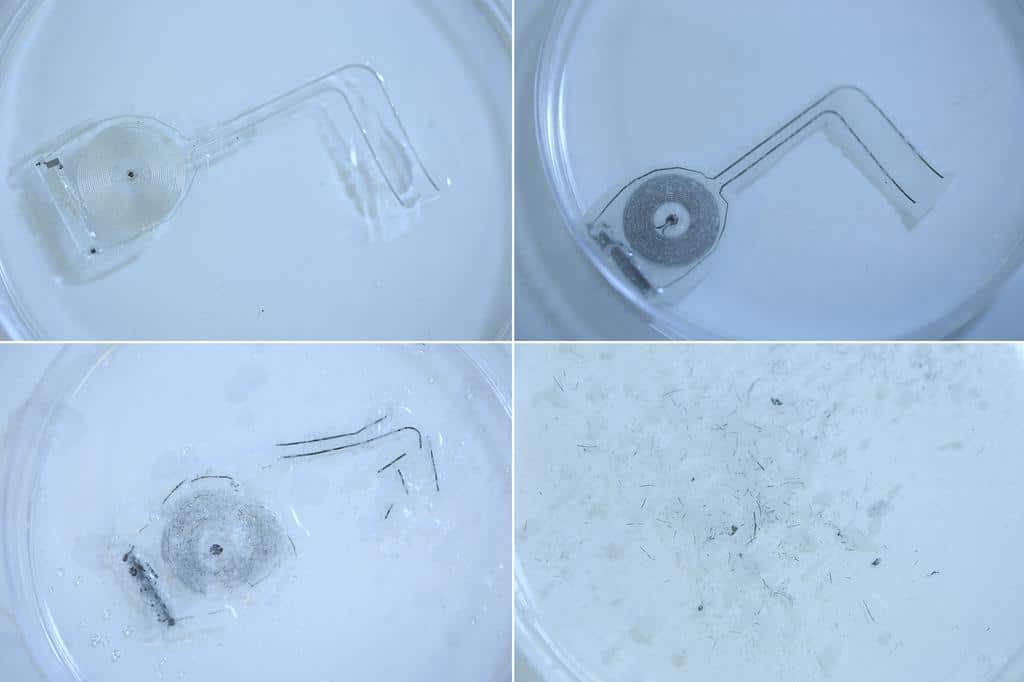
How It Works:
- The material itself consists of a mix of metals, semiconductors, and polymers to fashion a simple coil with two electrodes.
- The coil was designed to act as an antenna.
- The antenna picks up radio-frequency pulses transmitted wirelessly from outside the body.
- It then converts them into mild electrical pulses inside the body.
The Experiment:
- 25 rats were involved. The following procedure was carried out on all of them.
- They cut the sciatic nerve to one of the hind legs, then implanted the device.
- After the surgery, they stimulated the nerve ends for 1 hour a day for up to 6 days.
The Results:
- The stimulation sped up nerve healing by about 50% (compared with animals that received no stimulation or just one or a few days of it).
- There was no need to reopen the wounds to remove the gadgets (because the materials broke down and were excreted). Rogers said that “after 21 days the device is completely gone, and there appeared to be no adverse effect from degradation.”
- This study was reported on in the 8 October issue of Nature Medicine.
Xudong Wang
Xudong Wang is a bioelectronics expert at the University of Wisconsin in Madison. His research is branching off of a technology that has been pioneered by others to convert the body’s motion into electrical current. By taking advantage of this given information, he is developing miniature wireless devices to help people lose weight.
The currently available devices that apply this technology are pacemaker-size and contain batteries that often need replacement, requiring repeated surgeries. Wang’s version would not require any of this.

How It Works:
- The nickel-sized implant is only 1 millimeter (mm) thick and attaches to the outside of the stomach.
- It uses power generated by stomach movements to subdue feelings of hunger. Wang says that “once we eat something, the stomach starts to digest and move in a waveform, and that movement activates our device. It doesn’t need a program. The body uses its own function.”
- It does this by stimulating a branch of the vagus nerve, which runs from the colon and stomach to the brain stem. This stimulation helps relay the signals of fullness after eating.
The Experiment:
- They implanted the device on the outer wall of a rat’s stomach.
- When the rat ate, the organ’s motions would then power the generator.
The Result:
- The animals with the generator ate at normal times, but less than control animals.
- Rats with the implant lost 38 percent of their body weight over 18 days, at which point their weight stabilized.
- Rats in control groups, which either did not receive the implant or had a sham implant, did not lose any weight.
- This study was published in the journal Nature Communications.
Bonus Experiment:
- They put a similar fingertip-size generator that delivered a stream of tiny electrical pulses to wounds on rats’ skin instead of in their stomach.
Result:
- It sped up healing.
- This study was reported on 29 November in ACS Nano.
Jacob Robinson
Jacob Robinson is an applied physicist at Rice University in Houston, Texas. His device is intended to replace the large, battery-powered brain stimulators used to control tremors in some patients with Parkinson’s disease. He shrank his implantable stimulator even further than everyone else – to the size of a grain of rice.
How It Works:
- It is powered by magnetic field pulses delivered from outside the body.
The Experiment:
- They took rats with a version of Parkinson’s disease and implanted his minuscule device in the subthalamic nucleus (which is the same brain region targeted by larger devices currently used).
The Result:
- The animals’ tremors disappeared and their movements overall became normal.
In Conclusion

By making bioelectronics easier to live with, these advances could even expand their use and bring a new approach to medicine beyond pharmaceuticals. Many people got very excited and had great things to say about this technology at the meeting, so its use will surely be a reality in the near future making lives easier and necessary medical procedures more comfortable.


