
The Korea Advanced Institute of Science and Technology (KAIST) research team, led by Professor Jae-Woong Jeong, invented a fully implantable, soft optoelectronic system for a brain implant. It can be remotely and selectively controlled by a smartphone app and recharges wirelessly from outside the body.
KAIST researcher and co-lead author Choong Yeon Kim, who is also a professor of physiology at Yonsei University’s College of Medicine, said, “This device can be operated anywhere and anytime to manipulate neural circuits, which makes it a highly versatile tool for investigating brain functions.”
The ability to recharge wirelessly is fantastic because periodic battery replacement surgeries are no longer necessary so that scientists can control neural circuits for long periods. To top it off, the implant’s smartphone-controlling feature allows for real-time brain manipulation and eliminates the need for tethers or bulky equipment.
Co-lead author Professor Jae-Woong Jeong, who is also a KAIST researcher, said, “This powerful device eliminates the need for additional painful surgeries to replace an exhausted battery in the implant, allowing seamless chronic neuromodulation.”

The press release explained the device as such: “The device is constructed of ultra-soft and bio-compliant polymers to help provide long-term compatibility with tissue. Geared with micrometer-sized LEDs (equivalent to the size of a grain of salt) mounted on ultrathin probes (the thickness of a human hair), it can wirelessly manipulate target neurons in the deep brain using light. To enable wireless battery charging and controls, researchers developed a tiny circuit that integrates a wireless energy harvester with a coil antenna and a Bluetooth low-energy chip. An alternating magnetic field can harmlessly penetrate through tissue and generate electricity inside the device to charge the battery. Then the battery-powered Bluetooth implant delivers programmable patterns of light to brain cells using an “easy-to-use” smartphone app for real-time brain control.”
Furthermore, wireless charging technology helps minimize stress and inflammation in animals during experiments since they can freely move around as they usually would.
The pursuit of softer, less irritating interfaces has moved on since. A team in Denmark and the UK has now built a needle-thin brain implant that combines recording, light stimulation, and drug delivery in a single flexible fiber, designed to move with brain tissue rather than cut through it.
Min Jeong Ku, another co-lead author and a researcher at Yonsei University’s College of Medicine, said, “Wireless battery recharging makes experimental procedures much less complicated.”
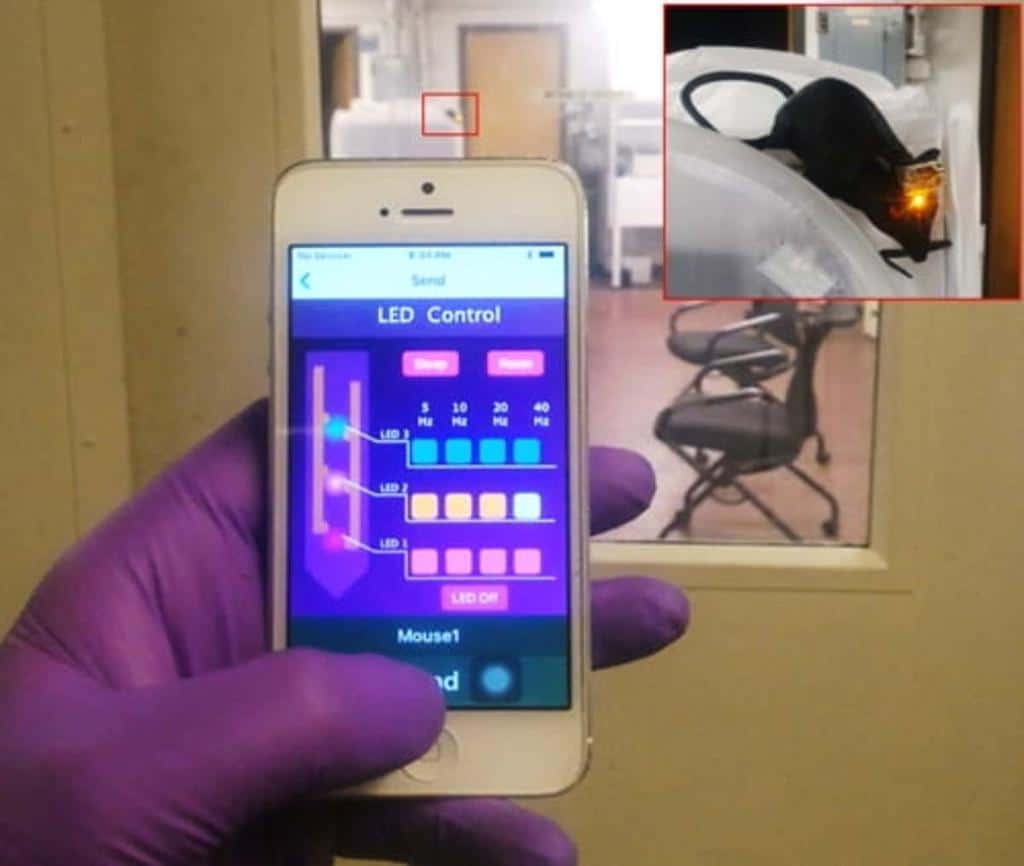
During this particular test, the scientists injected rats using implants with cocaine. Then, they blocked cocaine-associated behaviors in the animals immediately from the app.
Professor Kim said, “The fact that we can control a specific behavior of animals by delivering light stimulation into the brain just with a simple manipulation of the smartphone app, watching freely moving animals nearby, is fascinating and stimulates a lot of imagination. This technology will facilitate various avenues of brain research.”
But the implant’s abilities aren’t limited to the brain! The researchers believe the technology can lead to therapeutic intervention to treat disease in other organs, too.
Jeong said, “We believe that the same basic technology can be applied to various types of implants, including deep brain stimulators and cardiac and gastric pacemakers, to reduce the burden on patients for long-term use within the body.
Unlike implantable systems that require surgery, a recent noninvasive ultrasound patch for REM sleep shows how deep-brain circuits can be targeted from the skin.
The team envisions this technology being used to uncover and treat psychiatric disorders (like depression and addiction), neurodegenerative diseases (such as Parkinson’s), and so much more. The list of potential applications is long.


