
A University of Washington (UW) team developed an innovative “smelling” autonomous drone—dubbed Smellicopter—that uses a live moth antenna to navigate toward smells. Smellicopter has incredible potential; it can already sense and avoid obstacles mid-flight. The discovery was published on Oct. 16, 2020, in the journal IOP Bioinspiration & Biomimetics.
“I’m sure that the drone would be able to fly on Mars,” said Melanie Anderson, a doctoral student in mechanical engineering at UW. It’s currently unclear how a moth antenna would endure the Martian atmosphere, but “if it did survive, it could smell chemicals there too.”
Smellicopter Advantages
These little drones can explore where people can’t—such as dangerous and deadly areas, like the catastrophic aftermath of a natural disaster, unexploded devices, or unstable structures.
Worldwide, engineers are actively pursuing the development of advanced drones that can expertly maneuver through challenging situations—via the “smell” of chemicals—to pinpoint the location of gas leaks, explosives, disaster survivors, and more.
“We designed the Smellicopter so that it would be small and fit into small indoor spaces, which are not usually accessible to large drones,” said Anderson. However, if some components were exchanged for ones more suitable for Mars, the Smellicopter could potentially “smell” odors on the Red Planet.
Artificial Sensors vs. Natural
Most artificial sensors aren’t sensitive or fast enough to recognize, process, and follow specific odors while flying.
Anderson said, “Natural sensors are much better at detecting odors than portable artificial sensors. Moth antennae are small, lightweight, low-powered, and extremely sensitive compared to artificial sensors. By using an actual moth antenna with Smellicopter, we’re able to get the best of both worlds: sensitivity of a biological organism on a robotic platform where we can control its motion.”
Live Moth Antenna
Moths use their antennae to navigate toward food or potential mates and can smell chemicals in the environment. “Cells in a moth antenna amplify chemical signals,” explained Thomas Daniel, the study’s co-author.
Anderson added, “Our antennae come from a model moth species, the Manduca Sexta, which is used for a lot of other research in our lab such as muscle mechanics and even learning.”
The UW team placed the moths in a fridge to anesthetize them before removing the antenna from their bodies. Once the antenna is separated from the live moth, it remains active (chemically and biologically) for approximately four hours. Though, that time limit could be extended by storing the antennas back in the fridge.
The team added tiny wires into both ends of the antenna and then connected it to an electrical circuit, allowing them to measure the antenna cells’ average signal. This signal was then compared to an artificial sensor by placing both devices at the end of a wind tunnel and releasing smells to breeze down the channel of air toward both sensors. These scents involved ethanol and a floral aroma.
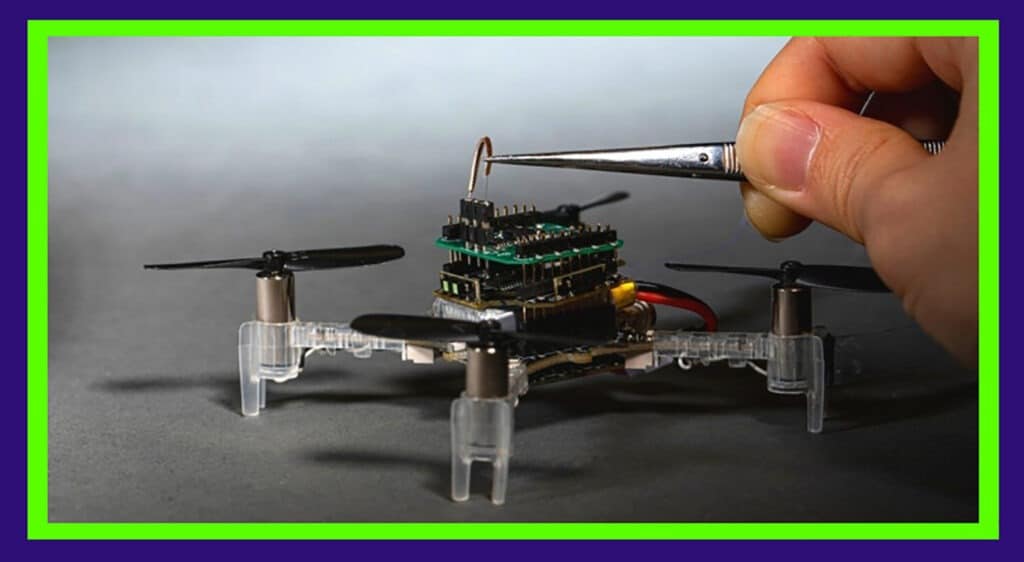
Anderson added, “We based the Smellicopter’s search trajectory off of a nature-inspired research algorithm much like what a moth does to seek out odors. When you smell the odor, and there is a slight breeze, you can almost always assume that the source of the odor is upwind from you since odor travels with the wind.”
Remarkably, the drone with the moth antenna reacted faster, recovering between odor gusts with less delay time. “The algorithm, cast-and-surge, takes advantage of this fact so that when the Smellicopter smells an odor, it flies upwind, and when it loses track of the odor, then it casts crosswind until it picks back up the odor trail. This produces a pretty robust tracking system,” explained Anderson.
Anderson said, “The Smellicopter drone base is the Crazyflie 2.1 from the company Bitcraze. Their open-source hardware and software have been a valuable resource to design and alter the drone platform to add our custom, fins, antenna sensor, and software for the search algorithm.”
Avoiding Obstacles
Smellicopter uses the ‘cast and surge’ algorithm, designed by the UW team, to hunt odors. The drone avoids obstacles using four infrared sensors that can measure its surroundings about ten times per second. When an object is within approximately eight inches (20 cm) of the drone, it changes direction by moving into the next phase of its cast-and-surge algorithm.
Anderson explained, “If Smellicopter was casting left and now there’s an obstacle on the left, it’ll switch to casting right. And, if Smellicopter smells an odor, but there’s an obstacle in front of it, it’s going to continue casting left or right until it’s able to surge forward when there’s not an obstacle in its path.”
Instead of using GPS to navigate, Smellicopter uses a camera to evaluate its surroundings, similar to how insects use their eyes.

Smellicopter on Mars
Whether the drone could detect odors on the Red Planet is up for debate. “I’m not sure how the antenna would react to the atmosphere,” Anderson added. However, if the antenna survived the interplanetary trip, it could pave the way for biometric drones like the Smellicopter to search for organic compounds (or smelly aliens) on Mars.
The UW team is working with a different laboratory “to genetically engineer moth antennae so that they are sensitive to other chemicals, like bomb scents,” explained Anderson.
Overall, Smellicopter has incredible potential in dangerous environments—from assisting in disasters to exploring new worlds. Meanwhile, the digital side of scent is advancing too: researchers at Yale have developed an AI model that predicts how humans perceive complex odor mixtures, laying the groundwork for digitizing the sense of smell itself.


