
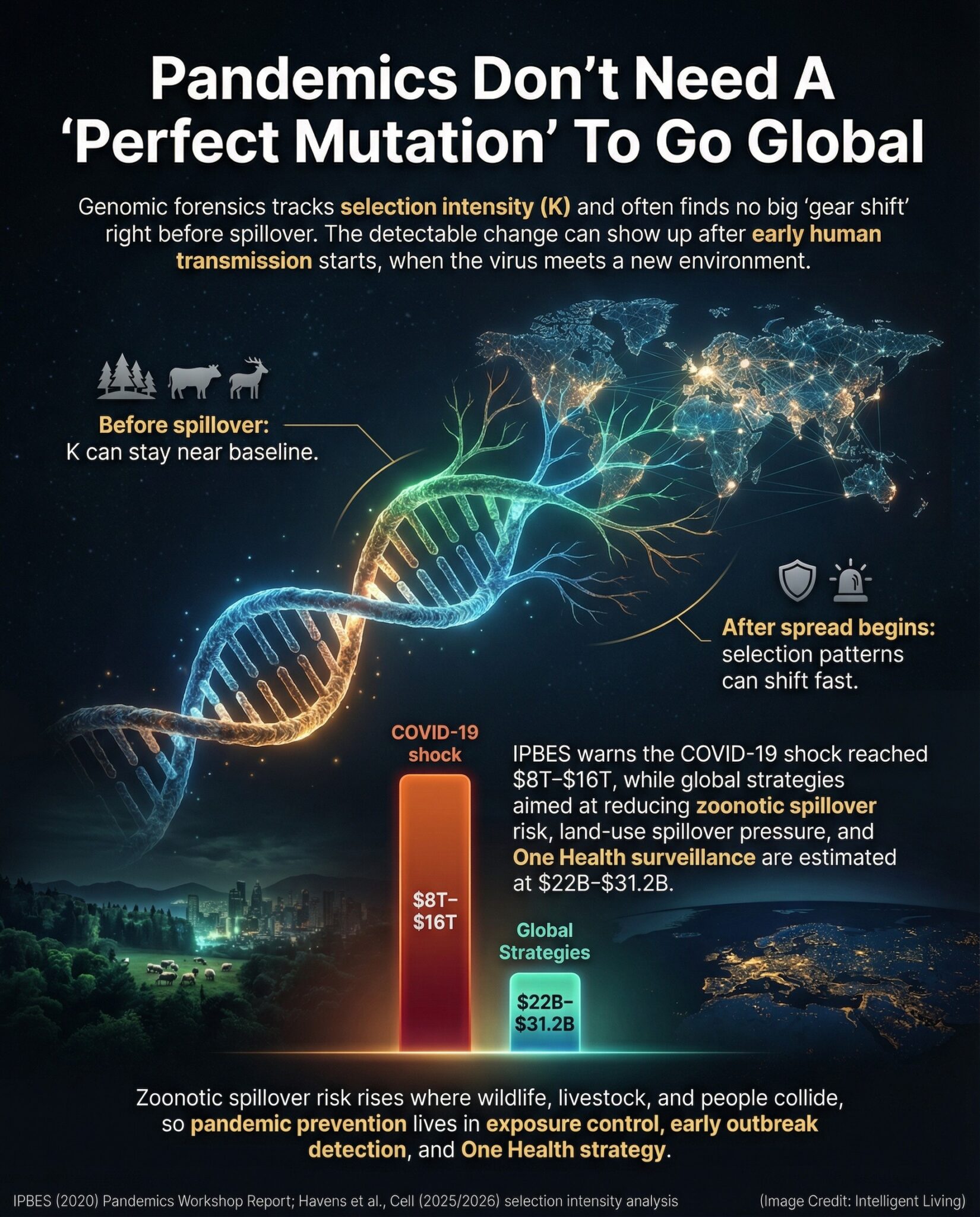
Pathogens don’t always follow the rules of a slow genetic runway. While many believe a virus must “learn” to infect people through a specific string of mutations before it can spread, the truth is often less predictable.
A recent study focusing on viral selection patterns before pandemics challenges this view by asking if scientists can detect a distinct evolutionary “gear shift” in a genome right before human transmission begins. Findings suggest that for many zoonotic spillover events, the answer is no. Instead, the real driver is opportunity—a chaotic combination of animal contact, dense social networks, and delayed detection that allows a pathogen to take hold before anyone notices.
Decoding Pre-Adaptation Signals and Zoonotic Spillover Reality
Quick Facts: What Readers Should Know About Pre-Adaptation and Spillover
- Look closely at the data and you’ll find no evidence of a consistent, detectable shift in selection intensity right before several major human outbreaks. This conclusion stems from patterns found by tracking how epidemic viruses shift across their entire phylogenetic history.
- The core test looks for changes in evolutionary pressure on the short branch right before a human outbreak. It then compares that pattern to evolution in animal reservoirs and early human transmission.
- “No detectable pre-adaptation signal” is not the same as “no animals” or “no intermediate host.” Brief circulation and sampling gaps can hide real biological detours that genomes simply don’t record.
- The 1977 H1N1 reappearance remains a widely discussed exception, often cited because its genetics look unusually close to older strains, which makes it useful for thinking about anomalous evolutionary patterns.
- Prevention implications lean toward reducing spillover opportunities and catching early transmission faster, rather than waiting for a hypothetical single mutation to announce danger.
- The cross-pathogen research database provides a broader look at these findings, framing this as a global question rather than a single-outbreak issue.
The Headline Problem: What “Jumped Directly to Humans” Really Means
How the ‘Direct Jump’ Phrase Often Gets Misread
Headlines that say a virus “jumped directly to humans” can land in two different places. One interpretation implies an animal origin is being dismissed. A more precise interpretation, aligned with the study’s approach, is narrower: the genome does not show a long, detectable episode of evolutionary change under a new selection regime right before human spread, echoing reports of viruses spreading without prior adaptation without significant early changes.
Why Genomes Do Not Record Events
Evolutionary tests don’t record events like a camera; they detect statistical patterns buried within genetic sequences.
If a virus circulated briefly in an intermediate host, a real biological detour can be hard to see. This is especially true if sampling of reservoir viruses is sparse. Think of a bridge crossed at dawn when no cameras are watching. The bridge still exists, but the evidence trail is thin.
A Real-World Spillover Blind Spot
A minimal, human-scale example shows how this plays out: a small livestock farm that swaps animals with neighbors on a routine schedule can create many short contacts that are difficult to reconstruct later, even though those contacts can shape spillover risk.
Genomic Forensics and Selection Intensity: Analyzing Outbreak Patterns
Simplifying Genomic Forensic Principles and Selection Tests
Analyzing the Three Windows of Viral Evolution
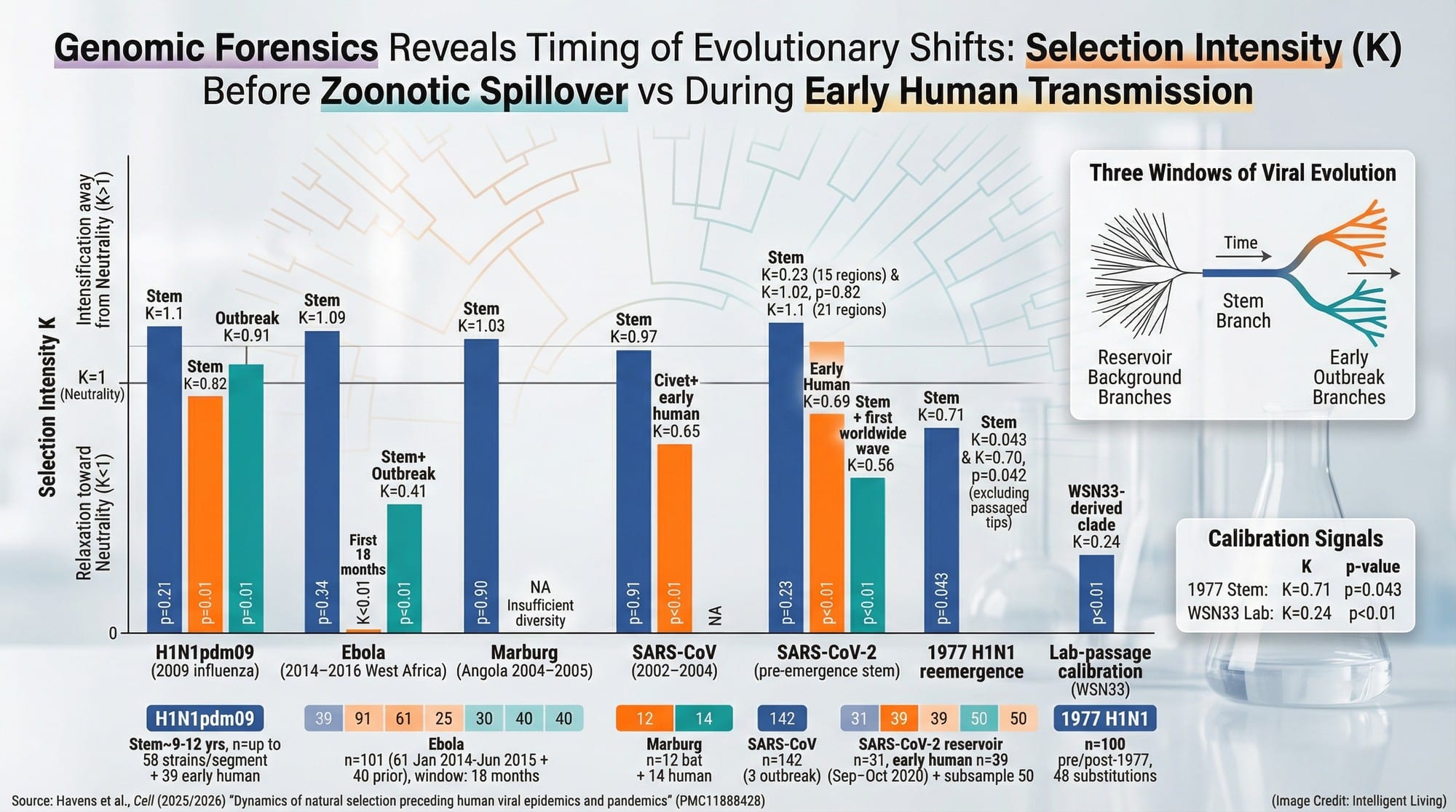
Treating viral genomes as forensic evidence offers a powerful lens for tracking pandemic origins, provided the analogy remains grounded in data. The method in this study compares three windows of evolution: the reservoir-host background, the short branch right before the human outbreak (the stem), and early human transmission branches. The goal is to test whether the stem looks like it experienced a meaningful change in evolutionary pressure compared to the background.
What RELAX and K Measure
One way to formalize that idea is the RELAX framework, described in the RELAX framework for codon analysis and implemented in HyPhy. It summarizes shifts in selection intensity with a parameter called K. K above one suggests intensification of selection, while K below one suggests relaxation toward neutrality.
HyPhy’s guide to selection models explains how these tools function under the hood, especially the difference between a change in selection intensity and a claim about a real-world “cause.”
Why Scale and Sampling Shape What You See
Both cost and the scale of testing determine which viral patterns scientists actually see. When sequencing economics shift, workflows like genome sequencing priced near $100 per person change who can run large surveillance programs and how quickly, and choices around cost-efficient NGS library prep strategies often determine whether sequencing stays confined to a few labs or becomes routine at scale.
A brief, relatable example helps keep expectations realistic: a field team can sequence only what it captures, so a biologist collecting a handful of bat samples at a remote site might miss the particular lineage that later seeded a human outbreak.
What this Test Can and Cannot Tell You
Understanding the boundaries of these tests is critical for interpreting pandemic origins. While genomic signals offer deep insights, they are part of a larger forensic puzzle that requires context.
- It can show whether the branch immediately preceding a human outbreak has a detectable change in selection intensity compared with typical evolution in reservoir hosts.
- It cannot prove there was no intermediate host, and it cannot rule out brief circulation that left a weak genetic footprint.
- It cannot replace field ecology, outbreak investigation, or direct epidemiological tracing.
These limitations remind us that genomic data works best alongside field evidence. Relying solely on sequences can lead to narrow conclusions about how a pathogen actually emerged.
Analyzing Evolutionary Trends Across Global Outbreak Viruses
Where the Selection Shift Shows Up
Using the same framework across multiple epidemics and pandemics, the authors report a recurring pattern: the strongest detectable shifts in evolutionary pressure often show up after sustained human transmission begins, rather than right before the jump.
Opportunity Beats Mutation in Practice
Most viruses bypass the long genetic runway. They flourish when human systems create vulnerabilities, such as high animal-contact rates and dense social networks.
A small, everyday example makes this concrete: when a community clinic notices an unusual cluster of respiratory cases and reports it quickly, the response time can shape whether early transmission chains fizzle or expand, which is the same logic public health teams apply when using genome data to spot clusters sooner.
To keep the story grounded beyond any one disease, the framing in swine flu monitoring shows how outbreak risk is often discussed in terms of exposure and monitoring, not a single decisive mutation.

Evolution, Detours, and Human-Ready Traits in Pandemic Emergence
The 1977 H1N1 Time Capsule: The Exception that Teaches the Method
The 1977 reappearance of an H1N1 influenza strain is a rare and instructive outlier. Genetic analyses have long noted that it looked unusually close to older strains, including arguments regarding lost evolutionary periods that suggest preserved sources. The episode is frequently discussed in the context of biosafety and scientific transparency.
In research circles, the 1977 H1N1 genetic debate explains why this event is treated differently from typical zoonotic emergence and why it still matters as a cautionary reference point.
This outlier is useful because it shows what a genuinely anomalous evolutionary pattern looks like. It is also a reminder not to treat every outbreak as if it must fit one dramatic template.
A concise anecdote from the research world captures the mood: some labs still use “1977” as shorthand for the uncomfortable reality that unusual patterns can demand uncomfortable questions.
Do Intermediate Hosts Still Matter?
Intermediate hosts haven’t lost their importance in the spillover story, but we need to rethink their role. Rather than acting as long-term stepping stones, these hosts may only provide a brief, undetectable bridge between species.
Several analytical factors can blur the signals of zoonotic spillover. When these events occur, the genetic record is often incomplete or messy.
- The intermediate phase may be too brief to leave a detectable signature.
- Current sampling often misses the specific lineage that leads to an outbreak.
- Processes like recombination and reassortment can complicate the evolutionary trail.
Practically, the implication remains steady regardless of these gaps. Limiting opportunities for cross-species transmission is the most reliable way to reduce future risk.
Short-contact environments can make this intuitive. The risk is not only in long-term farming systems but also in fast-moving trade and handling settings, including wildlife trade settings that remained active during global lockdowns.
The Shared Lock: How ACE2 Helps Explain “Human-Ready” Traits
A mechanistic reason some viruses bypass a long pre-adaptation runway is that they already carry traits that lower the infection barrier. These ‘human-ready’ features allow for a more rapid transition into human populations.
For certain coronaviruses, ACE2 binding is not a single rare trick. It is a capability found across related lineages that can evolve through relatively small changes.
Specific evidence regarding ACE2 binding as an ancestral and evolvable trait exists across diverse coronaviruses, which shows how ‘human-ready’ traits emerge without a long prelude.
It is still important to separate necessary from sufficient conditions. Binding to a receptor can be necessary for entry, but a pandemic also depends on transmission routes, immune escape, and social opportunity.
Receptor binding works like a rough key that already fits the lock. Even so, notice how a global crisis still requires an open door and a crowded hallway to truly take off.
Shifting Pandemic Prevention Strategies and Detection Priorities
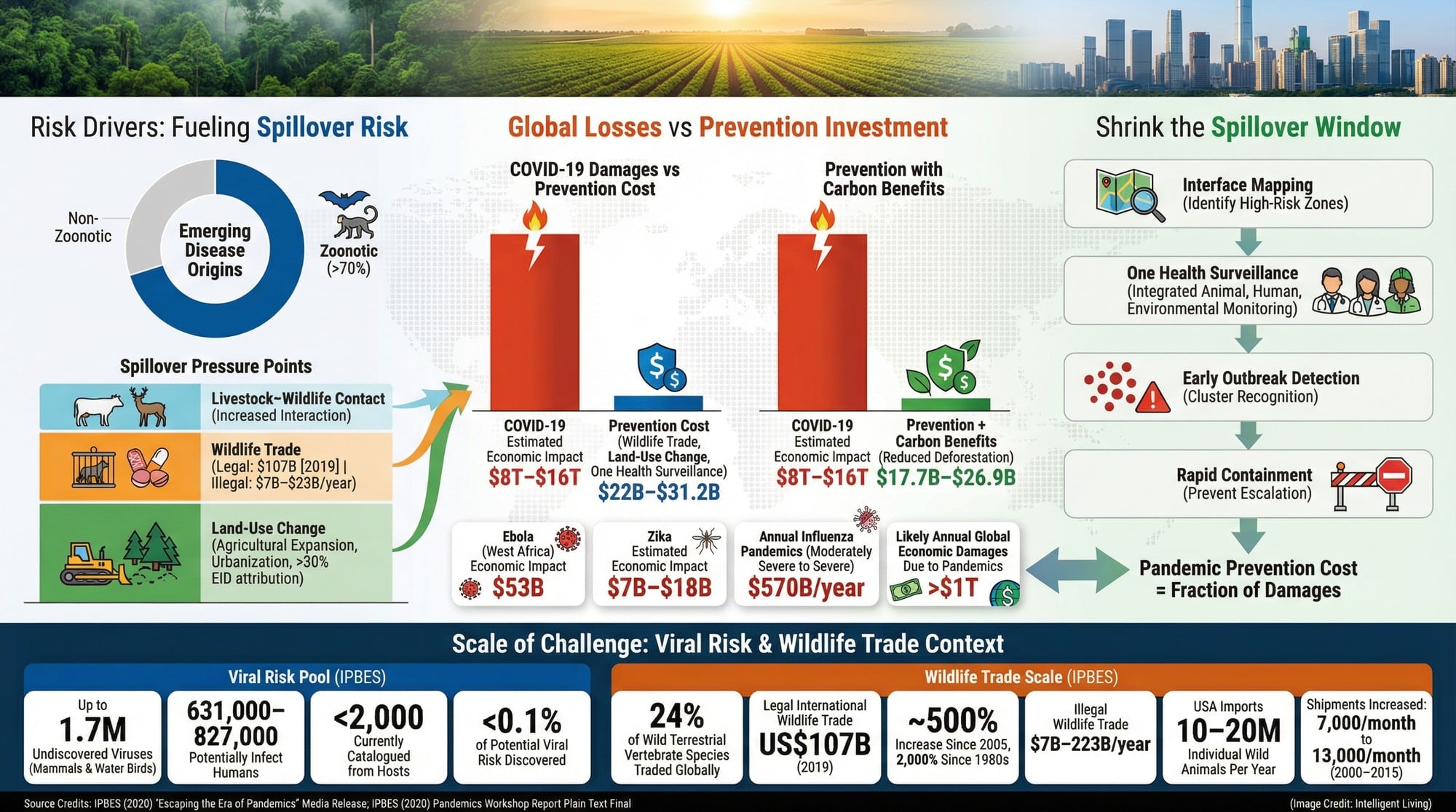
If many pandemic viruses do not show a long, detectable pre-adaptation signature, then prevention needs to prioritize reducing opportunity. That means fewer risky contacts across species boundaries, faster detection of unusual clusters, and fewer blind spots where small outbreaks can grow.
Upstream Spillover Prevention and One Health Integration
Addressing upstream drivers is the first step in successful spillover prevention. By focusing on ecological health, we can lower the risk of pathogens jumping to people:
- Habitat disruption and supply-chain shifts increase contact with new pathogens, making the WHO One Health approach a practical baseline for action.
- Environmental choices are central, as the deforestation and zoonotic-risk connection demonstrates the link between land use and health.
- Proactive risk reduction, as noted in reports on biodiversity and pandemics, treats prevention as an economic and environmental tradeoff.
For a tactical lens, experts argue for preventing spillover at the source through better biosurveillance and reduced high-risk interfaces.
Enhancing Early Detection Windows and Genomic Surveillance
When early detection does happen, speed matters. Field-ready tools, including a portable iPhone-linked DNA sequencing workflow that shortens detection times, help bridge the gap between a suspicious cluster and a verified signal.
Preparedness that Reduces Panic and Disruption
Preparedness also lives at the household level. Practical routines, such as building a 72-hour emergency preparedness kit plan, can reduce the chaos that turns uncertainty into panic.
Navigating Public Health Information and Misinformation Risks
Finally, communication is part of prevention. Confusing messages can erode trust, and health misinformation and Long COVID pressures show how quickly mixed signals can become a second crisis.
Clear messaging can also work in the opposite direction. Evidence on community health campaigns shows how simple, repeated guidance can change community behavior when it is consistent and easy to act on.
Misinformation outpaces corrections with ease. A snapshot of online misinformation trends illustrates how early uncertainty hardens into false certainty when communication is left to chance.
A minimal, relatable example ties this together: communities that normalize reporting unusual animal sicknesses and early respiratory clusters build a kind of social early-warning system that keeps small sparks from becoming wildfires.

Viral Opportunity and the Future of Pandemic Prevention
The next global health crisis might not wait for a perfect mutation to arrive. Instead, pandemic origins often trace back to a simple lack of barriers between species. When human systems provide the right environment, a virus can transition from a reservoir host to a human community without a long genetic runway.
Shifting focus toward genomic forensics and faster detection allows us to close the gap between spillover and response. Prevention isn’t just about watching for a single mutation; it’s about reducing high-risk animal contact and building social early-warning systems that catch a spark before it becomes a wildfire. A brief, human-scale note fits here: most people remember the first week when guidance changed rapidly, and that memory is a reminder that prevention is as much about systems and trust as it is about biology.
Experts describe the goal as preventing future global outbreaks by addressing the drivers that create repeated spillover opportunities. This evidence sharpens our priorities: strengthen surveillance, reduce high-risk animal contact, and make land-use choices that lower spillover opportunities.
Common Questions About Zoonotic Emergence
Can genomic forensics prove where a virus started?
Genetics reveal patterns consistent with specific pathways, but sequences alone rarely offer final proof. Experts combine these genomic signals with field ecology and outbreak investigations to map the most likely source based on whole-genome analysis techniques.
Do viruses always need mutations to infect humans?
Not necessarily. Some pathogens already carry ‘human-ready’ traits, like ACE2 binding, allowing them to jump directly into people if the social and environmental opportunities exist.
Why do some zoonotic spillover events fail?
Most instances of cross-species transmission fizzle because the virus cannot sustain human-to-human spread. A recent study notes that new pathogens emerge frequently, though only a small fraction become global events. Success depends more on contact rates and dense human networks than on a single mutation.
What role do intermediate hosts play in emergence?
These hosts can act as bridges between reservoirs and humans, though the phase might be too brief to leave a detectable genetic footprint. Limiting trade and handling of wild animals remains a primary prevention tactic.
How does the RELAX framework help track evolution?
This method tests for changes in selection intensity within a viral genome. Insights into how statistical models track selection explain what these models mean when they describe intensification or relaxation.
What does “prevention at source” look like in practice?
It often includes improving wildlife trade controls, protecting habitats, and strengthening livestock biosecurity. The One Health strategy connects human, animal, and environmental health in a practical cross-sector frame.


