
Conservationists have released 155 giant tortoises on Santa Fe Island in the Galápagos, to help replace a similar species that died out about 150 years ago.
The giant tortoises, also known as Española Giant Tortoises, are of the breed Chelonoidis hoodensis. They are a similar species to the Chelonoidis spp, which are currently extinct. Originally they came from Española Island, also known as Hood Island, in the southeast of the Galápagos chain.
The tortoises were held captive at the Fausto Llerena breeding center as part of a breeding program. Before being released, the tortoises underwent a precise quarantine process. The release is a part of the ecological restoration of the island.
 “The tortoises that have been released carry a microchip under their skin with a permanent number attached to make it easier to track them,” said Jorge Carrion, the head of the Galápagos National Park. The newly released tortoises join the other 394, which were set free in previous years.
“The first turtles released in 2015 are currently between 10 and 12 years old, so they are expected to start [to] reproduce in the next five to seven years,” said Washington Tapia, director of the ecological restoration program. In releasing these giant tortoises, there is hope they will fulfill their role as an ecosystem engineer and contribute to the spread of the species. The program, run by the Galápagos National Park and the Galápagos Conservancy, is due to run until 2026.

Did You Know?
Giant tortoises are believed to have arrived on the volcanic island chain about three to four million years ago. With no predators, they spread across the islands and split into different species. However, in the 19th century, their population was destroyed by sailors who consumed them on long ocean journeys and by invasive animals that ate their eggs.
Island isolation driving evolution is not unique to the Galápagos. Halfway around the world, the gentoo penguin has quietly become four separate species, including one new to science, because populations that stayed put on remote Southern Ocean islands drifted apart genetically over hundreds of thousands of years.
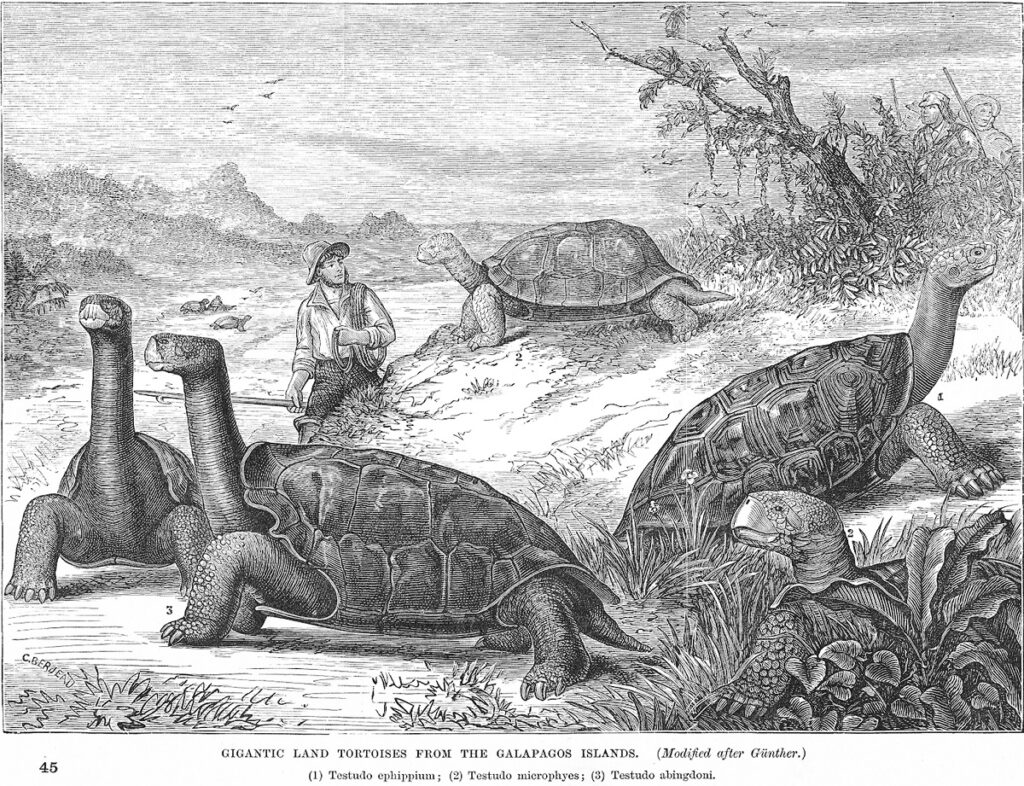 The Galápagos archipelago was discovered in 1535 by a Spanish bishop named Fray Thomas de Berlanga. He named the Galápagos after the impressive giant tortoises. In 1835 a visit to the Galápagos inspired Charles Darwin to form his ideas on natural selection. Several species of finch differed in beak shape, food source, and how the food was captured. Thus, his theory of evolution followed.
In 1978, the Galápagos Islands were declared a World Heritage Site by the United Nations Educational, Scientific and Cultural Organization (UNESCO).


