Using natural materials is an essential ingredient for the world to become more sustainable. Last year researchers from Cambridge University’s Department of Architecture studied the properties of bamboo to help with the development of fire safety in buildings and energy efficiency.
It’s reported by Phys.org that the building sector is responsible for 30-40% of all carbon emissions. This is in large part because of the energy needed to heat and cool steel and concrete. Adopting more sustainable environmentally friendly building methods needs to take place if we are to reduce emissions.
The research team from Cambridge studied the cross-sections of the bamboo’s vascular tissue, which transport the nutrients and fluids within the plant. The image scans revealed an intricate fiber structure that has alternating layers of thin and thick cell walls. Along with providing bamboo its strength and structure, the team found that the thicker cell walls also offer peak thermal conductivity, due to chains of cellulose being almost parallel to the plant stem. The thinner cell walls have cellulose chains that are almost at a right angle, which gives them a lower thermal conductivity.

The study was led by Cambridge researcher Darshil Shah, who explains the bamboo properties:
Nature is an amazing architect. Bamboo is structured in a really clever way. It grows by one millimeter every ninety seconds, making it one of the fastest-growing plant materials. Through the images we collected, we can see that it does this by generating a naturally cross-laminated fiber structure.
This is one of the first studies that focused on the cellular structure of bamboo and how it relates to the thermal properties. Materials used to make buildings are directly related to how well they will conduct and store heat. By understanding the thermal properties of bamboo, scientists can determine the safest way to use the materials, and at the same time reducing energy consumption.
Shah continues:
People may worry about [the] fire safety of bamboo buildings. To address this properly we have to understand the thermal properties of the building material. Through our work, we can see that heat travels along the structure-supporting thick cell wall fibers in bamboo, so if exposed to the heat of a fire the bamboo might soften more quickly in the direction of those fibers. This helps us work out how to reinforce the building appropriately.
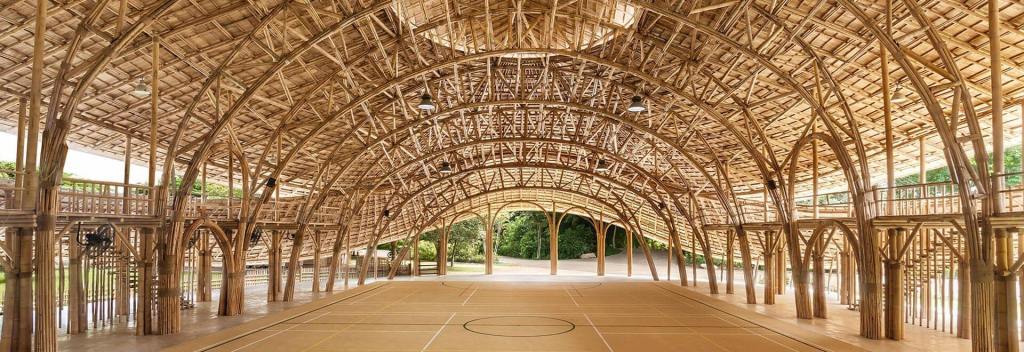
Bamboo has been used in S.E. Asia for a long time to build houses and different structures. This can be seen in a beautiful bamboo sports hall that was recently constructed in Northern Thailand, to help maintain a low carbon footprint.
Shah points out that cross-laminated timber is a popular choice for construction, most of which is made by gluing together layers of sawn timber, each one at a right angle to the one below. “Seeing this as a natural structure in bamboo fibers is inspiration for the development of better building products,” said Shah.
Next up for Shah and the Cambridge researchers, they plan to further investigate the heat flow in bamboo and what happens to surface when it’s burned and forms a char. Shah hopes that modifying the tissue scale properties of wood will help to advance the use of timber for construction and make it more reliable.