
Establishing a financial liquidity baseline is the quiet engine behind every successful long-term wealth accumulation strategy. Market gains often entice beginners toward immediate investing, yet the most resilient strategies prioritize a sturdy cash-first investing foundation. That many beginners overlook: establishing a synergy between your cash layer and your investing layer is essential for maintaining a durable financial liquidity baseline.
Think of your emergency cash reserves and your investment accounts not as competitors for your dollars but as a synchronized team. Access to liquid assets ensures your long-term holdings grow undisturbed even during periods of high economic uncertainty. Without this buffer, you risk being forced to liquidate a conservative starter portfolio at the worst possible time, locking in losses just to cover basic survival budget math.
This guide provides the tactical steps to bridge that gap. We will walk through securing your cash layer, triaging high-interest debt, and eventually moving into a diversified portfolio built for low-drama execution. Establishing this diversified starter portfolio creates a resilient system capable of weathering sudden layoffs and mechanical repairs while your long-term wealth accumulation continues undisturbed.

Key Principles of a Cash-First Investing Strategy
Cash-first investing is a sequence, not a slogan. The goal is to protect emergency cash reserves from market volatility while building long-term wealth accumulation with tools that stay simple under stress.
- Building a three-to-six-month cash buffer creates the necessary liquidity to begin investing without risking your core stability.
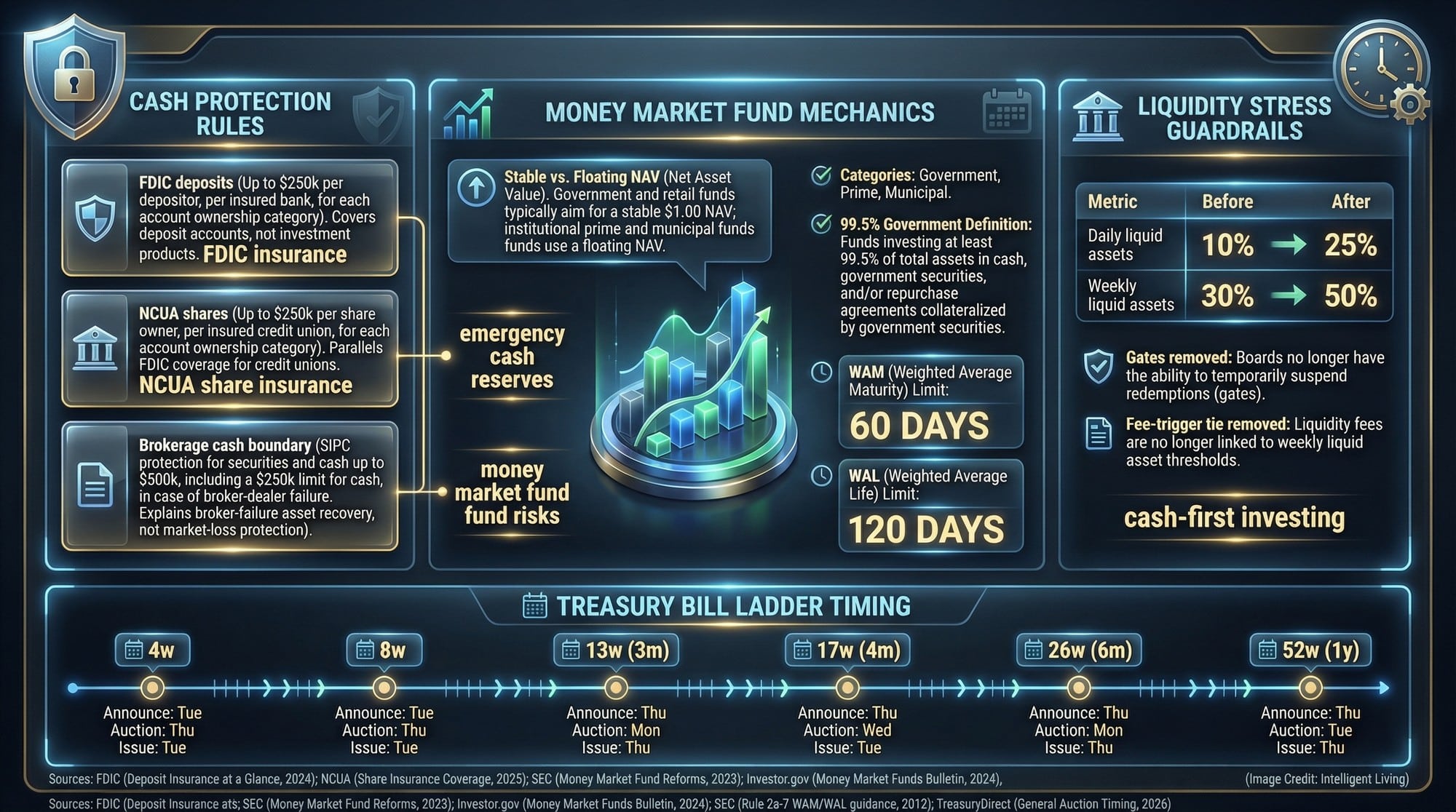
- Confirming your bank balances fall within federal deposit insurance limits safeguards your principal from institutional failure.
- Recognizing that SIPC protection focuses on missing brokerage assets rather than market volatility helps clarify your actual risk exposure.
- Evaluating money market fund risks is vital because these instruments carry different protections than traditional bank-issued accounts.
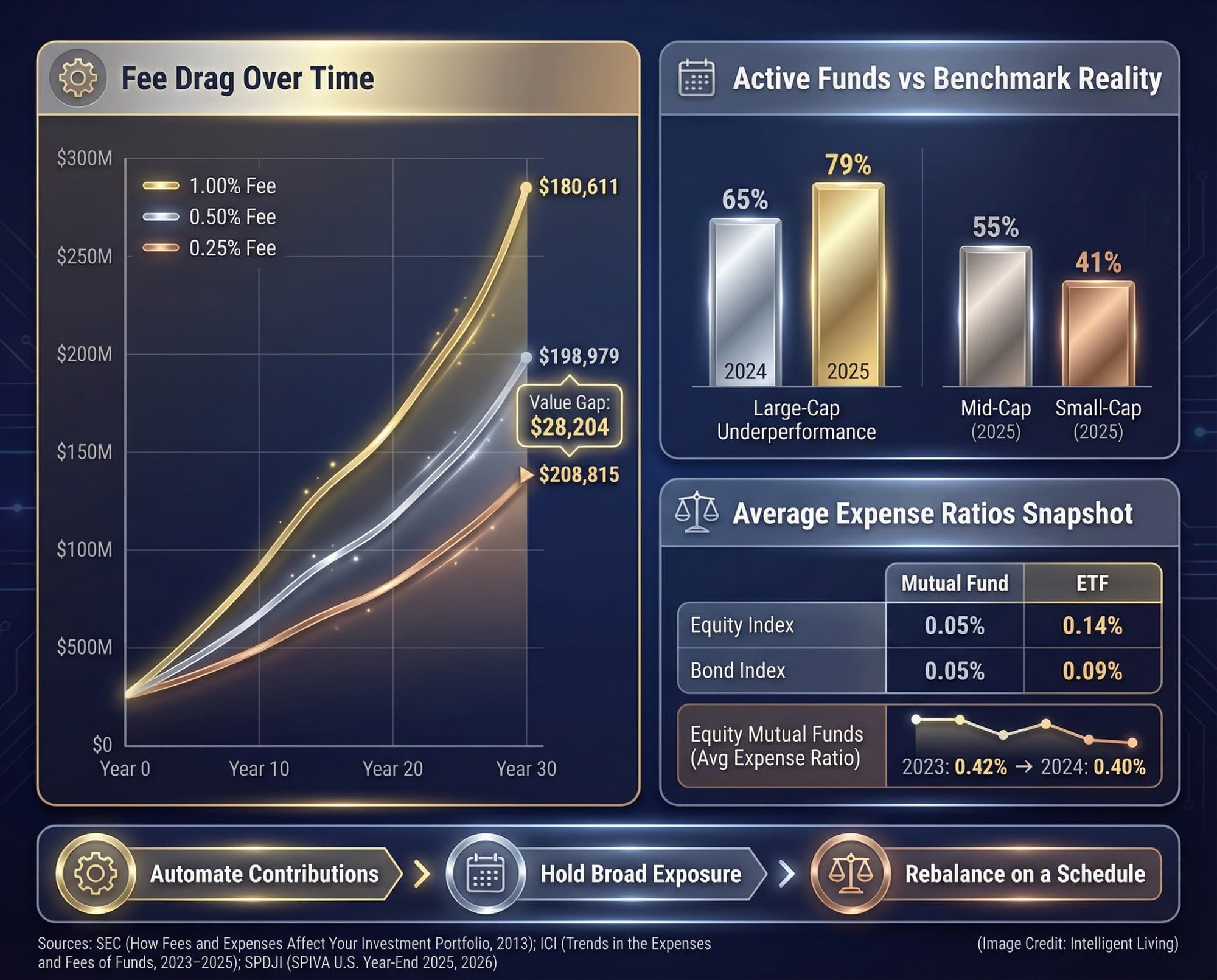
- Analyzing mutual fund expense structures reveals how small, recurring costs significantly erode your final wealth over several decades.
If you only remember one guardrail, make it this: emergency cash should be boring and reachable, while investing should be diversified and consistent. That separation is what keeps a conservative plan from collapsing the first time life gets expensive.
Building Your Cash-First Foundation for Long-Term Wealth
Step 1: Establish an Emergency Cash Reserve to Protect Your Assets
What an Emergency Fund Is and Is Not
An emergency fund is a dedicated pool of liquid cash set aside to cover unplanned expenses or sudden income loss. Establishing this liquid resource ensures you can address unplanned expenses or sudden income loss without disrupting your broader financial plan. Consumer finance regulators describe emergency fund essentials as cash reserved for the unexpected, with access prioritized over return.
Treating this cash layer as separate from discretionary savings prevents the forced selling of market assets during volatility. Maintaining a strict survival budget baseline ensures you never lock in losses to cover essential monthly bills.
Without this buffer, minor life events quickly escalate into financial crises:
- Mechanical failures like a slipping transmission become insurmountable costs.
- Medical surprises such as unexpected specialist referrals trigger immediate debt.
- Forced liquidations occur when you must sell investments at a loss to cover basic survival budget math.
Establishing this dedicated cushion shifts these situations from life-altering events into manageable, routine transactions. When that cushion is missing, the same event can trigger debt, missed payments, or a rushed investment sale.
How Much to Save Before Investing
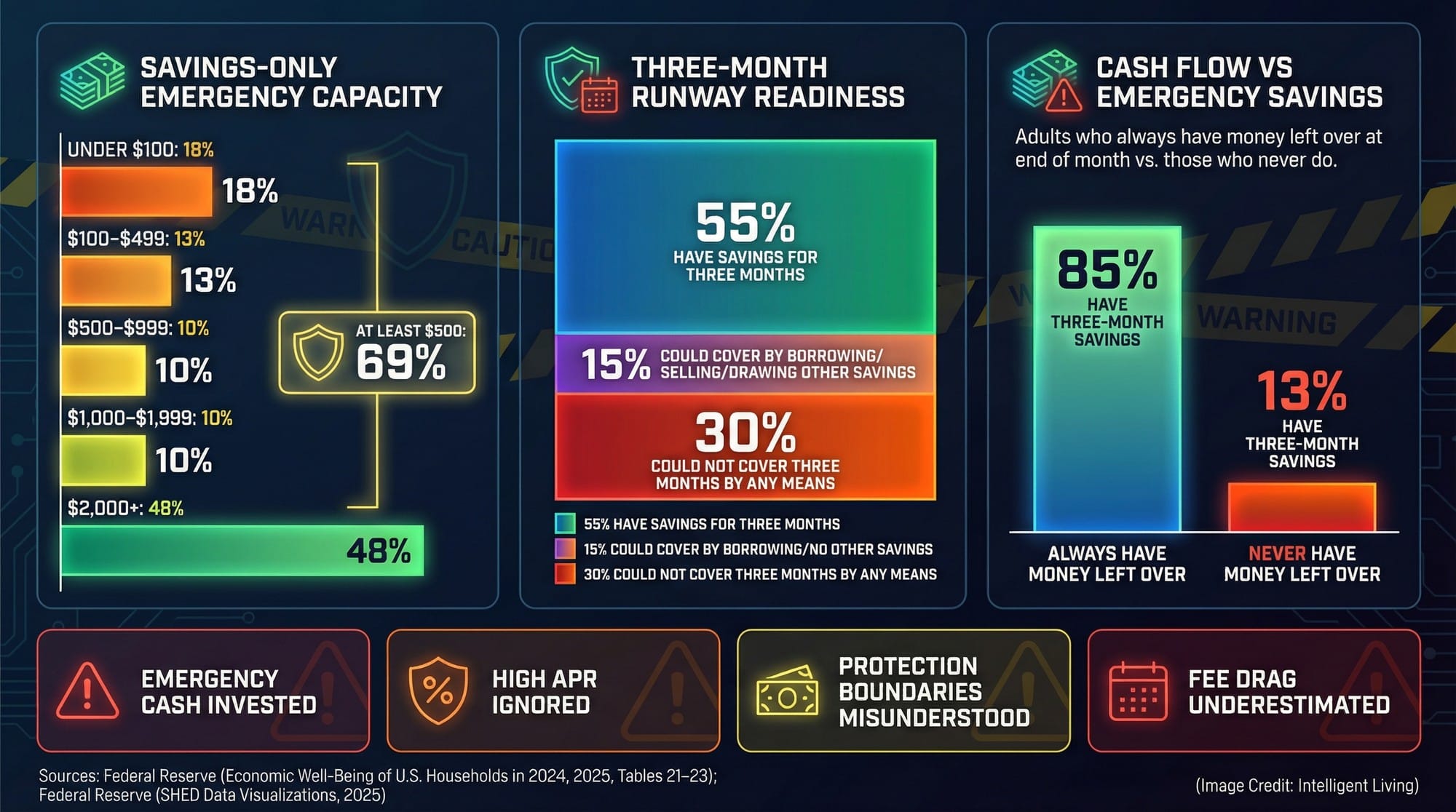
Aim for a financial liquidity baseline covering three to six months of core living expenses. Adjust this total based on your specific job security, healthcare requirements, and household obligations. For those with variable income, basing your survival budget math on your lowest-earning months creates a more reliable safety margin than using an average.
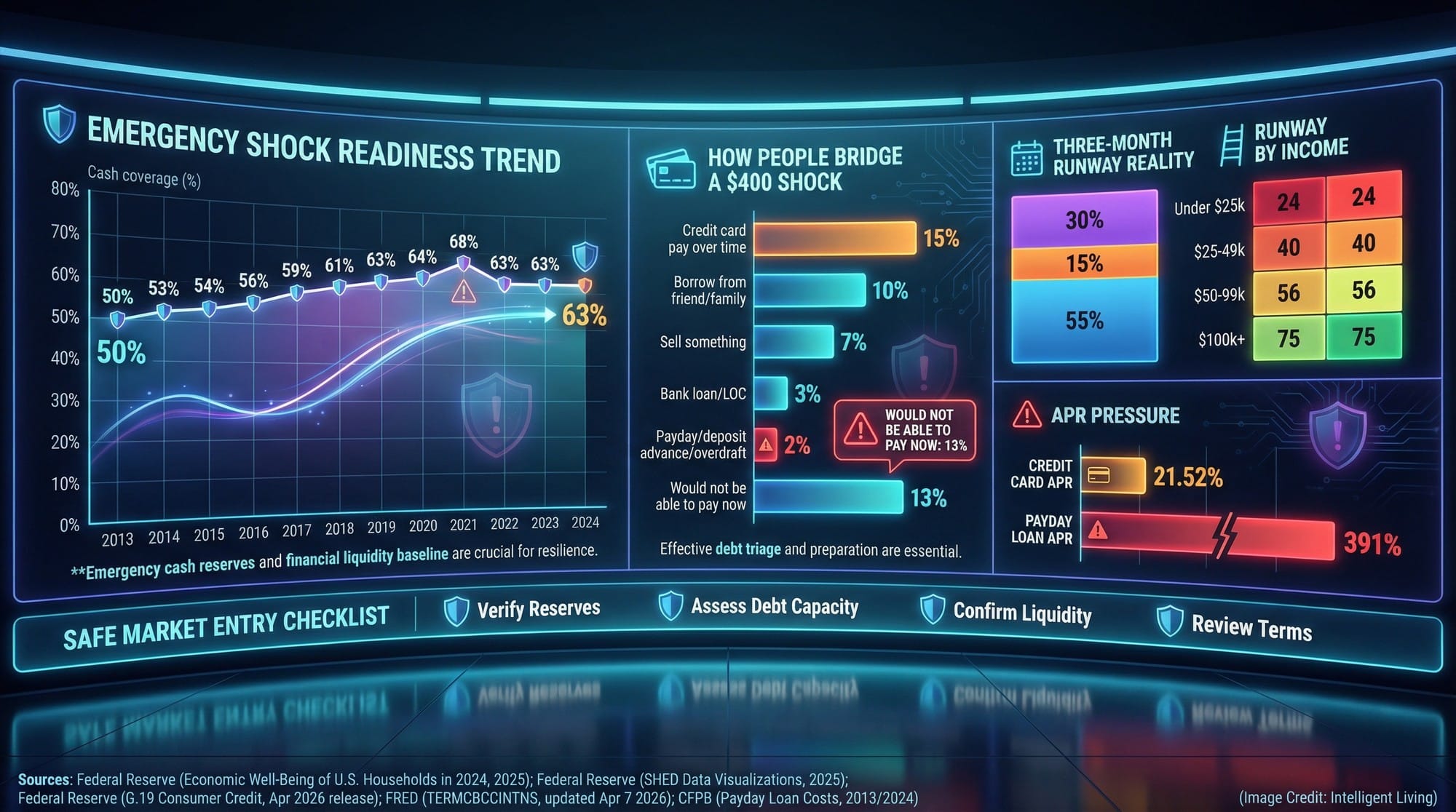
Many readers underestimate how common it is to be underprepared. Data on national emergency savings trends illustrates that household readiness varies significantly depending on your specific income and life situation. Statistical shifts in emergency preparedness by age suggest that a universal savings target often fails to account for diverse life stages.
Emergency Fund Target Formula
Isolate your essential costs to keep your survival budget calculation accurate. Focusing on the absolute minimum monthly requirement ensures your cash-first investing strategy remains realistic and achievable.
Your core essential categories often include:
- Primary housing and utility costs
- Monthly food and grocery staples
- Necessary transportation to and from work
- Critical insurance premiums and healthcare
By stripping away discretionary spending, you arrive at a lean figure that truly represents your financial floor. This baseline ensures that your emergency fund serves its primary purpose: keeping you solvent during a crisis.
- Document your monthly essential obligations.
- Select a target runway length, typically between three and six months.
- Multiply and add a small buffer, often 10 percent, for irregular expenses.
- Leverage automatic saving routines to expand your reserves without needing constant behavioral discipline.
Consider a household with $3,000 in monthly essentials targeting a four-month runway; their base fund would be $12,000, or $13,200 including a prudent 10 percent buffer.
Step 2: Selecting Secure Accounts for Your Liquid Cash Reserves
FDIC Insurance in Plain Language
Safeguarding your principal through FDIC coverage limits provides the security required for a conservative strategy. Your standard checking and savings accounts typically fall under these federal protection rules. Selecting the right FDIC-protected account type is a critical step in building a secure and reachable cash reserve.
In many towns, the emergency fund sits at a credit union because it is close to home and easy to access. Those accounts use credit union share insurance coverage, which matters for the same reason FDIC limits matter at banks.
SIPC: What It Does and Does Not Cover
SIPC provides limited protection if a broker fails and customer assets are missing. It is a recovery framework, not insurance against market losses. Differentiate the protections by noting that SIPC addresses asset recovery during institutional failure, whereas market volatility remains a separate risk inherent to any diversified portfolio. A simple way to remember the boundary is that SIPC focuses on missing assets in a broker failure scenario, while prices still rise and fall regardless.
Money Market Funds Versus Money Market Deposit Accounts
Understand the technical differences between cash-equivalent instruments to ensure your emergency fund remains secure:
- Money Market Mutual Funds: These invest in short-term debt and lack FDIC backing, carrying a different risk profile than bank accounts.
- Money Market Deposit Accounts: These are bank products that typically include federal insurance, offering a higher safety tier for your principal.
- Cash Sweep Programs: Brokerages often use automated sweep mechanics to route idle cash, which can change your insurance coverage depending on the target account.
Verifying how your chosen account functions is essential for maintaining your financial liquidity baseline.
Treasury Bills as a Short-Term, Low-Complexity Option
Treasury bills are short-term U.S. government securities sold for terms ranging from four to 52 weeks. The Treasury bill auction basics are straightforward: sold at a discount or at par and paid at face value at maturity. Utilizing a T-bill maturity schedule ensures precise liquidity timing when constructing a simple cash ladder.
The Safe Market Entry Checklist: Debt Triage and Portfolio Prep
Step 3: Make Your Money Safe to Invest Before You Enter the Market
High-Interest Debt and the Opportunity Cost of Returns
Prioritizing high-interest liabilities like revolving credit card debt and predatory payday loans as part of your primary debt triage strategy. Double-digit APRs can quietly outrun conservative market returns. Over time, these costs can turn your long-term wealth accumulation into a frustrating financial treadmill.
Fixating on minimum payments can allow interest to accumulate faster than your portfolio grows, making market entry feel impossible. Relying on minimum payments often leads to a stagnant debt cycle where high interest rates outpace your ability to reduce the principal balance. When debt is already heavy, a structured plan matters more than willpower. The credit card debt relief system prioritizes high-cost balances and reduces fee spirals so future investing has room to breathe.
Capture Employer Matches and Other Guaranteed Returns
If you have access to a workplace retirement plan with a matching contribution, that match functions like an immediate, risk-free return once you have a starter emergency fund in place. A clean 401(k) match contribution overview clarifies how matching formulas work in practice.
A Fast “Safe to Invest” Checklist
Determining if you are truly ready to enter the market requires a cold look at your current liquidity. Use this fast, conservative checklist to verify your standing before you increase your market exposure:
- Emergency cash reserves are separated from spending money and kept liquid.
- Minimum bills and insurance premiums can be paid on time without borrowing.
- Executing a dedicated debt triage strategy to aggressively reduce revolving balances.
- A simple investing contribution is automated and sized so it does not destabilize cash flow.
If you can check each of these boxes, your financial foundation is likely strong enough to support risk. This preparation ensures that once you start investing, you won’t have to look back.
Step 4: Build a Conservative Portfolio with Broad-Market Index Funds and ETFs
Diversification, Asset Allocation, and Rebalancing Defined
To maintain a conservative strategy, you must master three core concepts of portfolio management:
- Diversification: Spreading capital across diverse asset types ensures that a single sector shock does not derail your entire long-term wealth accumulation plan.
- Asset Allocation: This represents the specific percentage split between stocks, bonds, and cash that aligns with your individual risk tolerance.
- Rebalancing: This periodic process restores your target allocation after market shifts cause your portfolio weights to drift.
Managing the link between asset allocation and market volatility is central to long-term wealth accumulation. These diversification basics help protect your starter portfolio from localized economic shocks, which is why diversifying your holdings remains the most reliable method for reducing risk within a conservative strategy.
ETF Versus Index Mutual Fund: A Beginner Decision
Evaluate the primary differences between these low-cost vehicles to determine which fits your operational style:
- Exchange-Traded Funds (ETFs): These trade intraday like individual stocks, offering high flexibility for active monitoring.
- Index Mutual Funds: These typically settle at end-of-day net asset value, favoring investors who prefer a slower, once-per-day execution.
Your practical decision should focus on total costs, simplicity, and your personal investment preference. A regulator-grade baseline for disclosures, risks, and fund mechanics is mutual fund and ETF disclosure basics, including how objectives, holdings, and fees are presented.
Two Low-Complexity Portfolio Paths
Select one of these low-complexity portfolio paths to begin your market entry:
- Path A: All-in-One Target-Date Fund: These automatically shift toward conservative assets as your retirement date nears, serving as a ‘hands-off’ solution.
- Path B: Simple Index Mix: This allows you to combine total U.S., international, and bond market funds for a customized, easily rebalanced core. A practical template is the three-fund index portfolio template, which shows how broad exposure can be built from just a few core funds.
Some people prefer a single all-in-one choice when life is busy, while others prefer to see each building block separately. Following a structured investing roadmap ensures your initial steps into the market are deliberate and low-risk.
Low-Fee Investing Strategy: Managing Costs, Automation, and Portfolio Rebalancing
Step 5: Minimizing Investment Fees and Avoiding Portfolio Complexity
The Three Numbers to Check Before You Buy a Fund
Before committing to a specific fund, evaluate these three metrics to ensure your costs remain low and your strategy efficient:
- Expense Ratio: This annual fee represents the percentage of assets used for management; lower ratios directly increase your long-term returns.
- Tracking Difference: This measures how closely a fund follows its benchmark; high gaps suggest hidden costs or poor execution.
- Portfolio Turnover: Frequent trading within a fund creates hidden transaction costs that can erode your wealth quietly over time.
Resist the urge to prioritize past performance over present costs; long-term data shows that low expense ratios are often the most reliable predictor of future success. The prospectus fee table requirements break down the most common charges in plain terms.
Why Active Funds are Usually Not the Beginner Default
Statistical data reveals that a significant majority of active managers lag behind their benchmarks after accounting for management fees. Conservative investing for beginners often starts by taking the market return at low cost, then only adding complexity when there is a clear reason. The active fund underperformance scorecards track how frequently active funds lag their benchmarks across multi-year windows, while active versus passive tradeoffs clarify the decision between manager selection and broad-market exposure.
Complexity Traps to Avoid Early
Avoid unnecessary portfolio complexity by distinguishing between durable broad-market ETFs and speculative tactical tools. Avoid these common complexity traps until you fully understand how they behave in volatile environments:
- Leveraged or inverse exchange-traded products
- Narrow thematic funds based on fragile market narratives
- Specialized derivative wrappers or structured notes
A plain ETF structure and risk bulletin can help you separate broad-market ETFs from products built for tactical trading. Staying simple is often your greatest advantage.
Step 6: Automating Your Contributions and Maintaining Balance
Dollar-Cost Averaging and the Behavior Layer
Executing a dollar-cost averaging schedule involves investing fixed amounts at set intervals to mitigate the impact of market volatility. While this strategy isn’t a profit guarantee, it mitigates decision fatigue and supports a systematic approach to your long-term wealth accumulation goals. The dollar-cost averaging definition frames the approach as fixed purchases on a schedule, independent of price.
Sustain your momentum with small, weekly transfers rather than waiting for a ‘perfect’ market entry that rarely arrives when you need it.
A Simple Rebalancing Cadence
Conservative strategies often require only a yearly check-in to assess whether market movement has shifted the portfolio away from its target weights. The portfolio performance checkup framework focuses on drift, risk, and consistency rather than noise. Routine-based automatic saving routines keep contributions moving even when attention is elsewhere, which is often the difference between a plan that lasts and a plan that fades.
Common Mistakes that Break Conservative Plans
Protect your conservative strategy by recognizing the common errors that often stall long-term wealth accumulation for beginners:
- Eroding your financial liquidity baseline: Committing your emergency cash reserves to volatile markets compromises your safety net and leads to unavoidable forced selling.
- Confusing protection boundaries: FDIC insurance safeguards bank deposits, while SIPC provides a recovery framework for missing brokerage assets—neither protects against standard market price declines. Reviewing federal insurance FAQs can help you avoid common misunderstandings regarding the scope of your protections.
- Fee blindness: Costs that look tiny on paper can compound into large gaps, and failing to account for how investment fees compound can leave a significant gap in your projected long-term wealth.
- Prioritizing past performance: Buying assets based on last year’s winners often leads to poor timing, whereas broad diversification maintains utility across diverse market cycles.
Acknowledging these pitfalls early allows you to build a system that is resilient by design. By avoiding these traps, you ensure your long-term wealth accumulation remains a steady, predictable process.

Conclusion: The Cash-First System that Turns Investing into a Habit
Start with a sturdy financial floor to ensure your future investment moves are deliberate choices rather than acts of desperation. Cash-first investing preserves your options; when life gets expensive, your emergency cash reserves act as a firewall against panic selling. When the market dips, your plan remains intact because your daily survival isn’t tied to the price of a broad-market ETF. This low-complexity system is designed to survive the messy reality of repairs and bad headlines while your wealth builds momentum.
Commit to this sequence to turn long-term wealth accumulation from a stressful chore into an automated habit. By focusing on a diversified starter portfolio and maintaining a strict financial liquidity baseline, you remove the emotional weight of timing the market. Prospering through broad-market investing requires disciplined patience rather than foresight. Allow your low-fee index fund mix to appreciate over time while your sturdy cash reserves provide the necessary stability to stay the course.
Expert Insights: Cash-First Investing FAQ
What is the ideal financial liquidity baseline before I start investing?
Target a financial liquidity baseline covering three to six months of core living expenses to shield your starter portfolio from personal crises. This baseline protects your long-term wealth accumulation from being interrupted by minor emergencies or temporary income loss. The cash coverage for a $400 emergency expense highlights that even a small financial shock can disrupt a household without a dedicated cash reserve.
Where is the safest place to park my emergency cash reserves?
For principal protection, an FDIC-insured savings account or a money market deposit account is the most reliable choice. If your timing is predictable, short-term Treasury bills offer a low-complexity alternative with high security.
Is there a real difference between FDIC and SIPC for beginners?
Yes. FDIC covers bank deposits up to standard limits if the bank fails. SIPC is a broker failure recovery system that protects against missing assets, but it does not insure you against market losses or price drops in your diversified portfolio.
Are money market funds safe enough for my entire cash reserve?
Money market funds are built for stability, but they are not FDIC-insured. While they are a staple of conservative investing, they carry different risks than a traditional bank deposit account and should be used with that distinction in mind.
Should I prioritize high-interest debt triage or index fund investing?
If you have high-interest liabilities like credit card debt, those double-digit APRs usually outrun market returns. Build a small starter emergency fund first, then focus on debt triage before committing heavily to broad-market ETFs.


