
Modern concrete mixes hide a microscopic chemistry that has remained notoriously difficult to master for millennia. Breakthroughs in Concrete AI now penetrate these complex layers, moving beyond the sensationalism of widely shared concrete-reinvented headlines to establish verifiable scientific data. A molecular dynamics foundation model recently demonstrated an ability to scale to multibillion-atom systems, redefining what is possible in materials science.
Exascale AI simulation provides the computational horsepower required to model these intricate interactions in real-time. By utilizing an equivariant foundation model, researchers can now simulate the behavior of 4 billion atoms simultaneously. The ability to test new binders and additives in silico drastically reduces the time spent on trial-and-error mixing in physical laboratories.
A 4-billion-atom simulation creates a bridge between purely theoretical chemistry and the macroscopic performance of infrastructure. Instead of guessing how a new mix might handle environmental stress, engineers use materials AI to predict durability and strength with unprecedented precision. Aligning digital discovery with physical application remains the primary objective in decarbonizing global construction.

Analyzing the 4-Billion-Atom Breakthrough in Exascale Materials Simulation
Core Technical Benchmarks and Exascale Performance Metrics
Integrating the Aurora supercomputer with the Allegro-FM model establishes a robust environment for materials analysis. This synergy provides the high-resolution data necessary to track structural changes within cementitious compounds.
- Allegro-FM and Scaling: This equivariant foundation model for exascale molecular dynamics covers 89 elements and scales to multibillion-atom simulations on the Aurora exascale supercomputer.
- Benchmark Efficiency: A USC press summary reports a 0.975 parallel efficiency figure, confirming the system’s ability to handle massive workloads.
- Concrete and Climate: The IEA tracking view highlights how chemistry and high-temperature heat make emissions difficult to eliminate.
- Carbonation Tradeoff: While carbonation stores CO2, the BS EN 14630 test method shows how alkalinity loss can also accelerate corrosion.
These benchmarks illustrate how exascale-aware models are turning theoretical physics into actionable engineering data.
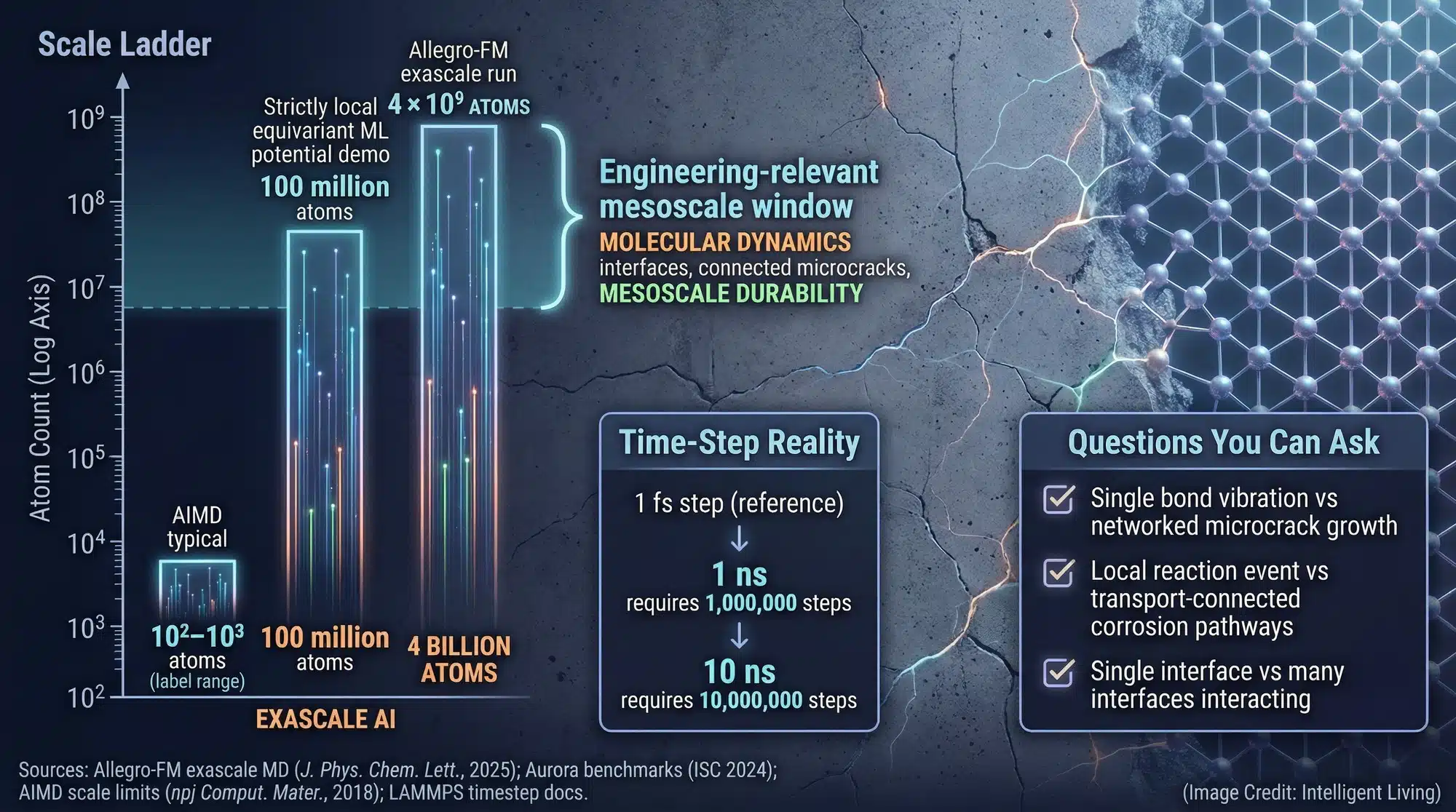
What Does “Simulating 4 Billion Atoms” Actually Mean?
Why Atom Count Changes the Questions You Can Ask
While simulating millions of atoms reveals local chemical reactions, exascale molecular dynamics workflows uncover how length and time scales create distinct bottlenecks, even for the world’s fastest systems.
Scaling to billions opens up the mesoscale: interfaces between phases, networks of microcracks, and how hydration products organize across neighborhoods large enough to influence permeability and fracture. Put simply, more atoms let researchers model not only a single chemical event but also the ways many events combine to create macroscopic behavior.
Visualizing the scale requires an analogy: while a million-atom simulation acts as a neighborhood snapshot, a four-billion-atom model functions as a city map where global patterns emerge from many interacting parts. Such resolution distinguishes the study of isolated crack tips from the analysis of interconnected weak points reacting to moisture, thermal cycles, and structural load.
What the Paper Actually Reports
Researchers utilizing the Allegro-FM architecture describe a foundation model for molecular dynamics trained across diverse organic and inorganic datasets merged through a Total Energy Alignment approach. They also describe tests relevant to cement chemistry such as calcium silicate hydrates, which are central to how concrete gains strength and evolves over time.
At the binding-phase level, a NIST summary of amorphous calcium-silicate-hydrate in cement shows why this material is treated as the core glue of hardened paste, even though its structure is disordered and still debated.
Observation of field-mixed concrete reveals how environmental shifts—like a humid morning turning into a hot afternoon—drastically alter material behavior. Simulation addresses this unpredictability by exploring vast chemical and climatic variables before committing resources to expensive trial pours.

Evaluating Concrete Durability Through the Lens of Materials AI and Mesoscale Modeling
Why Concrete is a Perfect Stress Test for Materials AI
Interfaces, Phases, and Messy Real-World Chemistry
Concrete is a dynamic composite of hydrated phases and particles. Research into how cement hydration changes over time illustrates why this evolution remains a scientific challenge despite decades of study.
Microstructure governs strength, permeability, and CO2 movement through the paste. Materials AI that captures these interactions at scale is uniquely suited for concrete. Small changes at the nano-level often cascade into massive differences in long-term durability.
Engineers often observe that minor shifts in water content lead to surface staining after only a few seasons. Such sensitivity underscores the value of predictive Concrete AI, particularly for large-scale infrastructure where errors compound across decades.
Concrete as a Policy and Market Lever
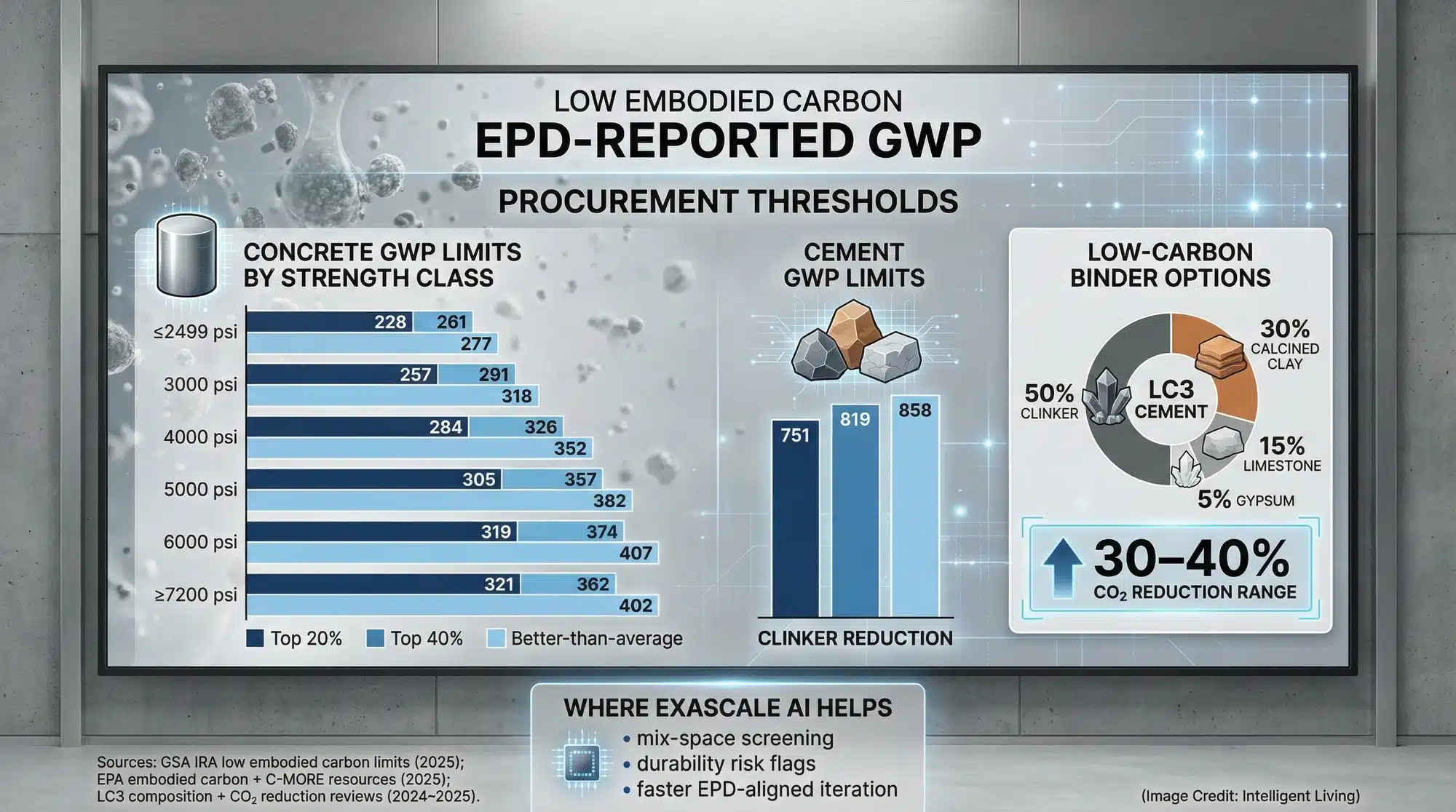
Decisions regarding mix design carry significant weight, dictating maintenance costs and cumulative emissions over decades. Current market and policy shifts are turning these metrics into mandatory procurement requirements.
- Standardized Disclosure: Environmental Product Declarations are becoming a baseline requirement, supported by EPA initiatives for reducing embodied carbon in construction materials.
- Regulatory Thresholds: Policies such as the Federal Buy Clean definition of embodied emissions and the GSA IRA low-embodied carbon concrete limits establish strict GWP limits for federal projects.
- Economic Efficiency: Advanced simulation tools shorten the transition from hypothesis to validated mix, reducing expensive trial batches and optimizing cost curves.
These regulatory signals incentivize the adoption of AI-optimized materials across the construction industry.

Technical Architecture of Allegro-FM: A Molecular Dynamics Foundation Model
What a Foundation Model Means for Materials Science
A foundation model in this context is a large, flexible interatomic potential trained on many kinds of atomic-scale data so it can be reused across multiple downstream tasks.
Machine learning and generative AI for materials science accelerate significantly within open-source AI infrastructure for materials discovery. These collaborative environments allow datasets, simulations, and pilot manufacturing results to be compared with minimal oversight errors. Instead of building a bespoke potential for each new material system, a research team can adapt a general model to explore new chemistries more quickly, then validate the most promising candidates in the lab.
Equivariance and Locality, What they Mean Simply
The scalability of Allegro-FM relies on two fundamental architectural principles that ensure both physical accuracy and computational efficiency.
- Spatial Equivariance: The model respects geometric symmetries. If an atomic arrangement rotates, the predicted forces follow suit, maintaining strict alignment with physical laws as demonstrated in the NequIP E(3)-equivariant approach.
- Structural Locality: Interactions are computed within nearby neighborhoods rather than across the entire system. The strictly local Allegro architecture eliminates the communication bottlenecks that typically limit massive simulations.
These properties allow the system to maintain accuracy while expanding to billions of atoms.
Reactive Generalization and its Limits
Predicting reactive chemistry—the breaking and forming of bonds—is significantly more complex than modeling near-equilibrium vibrations, necessitating the use of the specialized Transition1x reaction-pathway dataset.
While models suggest optimal compositions, variables such as curing conditions and impurities can alter final outcomes. Experts who have witnessed small-scale success fail during mass production understand the reality: prediction serves as a filter, but rigorous validation remains the final threshold.

Carbon Sequestration and Lifecycle Durability in Modern Concrete Chemistry
The Climate Math: Cement Emissions and the Carbonation Twist
Where Cement Emissions Come From
Cement production emissions stem from limestone-to-clinker conversion and the high-temperature thermal energy required during kiln operations. The IEA cement progress tracker frames this as a sector where near-zero emission technologies exist on paper but still face cost and demand barriers, especially without strong market pull.
Industry roadmaps such as the cement and concrete net-zero roadmap make the same point: clinker reduction, fuel switching, efficiency upgrades, and carbon capture have to stack, not substitute, if net-zero claims are going to hold up.
Carbonation: Real Uptake, Bounded Effect
How Global Carbonation Uptake Gets Counted
Concrete can physically and chemically absorb CO2 over time through carbonation. A global cement CO2 uptake accounting study estimates annual uptake of about 0.93 Gt per year in 2023, with uncertainty bounds, and it also estimates cumulative uptake over the long arc of modern construction, which helps separate accounting from wishful thinking.
Why Uptake Does Not Equal Carbon Neutral
While significant, benefits from uptake vary based on surface area and humidity and must be balanced against the high emissions generated during initial manufacturing.
Physical evidence of carbonation often appears as a chalky white crust on aging infrastructure. This transformation demonstrates that carbon storage in concrete is a tangible chemical shift rather than a theoretical accounting metric.
Mineralization Concepts Beyond Ordinary Carbonation
New proposals push even further by treating binder chemistry as a carbon sink, including olivine-based carbon-negative concrete concepts that target mineralization pathways beyond ordinary carbonation, though real deployment still depends on supply chains and validation.
Structural Durability Impact: Balancing Surface Densification and Reinforcement Corrosion
The Dual Nature of Carbonation
Carbonation converts alkaline hydration products into calcium carbonate near exposed surfaces. This can densify surface layers and sometimes reduce permeability. However, carbonation also lowers pH, and in reinforced concrete the original alkalinity helps keep steel in a passive, protected state. The Concrete Society carbonation depth explainer notes that loss of passivity occurs around pH 11 and discusses how carbonation depth is assessed in practice, including the phenolphthalein approach, and the RILEM CPC-18R1 carbonation-depth guideline shows how indicator-based testing is being formalized for modern concrete mixes.
Identical chemical processes yield divergent outcomes based on environmental context. Carbonation may densify surface layers, yet it simultaneously compromises steel reinforcement by lowering the internal pH once the carbonation front reaches the rebar.
Service-Life Expectations and Practical Outcomes
Built infrastructure is often designed for service lives that range from decades to a century depending on asset class and standards, and the Eurocode design working life categories commonly cited in practice help explain why 50-year and 100-year targets show up so often in specifications. Extending that lifetime reduces resource use and emissions over time because fewer rebuild cycles are needed. Yet any claim that a simulated mix will last centuries should be treated as a research hypothesis until validated by durability protocols and exposure tests.
Emerging laboratory research focuses on enhancing durability through autonomous repair and structural flexibility. These strategies aim to mitigate damage before hairline flaws necessitate expensive intervention.
- Self-Healing Technology: Innovations include self-healing concrete that consumes CO2 to seal small cracks, preventing moisture and salts from accelerating deterioration.
- Microstructure Design: Advanced materials like bendable concrete made from wood, waste, and recycled concrete utilize internal design to resist sudden failure during repeated flexing.
These approaches shift the focus from reactive maintenance to proactive material resilience.
Scaling Low-Carbon Concrete Innovations through Exascale AI Integration
The Near-Term Path to Lower-Carbon Concrete is Already Here
Practical Low-Carbon Options Now
Clinker Reduction and SCM Blends
Embodied emission reductions often center on clinker substitution and the integration of alternative binders. Green cement and concrete innovations illustrate a realistic path forward through the aggregation of incremental improvements. Rapid emissions reductions occur when multiple strategic levers are applied simultaneously.
- Clinker Reduction: Utilizing supplementary cementitious materials offers rapid decarbonization. Research into LC3 emissions reductions indicates potential decreases of 30 to 40 percent compared to ordinary Portland cement.
This approach represents the most accessible method for immediate industry-wide carbon reduction.
Circular Feedstocks and Recycled Fines
Urban infrastructure projects now test mixtures combining SCMs with circular feedstocks, such as hybrid waste concrete recipes blending recycled plastics with lower-cement binders. These applications focus on specific performance targets where durability requirements are strictly defined.
Another circular lever is recycled concrete fines as clinker feedstock, which reframes demolition dust as a partial replacement for the most carbon-heavy part of cement in some pathways.
Emerging Carbon Curing and Mineralization Routes
Separate from mix chemistry, researchers are exploring curing methods that mineralize CO2 into the binder. An open-access Communications Materials study on cement-suspension carbonation curing highlights why process design matters, because some carbonation approaches suffer from low capture efficiency or weaken the final material in specific curing regimes.
Evaluations of CO2 curing must weigh structural strength against lifecycle data to ensure a net benefit, avoiding reliance on isolated performance metrics.
Scalability Limits and Error Profiles of Equivariant AI Architectures
Why This Class of Model Scales Better
Local, symmetry-aware models scale because computation grows with nearby neighborhoods rather than exploding with global connectivity. That is one reason the researchers can plausibly report multibillion-atom runs at meaningful efficiency on an exascale machine. In the broader DOE context, the Exascale Computing Project ecosystem illustrates how simulation, data, and software stacks were pushed to support problems that previously hit communication walls.
Infrastructure limits for exascale supercomputers—including power and cooling requirements—dictate the feasibility and repetition of multibillion-atom simulations.
Validation Checklist: What to Require Before Trusting a Simulated Mix
Ensuring the reliability of simulated results requires a strict adherence to scientific standards. Procurement teams and researchers must follow a specific validation protocol before adopting new mixes.
- Benchmark against high-accuracy quantum calculations where feasible.
- Demonstrate out-of-distribution testing, especially for reactive events.
- Produce laboratory mixes informed by the simulation to show comparable durability behavior.
- Provide lifecycle analysis that accounts for both manufacturing emissions and projected uptake.
Following these steps ensures that digital discoveries translate accurately into physical performance.
An applied researcher once recalled a simulation that suggested a promising additive, only for the lab team to find unexpected shrinkage when the mix was produced at scale. Such a mismatch is precisely why simulation should be treated as a funnel that selects candidates, not a stamp that guarantees performance.

Strategic Validation Roadmap for AI-Driven Sustainable Materials
Future Industry Signals and Material Adoption Milestones
The transition from simulation to standard practice is marked by specific milestones over the next two years. Watching these signals helps separate theoretical potential from near-term adoption.
- Peer-reviewed lab validations that replicate simulation predictions for concrete microstructure.
- Publications showing field trials or standardized accelerated durability tests for new mixes.
- Transparency reports that detail training data coverage and out-of-distribution error metrics.
These indicators confirm that the simulation pipeline is moving toward real-world industrial application.
Medium-Term Signals (2–5 Years)
Scaling these technologies over a three-to-five-year period requires broad market participation. Demand from procurement pilots will serve as the primary driver for widespread use.
- Adoption of simulation-informed mix design by pilot civil projects and public procurement pilots.
- Inclusion of validated low-carbon mixes into regional standards or guidance documents.
- Wider use of exascale-informed materials pipelines across other hard-to-decarbonize industries, including those tracked via the IEA cement and concrete breakthrough tracking.
Success at this stage depends on aligning computational breakthroughs with the practical needs of the construction market.
Long-Term Signals (5+ Years)
The true impact of Concrete AI will become visible over decades as infrastructure matures. Long-term success is measured by the durability and carbon balance of entire asset portfolios.
- Evidence of lifecycle improvements across portfolios of assets, including fewer major repairs.
- Measurable carbon benefits after accounting for manufacturing emissions and cumulative carbonation.
Ongoing monitoring of these assets will provide the final validation for exascale-designed materials.

Conclusion: The New Materials Era is a Pipeline, Not a Press Release
Computational milestones like this exascale-aware breakthrough represent a fundamental shift in materials discovery. Symmetry-respecting models make massive molecular dynamics simulations practical for the first time, offering a clear roadmap for developing low-carbon concrete. Such capabilities accelerate the search for durable materials, allowing researchers to isolate high-performing candidates before they ever reach a job site.
Transitioning from simulation to industrial practice requires a robust pipeline connecting the Aurora supercomputer to physical construction sites. While 4-billion-atom models narrow the search space, adoption hinges on laboratory validation and field-testing. Aligning digital discovery with physical application remains the primary objective in decarbonizing global construction.
Essential Inquiries Into Concrete AI and Materials Science Innovation
What is an exascale AI simulation in materials science?
Exascale AI simulation refers to the use of supercomputers capable of performing a quintillion calculations per second to model atomic interactions. This level of power allows for a 4-billion-atom simulation, providing enough detail to observe how cracks and chemical phases evolve in complex materials like concrete. The comprehensive molecular dynamics capability developed for exascale systems explains how these massive scales connect atomistic chemistry to macroscopic performance.
How does the Allegro-FM model improve concrete design?
Allegro-FM is a molecular dynamics foundation model that uses equivariance and locality to scale efficiently. It allows researchers to predict how different elements in a concrete mix interact across massive scales without the computational bottlenecks found in traditional AI models.
Can materials AI achieve cement decarbonization?
Yes, materials AI accelerates cement decarbonization by identifying clinker-replacement materials and optimizing the carbonation process. It helps engineers design low-carbon concrete mixes that maintain structural integrity while significantly reducing embodied emissions.
Why is the Aurora exascale supercomputer significant for this research?
The Aurora exascale supercomputer provides the massive parallel processing power needed to benchmark these foundation models. Scaling to multibillion-atom systems requires specialized hardware to ensure that simulations are accurate and completed within a practical timeframe.
Is a 4-billion-atom simulation accurate for real-world construction?
A 4-billion-atom simulation is a powerful predictive tool, but it serves as a funnel for discovery rather than a final guarantee. All simulation-derived mixes must undergo rigorous laboratory testing and field validation to confirm they meet safety and durability standards. Procurement guidelines, such as the C-MORE construction materials program, reflect the increasing importance of disclosure and validation in practical applications.
Why does carbonation sometimes make concrete weaker?
Carbonation lowers pH and can depassivate embedded steel, beginning corrosion that weakens reinforced structures over time. A critical review of standardized carbonation resistance tests explains how indicator choice and exposure conditions shift the apparent carbonation front. Whether carbonation is beneficial depends on reinforcement type and specific mix design.


