
Texas Gulf Coast energy markets now face a rigorous reality check as clean-fuel narratives collide with resource scarcity. Civic-scale constraints now dictate the success of any Texas Gulf Coast green ammonia 240 MW test case, particularly as reservoir scarcity challenges industrial growth.
Hydrogen-powered fleet adoption and freight demands are pulling early clean-fuel infrastructure into a corridor-centric challenge. Industrial timelines for deploying hydrogen-powered freight fleets have become immediate concerns for South Texas communities, as new loads compete with residential faucets and local drought management plans.
Reliable green hydrogen feedstock production requires balancing the ERCOT grid with sensitive local aquifers. Adhering to 45V tax credit compliance mandates verifiable emissions accounting, which makes the deployment of electrolyzer desalination a commercial requirement for long-term project viability.
National energy dominance hinges on resolving these infrastructure conflicts before regional scarcity transforms a technological advantage into a resource crisis. Success depends on aligning industrial scaling with civic resource availability.

Strategic Reality Check: Navigating 2026 Texas Green Ammonia Water Scarcity
Case Study Analysis: 240 MW Texas Green Ammonia Water Emergency
Before diving into grid studies and procurement drama, it helps to lock a few facts in place. Research identifies the regional capacity to support water-intensive industrial loads without compromising residential supply.
Drought alerts transform daily life long before reservoir levels reach critical lows. Hardware store queues grow, neighbors compare water-saving tactics, and regional politics pivots toward faucet pressure over theoretical slogans.
Specific data points anchor the 240 MW test case within this high-stakes environment:
- Reference Plant Scale: Electric Hydrogen’s award for a domestic 240 MW green ammonia project specifies two 120 MW electrolyzer plants intended to supply hydrogen for a Texas green ammonia pathway, a load size that behaves more like heavy industry than a conventional commercial customer.
- Developer Timeline: Synergen’s current industrial project roadmap describes a modular green ammonia concept at roughly 600 tons per day with a 2026 investment decision target, rendering near-term water and power contracts critical to the decision logic.
- Municipal Supply Stress Signal: A March 27, 2026 Corpus Christi Water Supply Update memo describes emergency-stage conditions and supply additions measured in city-scale units used for hospitals, refineries, and new housing.
- Regional Drought Baseline: Monitoring weekly Texas drought categories and basin maps provides a shared baseline that utilities, industries, and households track week by week.
- Public Utility Resilience: Public utility systems operate on high-reliability standards that are rarely equipped for the sudden step changes associated with electrolysis. Municipal governance must prioritize a complex set of daily responsibilities alongside industrial growth:
- Maintaining consistent fire protection pressure
- Meeting rigorous EPA drinking water standards
- Managing residential supply during extreme drought
- Balancing long-term infrastructure funding
- Community Impact of Scarcity: Governance decisions regarding high-demand contracts now focus on these civic-scale risks. Every new industrial project becomes a test of regional infrastructure resilience rather than a simple utility connection.
- Why Households Notice: In drought years, scarcity shows up as higher rates, tighter restrictions, and longer timelines for repairs and upgrades. That social pressure can determine what projects get fast-tracked, slowed, or asked to bring their own drought-proof supply.
A 240 MW-class electrolyzer project can be technically sound and still be commercially fragile if water access and deliverable power remain unsettled.

Emergency Procurement Dynamics: Impact on 2026 Final Investment Decisions
Reservoirs, Council Action, and an Emergency Procurement
Severe reservoir conditions in late March forced Corpus Christi officials to overhaul risk management for both residential and industrial sectors. Green ammonia buildouts lose their abstract status the moment industrial expansion threatens household water pressure, which neighbors notice when watering rules tighten and every bucket suddenly matters.
In that environment, drought governance stops being a background topic. Regulatory drought actions within the Nueces River basin show how regulators communicate restrictions and priority expectations when conditions are stressed.
In parallel, the March 2026 decision to pursue a near-term potable supply through the city’s authorization to negotiate with Aquatech signals a practical pivot toward drought-proof water while longer-term projects move through construction.
Why this Changes Final Investment Decision Timing
A final investment decision is the moment investors and lenders commit construction capital, and it usually hinges on proof that essential inputs are secured. Water and power are not background variables for a 240 MW-class electrolyzer load. Stakeholders predicting schedule risks must analyze these signals to avoid project stagnation, especially when a city is forced into emergency procurement.
That tension is not limited to new projects. Efforts where Corpus Christi refineries seek supplemental water resources show why existing operators are already planning for the same scarcity, which tightens the competition for supply and can affect the pace of 2026 financing decisions.
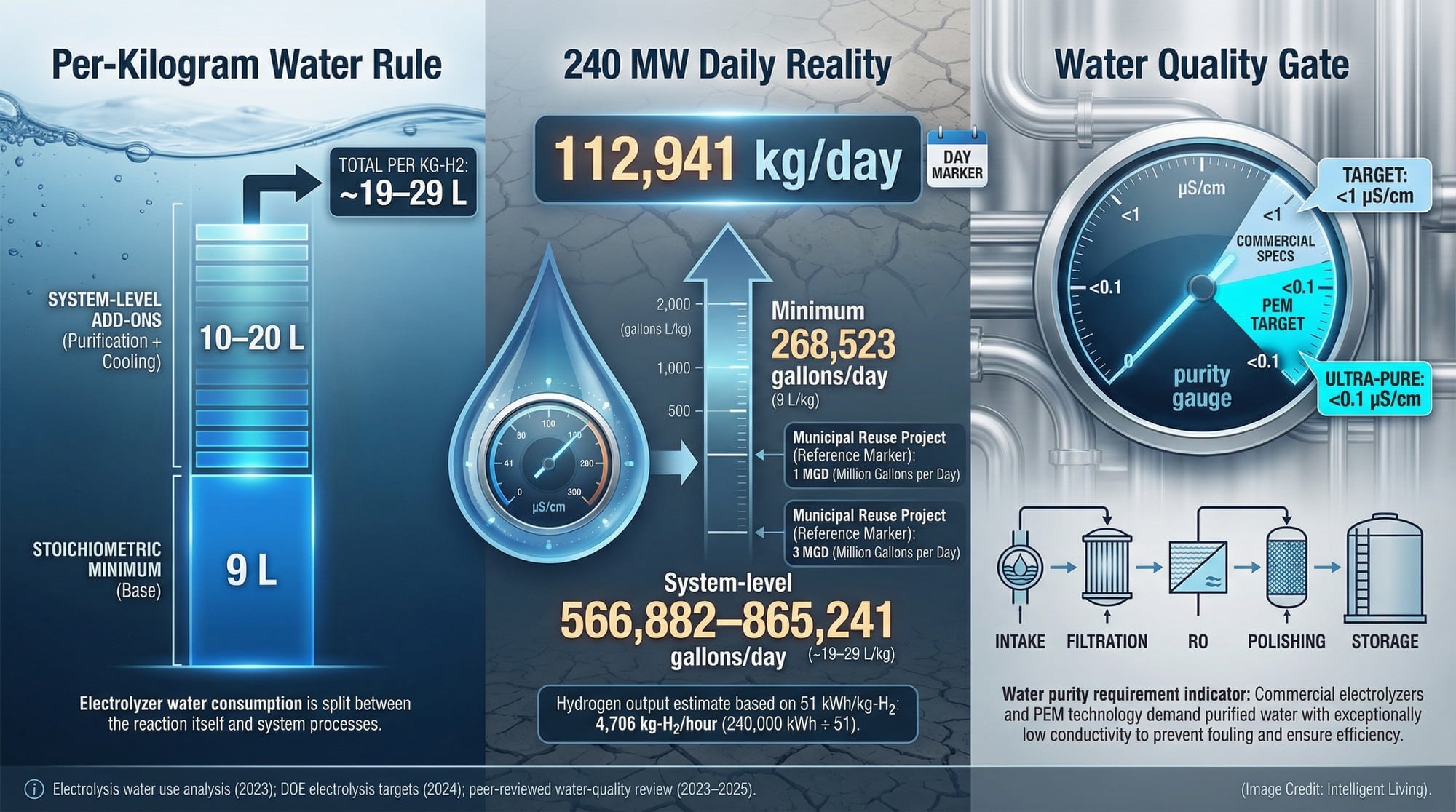
Industrial Water Security: Managing Feedstock Risks in Large-Scale Electrolysis
Electrolyzer Water Consumption: Quantifying Green Hydrogen Feedstock Needs
Green hydrogen is made by splitting water with electricity. The minimum input is straightforward, but the operational reality is not. Analyzing the actual water demand for green hydrogen production shows why liters-per-kilogram rules of thumb can understate real plant needs once purification, cooling, and losses are included.
Electrolyzers require water treated to high purity levels, adding significant cost and operational complexity to the feedstock loop. Water planning happens in the same units used for city growth, making industrial demand visible in municipal budget math.
Regional Infrastructure Strain: Operational Water Loads for Ammonia Synthesis
A plant designed for hundreds of tons of ammonia per day needs a steady hydrogen stream, and hydrogen needs treated water. That converts quickly into daily volumes large enough to matter in a region where current storage levels at the Choke Canyon reservoir are updated like a scoreboard. In a drought year, that scoreboard is not trivia. It becomes a boundary that decides whether projects can proceed without forcing tradeoffs.
Immediate community impacts occur as homes, schools, and businesses compete with heavy industry for limited reservoir capacity. Falling reservoir levels trigger ripples that manifest as tighter watering restrictions and higher utility rates. Resource scarcity sparks sharp debates regarding who carries the cost of new drought-proof infrastructure.
Long-range projections put the scaling risk into context. Projections for statewide hydrogen-related water demand through 2050 explain why statewide totals can look manageable while local impacts become severe in specific basins and coastal counties.
Those findings matter because the constraint is rarely statewide volume alone. The limiting factor is whether a specific county can deliver treated water at the same time new plants want to lock long-term contracts, which can raise industrial water pricing and delay final investment decisions. For residents, the same dynamic can show up as tighter restrictions, higher utility rates, and slower timelines for the everyday fixes people notice first, like mains, pressure, and drought-proof backup supply.

Water Security Mitigation Strategies: Evaluating Desalination and Industrial Reuse
Resource planning requires harsh tradeoffs, as developers prioritize long-term reliability over initial capital outlays. Clean hydrogen production demands constant hydration—an uninterrupted flow that must persist even during peak summer months when residential systems are under maximum stress.
Reclaimed Water and Industrial Reuse
Reclaimed municipal water offers a viable path to reducing freshwater pressure during industrial scaling. Developers typically target reuse for several balance-of-plant requirements:
- Industrial cooling system makeup
- Facility washdown and maintenance
- Secondary processing loop inputs
Success in this area depends on stable inflow and contracts that survive seasonal drought politics. Public debate often centers on whether municipal funds should upgrade treatment capacity that primarily serves new industrial offtakers.
Brackish Groundwater Treatment
Brackish groundwater treatment can be faster to develop locally, but yields and water quality constraints vary by site. It also demands energy for treatment and pumping, which can matter when the same region is trying to reserve clean electricity for electrolyzers and grid firming.
Seawater Reverse Osmosis Desalination and Brine Controls
Seawater reverse osmosis is drought-proof in a way reservoirs are not, but it adds energy demand, permitting requirements, and brine management challenges. Evaluating energy intensity for seawater reverse osmosis helps explain why desal can stabilize water supply while increasing the electrical load that the same region is struggling to deliver.
Advancing treatment technologies directly influence long-run cost curves by reducing the energy intensity of desalination. The chemistry and process logic behind implementing salt-free electrodialysis metathesis helps explain why researchers focus on lowering waste and brine burdens, even when near-term deployments still lean on conventional reverse osmosis.
Seawater as a Hydrogen Feedstock Input
Industrial planners keep revisiting the idea that coastal regions can treat seawater as a reliable input stream for hydrogen production. One example is the direct electrolysis of seawater for hydrogen feedstock that highlights why intake treatment, corrosion controls, and water quality are not side issues for electrolysis.
Visible coastal infrastructure decisions often spark local political friction, especially when residents feel the weight of regional drought. Intake locations, discharge plans, and shoreline impacts can become local political flashpoints, especially when residents already feel stretched by drought and growth.
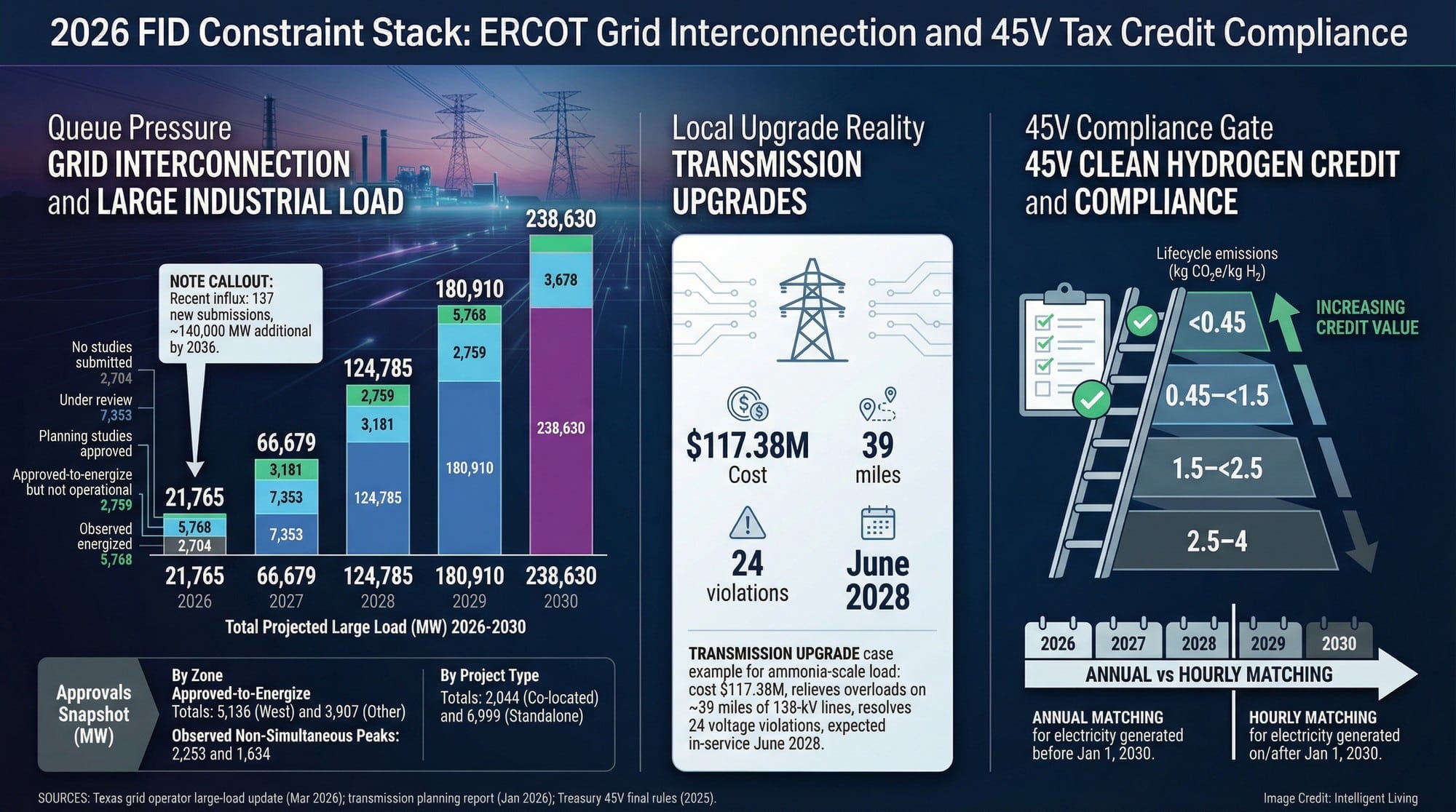
The 2026 FID Constraint Stack: ERCOT Grid Interconnection and 45V Tax Credit Compliance
ERCOT Transmission Constraints: Interconnecting High-Megawatt Industrial Loads
Why Large Industrial Loads Require Transmission Work
ERCOT’s grid maintains a strict balance between supply and demand while adhering to transmission limits. A 240 MW-class electrolyzer farm functions as a massive, steady industrial load. Integrating such a facility requires a study of interconnection for ammonia plant loads in Victoria County, moving far beyond a standard plug-and-play connection.
Plants cannot maintain full output without ready transmission infrastructure, regardless of electrolyzer installation status. That risk flows back into financing, because offtakers typically want certainty, not partial operation.
Firming Strategies and Time Matching
Developers often propose firming strategies such as battery storage, hydrogen storage, and operational flexibility to reduce peak strain and smooth renewable variability. ERCOT has also been formalizing how it evaluates and integrates large loads, which makes the standardized process for large load integration a practical marker for how quickly a project can move from an interconnection request to actual energization.
The scale of that pipeline is now part of the story. Reporting on current ERCOT large load interconnection queues provides a reality check on how many high-megawatt projects are competing for studies, upgrades, and commissioning windows.
Residents who have lived through summer heat alerts already understand the emotional version of this issue. When the grid is tight, people start watching forecasts, not just bills. An explanation of Texas ERCOT reliability pressures connects why household concerns and industrial interconnection planning are colliding.
Supply Chain Execution Risks: Lessons From the Topsoe First Ammonia Shift
What Happened and What it Means
Late March 2026 delivered a reminder that clean-energy projects are still hardware projects. Topsoe’s decision not to extend supply agreements with First Ammonia shows how milestone disputes and supplier strategy changes can disrupt a technology stack.
Supply disruptions extend construction windows, stretching traffic and noise impacts while delaying the local jobs and tax revenue promised during project announcements. Delays can stretch traffic and noise impacts and postpone the jobs and tax revenue that local leaders often cite when projects are announced.
The Technical Impact of an Electrolyzer Swap
First Ammonia’s update regarding the selection of a new hydrogen equipment supplier points to a practical reality: switching electrolyzer approaches can change feedwater purity requirements, operating temperatures, ramp behaviors, and balance-of-plant integration.
Those integration details matter even more when projects rely on flexible ammonia synthesis that must respond to variable power. A technical overview of how utilizing dynamic ammonia technology improves operational flexibility clarifies why control tuning, start-stop behavior, and ramp constraints affect both reliability and output quality.
Supply chain maturity also shapes bankability. A systems view of ongoing green hydrogen supply chain maturation puts procurement and commissioning bottlenecks in everyday terms, including why long lead times can quietly dictate a construction calendar.
Regulatory Compliance Mapping: Final 45V Clean Hydrogen Credit Guidance
What the Clean Hydrogen Tax Guidance Holds Projects To
Policy now influences engineering choices. The clean hydrogen production credit hinges on lifecycle emissions accounting and compliance requirements, and the rule text clarifies what must be documented for credit eligibility. Finalized clean hydrogen tax credit regulations provide the most direct reference for what counts as clean hydrogen under current U.S. tax guidance.
Tax eligibility hinges strictly on verified emissions accounting, overriding any sustainability marketing or industry branding. That distinction is already shaping how projects are structured, financed, and verified.
Why 45V Changes Contracting and Procurement
Developers now design power procurement and storage around 45V tax credit compliance flexibilities rather than annual averages. Documentation and modeling are essential project components. Monitoring these metrics has become a foundational design requirement rather than a final checklist item.

Gulf Coast Export Infrastructure and Strategic Low-Carbon Ammonia Development
Gulf Coast Ammonia Logistics: Assessing Low-Carbon Export Capacity
Existing Gulf Coast export infrastructure proves that ports, tanks, and industrial-scale logistics are fully operational. Reuters recently reported that Woodside assumed control of the Beaumont ammonia facility. However, low-carbon production timelines have slipped past 2026 because of critical upstream dependency delays.
Why Low Carbon Conversion Often Comes Later
Converting export capacity into low-carbon output depends on upstream hydrogen, water security, and often carbon management infrastructure. Low-carbon pathways depend on integrated design for the Beaumont New Ammonia project. When any of those inputs slip, the conversion date slips with them.
On the demand side, the debate is also evolving. Debates regarding ammonia as a bunker fuel versus nuclear propulsion show why ammonia remains attractive as an energy carrier in shipping debates even as local constraints become the gating issue.
In parallel, clean-fuels planners increasingly treat ammonia as one node in a broader synthetic-fuels toolkit. Narratives surrounding green fuels produced from ammonia and eFuels help explain why off-take narratives often bundle shipping, aviation, and industrial heat under one decarbonization umbrella.
Strategic Monitoring: The 2026 Green Ammonia FID Gate Checklist
When projects move from announcements to construction, the proof tends to show up in paperwork and dates. A practical monitoring checklist allows residents and lenders to distinguish between project certainty and schedule drift.
- Water Contracts: watch for signed long-term off-take agreements and posted project milestones in the Corpus Christi archive of municipal water supply updates, which posts schedule changes and delivery milestones during emergency stages.
- Grid Planning Updates: the March 2026 status updates regarding ERCOT large load integration offer a snapshot of how load approvals, queue behavior, and study processes are changing.
- Transmission Approvals: track interconnection and upgrade milestones that shape energization timelines for ammonia-scale loads.
- Vendor Deliveries: monitor supplier milestone confirmations and FEED completion announcements.
- Policy Documentation: watch how developers describe compliance pathways in public filings and contract language.
Checkpoints form a practical checklist that residents, lenders, and offtakers can use to judge whether a project is moving toward construction certainty or drifting toward redesign.
Community Resource Resilience: Social License and Infrastructure Transparency
South Texas residents now calculate water usage with the same precision developers apply to industrial load planning. A city water advisory changes daily routines fast, and it makes long-range industrial planning feel immediate. In South Texas, that can mean quick mental math at the grocery store, a shorter shower, and a growing awareness that new industrial growth must match local resources instead of assuming they will appear on demand.
Transparency and fair resource allocation maintain social license—a non-technical asset as valuable as a water permit. Scarcity transforms trust into a tangible resource. Acceptance of industrial growth typically follows when community rules feel equitable, tradeoffs are explained without jargon, and promised benefits arrive on schedule.

Securing the Future of Texas Green Ammonia: A 2026 Readiness Roadmap
Verifiable milestones—including secured water contracts and supply chain integrity—distinguish viable projects from speculative announcements. Progress is measured by secured water contracts with credible delivery dates and a confirmed transmission upgrade path that survives ERCOT grid contingency planning.
Gulf Coast developers must prioritize drought-proof supply and 45V tax credit compliance as the primary gating items for 2026. Long-term competitiveness belongs to projects that balance industrial load with regional water security. Success requires a clean-fuel transition that supports the local community rather than exhausting its primary resources.
Texas Green Ammonia and Regional Water Security FAQ
How Much Water Does a 240 MW Green Ammonia Project Need?
Estimates suggest a 240 MW facility requires millions of gallons daily for electrolysis and cooling. Real-world demand fluctuates based on purification losses and system efficiency.
Why Is Corpus Christi Pursuing Desalinated Potable Water Now?
Infrastructure for desalination provides a drought-proof supply that survives reservoir depletion. Infrastructure upgrades secure both residential taps and industrial electrolyzer desalination needs during emergencies.
Can Desalination Scale Without Creating New Environmental Problems?
Engineering choices must manage brine discharge and high electrical intensity to mitigate shoreline impacts. Modern permitting requires rigorous mitigation strategies for any industrial-scale deployment.
What Does FEED Lock In and Why Does It Matter?
Blueprinting through front-end engineering and design finalizes equipment specifications and cost baselines. Completing this phase allows developers to sign binding supply and offtake agreements.
How Does Vendor Volatility Affect Nearby Projects?
Supplier shifts often trigger new grid studies and permitting delays. Shifting supplier agreements can force expensive redesigns of feedwater purity and power integration systems.


