
Professionals now demand clear insights into the job ladder’s structural shifts as algorithmic agents begin managing tasks previously handled by experienced staff. In everyday career conversations regarding the manager mindset reshaping entry-level work today, the anxiety is rarely abstract.
Hiring checklists now frequently prioritize AI literacy as an entry-level requirement, signaling that candidates must demonstrate proof of work through tool supervision. Collaboration between machine and human replaces the old fear of total displacement, turning traditional roles into supervisory functions. As capital returns from automated systems scale, the question of who captures that value becomes central to maintaining social stability.
Economic analysis translates a recent working paper into plain terms, pressure-testing the data against real-world constraints. A comprehensive IMF assessment of genAI exposure across jobs serves as a vital reminder that model results are conditional. We will examine the specific capability thresholds and policy levers required to turn technological rent into a stable public dividend.
Essential Insights into AI Rent-Funded UBI Requirements
Emerging economic data indicates that breakthroughs in machine learning can fundamentally reshape fiscal strategy through automated profit streams. Examining the AI capability threshold preprint reveals several core requirements for self-financing safety nets. Foundational insights include:
- The preprint derives a closed-form condition for when AI capital profits could finance a transfer approximating universal basic income within its model assumptions.
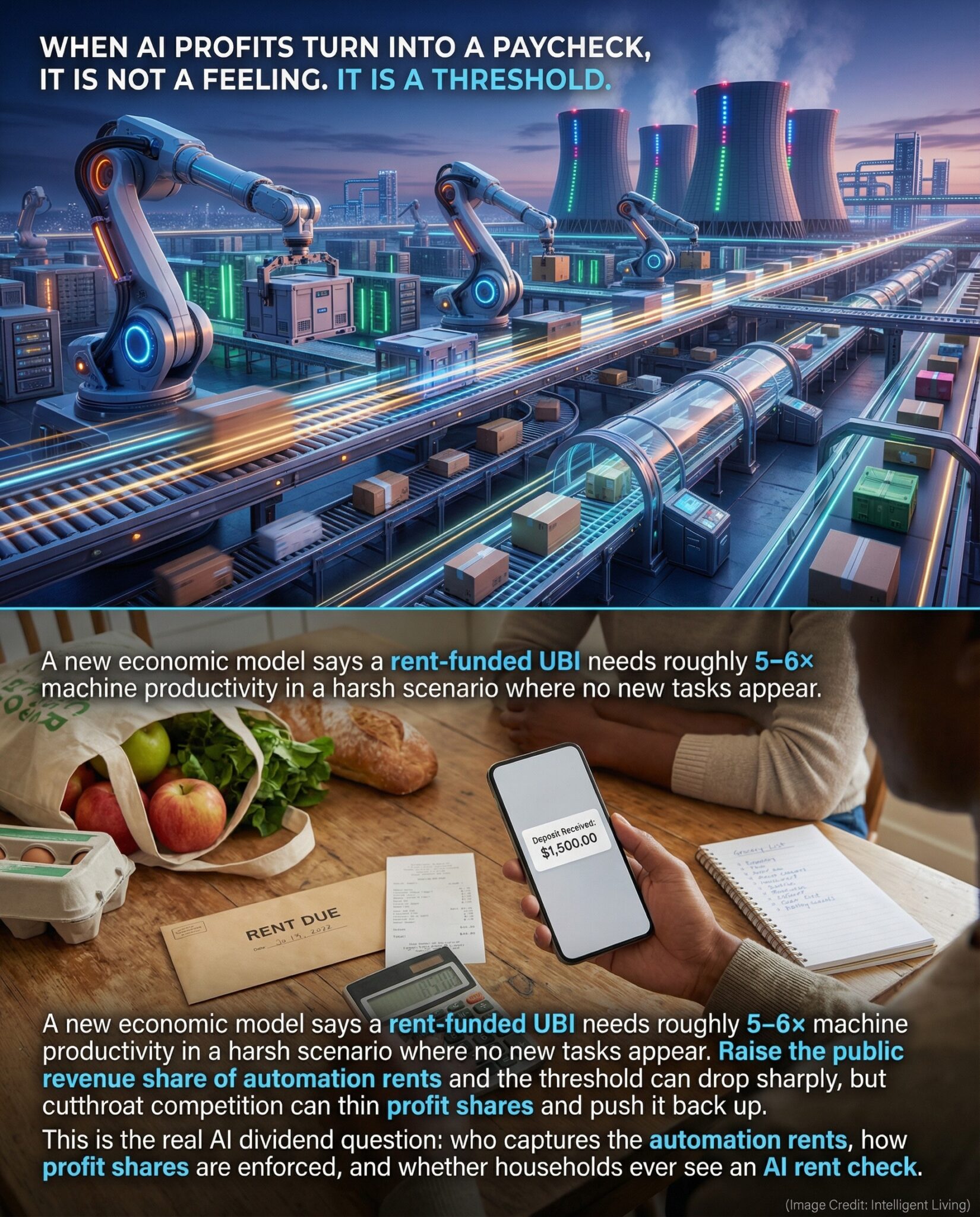
- In the paper’s conservative, no-new-tasks calibration, the model finds AI capability must rise roughly 5–6x relative to current automation productivity before an 11% of GDP UBI could be supported.
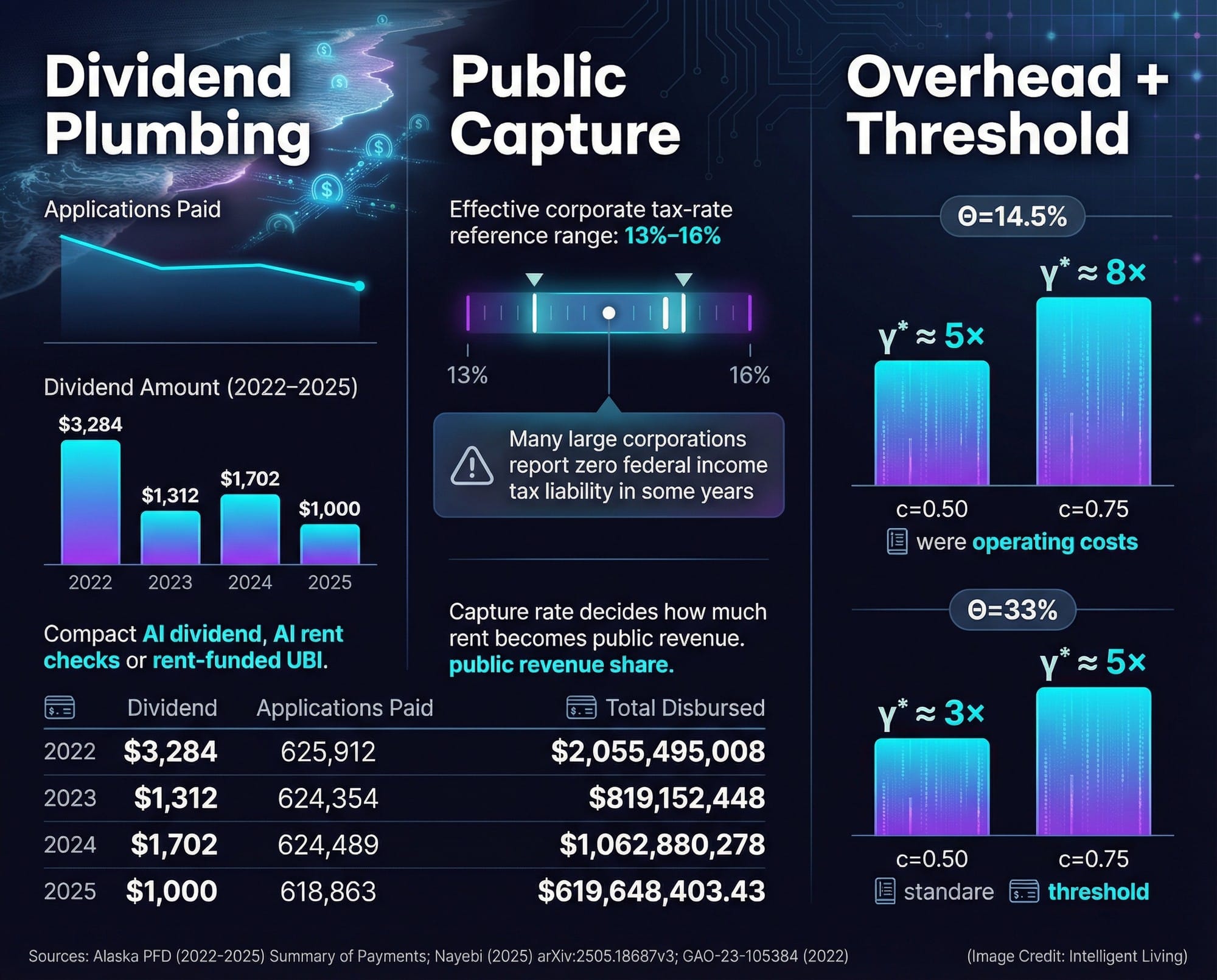
- A central policy lever is the public revenue share of AI rents: increasing the share of profits captured publicly can materially reduce the capability gap.
- Market concentration matters in an unexpected way: higher rents from concentrated markets can make the funding target easier to reach.
Variables suggest that market structure is as vital as technological progress. Beyond software, the physical scaling of automation adds a layer of complexity to the transition.
- The Permanent Fund Dividend program mission shows how a resource-dividend system can be administered over time, despite the differences in asset types.
- Global trends in IFR industrial robot deployment data show annual installations reaching the half-million range.
- A simple proxy for intensity is the robot-to-worker ratio leaderboard, which translates density into a human-scale metric.
- When automation moves beyond code, robot schools and embodied AI training pipelines turn prototypes into repeatable industrial pilots.

Analyzing the Economic Mechanics of AI Capability Thresholds
Defining the Parameters of High-Output AI Productivity
The Model Question in Plain English
Economists are investigating a vital policy dilemma: at what level of technical proficiency does labor-substituting technology generate enough surplus to support a broad safety net? The study formalizes its answer as an algebraic threshold while showing how policy and market variables push the number up or down. Interpret the resulting threshold as a conditional framework—if specific variables align, the outcome follows—and analyze the data through that lens.
Why the “No New Tasks” Scenario is Intentionally Harsh
Economists studying automation often split outcomes into two broad possibilities: task displacement and task creation. The first is the worry that machines will simply take over existing tasks; the second is the historical pattern where new tasks appear that humans perform. A task-based review of automation and new tasks clarifies how these paths converge in reality, positioning the displacement-only model as a rigorous stress test rather than a definitive prediction.
Quantifying the 5–6x Automation Productivity Benchmark
What the 5–6x Number Represents
Anchored in plausible calibrations, the central number serves as a critical engineering-style multiplier. The paper’s machinery estimates that AI would need to be several times more productive at substituting for human tasks than the current baseline to cover an 11% of GDP cash program. Meaningful household support relies on this 11% figure as a benchmark, moving the discussion beyond symbolic micro-payments toward genuine financial security.
Scale Checks for a General Reader
To make that feel real, it helps to keep “gross cost” and “net cost” distinct. Comparing VAT and UBI costs reveals how rapidly payments reach the multi-trillion-dollar mark; consequently, the paper’s GDP-based framing provides a more manageable scale for analysis. In communities that have watched a single employer shrink, the first stress signal is usually not ideology. It is the small decisions, like groceries, school supplies, and the gas tank, that start to feel unstable.
The Three Levers that Decide whether an AI Dividend Works
Alaska’s Permanent Fund as a Blueprint for AI Wealth Distribution
Why the Alaska Permanent Fund Matters as a Template
Operating under institutional protection, the Alaska Permanent Fund demonstrates that cash dividends remain politically viable when revenue streams are transparently managed. The Alaska dividend employment evidence reports no reduction in overall employment and an increase in part-time work in the study’s estimates, which helps ground one of the most common fears about cash channels.
How the AI Resource is Different from Oil
Economic scarcity shifts from physical barrels to digital bandwidth, making the distinction between resource types vital as oil rents remain tangible while AI profits flow through compute cycles and platform dominance. Strategic infrastructure bottlenecks track LLM market share dominance and determine who can scale models cheaply, providing a clear indicator of where value accumulates. When small business owners describe automation that “worked,” they often mention the monthly costs and the vendor lock-in long before they talk about the headline feature set.
Optimizing Public Revenue Shares from AI Capital Returns
What “Public Revenue Share” Means in Practice
Public revenue share is the fraction of profits, rents, or returns from AI capital that is captured for public purposes. A practical menu of public finance approaches for transformative AI includes taxes on extraordinary returns, windfall clauses, public equity stakes, and sovereign-wealth-style structures that can convert rents into broad-based benefits.
Practical Policy Tools and Tradeoffs
Design is where lofty concepts face rigorous testing. The IMF fiscal policy guidance for broadening genAI gains highlights uncertainties in pace and impact. Consequently, governments must develop adaptive policies that respond to unpredictable technological shifts. In local tax debates, the hardest part is often not the rate. It is defining what counts, what gets exempted, and who bears the paperwork.
Balancing Market Concentration and Public Rent Capture
Why Fewer Firms Can Make a Dividend Easier
Concentrating the economic surplus from AI within a small group of providers allows those firms to accumulate substantial rents. Work on scaling-driven foundation model market structure explains why fixed costs, data advantages, and compute bottlenecks can push value toward a small set of providers even when models proliferate. Larger rents mean a bigger pool from which a public share could be drawn. In the paper’s logic, greater concentration can reduce the required capability threshold because more output shows up as profit rather than being competed away.
Why that is Politically and Ethically Uncomfortable
A dividend funded by monopoly-like rents runs into a basic tension: the same concentration that expands the taxable pool can also raise prices, narrow choices, and increase political power. A research synthesis on competition and welfare frames market structure as a first-order variable for outcomes, not just a business story.
Platform owners cluster gains while mid-level service work thins, a dynamic already apparent as AI tools hollow out marketing’s middle tier. Workers in regions with only a few dominant employers often talk about losing bargaining options before they talk about losing tasks.

Validating AI Economic Models Against Global Market Realities
Factors Limiting the Scale of Automated Safety Nets
Every model threshold remains highly sensitive to real-world shifts. Rapid task creation could expand the wage and profit bases beyond baseline projections, while expensive compute might stifle the rent pool. Infrastructure constraints are already visible as AI data center energy and water constraints become binding limits during grid tightening.
In lived experience, staggered technological adoption often feels like a gradual economic tightening rather than a sudden structural shift. Ambient technostress is captured in the hidden cost of everyday AI in home, health, and work.
Measurement and Definitions: What Counts as Profit?
Standardized accounting frameworks remain vital for defining which revenue streams qualify as distributable profits in a national audit. The BEA corporate profits framework provides a clean baseline for what “profits” means in official statistics. When someone hears “profits can pay for it,” they often imagine a pile of cash sitting in one place. In practice, timing, accounting, and legal structure decide what is taxable and when.
Critical Signals for Future AI Economic Integration
A fast-moving scoreboard of frontier milestones shaping next year’s progress helps readers track pace without treating any single benchmark as destiny.
Capability Signals: Deployment, Reliability, and Cost Curves
Reliable metrics for progress include falling inference costs, widespread adoption in daily workflows, and consistent performance in unpredictable environments. High-performance throughput is often framed as an operations metric, as seen in recent Nemotron 3 Super throughput claims.
Policy Signals: Pilots, Tax Proposals, and Ownership Experiments
The most informative pilots are the ones that reveal administrative friction. Programs that resemble an “AI dividend” will rise or fall on legitimacy and compliance, which is why public mistrust and transparency gaps can become an economic constraint, not just a messaging problem.
Market Signals: Concentration, Licensing, and Access
As AI becomes infrastructure, margins are shaped by cooling, utilization, and power procurement as much as by model quality. Resource efficiency is now managed through carbon-aware computing practices that treat emissions and cost as critical variables.
Cost curves also depend on where inference runs, as the tradeoffs between local and cloud AI highlight how on-device models reduce bandwidth exposure. On the hardware side, Microsoft Maia power economics illustrate how token generation gets priced around networking and throughput.

Strengthening Social Stability through AI Capital Dividends
The research suggests a self-financing safety net is achievable if specific technological and policy milestones are met. Value is already shifting toward owners of automated systems, as seen in the role of digital workers in business workflows, often occurring long before mass unemployment headlines. By reframing the debate from slogans to conditional data, we can better evaluate the specific public share and market structures needed for success.
Trust, care, and physical presence remain human-centric domains, as the roles AI still struggles to replace demonstrate. A durable dividend depends less on a single breakthrough and more on deliberate democratic choices regarding profit sharing. Shifting these levers allows society to transition toward an era where automation supports broad-based prosperity rather than concentrated wealth.
Common Inquiries Regarding Rent-Funded UBI
What constitutes an AI dividend?
An AI dividend represents regular cash payments funded by public claims on profits or rents from AI systems, mimicking the structure of resource-based wealth funds.
How is the AI capability threshold defined?
Economic modeling uses this threshold to describe the specific productivity level AI must reach, relative to today’s baseline, to self-finance a cash transfer program through capital gains.
Can AI capital profits fund UBI without new taxation?
In theory, yes, provided the public revenue share and machine capability meet the paper’s 5–6x multiplier. In practice, success likely requires blended funding and public stakes.
Does a dividend reduce workforce participation?
Alaska’s resource-dividend data shows no net decline in employment. Most recipients maintain their roles or shift toward part-time work for better work-life balance.
Who owns the profits in a rent-funded system?
Ownership currently resides with private firms and cloud providers. Transitioning to a dividend model involves licensing, windfall clauses, or sovereign wealth structures to distribute returns.


