
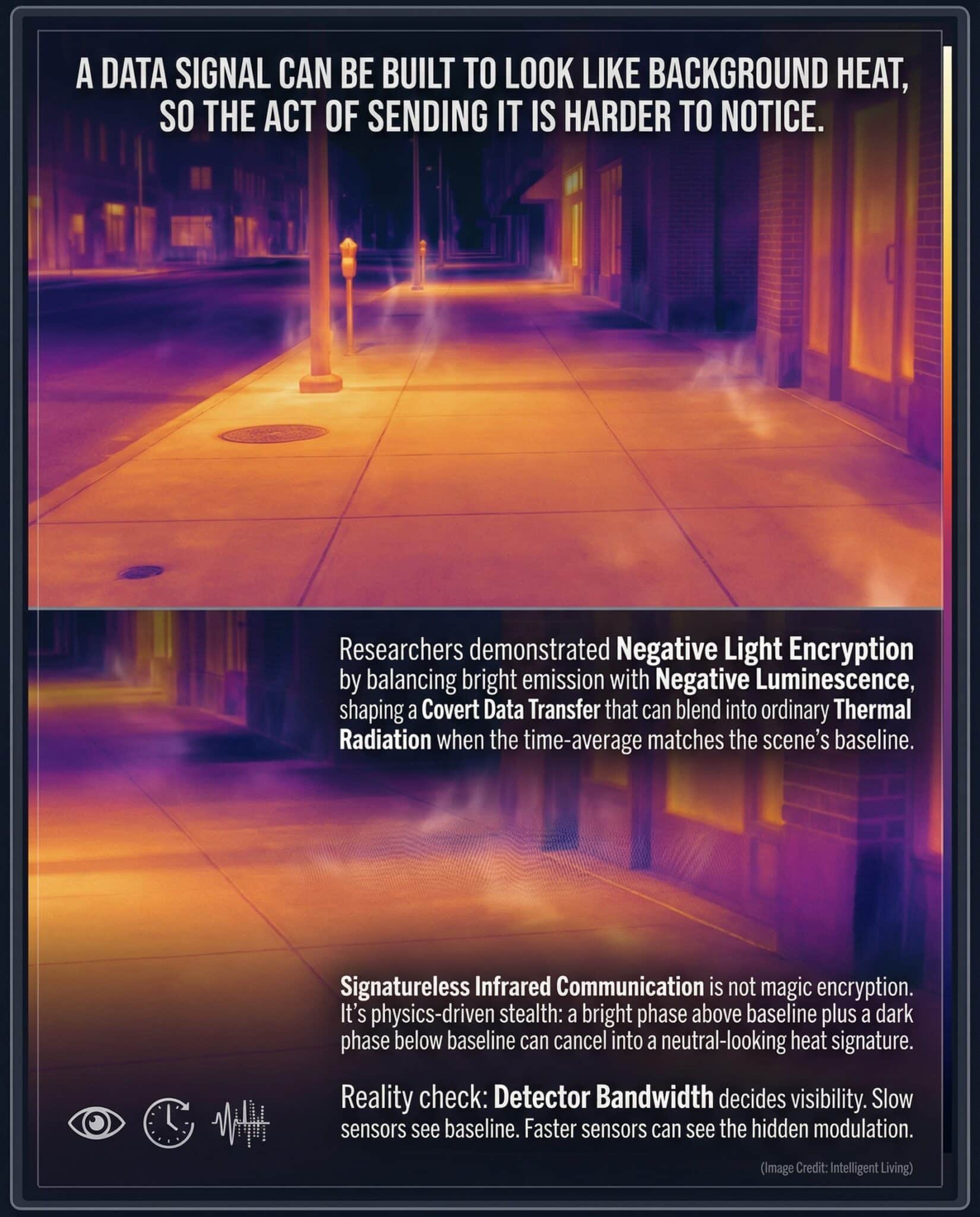
Modern environments are saturated with sensors that track every thermal pulse. Researchers at the University of New South Wales (UNSW) have now developed a method to disguise data transfers so they blend into this ambient heat. This negative light encryption technique balances intentional emission with a counterintuitive effect called negative luminescence, ensuring the time-averaged signal matches the scene’s thermal baseline. Analyze the underlying mechanics of signatureless infrared communication, the defensive role of negative luminescence, and the shifting hardware landscape defining thermal stealth limits.
The goal isn’t just scrambling content; it’s making the transmission invisible. This layer of physical stealth is critical when the mere act of communicating invites unwanted scrutiny.
As always-on sensing moves from novelty to default, the privacy question shifts from “Who can read my data?” to “Who can tell I am sending anything at all?” That shift is already showing up in everyday conversations about smart environments that react autonomously to thermal patterns where devices watch patterns and react automatically.
Foundations of Negative Light Encryption and Signatureless Signaling
Essential Capabilities and Constraints of Negative Light Technology
Thermal stealth technology presents technical constraints that researchers must resolve to achieve reliable covert transport. The following technical highlights define the current state of signatureless infrared communication:
- Covert mid-infrared signaling alternates between bright and suppressed emission phases.
- The journal DOI record for the signatureless method anchors the core technical claim.
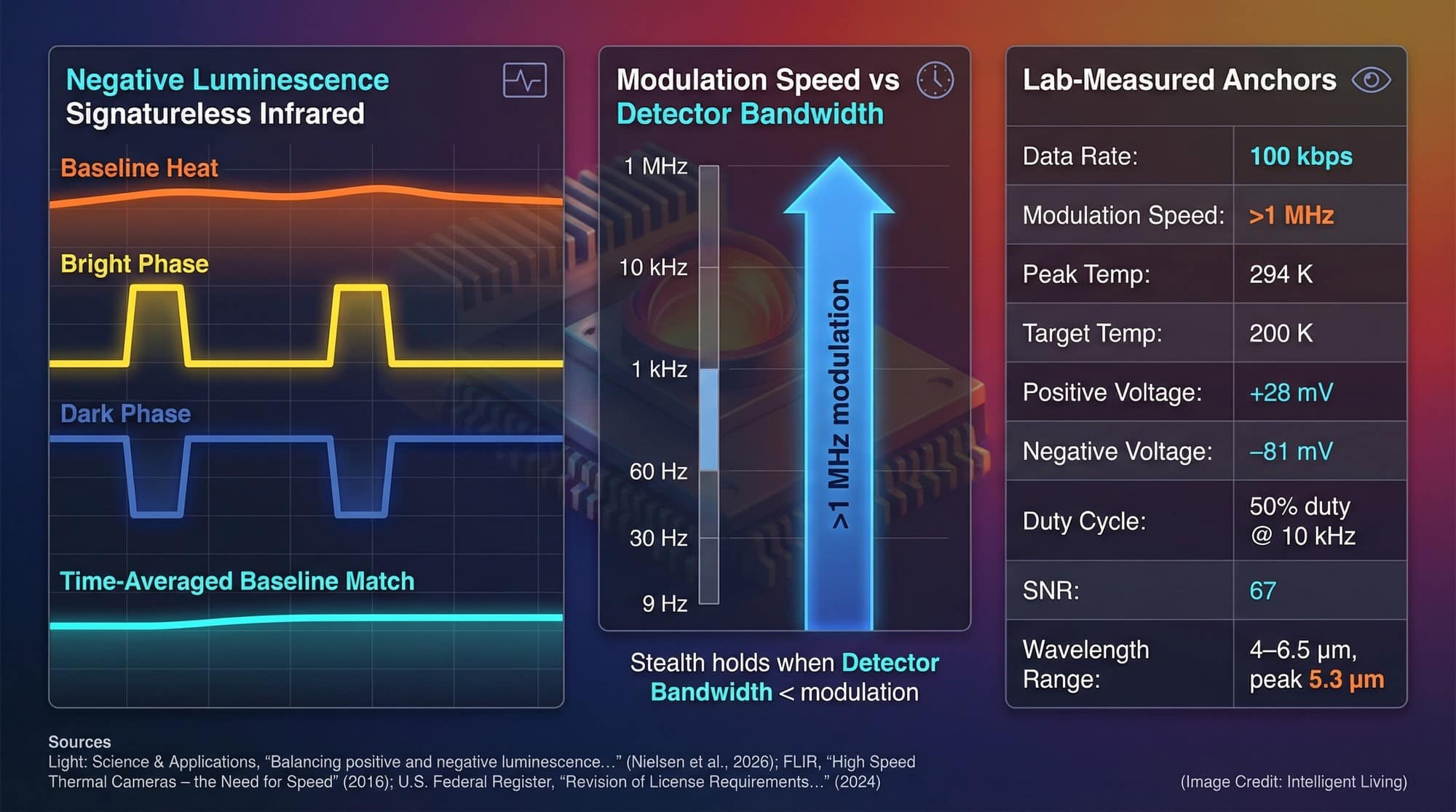
- Laboratory benchmarks sit in the kilobit-per-second range for current prototypes.
- Peer-reviewed figures should guide performance expectations over secondary news coverage, including recent breakthroughs in signatureless infrared signaling.
- Atmospheric windows determine how freely thermal radiation propagates in outdoor environments.
- NASA’s data on specific wavelengths that bypass atmospheric interference explains wavelength propagation limits.
- The approach is compatible with conventional encryption; it changes detectability, not cryptographic confidentiality.
Security professionals should treat these characteristics as a physical-layer enhancement rather than a digital replacement. The approach remains compatible with conventional encryption while fundamentally altering the detectability of secure links.
What is “Signatureless” Infrared Communication, Exactly?
Defining the Mechanics of Signatureless Infrared Communication
The theoretical framework for balancing emission with background heat defines this method by its ability to shape emission waveforms. By averaging energy over a specific timescale, the signal matches the thermal background. The device toggles between electroluminescence and negative luminescence. This balance prevents low-bandwidth detectors from registering net temperature changes.
Why Publication Metadata Matters
The validated performance metrics for covert mid-infrared links capture the publication metadata in a way that helps readers verify dates, authorship, and citation trails.
Why Detector Bandwidth Decides Visibility
Detector bandwidth determines visibility. It defines the speed at which a sensor registers environmental shifts. If a detector samples slowly compared with the signaling modulation, rapid bright-and-dark toggles blur into the background. If a detector samples faster, those toggles stand out and the stealth advantage fades.
What the Lab Demonstration Covers and What it Doesn’t
In the UNSW laboratory write-up, the lab setup and early materials choices are described in a way that helps separate what has been shown in controlled conditions from what still needs engineering for real environments.
Leveraging Negative Luminescence for Advanced Covert Security
Physical Principles of Negative Luminescence in Semiconductors
Research in Applied Physics Letters regarding reverse bias techniques that suppress radiative signatures provides a technical foundation for negative luminescence. Under specific bias conditions, a semiconductor emits less radiation than it would in thermal equilibrium.
Practitioners describe this as looking “darker than off” in the mid-infrared spectrum. Reverse bias suppresses radiative emission by shifting the carrier populations that drive interband processes.
The device doesn’t actually delete heat. Instead, it manipulates how efficiently it radiates within a specific band to create a controllable dark phase in a communication pattern.
How Devices Use the Effect Practically
Researchers used thermoradiative diode architectures in the laboratory to alternate between emission and suppression. This method balances bright and dark phases to ensure the signal remains indistinguishable from the thermal baseline to low-bandwidth sensors.
Similar effects occur in daily life, such as security cameras failing to register flicker from certain LED arrays. These sampling limits are why smart cloud surveillance in modern homes often favors automated detection over manual monitoring.
Reshaping Threat Models through Undetectable Signaling Techniques
Unreadable vs. Undetectable
Encryption protects message content. Detectability addresses whether an adversary knows a message exists at all. The formal security framing behind this split is captured in work on low-probability-of-detection communication limits, where the “win condition” is often staying below a detection threshold, not merely keeping payloads secret.
How Covert Communication is Framed in Research
Research on covert communication and low probability of detection treats “not being noticed” as a separate engineering goal from keeping payloads unreadable.
Why Suspicion Can Be the Real Trigger
Consider a building operator who investigates sudden, unexplained data bursts. A thermal link that matches the background avoids these triggers entirely, even if the underlying data is still encrypted.
How Stealth Layers with Encryption Hygiene
Physical-layer stealth integrates with standard cryptographic hygiene. The protocols in standard cryptographic hygiene for networked hardware stay relevant because covert transport cannot resolve weak authentication or compromised endpoints.
Technical Constraints and Historical Lineage of Thermal Infrared Links
Operational Limits of Thermal Stealth in Real-World Environments
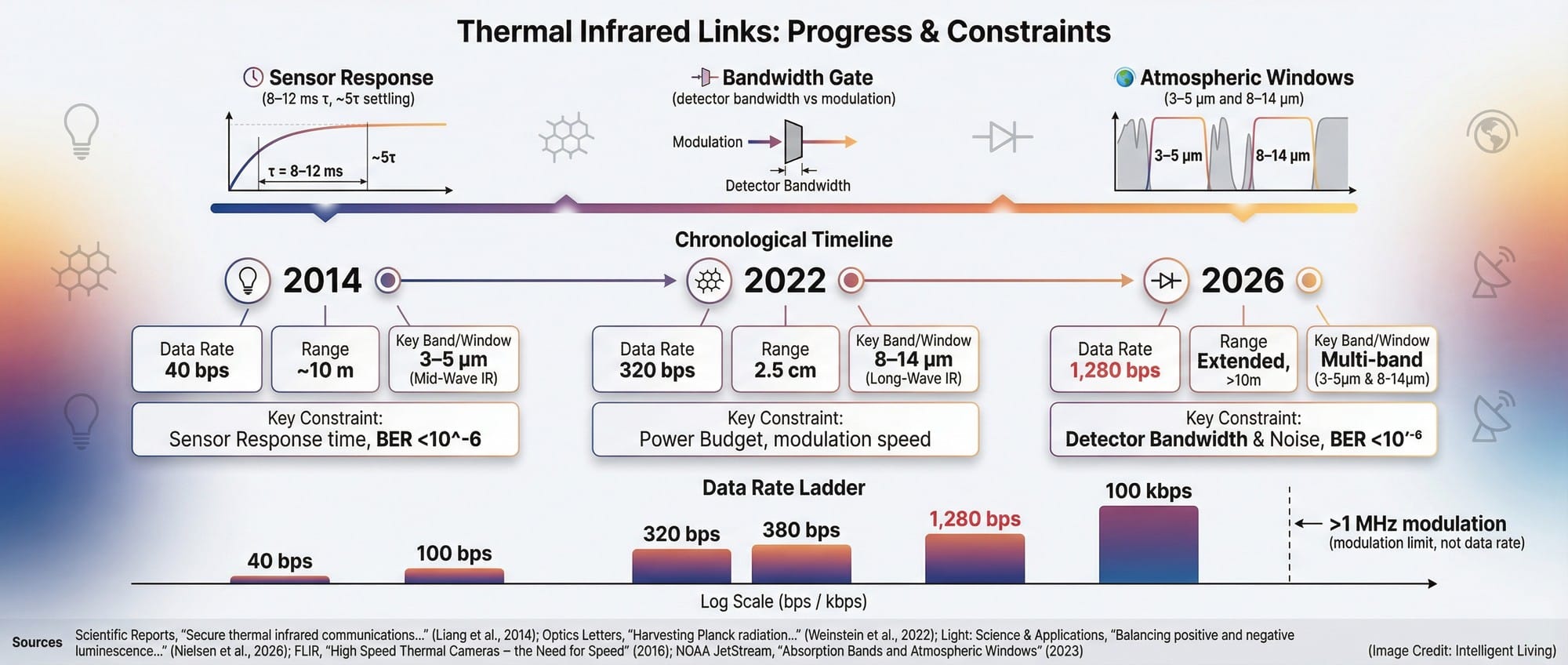
The invisibility claim depends on a sensor’s sampling speed relative to the modulation rate. If the detector bandwidth exceeds the signal bandwidth, the transmission no longer looks signatureless, and the modulation can become visible. Frequent lifecycles of sensor hardware and detector performance prove that ‘good enough’ sensors quickly become obsolete.
Environmental and Practical Frictions
Outdoor environments introduce significant practical friction for thermal links. Several environmental factors directly impact the link budget:
- Atmospheric absorption bands and scattering
- Background thermal clutter
- Precise physical alignment
- Signal propagation distance
These variables force engineers to select specific predictable gaps in infrared absorption to maintain outdoor performance.
Hardware evolves quickly. The ‘good enough’ sensors of today are constantly replaced by high-bandwidth upgrades that can shrink the window a covert scheme relies on. This matters because thermal imaging features in modern CCTV systems highlight the speed of hardware evolution.
A short field detail makes this concrete. A technician testing sensors in a leafy courtyard will see thermal noise from sun-warmed walls, wind, and shifting shade, and that messy baseline is exactly what determines whether a stealth technique stays subtle or sticks out.
Threaded Context: Thermal IR Comms Didn’t Start Today
Thermal infrared communication has precedent, even if most people never think of heat as a data channel. Early work on engineered blackbody infrared communication framed thermal emission as an underused medium and demonstrated proof-of-concept links at modest data rates.
Later demonstrations explored more creative ways to treat thermal radiation as a usable signal, including an Optics Letters experiment on a Planck-radiation harvesting transmitter that emphasizes how link budgeting and background conditions shape performance.
Early demonstrations required tight alignment and patient repetition. These challenges indicate that the leap from lab results to dependable deployment involves significant engineering.

Expanding Thermal Stealth Ecosystems and Future Technology Horizons
Integrating Cloaking and Deception within the Thermal Stealth Stack
Covert links are part of a broader trend: shaping what infrared sensors perceive. A Nature Communications demonstration of engineering false thermal signatures for deceptive messaging shows how concealment and controllable thermal patterns can be engineered for different purposes, from hiding an object’s apparent temperature to presenting a false thermal signature.
For a familiar example, heat-sensitive thermal invisibility materials capture how thermal concealment is often described in everyday conversation, even when the underlying mechanisms differ.
These technical baselines establish the operational limits for coverage policies in high-security environments.
Future Directions in Materials Science and Sensing Capabilities
Early demonstrations relied on complex materials. Future scaling requires manufacturable alternatives and stable performance outside controlled lab environments. This lineage stems from night-time solar technology as a thermoradiative pathway, showing how energy research evolves into secure communication tools.
In thermoradiative photovoltaics, as PV in reverse, the same device family is described in accessible terms.
Sensing and the Arms Race
Stealth depends on the sensor base. If watchers upgrade detectors by widening bandwidth, raising sampling rates, or improving signal processing, the relative stealth advantage shrinks. Anticipated home security expectations and sensor integration will intensify this tension as hardware and software capabilities accelerate.
Standards, Ethics, and Policy
Physical-layer stealth introduces complex policy questions regarding lawful interception and dual-use risk. Parallel evolutions in cryptography and transport layers, such as the quiet deployment of next-generation security primitives, indicate that infrastructure is adapting even as sensing capabilities accelerate.
Connectivity narratives are shifting toward multi-layered security involving spectrum frontiers and advanced sensing. Broader evolving telecom roadmaps that favor high-frequency channels contextualize how mid-infrared approaches integrate with next-generation channels like terahertz and quantum links.

Enhancing Digital Privacy through Adaptive Thermal Baseline Stealth
This research forces a fundamental shift in the global privacy conversation. Cryptographic content secrecy is essential, yet the new frontier for secure digital infrastructure involves controlling activity detectability. Negative luminescence experiments from the UNSW team don’t just solve a technical puzzle; they sharpen our understanding of signal exposure in a world of pervasive sensing.
Reinforce the digital fundamentals that govern daily exposure rather than chasing exotic physics. Robust proven methods for shielding network traffic serve as the primary defense against routine network leaks. Organizations that pair strong network hygiene with emerging physical-layer stealth can secure their operations in a landscape of pervasive connectivity.
Vulnerabilities caused by misconfigured routers and reused credentials typically involve reused passwords, unpatched routers, or excessive app permissions.
For homes and small organizations surrounded by IoT sensors, isolating compromised hardware through effective segmentation can reduce risk even when devices are always listening and always connected, especially when the goal is limiting where data can travel.
Technical FAQ: Understanding Thermal Stealth and Negative Light Systems
1. What Is Negative Light Encryption Technology?
Negative Light refers to signaling techniques that mimic background heat by balancing bright emission phases with suppressed periods to evade detection.
2. How Does This Differ from Standard Encryption?
Standard encryption hides message content through math, while this technique addresses detectability by making the signal physically resemble ambient thermal radiation.
3. Why Is Detector Bandwidth Critical for Stealth?
Visibility depends on sampling speed. If a sensor’s bandwidth is high enough, it can register the rapid toggles that a slower detector misses.
4. Can messages truly look like ordinary heat?
Yes, by alternating emission and suppression at speeds faster than a detector can sample, the transmission blurs into the surrounding thermal baseline.
5. What are the Current Limitations of Thermal Links?
Present demonstrations are limited to kilobit-per-second rates in lab settings, requiring precise alignment and specific atmospheric windows to function outdoors.


