
A modern career functions as a dynamic operating system rather than a static résumé. Success requires translating high-value skills into tangible proof assets that generate market trust, allowing professionals to secure higher rates and sustain long-term financial stability. Effective career marketing prioritizes evidence over aesthetics to meet the demands of a skills-based hiring landscape.
Professional clarity outpaces hype in every competitive market. While a clean presence creates visibility, the primary differentiator remains verifiable evidence. Social media personal branding habits yield the highest ROI when pointing toward documented wins that prove competence under real-world constraints. Documented outcomes serve as the bridge between basic talent and premium positioning.
Consistency bridges the gap between potential and payment. Establishing clear self-representation and personal branding enables clients to identify specific solutions and measurable success metrics. Actionable frameworks within this guide address cash-flow management and proof-of-work architectures required for stabilizing income. Quantified results combined with outcome-based pricing models provide the necessary roadmap for scaling expertise in a competitive market.

Skills-Based Hiring and Market Shift Data: The Numbers Behind Modern Professional Marketing
- Skills-Based Hiring is Expanding Candidate Pools: LinkedIn’s skills-first hiring data explains why many employers are moving from title filters toward skills signals, which raises the value of transferable proof assets.
- Organizations Struggle to Keep Up With Skill Change: A talent velocity gap analysis describes how skills evolve faster than many organizations can detect and deploy, so clear proof-of-impact becomes a shortcut to credibility.
- Core Job Skills are Expected to Shift Rapidly: The World Economic Forum’s skills outlook analysis highlights ongoing skill change through 2030, which makes reusable proof assets more practical than a one-time résumé rewrite.
- Cash Flow is About Timing, Not Only Totals: The CFPB’s cash-flow budget tool treats budgeting as a calendar problem, which matters when income arrives in uneven bursts.
- Independent Work Requires Tax Planning: For many U.S. freelancers and consultants, the IRS summary of self-employment tax basics is a practical reminder that tax reserves belong in the system, not in the “later” pile.
- Quarterly Tax Payments Can Be Part of the Routine: Strategic independent workers plan for four distinct payment periods each year to maintain tax compliance.
- Independent Work is a Measured Labor Category: The BLS overview of contingent and alternative work arrangements shows how nontraditional work is tracked and defined.

The Financial Runway and Income Protection: Stabilizing Cash Flow Before Scaling
Operationalizing the Cash-Flow Calendar: Moving Beyond Monthly Projections
A working calendar provides a visual timeline for when income arrives and when financial obligations hit. Strategic mapping of the next 30 to 90 days prevents avoidable fees by identifying timing gaps before they occur. The CFPB’s adjusting cash-flow calendar worksheet serves as a specialized tool for this timing-first view.
Efficient cash-flow management requires tracking several critical variables:
- Expected payment dates for all client invoices
- Recurring monthly bills and minimum debt obligations
- Seasonal spikes in heating, cooling, or annual renewals
- Buffers for exact due dates to avoid late-fee triggers
Including exact amounts and dates ensures that small timing errors trigger the highest fees. Proactive visibility transforms budgeting from a reactive task into a measurable risk-control system that protects long-term earning power.
A common pattern appears fast: one late client invoice can collide with one due date during unexpected work halts and trigger a cascade of overdrafts or late fees. Such collisions often force expensive short-term borrowing that competes with long-term savings goals.
One contractor described switching from vague monthly budgeting to a simple bill calendar as a primary psychological shift. Decisions immediately felt measurable instead of reactive, allowing for better income protection during variable work cycles.
Establishing the Bills Firewall to Safeguard Discretionary Income
A bill’s firewall separates essentials from daily spending, so rent, utilities, and minimum debt obligations are insulated from variable income. The simplest version is a straightforward two-account setup: bills live in one place, and discretionary spending lives in another. Auto-paying essentials from the bills account and sweeping a fixed weekly amount into spending can keep the firewall intact even during busy weeks. A timing-first survival budget for financial stability can reduce late-fee triggers without requiring perfect willpower.
Seasonal bills are the silent breaker of “good budgets” because they arrive on a different schedule than paychecks. A seasonal plan that inventories renewals, annual fees, and heating or cooling spikes reduces surprises, and a seasonal bill planning model helps make that inventory concrete. A practical shortcut is to divide predictable annual costs by twelve and treat them like monthly micro-bills.
Tax Readiness and Risk Control: Strategic Management of Tax Reserves
Tax readiness is not a finance hobby; it is risk control. The IRS explains how net earnings from self-employment are calculated on Schedule SE basics, and that technical detail matters because it clarifies what your reserve is protecting. The tax reserve prevents a predictable payment date from escalating into a financial emergency.
A simple operational rule helps: reserve a percentage the moment money hits your account, then treat it as unavailable. Automating that transfer via ACH bank-to-bank payments keeps the rule consistent when work gets busy. Parking the reserve in a separate account can also reduce accidental spending, especially when cash flow looks strong on paper. One small studio avoided a painful year-end scramble by automating the reserve on every invoice, which made rate increases feel real instead of temporary.

The Proof Asset Stack: Validating High-Value Skills in a Competitive Market
Verifiable Proof vs. General Claims in Skills-Based Hiring
Proof is any artifact that makes a claim testable. It can be a measured before-and-after, a case summary tied to a metric, a process receipt, or a portfolio artifact that shows how decisions were made. In skills-first screening, the question is rarely where a skill was learned and more often whether results show it was applied under real constraints. Results must demonstrate that skills were applied under authentic constraints to be considered valid proof.
The Proof Asset Scorecard: Turning Experience Into Marketable Evidence
The most effective professional marketing strategies rely on a scannable, one-page scorecard that converts experience into evidence. Updating this document immediately after project completion ensures that high-impact results are captured before they get lost in organizational noise.
A comprehensive proof asset scorecard should track these essential metrics:
- Specific skill demonstrated
- Professional context and constraints
- Strategic action taken
- Result metric or verifiable outcome
- Direct link to the proof artifact
- Confidence rating for the data provided
Assigning a confidence rating increases credibility by distinguishing between hard numbers and proxy measurements. Transparency keeps claims grounded and encourages trust during high-stakes client negotiations.
Quantitative STAR Case Summaries: Bridging Experience and Outcomes
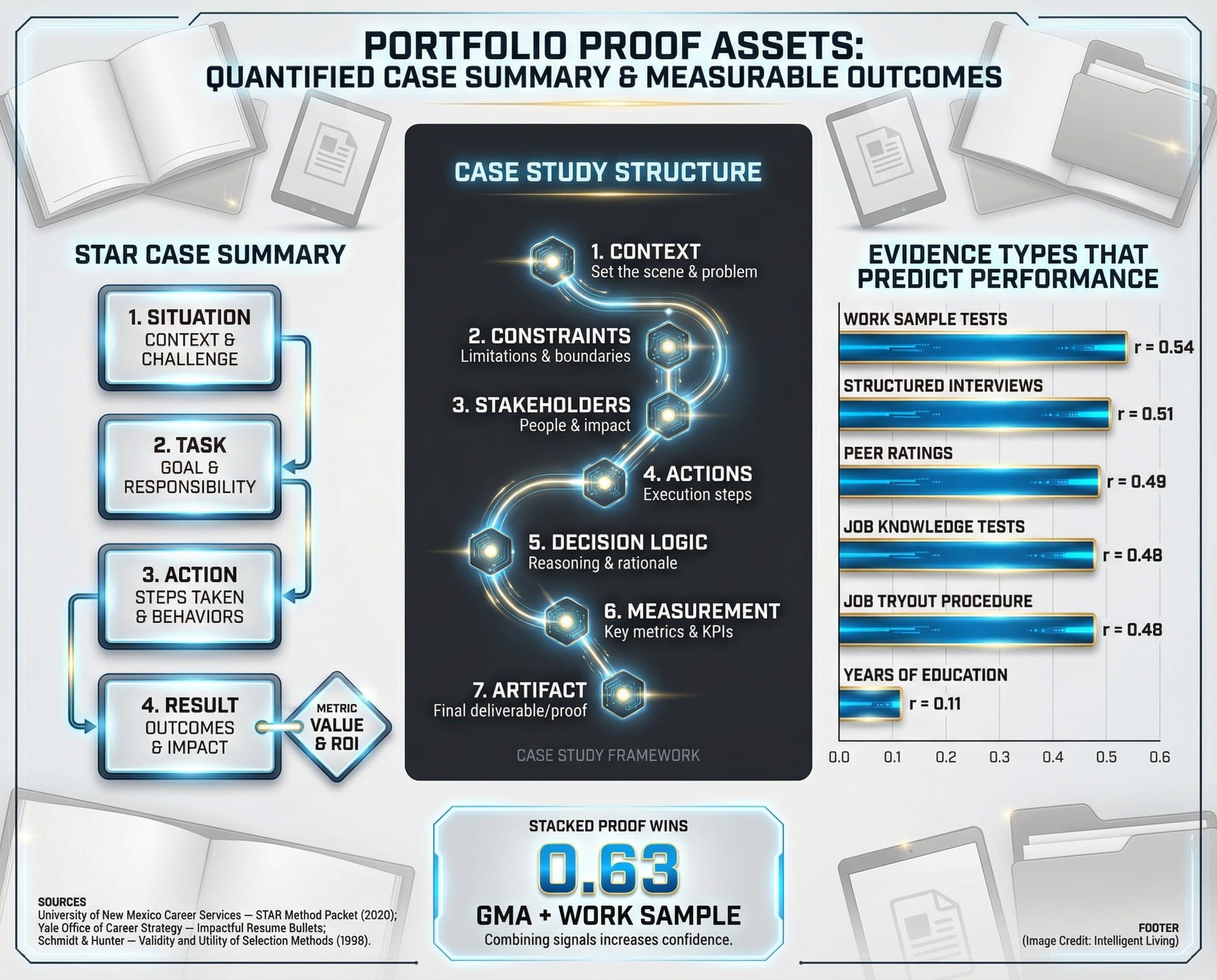
The STAR format makes results readable to humans and to screening systems. The University of New Mexico’s STAR method packet breaks the structure into Situation, Task, Action, and Result, which is ideal for converting fuzzy experience into clear cause-and-effect statements. A strong STAR summary also names the constraint, such as time pressure, limited budget, or stakeholder friction, because constraints make outcomes feel real.
Quantification is the upgrade. Yale’s approach to writing impactful resume bullets shows how to attach metrics without inflating claims. Qualitative roles rarely provide clean analytics, necessitating the use of defensible proxies to demonstrate improvement.
A career switcher once described feeling underqualified for a target role until three STAR summaries made outcomes legible. The title mismatch stopped being the headline once the results were clear. The same format also translates cleanly into client proposals, because it ties claims to measurable outcomes instead of self-description.
Proof Portfolio Assets and Case Study Frameworks for Professional Marketing
Portfolio Proof Assets: How to Write Case Studies that Live in Reality
Implementing the Seven-Step Case Study Architecture
Effective case studies serve as traceable decision stories rather than simple highlight reels. Structuring evidence through a logical progression ensures that stakeholders understand the methodology behind every outcome. Nielsen Norman Group’s portfolio case studies that show constraints emphasize tradeoffs and reasoning, which translates well to nearly any discipline.
A simple seven-step structure works across roles:
- Context and goal
- Constraints and risks
- Stakeholders and users
- Actions taken
- Decision logic
- Results and measurement method
- Artifact and what it proves
Documenting these variables provides a complete map of professional impact. The case study architecture allows reviewers to verify claims while understanding the complexity of the original engagement.
Quantifying Success Metrics without Automated Data Dashboards
Not every professional role provides immediate access to clean analytics or automated dashboards. In the absence of direct metrics, high-performing experts utilize defensible proxies tied to operational reality.
Utilizing the following proxies helps turn soft skills into documented wins:
- Cycle time and turnaround speed
- Revision counts and approval delays
- Ticket volume or throughput capacity
- Error rates and quality control markers
- Stakeholder satisfaction or retention rates
The objective remains measuring what was previously unmeasured rather than inventing data. Documenting these proxies allows for outcome-based pricing even in highly qualitative or creative disciplines.
Customizing Proof Assets for Specific Professional Roles
Proof assets must be tailored to specific professional functions to resonate with decision-makers. Identifying the most relevant metrics for your role ensures that your evidence speaks directly to the needs of the employer or client.
Consider these role-specific proof types:
- Technical contributors can show performance improvements, reliability changes, or reduced operational load.
- Operators can show throughput, reduced handoffs, fewer escalations, or smoother processes.
- Managers can show delivery predictability, improved retention, or reduced rework.
Choosing the right proof type clarifies your value proposition within the broader team. High-value skills become marketable wins when they are presented through the specific lens of your professional contribution. Portfolio-first entry paths can be effective for career pivots, and portfolio-based paths into remote data analyst roles show how proof-of-work can substitute for traditional credential signals.
Actionable Professional Marketing Checklist and Proof Capture Habit
The following module turns transferable skills and soft skills into marketable proof that feeds a calm compounding loop.
- Map three target roles and list the overlapping skills for each.
- Pick three recent wins and write one STAR case summary per win.
- Add one measurable metric or proxy to each summary.
- Convert one STAR into a one-page case study using the seven-step structure.
- Attach each proof asset to a pricing step you can justify.
- Schedule a monthly 10-minute proof capture habit.
- Run a quarterly proof audit and compress the best wins into your scorecard.
- Create one proxy metric for a soft skill, such as reduced revisions as a collaboration signal, using a human-centric skills measurement lens that treats collaboration as something observable.
- Keep one public artifact that shows process and impact without exposing sensitive client data.
- If income timing is unstable, adopt an irregular-income baseline that matches your lowest month and treats timing as the core variable.
A small, consistent habit beats rare bursts of motivation. One consultant described saving a weekly note titled “proof receipts,” and twelve months later that list became the backbone of a portfolio and a rate reset.
Outcome Pricing and Income Protection for Sustainable Rate Growth
Data-Driven Pricing Strategies: Scaling Rates via Documented Outcomes
Conceptualizing Outcome-Based Pricing in Professional Environments
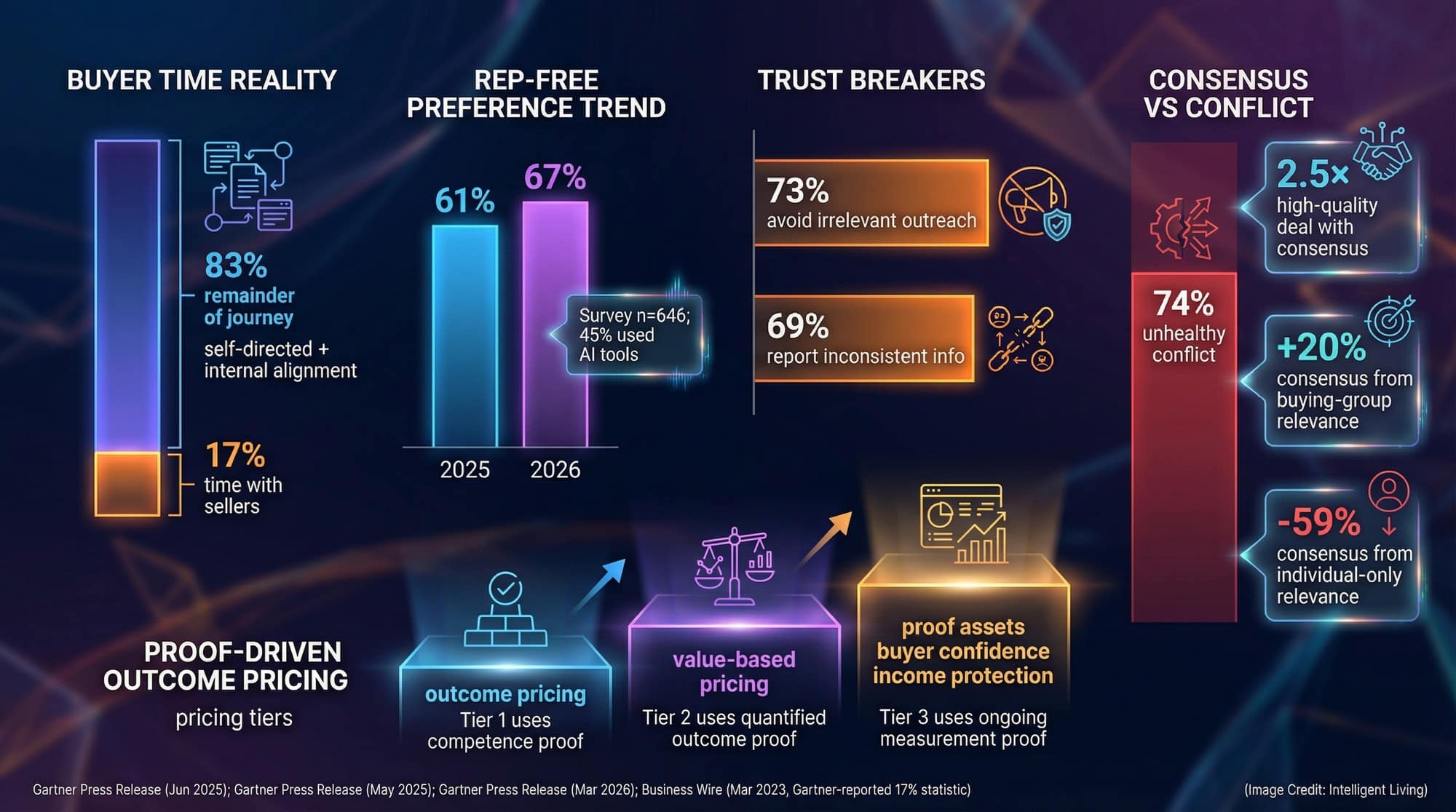
Outcome pricing links fees to the value a client can reasonably expect, rather than the number of hours spent delivering it. Harvard Business Review’s explanation of value-based pricing mechanics clarifies the difference between hourly billing and outcome-based pricing.
Build Good, Better, and Best Tiers that Reduce Client Friction
Tiered offers work because they help buyers self-select based on risk and budget. HBR’s overview of good-better-best tier design explains why the structure often increases conversions while protecting time.
The Evidence Ladder: Matching Proof Assets to Pricing Tiers
Strategic rate growth depends on an evidence ladder that matches specific proof levels to corresponding price points. Providing clear documentation for each tier justifies investment and reduces buyer hesitation.
Pricing tiers generally follow this progression:
- Entry tier: documented competence backed by one proof asset.
- Middle tier: measurable benefit supported by a quantified case study.
- Premium tier: an ongoing package where value is monitored and improved over time.
Climbing the evidence ladder ensures that rate increases are rooted in performance data rather than arbitrary estimates. Professional marketing succeeds when pricing reflects the depth and reliability of the documented results.
If the premium tier depends on tracking outcomes over time, financial tools for business leaders can help clarify cash flow, margins, and measurement cadence. Deltek’s breakdown of consulting pricing models is a useful framework for linking pricing to cost savings, revenue lift, or risk reduction.
A pay-versus-role comparison method can clarify whether the gap is pricing, positioning, or scope. Consistency is the invisible ingredient. A freelance discipline and scaling loop can help keep proof capture, offer refinement, and pricing adjustments on a schedule.
Keeping More of What You Earn (So the System Actually Compounds)
Emergency Fund Protocols for Navigating Variable Freelance Income
An emergency fund serves as a primary safeguard for your proof-building time. Without adequate reserves, every slow month forces short-term, desperation-based decisions that erode long-term earning power. The CFPB’s emergency fund guidance focuses on goal sizing and contribution habits that function without perfect financial conditions.
Small, automated savings systems often determine whether emergency funding persists long enough to be effective. Utilizing key facts about saving money transforms vague intentions into repeatable habits that stabilize your financial runway. Foundational micro-habits provide the stability required to protect net take-home pay.
Mitigating High-Fee Debt to Protect Professional Optionality
High-fee debt costs more than simple interest; it drains professional attention and reduces your optionality for future projects. A structured credit card debt payoff triage makes APR, due dates, and minimums visible, providing a clear path to break the minimum-payment trap.
Balanced repayment plans prioritize stability over isolated tactics, ensuring a sustainable path to debt relief. Focusing on equilibrium ensures long-term professional growth.
Measuring Net Take-Home Pay and Minimizing Tax-Related Drag
Independent experts often feel broke despite higher rates because net take-home pay is rarely calculated. Financial scoreboards solve income visibility gaps by subtracting fees, direct costs, and tax reserves from gross pay. A net take-home scoreboard for freelance work illustrates how quickly gross numbers collapse once fees and reserves are accounted for.
Calculate a conservative percentage based on your unique financial situation to ensure adequate reserves. A systematic approach to fixing credit report errors can remove unnecessary drag from monthly expenses.

Stabilizing Growth Through the Proof-Based Compounding Loop
Documenting outcomes from every engagement transforms routine tasks into reusable leverage. Proof assets reduce sales friction and rationalize promotions, providing the confidence to decline low-margin work. Transferable evidence allows professionals to navigate market shifts without losing momentum.
Protecting net take-home pay through robust financial systems ensures that professional growth translates into personal wealth. Focusing on outcome-based pricing and income protection allows experts to filter for high-value opportunities while maintaining the stability needed to ignore low-margin distractions. A calm compounding loop is the ultimate safeguard against economic volatility.
FAQ: Professional Marketing and Proof Asset Strategies
What qualifies as a high-value proof asset?
Measured results, STAR method case studies, or process receipts that show how skills solve specific business problems count as proof.
How does outcome-based pricing differ from hourly rates?
Hourly billing tracks time spent; outcome pricing anchors fees to the specific business value or risk reduction provided to the client.
Why is a cash-flow runway necessary before scaling?
Runways prevent desperation-based decision-making during slow months, allowing for a consistent focus on premium clients and high-value skills.
Can soft skills be turned into documented wins?
Yes, use proxy metrics like reduced revision cycles or improved team throughput as observable signals of effective collaboration.
How often should a proof asset scorecard be audited?
Quarterly audits ensure the strongest wins are captured immediately, preventing high-impact results from being lost to organizational noise.


