
A visual “profit control center” that signals net take-home clarity, platform fee awareness, and tax-ready habits. It reinforces the article’s promise: predictable gig income through better systems, not more hours. (Credit: Intelligent Living)
Eliminate financial guesswork with a structured scoreboard. Mastering a repeatable gig-evaluation system transforms low-rate errands into a scalable, skill-based freelance business. Utilize a precise net take-home calculator, a practical labor-upgrade path, and a compact operating system to ensure your gig economy earnings remain predictable during tax season.
Beyond driving-heavy tasks, turning a hobby into paying side work reframes skill-based income into a venture that scales. Specialized services yield a higher net per hour by eliminating the heavy overhead of vehicle maintenance and fuel.
A neighbor’s weekend delivery hustle can generate immediate cash but fail to build lasting wealth. A simple net take-home table revealed work as a short-term bridge rather than a sustainable career path. Conversely, a friend offering copyediting as a side skill secured one repeat client and increased net weekly income more than three separate errands could provide in the same window.
Essential Freelance Tax Compliance: Critical Rules for Protecting Your Earnings
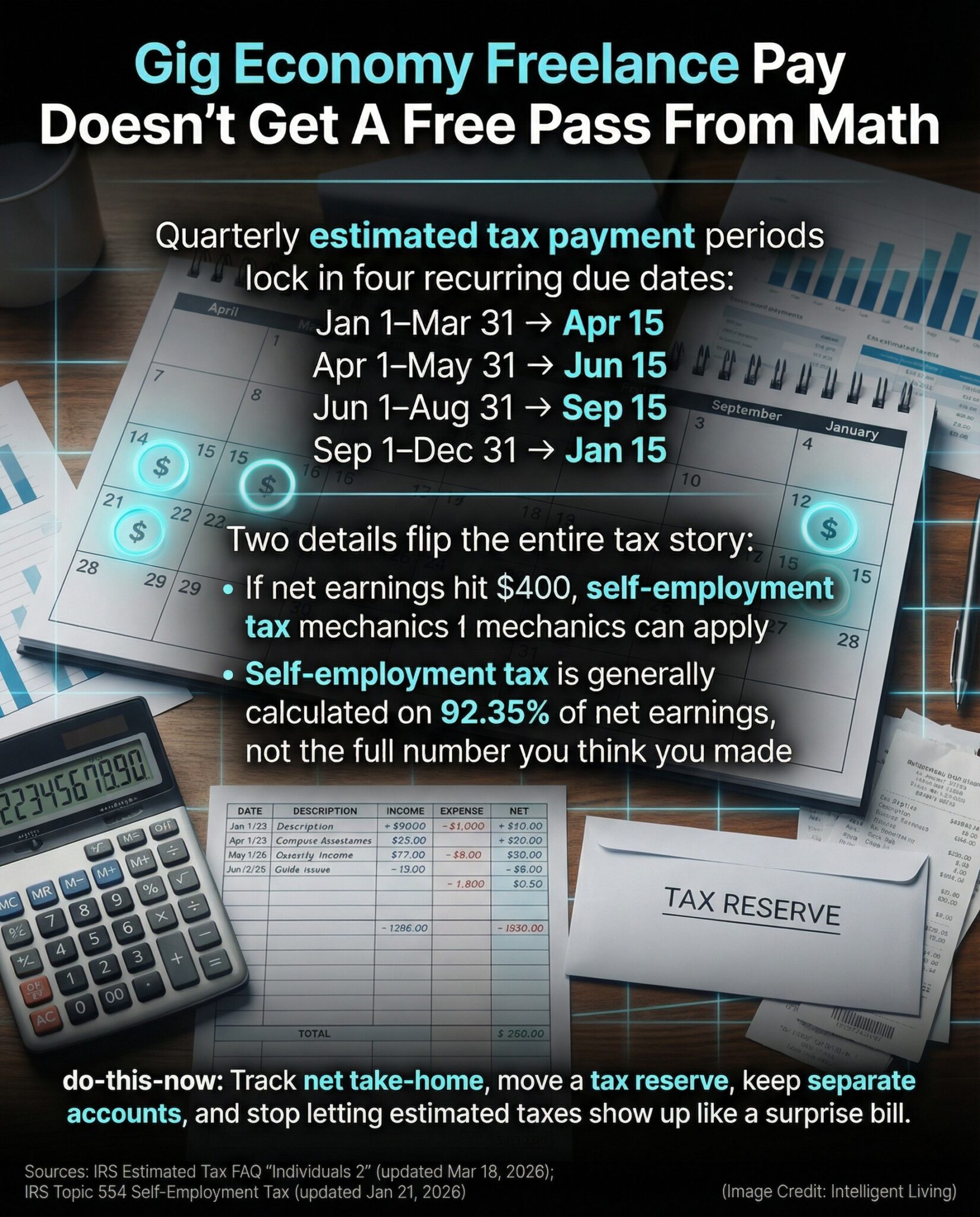
- App and marketplace earnings must strictly adhere to IRS gig income tax rules to ensure all revenue is accurately reported, even when no formal paperwork arrives.
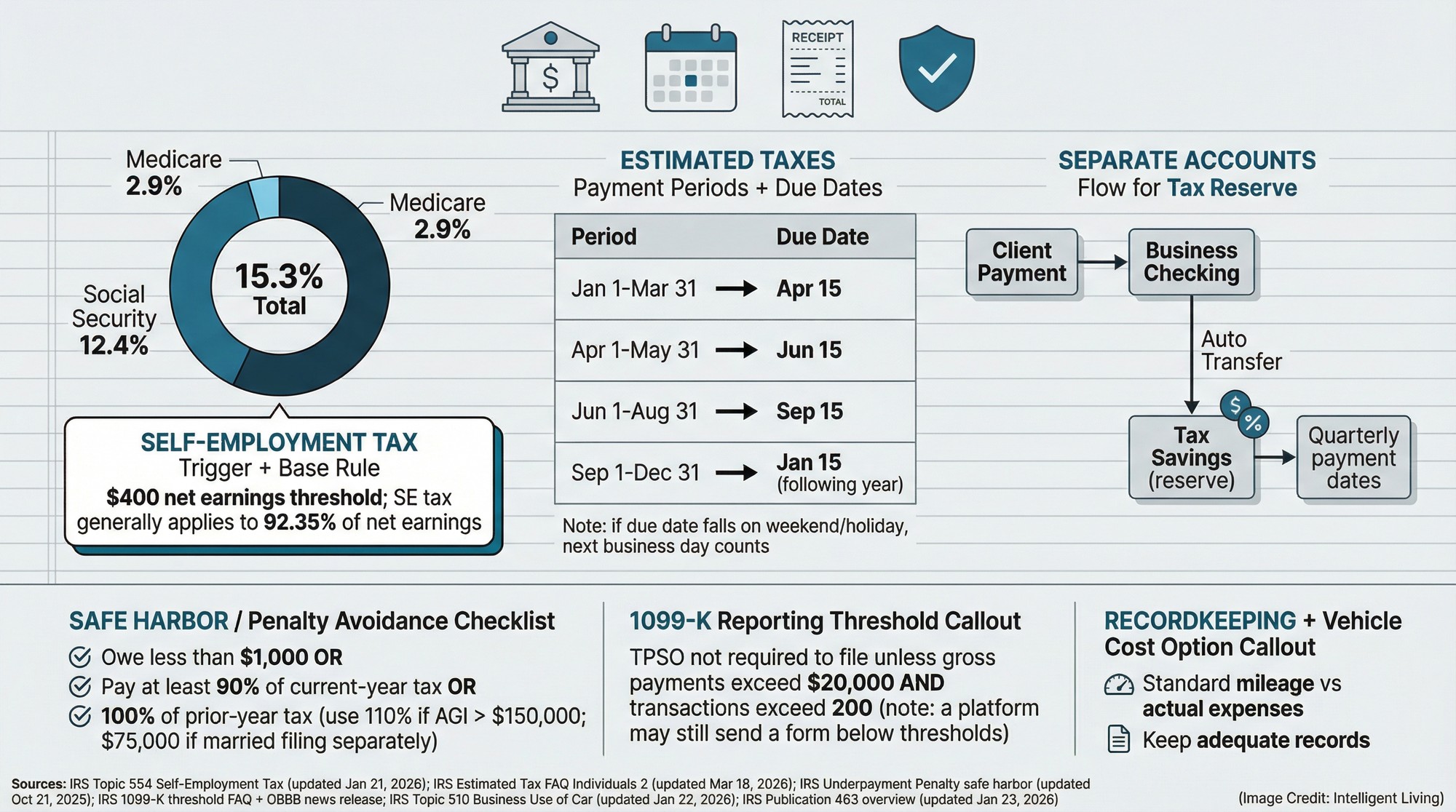
- Mandatory gig worker filing thresholds cover the $400 net earnings trigger and when self-employment tax mechanics start to matter.
- Establishing a self-employment tax calculation is easier when you understand how net earnings feed into the final math.
- Tracking the quarterly estimated tax schedule helps you maintain a consistent payment rhythm and prevents a significant financial surprise every January.
- Efficient separate account recordkeeping treats clean separation as a practical bookkeeping advantage that reduces errors.
The Net Pay Scoreboard: Building Your Professional Profit Tracking System
The Simple Net Formula You’ll Use Everywhere
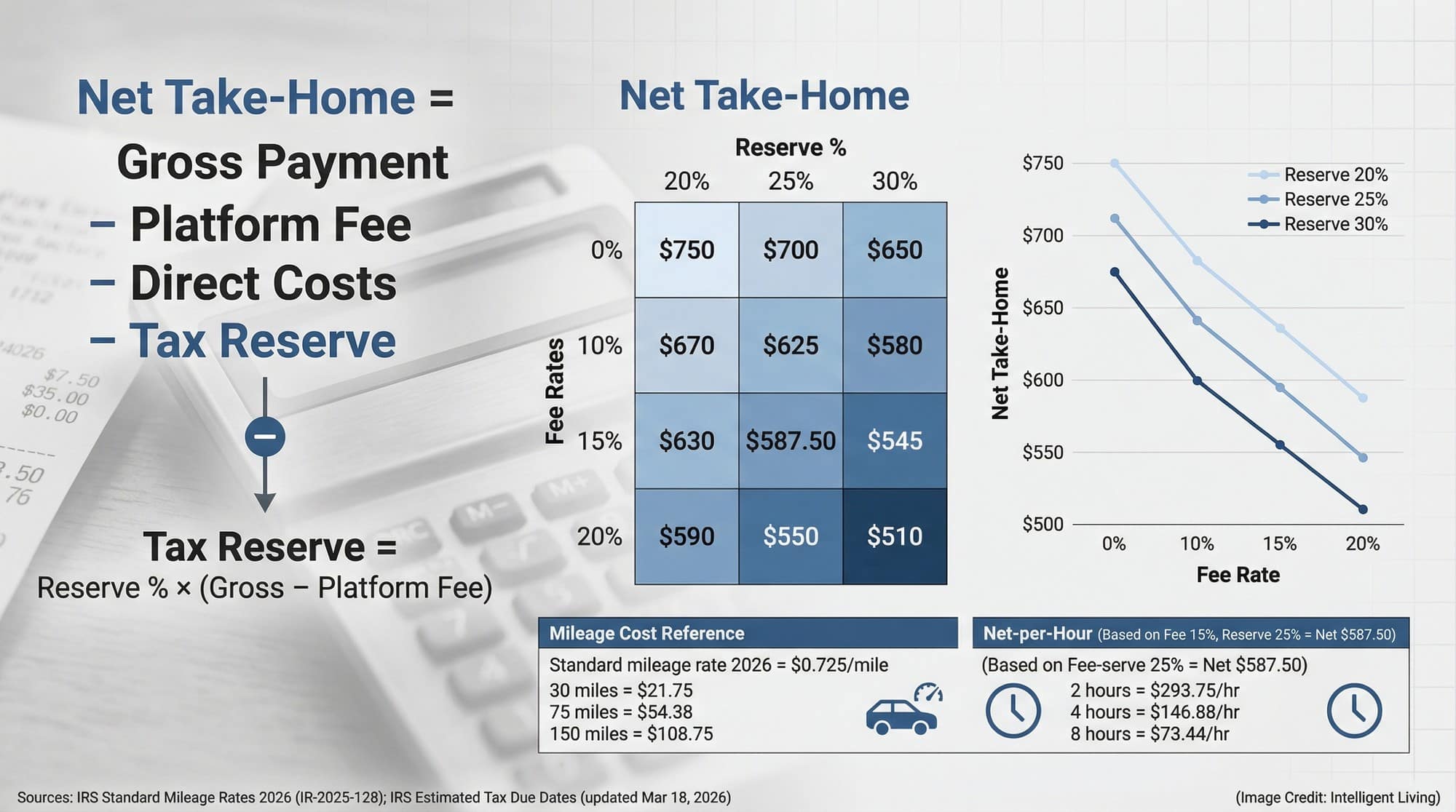
Net Take-Home = Gross Payment − Platform Fee − Direct Costs − Tax Reserve
Designed for simplicity, this formula fits on a single sticky note. By designating a fixed percentage for self-employment and income taxes, you ensure your operating capital remains protected. Apply a standard 25% tax reserve on day one. Refine this percentage as your actual totals and tax brackets materialize.
If monthly income swings make planning difficult, adopting a low-month budget strategy provides a practical constraint that reduces stress by focusing on your baseline earnings.
Consider a single $1,000 gig on a platform with a 20% service fee. This leaves $800 before expenses. With direct costs at $50 and a 25% tax reserve ($200), your final net take-home totals $550.
Calculating Real Net Per Hour: Measuring Your True Freelance Profitability
Ignore hourly screenshots until you strip away fees and hidden overhead. To find your true earning power, divide your net take-home by every minute spent on prep, execution, and client follow-up. Use this single metric to decide if a job deserves to be repeated, repriced, or packaged.
High-demand surge shifts often deliver less net profit than specialized service packages.
One former rideshare driver discovered that evening editing work—despite a lower gross—yielded higher net earnings due to minimal operating costs and fewer logistical hurdles.
Net per hour becomes easier to protect when you use a seasonal expense plan to account for recurring bills and spikes.
The Three Silent Drains: Fees, Costs, Taxes
- Platform Fees: These come off the top and vary by marketplace.
- Direct Costs: Mileage, supplies, software subscriptions, and business use of car deductions allow you to choose between standard mileage and actual expenses.
- Taxes: Self-employment and income tax obligations necessitate a dedicated reserve to prevent cash-flow shocks.
Master your financial baseline through consistent tracking. A dedicated scoreboard illuminates exactly where your revenue goes, allowing you to prioritize high-margin work. Maintain your records using these core columns:
- List every individual gig as a unique entry row.
- Include columns for gross payout and platform fee percentages.
- Track direct operating costs alongside your 25% tax reserve.
- Calculate the final net take-home for every transaction.
Commit to updating these records once a week. Grounding your business decisions in real-time data ensures you prioritize high-margin work over low-yield errands.
Errands Versus Skills: Transitioning to High-Value Service Packages
Solving the Income Ceiling: Why Time-Intensive Tasks Limit Your Growth
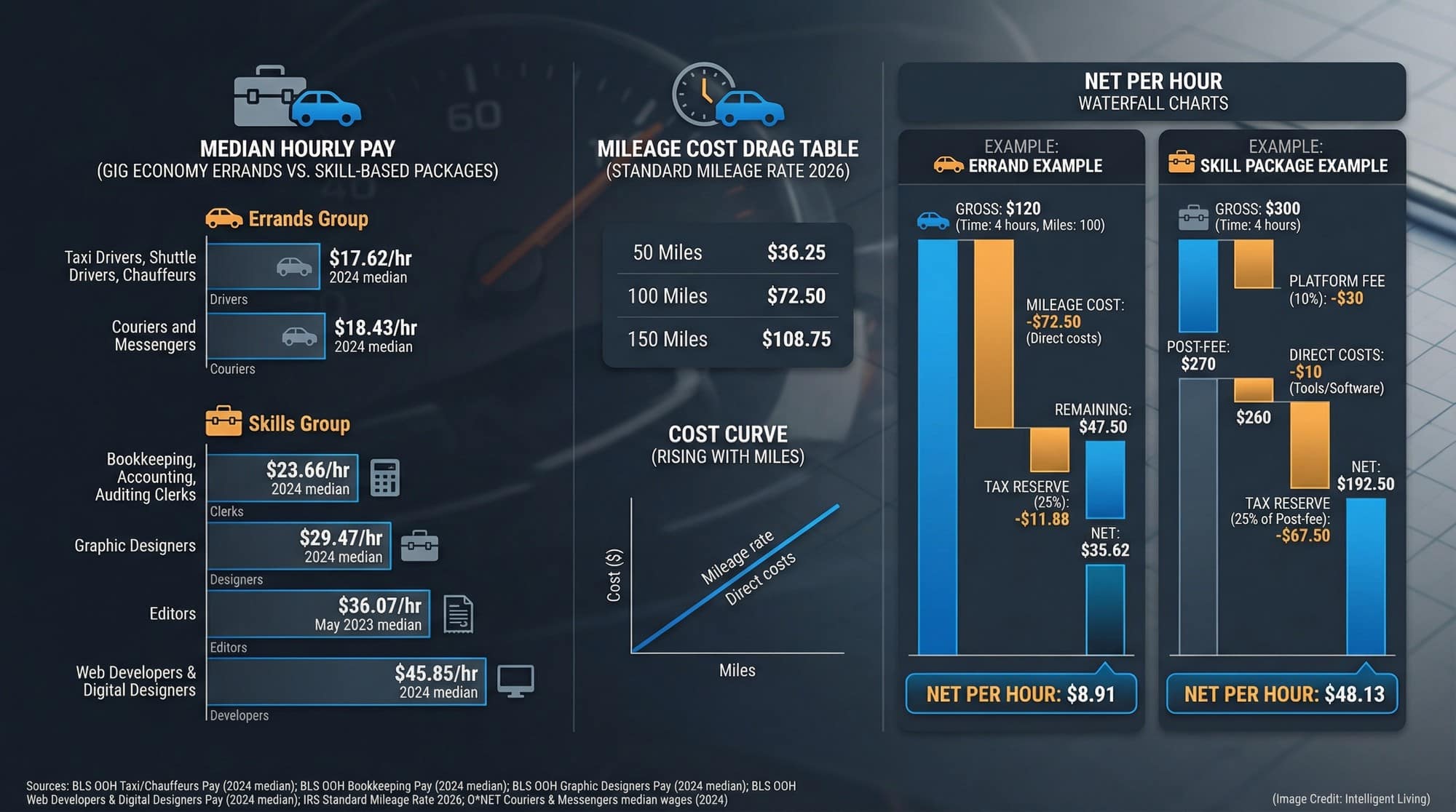
Errand work—including delivery, rideshare pickups, and short task runs—often hits a rigid practical ceiling. This happens because your revenue remains tied to hours and miles while operating costs scale aggressively with activity. Verified courier wage data provides a grounded reference point for delivery-type work when estimating long-run income limits.
Heavy driving work typically hits a structural ceiling. Reviewing the long-term earning potential for chauffeurs helps calibrate your expectations for when fuel and miles begin to dominate your schedule.
Managing the Cost Drag: Factoring Vehicle Expenses into Your Net Profit
Driving-based income carries heavy overhead. Apply the 2026 business standard mileage rate to your scoreboard to model a realistic cost estimate for delivery or rideshare tasks.
Track your expenses beyond simple mileage by following transportation recordkeeping rules to support deductible vehicle costs. High mileage overhead can quickly erode your net per hour once you factor in mandatory tax reserves.
A parent juggling school pickup and weekend deliveries often discovers the hidden loss is not the payout; it is the extra miles driven during dead time between tasks.
The Skill Ladder: A Practical Upgrade Path
Ascending the income ladder requires transitioning from one-off tasks to scalable service packages. This shift allows you to reclaim your time while increasing your overall valuation.
- Package repeatable skills like copy editing, design cleanup, or bookkeeping.
- Price your initial offers to cover platform service charges and tax reserves.
- Upsell repeat buyers into monthly retainers or bundled service packages.
Transitioning to a retainer model reduces transaction friction. This strategy stabilizes your weekly revenue and significantly raises your net per hour.
Marketplace Economics: A Strategic Comparison of Platform Service Charges
Fee Reality Check
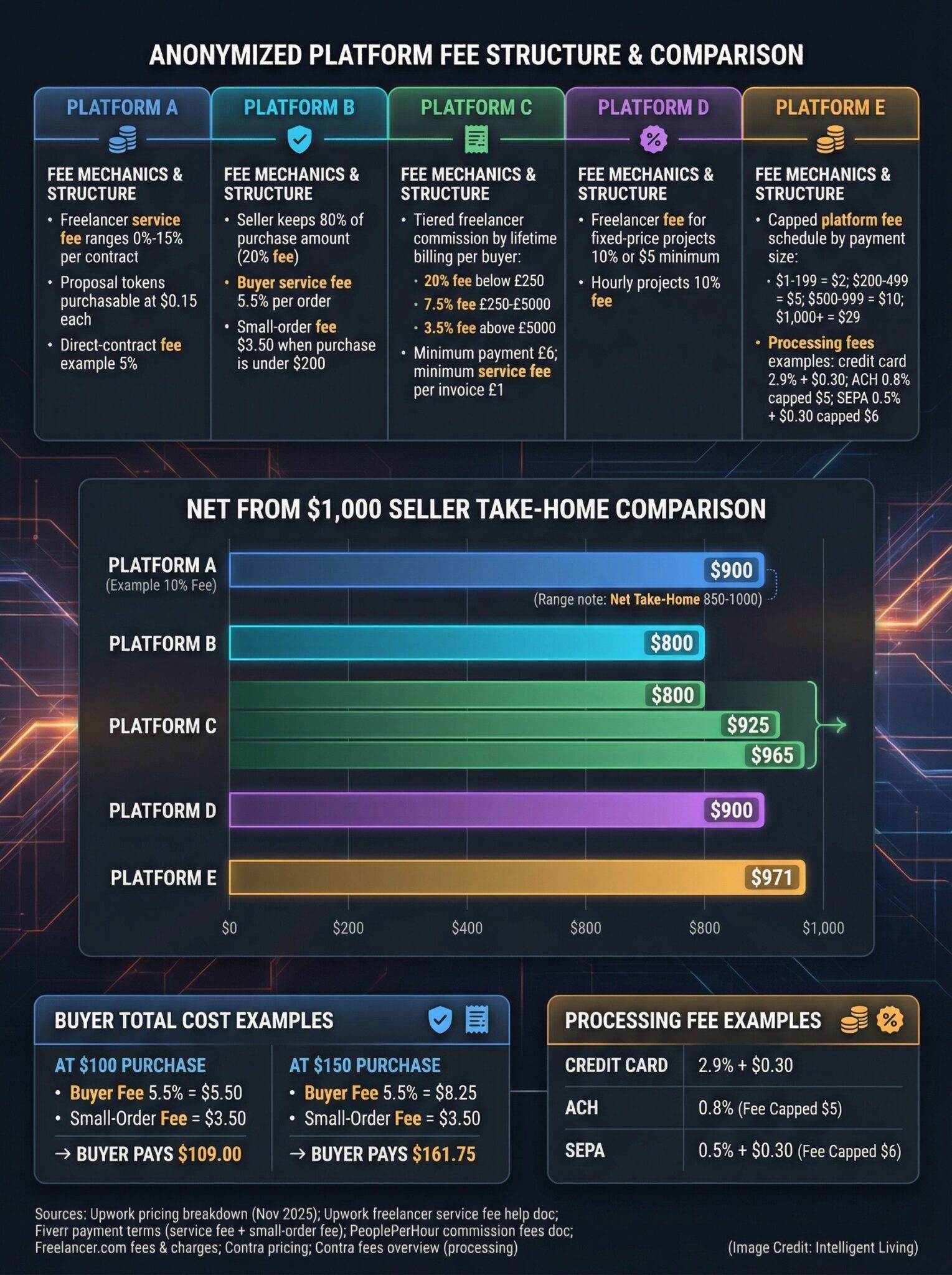
Marketplace service charges serve as the baseline for your pricing and package design.
- Upwork’s freelancer service fees function as a variable 0% to 15% charge per contract.
- Fiverr’s payment terms establish that seller earnings are 80% of the total purchase.
- PeoplePerHour’s commission fees follow a tiered structure that declines with lifetime billing.
- Freelancer.com’s fees and charges outline a standard 10% project commission.
- Contra’s platform fee model uses capped sizes and separates platform costs from payout processing.
Example Table: Fee Impact on a $1,000 Payment
Use a simple table so fee impact becomes visible immediately.
| Marketplace | $1,000 Payment | Fee Impact Snapshot |
|---|---|---|
| Upwork | $1,000 | 0% to 15% service fee ($0 to $150) |
| Fiverr | $1,000 | 20% seller fee ($200) |
| PeoplePerHour | $1,000 | Tiered 3.5% to 20% depending on lifetime billing |
| Freelancer.com | $1,000 | Standard 10% or promo 3% where applicable |
| Contra | $1,000 | Capped platform fee model, plus separate payout fees |
This table focuses exclusively on fee mechanics. It ensures your scoreboard subtracts real costs before you calculate the final tax reserve.
Buyer Fees and Price Sensitivity
Buyer fees can alter client price sensitivity, particularly when a Fiverr buyer fee structure applies per payment. If a platform adds visible buyer-side fees, higher prices may reduce demand for small orders. Packaging deliverables and moving toward repeat work is one way to stop competing on the smallest unit of labor.
A freelancer who tested small single orders against a monthly retainer found fewer payment headaches and better weekly stability with the retainer structure.
The Tax-Ready Microbusiness OS: Essential Systems for Independent Contractors
Separate Accounts and Clean Records
Separate systems prevent blurred math by maintaining two distinct systems: a business checking account for all client deposits and a business savings account dedicated to your tax reserve.
A recordkeeping system helps keep business activity separate from personal spending, ensuring all transactions remain professional.
Standard IRS recordkeeping ensures your books clearly show income and expenses through a clean summary of transactions.
Scheduled transfers remove human error from your accounting, and establishing automated tax reserve habits ensures your obligations are funded before you can spend the revenue.
Document every receipt on the day of purchase. Memory is unreliable during peak months; immediate logging saves hours of investigative bookkeeping later.
The Freelance Tax Forms Map: Navigating Schedule C and Schedule SE Filing
Navigate your tax filing by reporting income and expenses on Schedule C. This applies to any activity done for profit with continuity and regularity.
Use Schedule SE to calculate self-employment tax obligations once you cross the mandatory filing threshold. Think of Schedule C as the profit scoreboard and Schedule SE as the subsequent calculation.
Self-Employment Tax in Plain English
Social Security and Medicare contributions for independent contractors are funded through self-employment taxes. The self-employment tax rate specifies a 15.3% rate split. Note that the Social Security portion remains subject to an annual earnings cap.
Quarterly Estimated Payments: Dates, Safe Harbor, and a Simple Reserve Rule
Estimated payments are usually due in April, June, September, and January, and the safest workflow is to treat the tax reserve as money that never belonged to daily spending.
Professional estimated tax management explains how these payments are calculated for those without standard withholding.
The safe harbor rules describe how penalties are avoided, such as paying 100% of your prior-year tax total.
A simple operational rule for many new freelancers is to reserve 25% of net receipts for taxes and move that amount to the tax savings account on payout days, then refine the reserve as real totals accumulate.
The 1099-K Trap: Gross Payments Versus Net Profit
While platforms often issue 1099-K forms based on gross volume, these figures rarely account for service fees or customer refunds. Reliable tax reporting relies on your internal profit records, not raw payment processing totals.
The 1099-K guidance clarifies common scenarios, while the official Form 1099-K breakdown helps separate gross processed payments from taxable net profit.
Ignoring the gap between gross payments and net profit often leads to tax overpayment. One part-time seller avoided a major financial error only after their internal records proved allowable expense deductions against a confusing 1099-K.
7-Day and 30-Day Plan
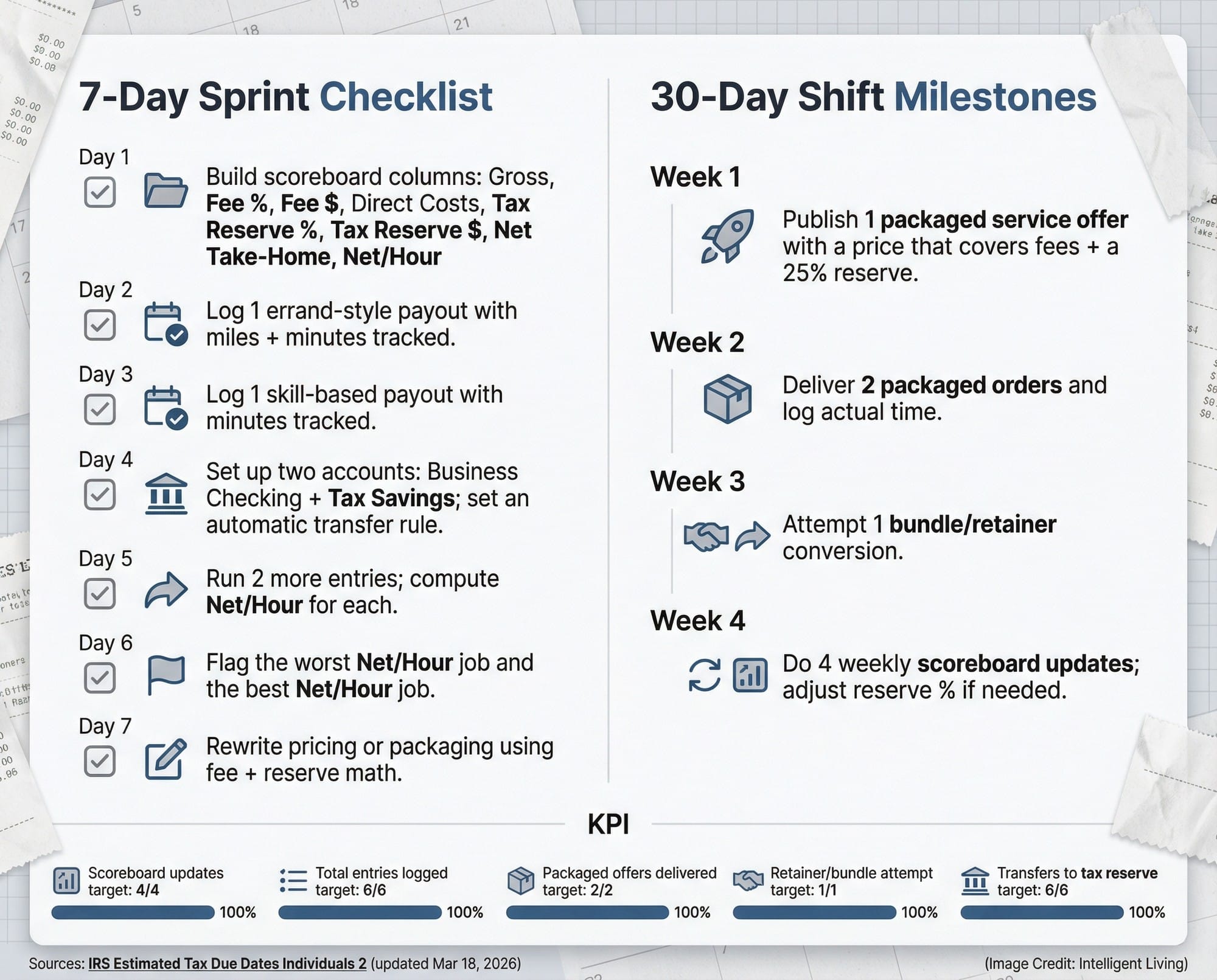
7 Days: Build the Scoreboard and Open the Accounts
- Day 1: Create a scoreboard spreadsheet with columns for gross, platform fee, direct costs, tax reserve, and net.
- Day 2 to Day 3: Identify one errand gig and one skill offer to compare using the scoreboard.
- Day 4: Open a business checking account and a business savings account, then set an automatic transfer for the tax reserve.
- Day 5 to Day 7: Run two live examples and record actual time spent so net per hour is accurate.
Smoothing irregular freelance paychecks ensures your operating expenses and personal spending never collide, even during unpredictable months.
30 Days: Replace One Errand block With One Skill Offer
- Week 1 to Week 2: Test pricing and packaging for a single skill offer and promote it in one marketplace.
- Week 3: Convert the best buyer into a bundled or retainer offer that stabilizes net per hour.
- Week 4: Recompute the scoreboard and adjust the tax reserve based on actual numbers.
Using cash flow milestones ensures your budget remains anchored to recurring needs during uneven months.
Systematic freelance money habits compound over time. These initial daily actions ensure your operating system becomes effortless to maintain.

Systemizing Your Gig Economy Earnings
Resilient profit protection stems from systems that make net numbers visible. Transitioning a client to a monthly package or opening separate business accounts transforms a chaotic side hustle into a professional operation. These tactical adjustments ensure you stop chasing volume and start prioritizing the net profit that actually hits your bank account.
Securing your financial future as a freelancer relies on consistency rather than luck. Use your scoreboard once a week to ground your decisions in real data, then adjust your pricing to reflect true marketplace fees. As you refine your operating system, credit card debt payoff can protect your net take-home while income ramps.
For those under immediate pressure, financial hardship triage helps stabilize essentials. Executing your first tax reserve transfer today builds the tactical momentum your freelance business deserves.
Frequently Asked Questions: Expert Advice on Taxes and Marketplace Fees
Do I Owe Taxes Without A 1099 Form?
IRS taxable income regulations apply to every dollar earned, meaning you must report your revenue even if a marketplace fails to provide a 1099-K.
When Are Quarterly Estimated Payments Due?
Estimated taxes are generally due in April, June, September, and January. Use a 25% tax reserve rule to ensure funds are available by these deadlines.
How Do I Calculate True Net Profit?
Deduct marketplace fees, direct operating costs, and your tax reserve from every gross payment. Your net take-home calculator provides the clarity needed to see what truly remains after meeting all obligations.
Why Are Separate Bank Accounts Necessary?
Separate accounts clarify your business expense tracking and prevent personal spending from depleting your tax reserves, making end-of-year filing much simpler.
How Do Marketplace Fees Impact My Pricing?
Fees vary between platforms, often ranging from 3% to 20%. You must price your services high enough to cover these service charges while maintaining your target net per hour.


