
Developers and researchers frequently utilize MMLU scores to quantify a large language model’s proficiency across diverse academic and professional domains. While these metrics offer valuable benchmarks, they reflect a highly specific evaluation environment consisting of multiple-choice exams sourced from educational repositories. This analysis clarifies benchmark mechanics, implementation shifts between leaderboards, and the critical role of dataset reliability in treating MMLU as a technical signal grounded in peer-reviewed findings from the ICLR conference record.
As the landscape of Large Language Models (LLMs) becomes increasingly crowded, these performance metrics serve as the primary gatekeepers for model adoption. Relying on a single accuracy percentage without scrutinizing the underlying evaluation pipeline often leads to misguided conclusions about a model’s true utility. To achieve genuine AI literacy, developers and stakeholders must look past the headline numbers to investigate the specific conditions under which these scores were generated.

Essential Insights: Navigating the MMLU Benchmark
Strategically evaluating model performance begins with an objective analysis of the baseline constraints. These foundational points provide a high-level overview of the MMLU framework and the technical nuances that define its execution.
- Researchers initially defined 57 subject areas to facilitate zero-shot and few-shot evaluation in a consistent format.
- Researchers organized the comprehensive split structure into 15,908 total questions, designating 14,079 for test splits and 1,540 for validation.
- Because the classic format uses four options, a pure guess baseline sits at 25 percent, making tiny accuracy moves look outsized.
- Recent analysis identifies diverse implementation styles where templates and harnesses change reported results even for identical weights.
- Audits have identified a measurable error rate within the dataset, demonstrating that correcting items shifts model comparisons.
- Applying contamination diagnostics illustrates why exposure to test-like content inflates performance metrics through subtle exposure.
Analyzing these variables establishes a foundation for the critical interpretation of leaderboard rankings. Developers who acknowledge inherent error rates and format sensitivities can more effectively calibrate expectations for real-world model deployment.

The Mechanics of MMLU: Scope and Limitations of AI Evaluation
The MMLU framework functions as a comprehensive multiple-choice assessment of academic and professional knowledge. Organizers categorize specific subsets and evaluation splits to measure how models select one answer from a fixed set of study sources. The multiple-choice structure enables MMLU to measure breadth effectively across various topics. Consequently, the benchmark evaluates three distinct skill sets:
- Factual recall across academic datasets.
- Pattern recognition within standardized exam formats.
- Short-form reasoning through process-of-elimination logic.
The disparity between broad recognition and procedural depth is a common challenge in AI evaluation. A model may demonstrate factual recall during a mixed quiz while lacking the deep procedural skills required for specialized tasks.
Benchmark Architecture: Quantifying Knowledge through Dataset Splits
MMLU organizes questions into 57 subject areas across STEM, social sciences, and humanities, and it is typically run in a zero-shot or few-shot style where the model gets either no examples or a small number of examples in the prompt. Resulting accuracy percentages represent raw performance across test splits under specific prompt and scoring configurations. When people use voice search phrases like “what does MMLU measure” or “is MMLU a reasoning benchmark,” the most honest answer is that it measures performance on exam-style multiple-choice tasks, not everything a model can do in real work.
Beyond the Dataset: Identifying the Functional Limits of AI Testing
As a specialized benchmark, MMLU lacks the capacity to measure general intelligence or multi-step strategic planning. It excludes metrics for environmental tool use and the practical judgment inherent in complex decision-making.
Fluency does not guarantee reliability in high-stakes environments. Models frequently provide incorrect outputs with high confidence, particularly when multiple-choice formats encourage aggressive guessing over reasoned refusal. Domain-specific validation remains essential for professional applications. For example, consistent legal reasoning in contract analysis is often more valuable than a high aggregate knowledge score. MMLU may correlate with general knowledge, but it does not replace the rigorous scrutiny required for specific professional domains.
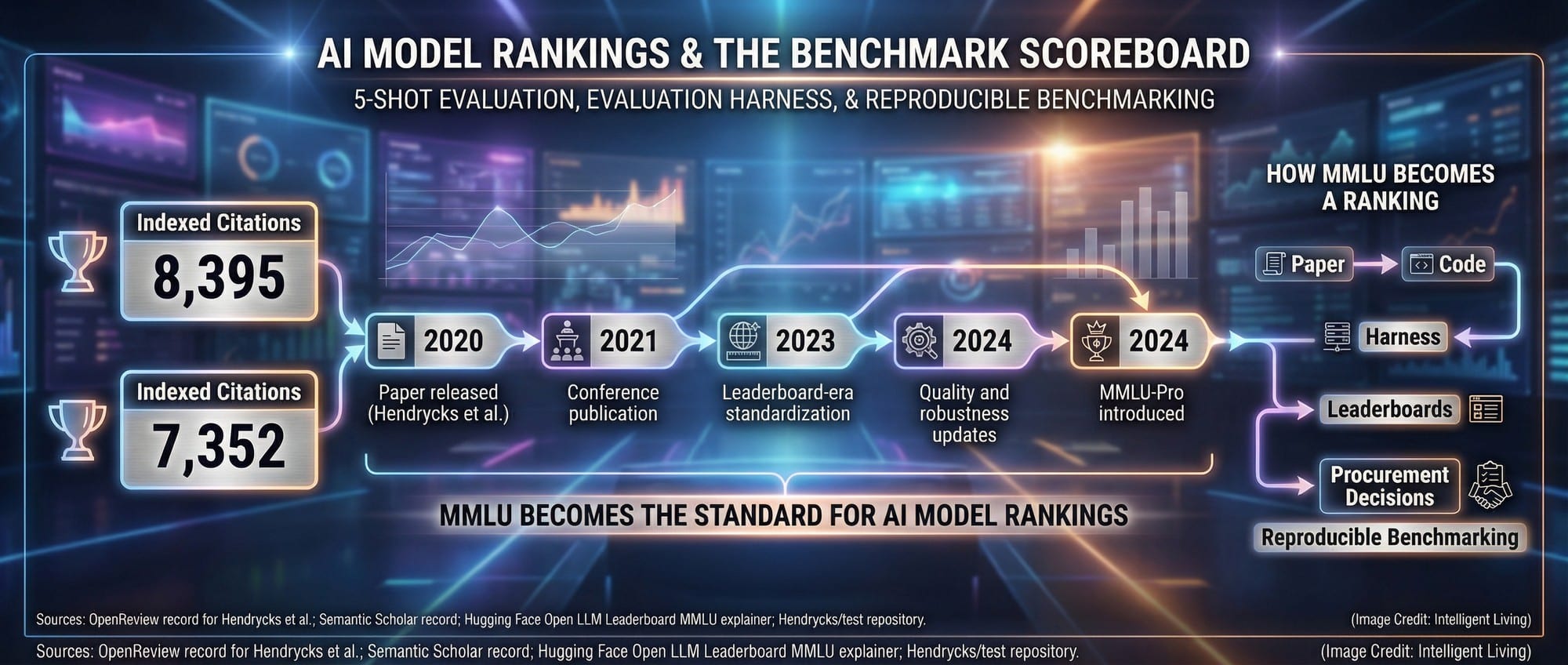
Industry Adoption: Why MMLU Dominates AI Model Rankings
MMLU gained industry dominance by distilling broad capabilities into a singular metric that facilitates rapid cross-model comparisons. Major research teams frequently include standard reference points in their technical reports to normalize capability claims across the ecosystem.
Ecosystem momentum within the AI research community further propelled the benchmark’s rapid adoption. Once a metric becomes a default citation, new model documentation tends to maintain the reporting standard to ensure continuity in evaluation history.
One Benchmark, Many MMLUs: Why Scores Differ by Implementation
Two identical models can yield different published MMLU scores because the benchmark requires a prompt template and a scoring harness, and both choices affect outcomes. Some setups score by comparing token probabilities for answer options, while others ask the model to generate a letter and then parse the output. These are not cosmetic differences when a model is sensitive to formatting.
Such implementation variance mirrors common disparities observed in broader software evaluation. A minor interface modification can drastically alter user metrics even if the core ranking system remains static.
Technical Disparities: Addressing the Challenge of Non-Standard Implementation
Technical disparities explain why separate leaderboards often report conflicting results despite utilizing identical model weights. While many runs utilize the original reference implementation, others rely on standardized benchmarking suites to manage prompt formatting and scoring at scale.
Visualizing the underlying evaluation plumbing clarifies where template and scoring decisions influence the final outcome. Transparency regarding these measurement choices is essential for maintaining an honest evaluation discourse.
Evaluation Logic: Balancing Probability Scoring and Text Generation
Scoring methodologies create distinct evaluation profiles. Probability-based metrics assess option likelihood, whereas generation-based models parse direct text outputs. Specific scoring nuances often trigger divergent results when models provide additional text or hedge their responses. Clear constraints reduce ambiguity, and structured prompt engineering often improves consistency on multiple-choice tasks by tightening output expectations.
Transparency Standards: Documenting the Evaluation Environment
When someone quotes an MMLU score, comparability requires the exact prompt template, the harness version, and the scoring method. Without those details, the reader is comparing measurements rather than comparing models. Reproducible reporting standards emphasize clarity so that results can be interpreted as objective evidence.

Identifying Risks: Subject Gaps and Benchmark Integrity Issues
Data Heterogeneity: Uncovering Domain-Specific Imbalance in Accuracy
Aggregate accuracy scores often obscure significant performance imbalances across specific subject domains. Reliability in specific technical environments depends on resolving these subject-level imbalances.
Subject-level accuracy is critical for operational reliability. A model with high average accuracy may still present significant risks in specialized fields if those domains are underrepresented. Practical AI coaching strategies often rely on translating these metrics into rules for verification.
Granular Diagnostics: Utilizing Per-Subject Profiles for Risk Assessment
Granular subject-level diagnostics determine whether model proficiency is truly comprehensive or limited to specific high-frequency datasets. Interactive reporting dashboards allow teams to compare per-subject profiles and identify specific weaknesses.
Calibration Metrics: Measuring Model Reliability and Error Probability
Calibration metrics quantify the relationship between model confidence and actual accuracy. Analysis of the next-token probability loop clarifies why models often project authority even when internal certainty levels are low. In deployment, overconfident errors pose a greater risk than acknowledged uncertainty.
Benchmark Governance: Mitigating Errors and Data Contamination Pressure
As benchmarks become standard citations in model papers, their structural integrity becomes a primary concern for the entire industry. Reproducible evaluation lessons suggest that small setup differences can overwhelm apparent progress if they are not controlled.
Errors within datasets and rising contamination pressure frequently distort the perceived pace of industry progress. These factors require rigorous oversight to maintain the utility of standardized testing.
Quality Control: Analyzing Error Rates via the MMLU-Redux Audit
MMLU-Redux audit findings revealed thousands of test items containing inherent errors that fundamentally distort model comparisons. This ongoing re-annotation effort tracks corrections and makes the discussion regarding dataset reliability concrete.
Integrity Safeguards: Preventing Performance Inflation Through Data Provenance
Professional evaluation standards mandate that accuracy claims should be accompanied by clear data provenance and contamination reports. Establishing a transparent control stack ensures that confidence is grounded in verification. Additional research safeguards can shift model behavior away from improvisation and toward evidence-anchored pipelines.
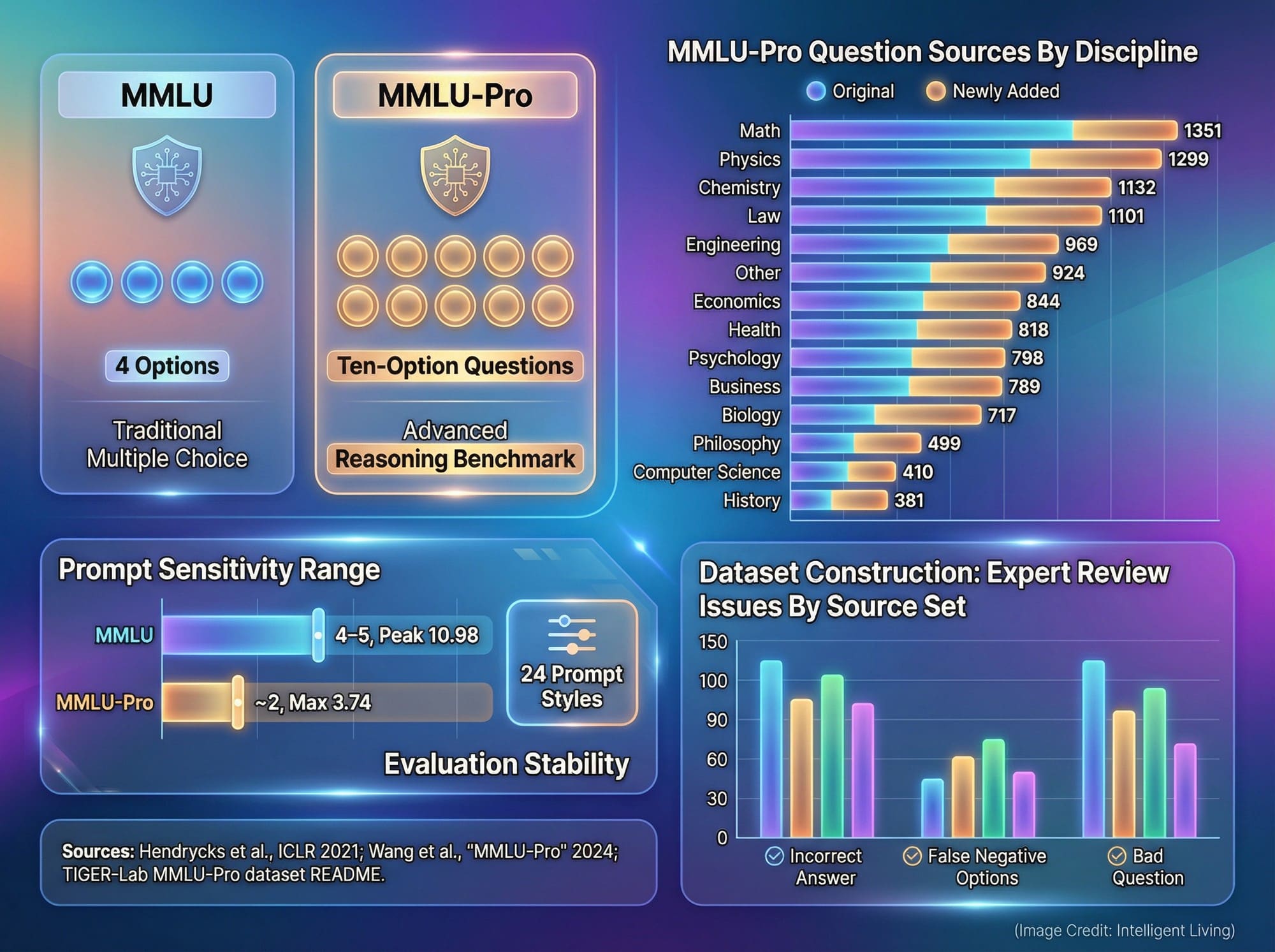
Advanced Evaluation: Transitioning to MMLU-Pro for Better Reasoning Data
MMLU-Pro addresses the limitations of the four-option format, which often permits elimination shortcuts rather than proving deep reasoning proficiency. Updated design choices emphasize increased stability and discrimination across various prompt styles.
Structural Enhancements: Expanding Answer Options and Reasoning Depth
MMLU-Pro increases the answer options and emphasizes more reasoning-focused questions. Accessing the publicly available dataset allows researchers to inspect subject coverage and difficulty distribution directly.
Operational Protocol: Verifying AI Model Claims in Professional Settings
Preventing flawed procurement decisions requires a rigorous framework of critical inquiry before a headline score is accepted as definitive evidence. Multi-agent reasoning protocols illustrate how constraints can change outcomes when accuracy depends on error detection.
Five Questions to Ask When Someone Quotes an MMLU Score
- Which evaluation harness and prompt template were used, including versions and parsing rules.
- Whether subject-level breakdowns are included, especially for the domains your users care about.
- Whether contamination checks were run, and what the team did when overlap was suspected.
- Whether known dataset errors or updated sets were considered in interpretation.
- Whether the comparison set uses identical scoring rules across all models.
Applying this five-point verification framework ensures that benchmark data supports informed decision-making rather than functioning as marketing collateral.

Why Comparing AI Model Evaluation Data Requires Technical Depth
MMLU provides a high-level signal of broad knowledge, yet accurate model selection requires a deep investigation into the scoring harnesses and dataset reliability. Standardized interpretation is becoming an essential workplace skill under emerging regulatory frameworks.
The ethical boundaries of generation illustrate why verification habits remain critical even for top-tier models. Strong benchmark scores do not prevent plausible-but-wrong outputs in production pipelines.
Navigating AI model evaluation requires a decisive shift from passive observation toward active interrogation. Stakeholders who demand transparency in scoring harnesses and prompt templates ensure that MMLU remains a reliable signal for the future of large language models.
Technical Insights: Addressing Common Queries on LLM Benchmarking
How does MMLU measure AI model evaluation?
MMLU tests accuracy across 57 academic subjects using a specific prompt and scoring harness to determine a model’s breadth of knowledge.
Is MMLU better at testing reasoning or memory?
It evaluates both, though factual recall is prominent; newer versions like MMLU-Pro aim to increase the reasoning load for higher-performing models.
Why do different leaderboards show different MMLU results?
Variation occurs because prompt templates, example formatting, and parsing rules differ between benchmarking pipelines, moving results across thousands of test items.
What is dataset contamination in AI benchmarks?
Contamination happens when test questions appear in the training data, artificially inflating scores without proving real-world generalization.
How should I trust an AI benchmark score?
Treat scores as signals; verify the specific evaluation setup, check for subject-level breakdowns, and ensure identical scoring rules were used for comparisons.


