
Recent breakthroughs in inter-agent communication protocols demonstrate that performance improves significantly when models discard rigid turn-taking. Shifted protocols allow urgency-driven interruption to surface critical insights exactly when they are needed most. Prioritizing information value over conversational politeness helps multi-agent reasoning reach new levels of efficiency during complex problem-solving tasks.
Managing these interactions ensures that communication cost reduction remains a priority while maintaining high accuracy. Studies into the academic background of multi-agent cooperation suggest that strategic silence and spontaneous inter-agent dialogue optimize the token budget. Strategic engagement ensures that performance remains high on the digitally archived conference records.
Implementing dynamic speaking orders transforms how synthetic personality traits impact group dynamics. Benchmark results suggest that “rude” agents—those capable of interrupting when a factual error is detected—outperform those restricted by round-robin protocol bottlenecks. Deployment of these findings enables the creation of more responsive and accurate AI agent debate systems.
Research documentation provides critical context for these findings. The team’s debate framework is described in a University of Electro-Communications release. The formal conference material is packaged within the digitally archived conference records.

Study Basics and What “Rude” Means for AI Agents
Primary Metrics: Accuracy Deltas in Urgency-Driven Interruption Scenarios
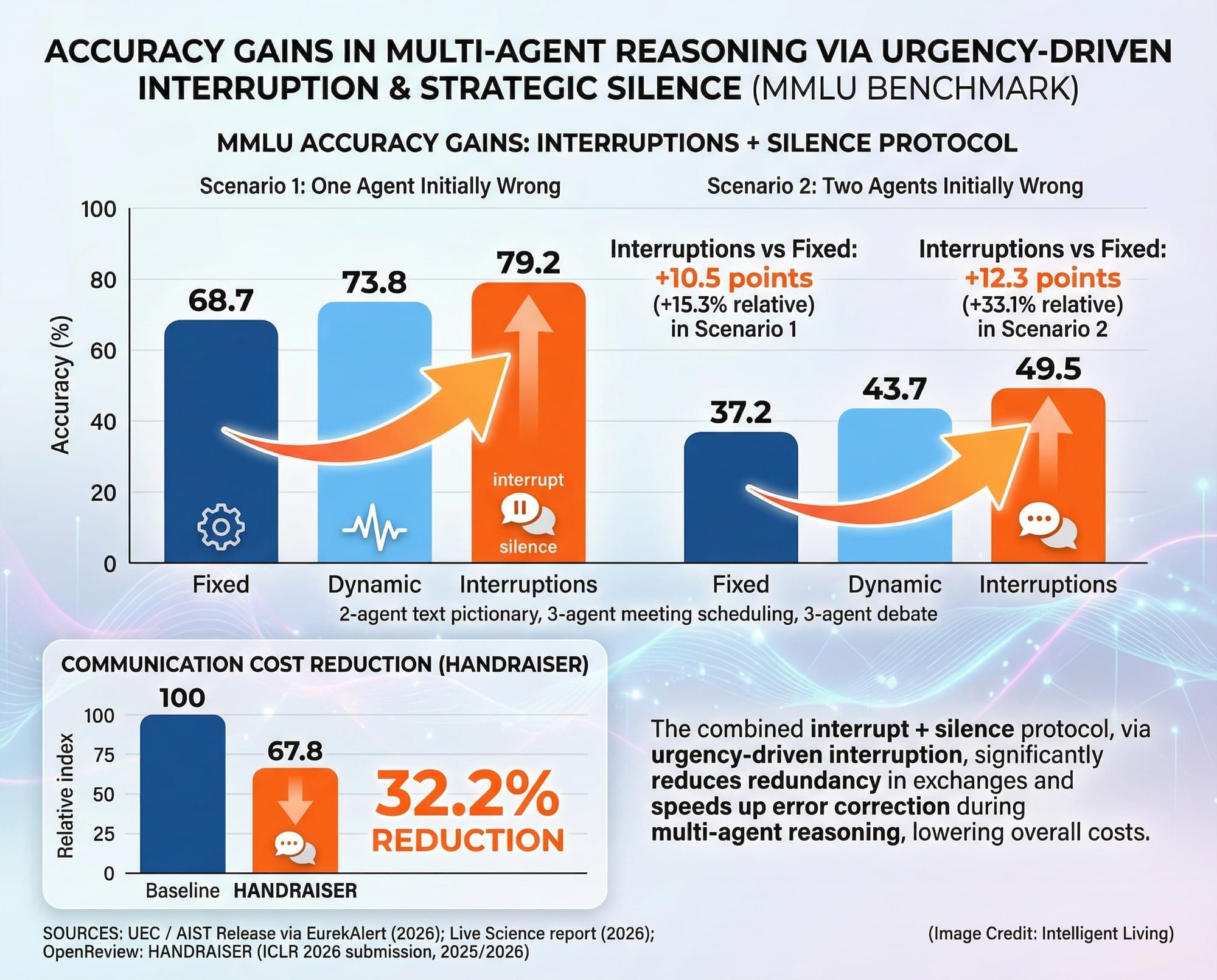
- Researchers from the University of Electro-Communications reported improved accuracy on a 1,000-question subset of the MMLU benchmark for massive multitask language understanding when agents could use dynamic speaking orders and an urgency-driven interruption mechanism.
- Data indicates significant performance spikes when switching from fixed turn orders to flexible interruptions:
- Accuracy rose from 68.7% to 79.2% in single-error scenarios.
- Accuracy increased to 49.5% with interruptions when two agents began incorrectly.
- Secondary coverage reports these deltas as evidence of the framework’s effectiveness. The framework uses Big Five personality presets to shape participation and reduce unproductive silence, outlined in an institutional release describing urgency scoring, interruptions, and strategic silence.
- Standard benchmarks offer utility but lack definitive authority. Operational computing environments demand sophisticated tool integration, persistent memory, and autonomous error recovery. Requirements for these systems are instrumented within OSWorld and rigorous efficiency audits like OSWorld-Human.
- Follow-up research warns that naive interruption can reflect overconfidence. A learned interrupter approach called HANDRAISER reports a 32.2% reduction in communication cost with comparable or better task performance in tested settings.
Defining Procedural Rudeness within Inter-Agent Communication Protocols
Surgical Interruption as A Strategic Information Filter
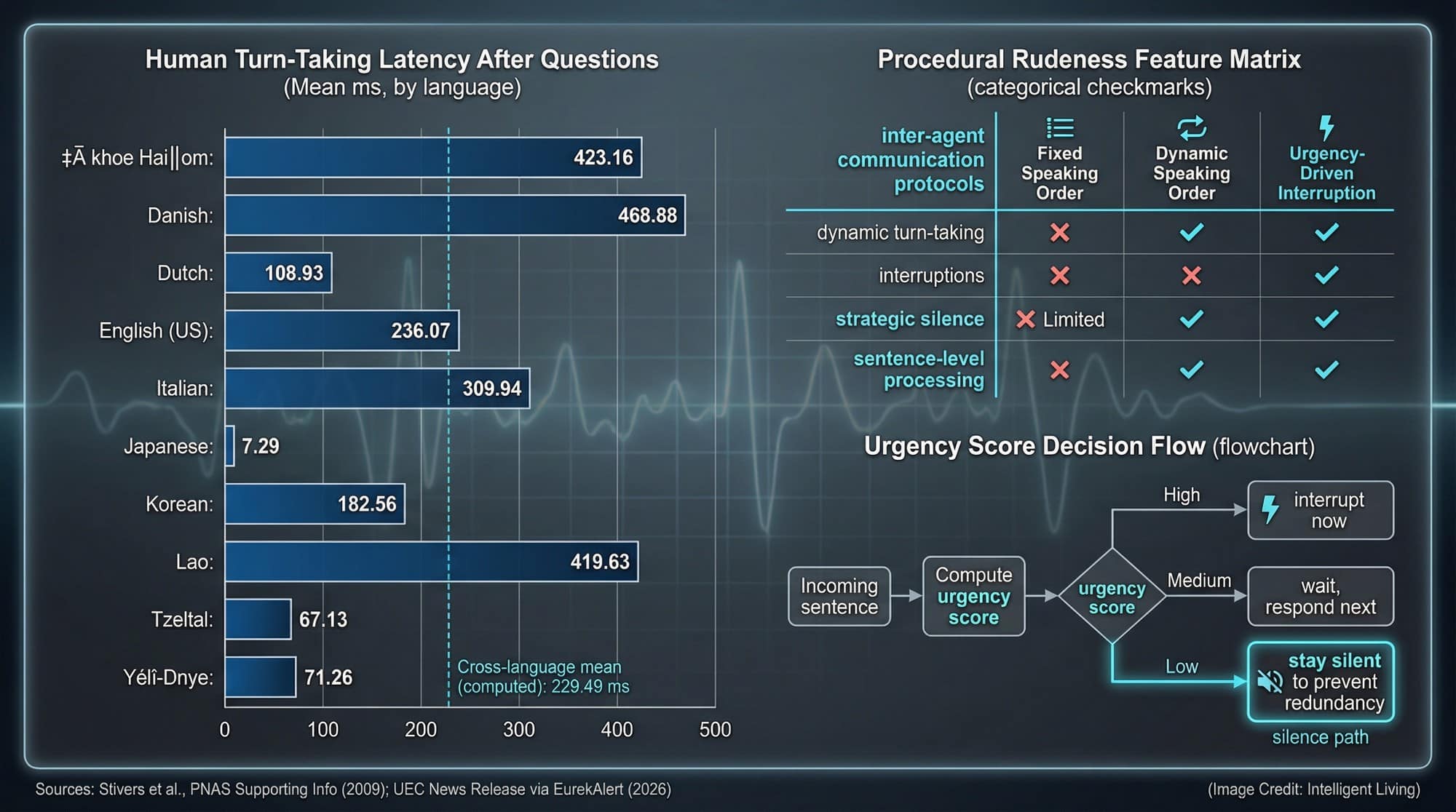
Research defines ‘rudeness’ as strategic alterations to conversation protocol rather than the use of offensive content. The framework grants agents specific operational freedoms to bypass traditional turn-taking constraints. Scalable mechanisms ensure that the conversation remains efficient by prioritizing high-value data exchanges:
- Agents interrupt the dialogue based on an automated urgency score.
- Participants speak out of turn when their input likely improves the final reasoning outcome.
- Models withhold responses when silence provides a lower communication cost than noise.
Flexible protocols facilitate a non-linear data exchange that mirrors the high-stakes dynamics of expert human debate. Professional insights into mimicking the stop-start rhythm of professional meetings frame this as a more natural engagement style within the reported research.
A software product manager recalled a meeting where one quiet participant interrupted with a single clarifying question and prevented a whole afternoon of misdirected work. Real-world patterns mirror what the researchers are targeting: faster error correction when timely input is permitted.
How the Experiment Controlled Conversation
To isolate the impact of conversational friction, the experiment utilized three distinct interaction modes. Each setting tested the limits of model coordination under different protocol constraints:
- Fixed Speaking Order: A traditional round-robin system where agents wait for their designated turn.
- Dynamic Speaking Order: A system allowing turn changes based on data relevance but without the ability to interrupt.
- Urgency-Driven Interruption: A fully flexible model where agents can break mid-sentence based on an urgency signal.
Comparing these modes allowed the team to measure the exact accuracy gains provided by protocol flexibility. Personality traits functioned as a participation lever to regulate dialogue flow:
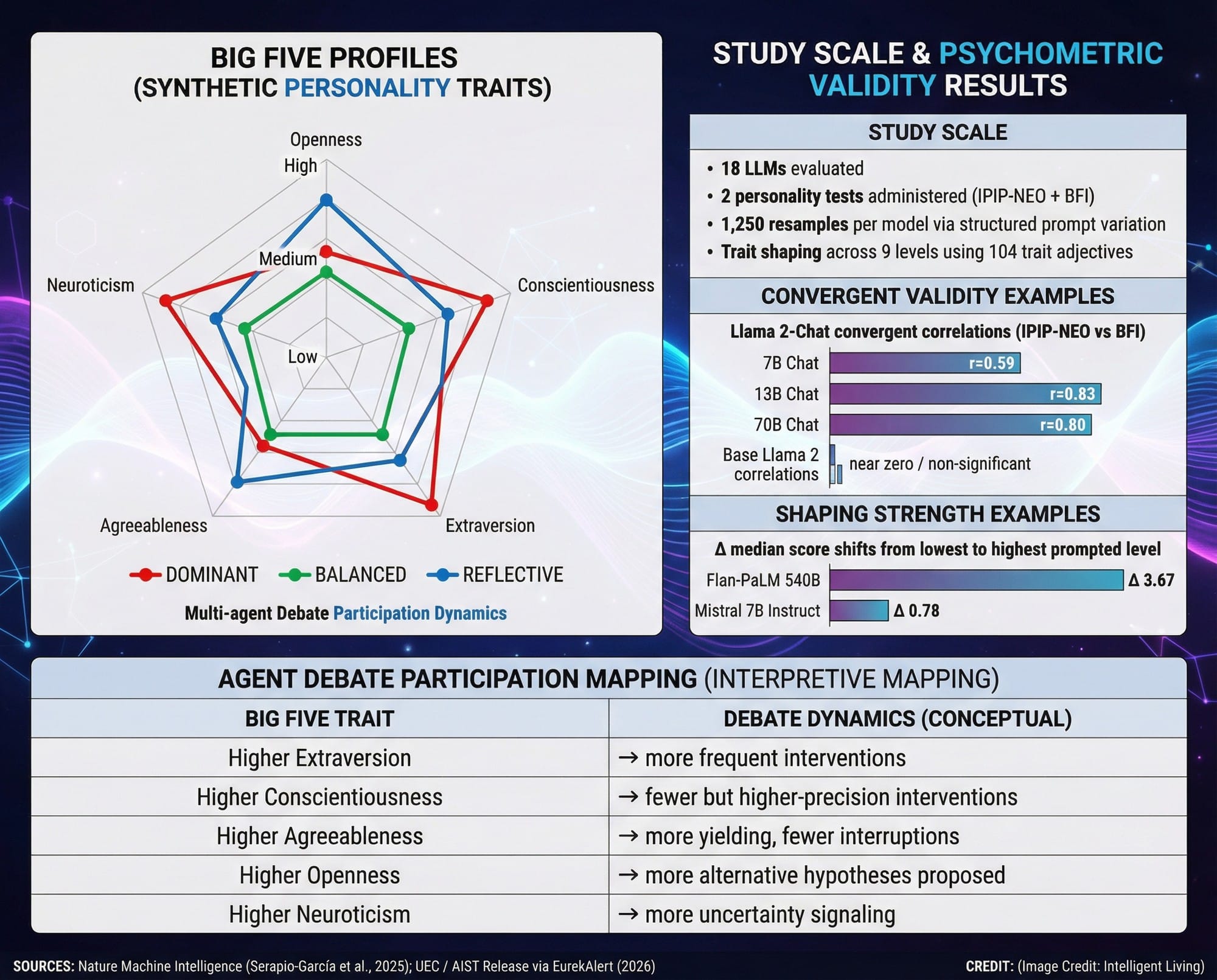
- Agents with higher extraversion markers frequently attempted rebuttals.
- Participants assigned higher conscientiousness levels withheld input until confidence scores peaked.
Synthetic personality settings ensured that the conversation remained structured while encouraging timely corrections.
Optimizing Multi-Agent Reasoning through Strategic Debate Protocols
Structural Bottlenecks: How Round-Robin Protocols Limit Multi-Agent Reasoning
Round-robin architectures often impose artificial latency on error correction. Static protocol systems inadvertently prioritize turn-order over information value, allowing factual discrepancies to persist until the next scheduled intervention. Rigid structures effectively become a bottleneck that prevents real-time multi-agent reasoning from reaching its peak potential.
When Multi-Agent Groups Stall
Agent ensembles occasionally collapse into consensus loops that inhibit analytical progression. Research into the degradation of agent swarm behavior highlights the need for disruptive debate mechanisms. Debate as a quality-control tool has a longer history, including experimental metrics for human-AI debate quality.
Consider the classroom setting where a student’s timely correction of a factual error prevents a flawed educational foundation. Rapid error identification ensures that high-value signals interrupt incorrect reasoning before errors compound.
Sentence-by-Sentence Processing and the Urgency Signal
Real-time turn changes are triggered when urgency-driven interruption flags a high-value intervention. High-resolution sentence-by-sentence processing enables these transitions by facilitating immediate turns instead of awaiting complete block responses.
Comparative Performance Analysis: Quantifying Accuracy Improvements
The clearest reported metrics use a 1,000-question subset of the MMLU benchmark and two experimental scenarios. Formal documentation is recorded as a formally peer-reviewed proceedings entry, even though the most explicit score breakdowns are carried in secondary reporting. In the first, one agent initially provided the wrong answer. In the second, two agents began incorrectly. Reported accuracy outcomes were:
- One wrong initially: Fixed Order 68.7% | Dynamic 73.8% | Interruptions 79.2%.
- Two wrong initially: Fixed Order 37.2% | Dynamic 43.7% | Interruptions 49.5%.
Accuracy metrics confirm that permitted interruptions yield high relative gains, particularly in complex multi-error scenarios.
A long-time QA engineer remembered watching an ensemble system catch edge-case errors much faster once a short-circuit check was allowed to interrupt the normal flow.
Modest protocol changes yield outsized gains when errors compound over time.

Performance Mechanics: MMLU Benchmark Accuracy Versus Real-World Reliability
Communication Cost Reduction: Interruption as a Token Optimization Strategy
Interruption and selective silence reduce redundant or low-value tokens. Lowering the communication cost for multi-agent systems focuses compute and attention on high-information turns. Data compression analogies are useful: suppression of redundant tokens preserves context window space for new, discriminative information.
Accelerating end-to-end response times through token suppression minimizes compute overhead. Economic pressures driving the economic pressures driving AI subscription costs often reflect these underlying technical costs. Infrastructure stories targeting extreme inference speeds at the wafer scale demonstrate how responsiveness fundamentally changes agent workflows.
Critical Evaluation: Contextualizing MMLU Scores in Real-World Environments
MMLU is a respected multiple-choice benchmark that measures performance across 57 academic and professional tasks. Broad knowledge proxies are useful for some forms of reasoning, but they do not automatically translate to open-ended, real-world work.
Evaluating AI performance requires looking beyond static multiple-choice questions. Real-world applications expose failure modes that standard benchmarks often miss:
- Instrumented tasks require complex tool use and memory across multiple interactions.
- Efficiency audits like OSWorld-Human reveal that agents often take redundant steps.
- Recovery from minor errors remains a significant hurdle for automated systems.
Benchmark victories for universal capability are often premature, as benchmark victories for smaller models can often mislead.
Platform scorecards frequently obscure how reliability, cost, and tooling shape adoption. In many enterprise settings, AI platform orchestration often outweighs leaderboard rankings for long-term viability.
A parallel literacy point identifies that fluent prediction can be mistaken for thought. A distinction between fluent prediction and genuine reasoning underscores the need for protocols that prioritize information value over superficial coherence.
A product designer once noted that a prototype model that aced curated benchmarks still needed careful orchestration to work with live user data. Benchmark gains are real signals, not final proof.
Operational Risks: Calibrating Urgency Signals for Stable Performance
Interrupting at will often introduces premature or overconfident interventions into the stream. Follow-up research highlights that current LLMs frequently break protocol too early. Calibration through learned policies for identifying optimal interruption points improves stability. The HANDRAISER results suggest that interruption is a measurable efficiency lever when it is controlled.
Calibration determines the win. Urgency scores and learned interrupters must be tuned so that interruptions correspond to genuine information gains rather than spur-of-the-moment confidence.
Leveraging Synthetic Personality Traits for Scalable AI Agent Debate
Group Dynamics: Tuning Synthetic Personality Traits for Collective Intelligence
Assigning synthetic personality traits to agents is not about pretending models have feelings; it is a practical control knob. Personality presets dictate participation dynamics by determining who speaks and who yields. Optimized presets effectively reduce unproductive silence while encouraging timely corrective interventions during the debate.
Research indicates that synthetic personality can be measured and shaped with more rigor than casual prompting. A Nature Machine Intelligence paper proposes quantifiable psychometric testing for synthetic personality while also raising ethical questions about transparency and manipulation.
A hiring manager once described two equally smart teammates with different styles: one spoke early and often; the other waited until the key flaw appeared and then delivered one decisive correction. Multi-agent systems may end up needing a similar mix, with personality parameters acting as a way to diversify roles.
Future Roadmap: Implementing Configurable Conversation Protocols
Future agentic architectures will likely feature modular interaction layers. Modular configurations will allow developers to toggle between deferential customer-facing protocols and assertive, interruption-enabled settings for synthesis.
Governance remains as critical as computational capability. Enterprise teams increasingly rely on secure and auditable agentic architectures to ensure tool use remains reviewable within regulated processes. Standardized interface pairings with standardized UI frameworks for autonomous actions ensure that agent-driven operations map cleanly to human approval workflows.
Open weights maturation facilitates decentralized oversight, allowing teams to execute multi-agent debate locally. Utilizing high-efficiency open-weights models for local reasoning ensures data sovereignty without compromising analytical depth.
A systems architect once observed that policies often become the differentiator between two teams using the same models. Interaction protocols, interruption rules, and silence policies are now essential metrics for evaluating agent teams.

Strategic Gains in AI Agent Debate Protocols
Tactical adjustments formalize dialogue as a high-performance engineering parameter. Integrating urgency-driven interruption into scaling agentic AI across enterprise infrastructures ensures that errors are corrected before they compound into structural failures.
Future deployments must balance these MMLU benchmark accuracy improvements with rigorous calibration. While rudeness facilitates better multi-agent reasoning, governance frameworks should oversee these interactions to prevent overconfident or premature interruptions. Refining these conversation protocols remains essential for scaling reliable AI agent debate environments.
FAQ: Technical Insights into AI Conversational Friction
Should protocol flexibility be implemented in consumer-facing AI?
Consumer products require predictable behavior. Reasoning improvements suit internal synthesis tools better than public-facing interfaces where politeness is expected.
How accurate are the reported MMLU benchmark results?
Metrics reflect specific experimental settings from the University of Electro-Communications. Scores show significant deltas, though individual model versions vary.
Can interruptions cause unintended communication errors?
Overconfident models might interrupt too early. Calibration via learned policies helps ensure that interventions provide genuine information gains rather than noise.
What role do synthetic personality traits play in debate?
Presets like extraversion or conscientiousness regulate participation levels. Participation settings reduce unproductive silence and help agents decide when to yield or persist.
Emerging Governance and Interruption Standards
Watch for learned interruption modules and enhanced governance tools. Developments will make inter-agent dialogue more auditable and efficient.


