
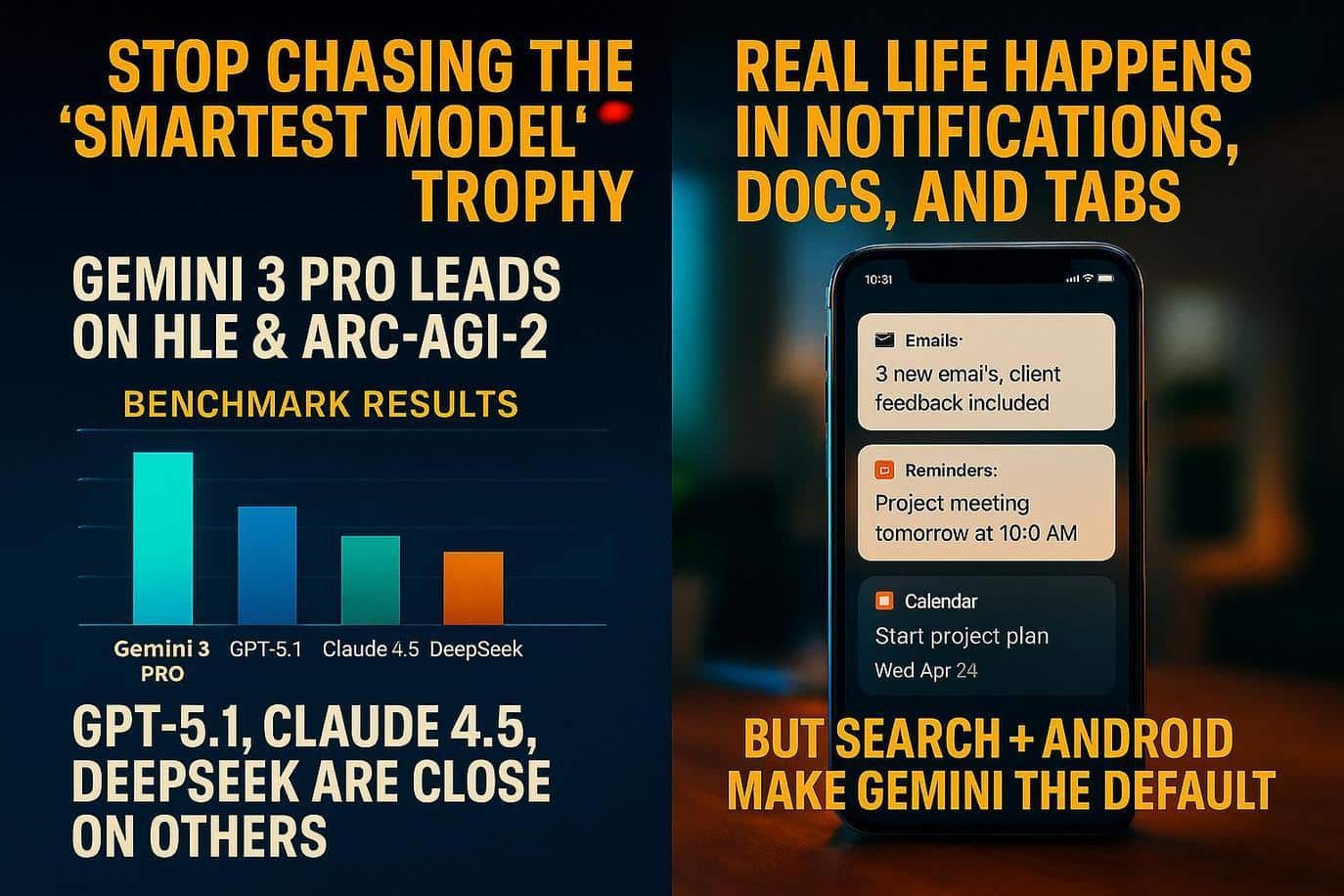
The narrative of the global AI race is often dominated by benchmark scores and head-to-head performance battles. News cycles heavily emphasize the fractional lead of a large language model (LLM) in reasoning tests such as ARC-AGI-2 or Humanity’s Last Exam (HLE). While these Gemini 3 benchmarks and GPT-5.1 vs Gemini 3 comparisons are crucial technical signals, they present only a partial view of the industry’s direction. The true shift lies in how effectively a model is integrated into the tools users rely on daily.
Broadened perspective reveals why Google’s strategy, focusing on deep AI platform integration across its ecosystem, may be the ultimate long-term winning move. When a highly capable model like Gemini 3 powers features in Search, Android, and Workspace, its reliability and omnipresence outweigh a competitor’s small, isolated technical edge.
This guide will dissect the latest Model Performance Benchmarks and explain how this shift toward AI Distribution Advantage is reshaping the competitive landscape for both developers and everyday users.
Quick Facts: Gemini 3 Benchmarks, Pricing, and Platform Reach
- Frontier Reasoning Lead: Public model pages list strong results for challenging reasoning suites such as Humanity’s Last Exam, ARC‑AGI‑2, GPQA, and AIME.
- Competitive Parity: Comparable roundups show GPT‑5.1 running close behind on many tasks, while DeepSeek V3.2 is gaining ground on openness and cost efficiency.
- Flexible Pricing Tiers: Google’s developer documentation outlines various pricing tiers and long‑context options tailored to different usage needs.
- Compute Allocation: Higher rates are charged for extended context and compute-intensive runs, reflecting the additional resources allocated to complex queries.
- Native Search Integration: Subscribers can enable AI Mode in Google Search that summarizes sources, adds tools, and suggests follow-ups inside the results page. When answers appear where people already search, a capable model becomes a daily habit rather than a separate destination. This routine presence reduces the importance of isolated performance gaps.
- Android and Everyday Use: Practical tradeoffs in daily life are examined in a data-driven analysis of everyday AI across home, health, and work that frames real benefits and risks.
- Head‑to‑Head Coding: Algorithmic performance and agent behavior are summarized in a coding-centric comparison of Gemini 3 and GPT-5.1.
Bard’s $100 Billion Lesson: How Google Started the AI Race Losing
The Error That Wrote the Headline
On the day Bard debuted in public, it confidently claimed that the James Webb Space Telescope had captured the first photo of a planet outside our solar system. That claim was false. Reuters reported Bard’s launch error and documented how quickly perception changed, including a steep sell‑off in Alphabet shares. The science context behind the mistake is clarified by Space.com’s explanation of the JWST misstatement, which shows why the error was so glaring.
The Market Reaction and Narrative Drag
Early missteps shaped the idea that Google had missed the moment. Meanwhile, rivals made crisp product demos and fast iteration the story. The time of the initial missteps proved valuable in hindsight because it directly set up the strategic swing that followed. Wider context on how the competition broadened appears in a multipolar AI race beyond OpenAI.
What the Market Really Learned
The core lesson was not just that Google erred. Public mistakes quickly become market narratives, and those narratives create significant drag. Recovery required two actions: improving the model family and embedding it where users already live online.

Gemini 2.5: The Model that Finally Made Google Competitive
Why Gemini 2.5 Mattered
When Google introduced Gemini 2.5, it framed the release as a turn toward stronger reasoning, coding, and math. The company’s summary lays out the direction in its Gemini 2.5 model update. Developers noticed because the model handled analysis and tool use with fewer dead ends and because long‑context behavior improved for research‑style work.
What the Tests Suggested
Public roundups during the Gemini 2.5 window showed competitive scores on tasks such as GPQA and AIME, and solid movement on real‑world coding tests like SWE‑Bench compared with earlier Gemini releases. The message for practitioners was straightforward: Google’s model family had closed the performance gap for demanding, expert-level tasks.
How Perception Began to Shift
Perception follows experience. As teams tried Gemini 2.5 in analysis, code assistants, and content workflows, confidence rose. It also helped that the broader ecosystem included credible alternatives beyond the big two, including DeepSeek V3.2, which gave developers a local and open path that pushed everyone to compete on quality and cost.
Gemini 3 Pro and Nano Banana Pro: Benchmark Beast, Visual Layer
The Reasoning Leap
Gemini 3 Pro’s model page aggregates results across several demanding tests. The primary headline is the model’s consistency on challenging reasoning suites like HLE and ARC‑AGI‑2. It also delivered strong GPQA and AIME numbers, all detailed on the published benchmark table. Benchmarks should not be mistaken for real-world utility, but they represent the most comparable signal we have for tracking progress on reasoning without tools.
Pricing, Context, and Deep Runs
Many readers weigh performance against cost and latency. Google’s developer documentation explains token pricing and long-context tiers for its Gemini API pricing in plain numbers, a schedule used for planning budgets. Some tiers allow much larger context windows, and certain modes devote more compute to challenging questions, which raises cost but can increase quality on frontier problems.
The Visual Stack that Reaches Users
For creators and marketers, the image layer matters because it meets people where they are. Google’s Gemini image model sits alongside text as a first‑class tool, and workflows are mapped in a practical image model guide with examples that span posters and campaign infographics. Related mobile AI photo editing patterns show how image tooling reaches users on phones. Features also reach the public through AI results in Google Search, so the larger picture comes into focus. The model is not just good on paper; it is present where people type, browse, and publish.

The Illusion of an “AI Edge”: Why Benchmarks Aren’t the Whole Story
What Benchmarks do Well, and Where they Mislead
Synthetic tests are useful, especially when they capture reasoning steps or evaluate knowledge under pressure. They are not the same thing as daily life. A model may edge another by ten points on a difficult suite, yet most people will notice little difference in everyday summaries, emails, or quick research; consequently, platform context and user literacy decide more than leaderboard deltas.
The Distribution Reality
Gemini 3 Pro powers features inside products that run many people’s day by default. When answers populate inside Search, when notifications condense on a phone, and when writing tools live in Gmail and Docs, small performance gaps matter less than reliable presence. The distribution layer makes a good model feel available, trusted, and routine.
Literacy Over Hype
A clear-eyed view of what these systems are and what they are not remains critical. A study of the illusion of thought and reasoning in large language models further develops this perspective. The practical takeaway is simple. Learn how to frame questions, cross-check complex claims, and bring your own judgment to bear. That is how readers make the most of any model while the market keeps moving.
Platform Gravity: Gemini in Search, Android, Chrome, and Workspace
Search as a Live Research Layer
Subscribers can enable AI Mode in Google Search that summarizes sources, adds tools, and suggests follow-ups inside the results page. When answers appear where people already search, a capable model becomes a daily habit rather than a separate destination. This routine presence reduces the importance of isolated performance gaps.
Android as a Daily Companion
On modern Android phones, Gemini condenses long notification threads, drafts replies, and assists across apps. These are tiny moments that add up to real time saved. The model meets people in the flow of their messages, maps, and photos instead of waiting behind a separate icon.
Chrome as a Reading and Task Bridge
Browser context makes Gemini more useful for research and work. Reading a complex article or scanning a dense PDF becomes much faster when the assistant is already sitting in the tab. It can summarize, compare, and extract next actions without copy‑and‑paste friction.
Workspace as a Cross‑App Assistant
In Docs, Gmail, Drive, and Calendar, the assistant turns scattered files and threads into prepared outlines, drafts, and task lists. The suite known as Gemini for Workspace packages these capabilities for organizations. The important point for readers is that these tools run where teams already store their work.
Distribution Beats a Narrow Model Edge
Modern AI leadership depends on datacenter scale, energy budgets, and chip supply as much as raw model scores, a theme traced in reports on datacenter- and chip-driven AI empires. When a strong model also rides the largest distribution rails in search, mobile, browser, and productivity, competitors’ lead times tend to shrink.

LLM Face-Off: Gemini 3, GPT-5.1, DeepSeek, and Claude 4.5
Reasoning and Multimodal Performance
Independent roundups place Gemini 3 at or near the top on frontier reasoning suites such as Humanity’s Last Exam and ARC‑AGI‑2, while GPT‑5.1 remains close on many tasks and often wins on speed at similar quality. Claude 4.5 is frequently highlighted for reliability on long contexts and document understanding. DeepSeek V3.2, though not always at the very top on reasoning, delivers competitive results given its openness and cost profile.
Coding and Software Tasks
Whole-repo editing and bug-fixing require different capabilities than solving small coding puzzles. Claude models often rank highly on real bug fixing, while Gemini 3 and GPT‑5.1 trade wins on algorithmic coding and tool‑augmented tasks. For readers following the open ecosystem, a technical explainer on DeepSeek R1 Slim shows how open models continue to raise the bar on agentic coding patterns.
Cost-Benefit Analysis and Open Source Trade-offs
Cost, Context, and Openness
Gemini 3 offers huge context windows and a higher-compute mode for hard problems. GPT‑5.1 is commonly priced lower per token at similar context sizes. Efficiency pushes, including FP8 training approaches in cheaper, greener AI platforms, also influence pricing strategies. Claude emphasizes very long context for contract review and research. DeepSeek’s open‑weight approach favors self‑hosting and fine‑tuning, which can push total cost down for teams with infrastructure. In video generation, a similar open-weights alternative is emerging with LTX-2.5 as a controllable open world model versus Gemini Omni, offering local deployment and fine-tuning against Google’s closed managed platform.
Which Model Fits Which User?
Instead of a monolithic ranking, the choice of the best model depends entirely on the use case. Here is a brief guide to matching user needs with model strengths:
- Everyday Users: Users who live in Google’s ecosystem benefit most from Gemini’s platform reach and ambient tools.
- Developers and Startups: These teams often balance GPT‑5.1’s cost, maturity of tools, and speed against Gemini’s reasoning capabilities in long or multimodal problems.
- Enterprises: Organizations that handle large documents and regulated workflows tend to lean toward Claude’s long context and predictable behavior.
- Open‑Source Practitioners: These users choose DeepSeek variants when local control and customization are more important than achieving the highest benchmark scores.

Managing AI: Subscriptions, Throttling, and Compute Costs
Why Monthly Plans Keep Rising
Training and serving frontier models require expensive chips, large data centers, and careful scheduling. Hardware constraints such as advanced compute packaging bottlenecks shape capacity and cost. As people ask for bigger context windows and more capable image or video tools, providers allocate more compute per request. Those choices raise operating costs, which show up as higher tiers or stricter daily limits.
What Throttling Signals to Readers
When companies tighten free access or reduce generation limits, it usually reflects GPU scarcity and energy constraints rather than indifference to users. Incumbents often have a clear advantage here. Firms with global infrastructure and multiple revenue streams can shoulder peak demand while competitors ration usage to stay solvent.
The Household View
Subscription fatigue is real. Practical strategies for value include picking one primary plan, limiting add-on tiers, and rotating month to month based on active projects. These approaches are summarized in a guide on finding value in expensive AI subscriptions and can be applied to current Gemini, GPT, Claude, or DeepSeek plans.
The Long-Term Impact of Gemini’s Distribution Strategy
A Shorter Window for Rivals’ Advantages
Gemini 3’s progress on reasoning and multimodal understanding is important, but distribution represents the greater story. Once a model is good enough, the platform that meets people in search results, notifications, browser tabs, and shared documents will shape everyday experiences. That compresses the time any standalone product can hold a clear edge.
Literacy Outlasts Leaderboards
Readers gain more by improving prompts, triangulating claims, and using multiple sources than by chasing the latest leaderboard shift. A practical guide to coaching students and families through AI‑assisted learning illustrates this mindset. The habits outlined in a guide to coaching students and families with AI transfer directly to professional research and creative work.
Practical Takeaways
- Pick the assistant that lives where you work and search.
- Keep one backup model for cross‑checks.
- Budget for the plan that matches your longest documents and image needs, not the highest tier on the page.
- Document what you trusted and why so that your future self can audit the result.

The Enduring Advantage: Distribution Over Raw Benchmarks
The journey from Bard’s early missteps to Gemini 3’s state-of-the-art competence clearly illustrates a fundamental truth about the modern AI race: technical progress is now table stakes. With rival models like GPT-5.1, DeepSeek V3.2, and Claude 4.5 achieving near-parity on complex tasks, the debate is shifting away from isolated benchmark wins. The market is now rewarding models that are simply present, reliable, and deeply woven into existing workflows—a concept we refer to as platform gravity.
This focus on the distribution advantage should guide both consumers and developers. For the individual user, the best model is the one that minimizes friction, appearing seamlessly inside the products they use to browse, write, and communicate. For the industry, the challenge is now less about reaching a new reasoning frontier and more about translating that capability into ubiquitous, trustworthy, and scalable utility across all environments. For the latest benchmarks comparing current models, see our updated 2026 comparison, and for the most recent Gemini Flash release, see our Gemini 3.8 Flash benchmarks and pricing breakdown.
Common Questions on LLM Performance and Platform Strategy
Is Gemini 3 Actually Better than GPT‑5.1 in Real Use?
It depends on the task. Gemini 3 often leads on difficult reasoning suites, while GPT‑5.1 is strong on coding speed and tool integrations. Most people will notice the difference less than they notice platform convenience.
Does Google’s Integration Mean I Must Use Gemini?
No. It means Gemini is nearby when you search, browse, write, or read on Google products. You can still keep a second model for comparison and use it when a task benefits from different strengths.
Where Does Claude Fit in Today’s Stack?
Claude 4.5 is widely used for long documents, summarization, and structured editing. Teams that handle contracts or research binders often find its long context attractive.
Why do Providers Throttle Free Use or Add Higher Tiers?
Frontier models consume significant compute and energy per request. Throttling and premium plans help providers match demand to limited hardware and fund ongoing improvements.
Is an Open Model like DeepSeek Worth it for a Small Team?
If your team values local control, customization, or data isolation, open‑weights options are compelling. Coverage of DeepSeek variants shows the tradeoffs and the growing maturity of the open ecosystem.


