
Restoring credit health requires a systematic approach rather than guesswork. This framework provides a repeatable, lawful method to audit records, dispute inaccuracies, and manage core scoring factors. Because credit scores vary by model and credit scoring models keep evolving, the goal is not chasing a single magic number but building a clean record that holds up across lenders.
Consumers frequently encounter conflicting advice and aggressive marketing from predatory repair firms. Successful credit recovery relies on understanding the Fair Credit Reporting Act (FCRA) and utilizing the official AnnualCreditReport.com request process. Managing your own data eliminates the need for expensive third-party intermediaries prone to deceptive marketing.
Proactive steps to fix credit report errors serve as a foundational skill for long-term financial stability. This guide ensures you can identify mixed files, reporting errors, and outdated entries while maintaining payment history consistency. Prioritizing these actions allows you to negotiate better loan terms and avoid the long-term costs of a suppressed credit score.
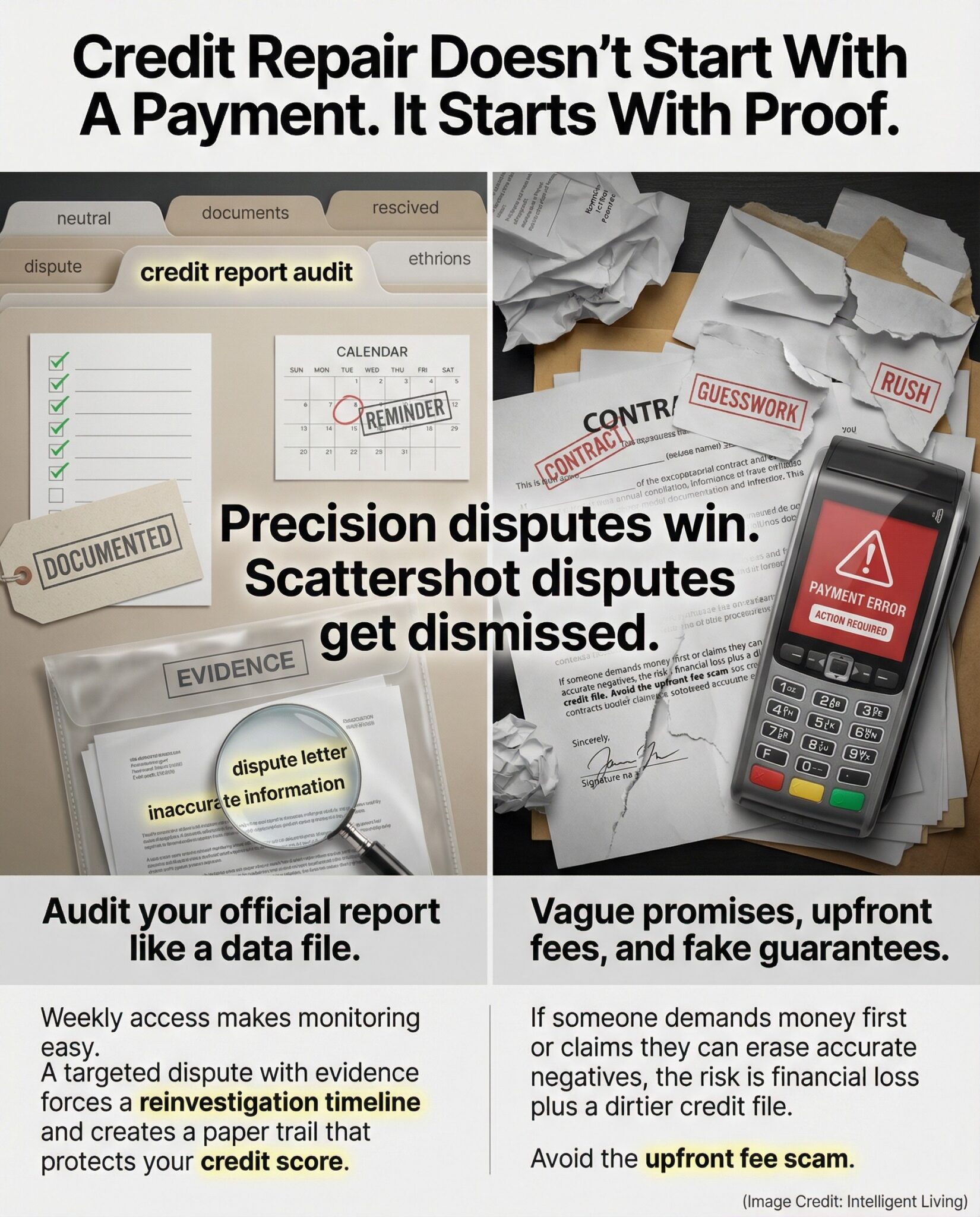
Federal Credit Report Rules and the Reputation Recovery System
Essential Federal Guidelines for Credit Reporting Accuracy
Knowledge of the regulatory landscape empowers you to navigate the dispute process with confidence. These core rules define your rights and the obligations of reporting agencies:
- Permanent free weekly credit reports make routine monitoring realistic and cost-free.
- The 30-day dispute investigation clock can extend to 45 days in specific situations, and results must be sent within five business days after an investigation ends.
- FICO’s category weights explain why the fastest honest wins usually come from payment history and amounts owed, not from gimmicks.
- Credit repair companies cannot lawfully delete accurate negatives on demand, and upfront-fee pressure is a common scam pattern.
Applying these facts during your audit prevents common pitfalls and ensures your expectations align with federal law. Mastery of these timelines and requirements serves as the first safeguard against predatory repair tactics.
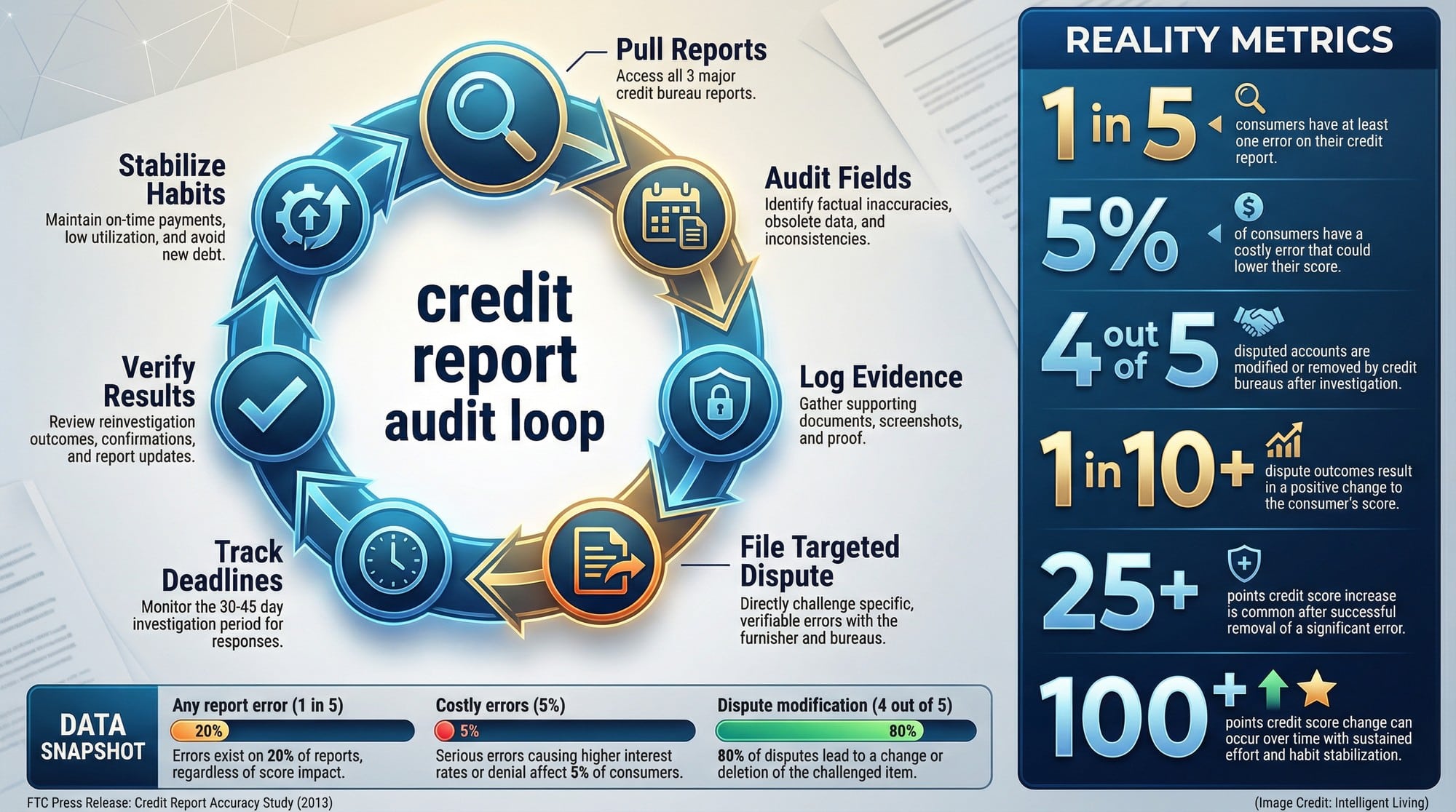
Recursive Framework for Credit Reputation Recovery
Step 1: Pull Your Reports the Official Way
Authorized portals provide reports that mirror lender data while eliminating unnecessary vendor fees. Access official reports exclusively through the official AnnualCreditReport.com request process to bypass deceptive pay sites and predatory marketing.
Anecdote: A renter discovered an unknown account listed under an old address during a routine check; pulling the official report made the mistaken tradeline visible and saved weeks of inaccurate credit activity being accepted by apartment screening.
Step 2: Read the Report Like a Data File
Analyze each report as a database export by verifying identity fields, account status, balances, limits, and public records. A plain-English breakdown of credit report sections helps keep the scan consistent across the three bureaus so the same categories get checked every time. Create an organized log of correct entries versus identified errors to prioritize your dispute workflow.
The Credit Reputation Recovery Loop (The System You’ll Repeat)
Identity Data Checks: Names, Addresses, Employer Fields, Mixed Files
Verify the following identity fields to prevent data merging errors:
- Name spellings and variations
- Current and previous residential addresses
- Employer history and occupation records
Mixed files, involving another consumer’s account data, serve as a frequent source of persistent reporting errors. Proactive digital data protection habits prevent personal information from being incorrectly merged into your credit profile.
Account Data Checks: Open and Closed Accounts, Limits, Balances, Payment Status
Audit each tradeline by cross-referencing these data points with your records:
- Reported credit limits and high balances
- Recent statement balances versus reported totals
- Payment status indicators and delinquency dates
Mismatched data often shifts utilization math and payment history interpretations used by scoring models. Differentiation between hard and soft inquiries facilitates the identification of unauthorized hard pulls that do not correspond to your applications.
Evaluating Negative Entries: Collections, Charge-Offs, and Public Records
Prioritize the verification of collection entries and public records for accuracy. Confirm all dates and amounts meticulously.
FCRA time limits for adverse items prevent most negatives from remaining on your report indefinitely. Delinquency clocks begin at the initial default date, regardless of subsequent debt sales. Medical debt collection inaccuracies necessitate meticulous verification of dates and amounts to avoid systemic reporting errors.
Anecdote: An older small collection reappeared after a merger of servicers. Once identified and disputed with supporting bank statements, the collection was removed, and the score halted its slide.
Step 3: Classify Findings So Your Dispute Is Specific
Label each issue as one of: identity mismatch, reporting error (wrong balance/status), duplicate entry, or potential identity theft. Specific categorization prevents disputes from being dismissed as insufficiently detailed, especially since a dispute can be rejected as frivolous or irrelevant when it lacks enough information to investigate.
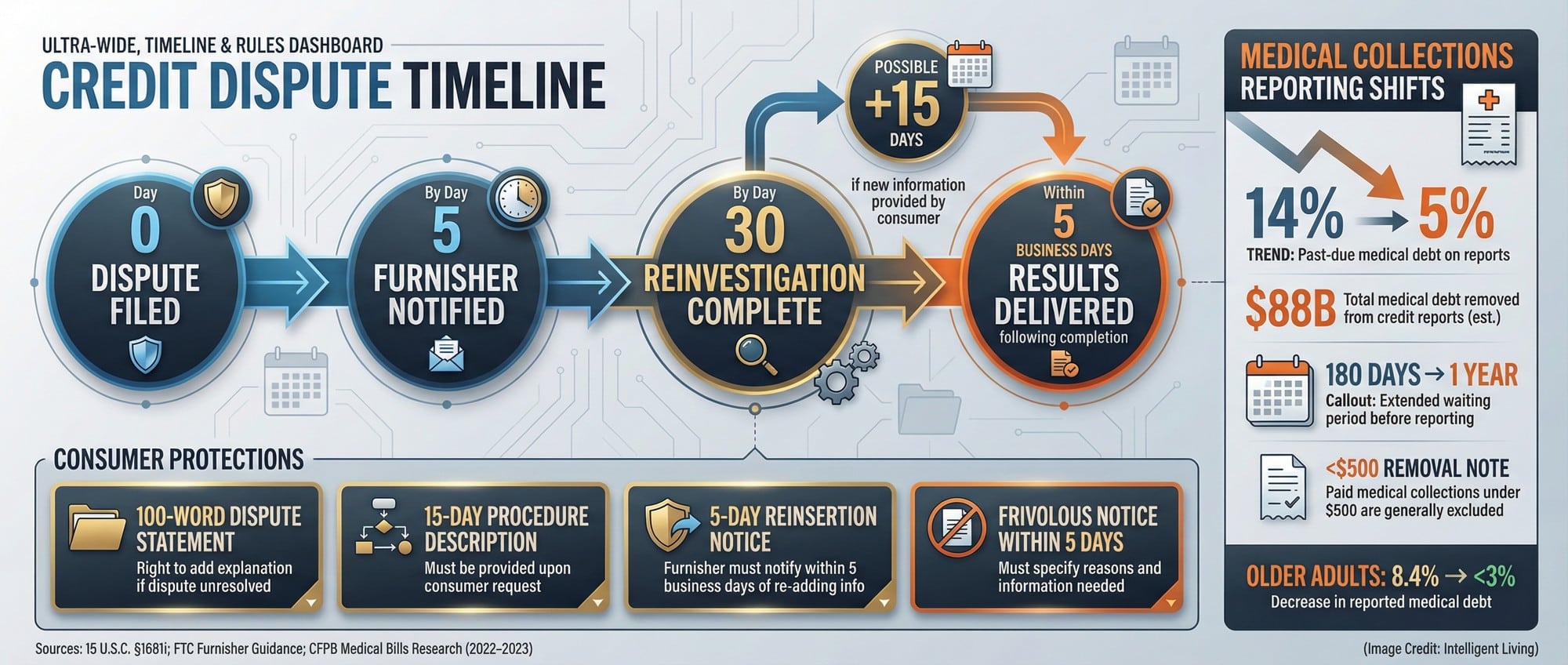
Find and Fix Errors: Credit Report Audits and Dispute Workflow
Auditing Official Credit Reports for Inaccuracies (A Practical Checklist)
Identifying the most damaging inaccuracies allows for a more efficient recovery process. Focus your audit on these high-priority error categories:
- Fraudulent Accounts: Unauthorized accounts signal mixed files or identity theft requiring immediate prioritization. Use an identity theft recovery plan to address these immediately.
- Reporting Inconsistencies: Priority correction is required because negative information can generally stay on a credit report for up to seven years. Errors in late payments, balances, or limits shift scoring math.
- Duplicate Collections: Erroneous collection records cause significant scoring harm. Request removal of redundant records to address erroneous collection tradelines and stabilize your profile.
Immediate identification of these issues removes long-term obstacles to major financial applications.
Why Auditing is Worth the Effort
Federal Trade Commission credit report accuracy research indicates that one in five consumers had an error on at least one report, and five percent had errors serious enough to affect loan terms. Routine audits prevent unexpected denials during critical financial applications, such as rental screenings or mortgage rate quotes.
Verified Dispute Procedures for Successful Investigations
Structural Requirements for Effective Dispute Documentation
Submit concise, specific disputes supported by documentation to trigger meaningful investigations. Utilize standardized credit bureau dispute templates to provide the level of specificity required: identify the exact item, state what is wrong, and attach copies of proof. For errors originating from a creditor, furnisher dispute forms streamline the request while keeping it narrow and factual.
Dispute the Credit Bureau, then the Furnisher
File the dispute with the bureau and separately with the company that furnished the information. Regulatory investigation workflows mirror what tends to work in real life: keep it in writing, be specific, include proof, and maintain a log. The Furnisher Rule mandates that furnishers must investigate disputes forwarded by bureaus; they must correct, delete, or block any unverifiable data.
What Timelines to Expect and When 45 Days Applies
Official documentation details regulatory investigation timelines and notes the five-business-day requirement for sending results after an investigation ends. Logging these dates makes your progress measurable and simplifies timely follow-ups.
How to Handle Verified Results when Disagreement Persists
If the bureau or furnisher verifies an item and the consumer still disagrees, add new supporting evidence and re-submit. If verification continues, submit a consumer statement of dispute to be included in future reports. In cases where a company response stays inconsistent, a CFPB consumer complaint can prompt a written reply tied to the same dates and documents already in the dispute file.
Anecdote: After a verified response that still seemed incorrect, a document showing a cleared payment posted on the issuer’s portal convinced the furnisher to reopen the investigation and correct the status.
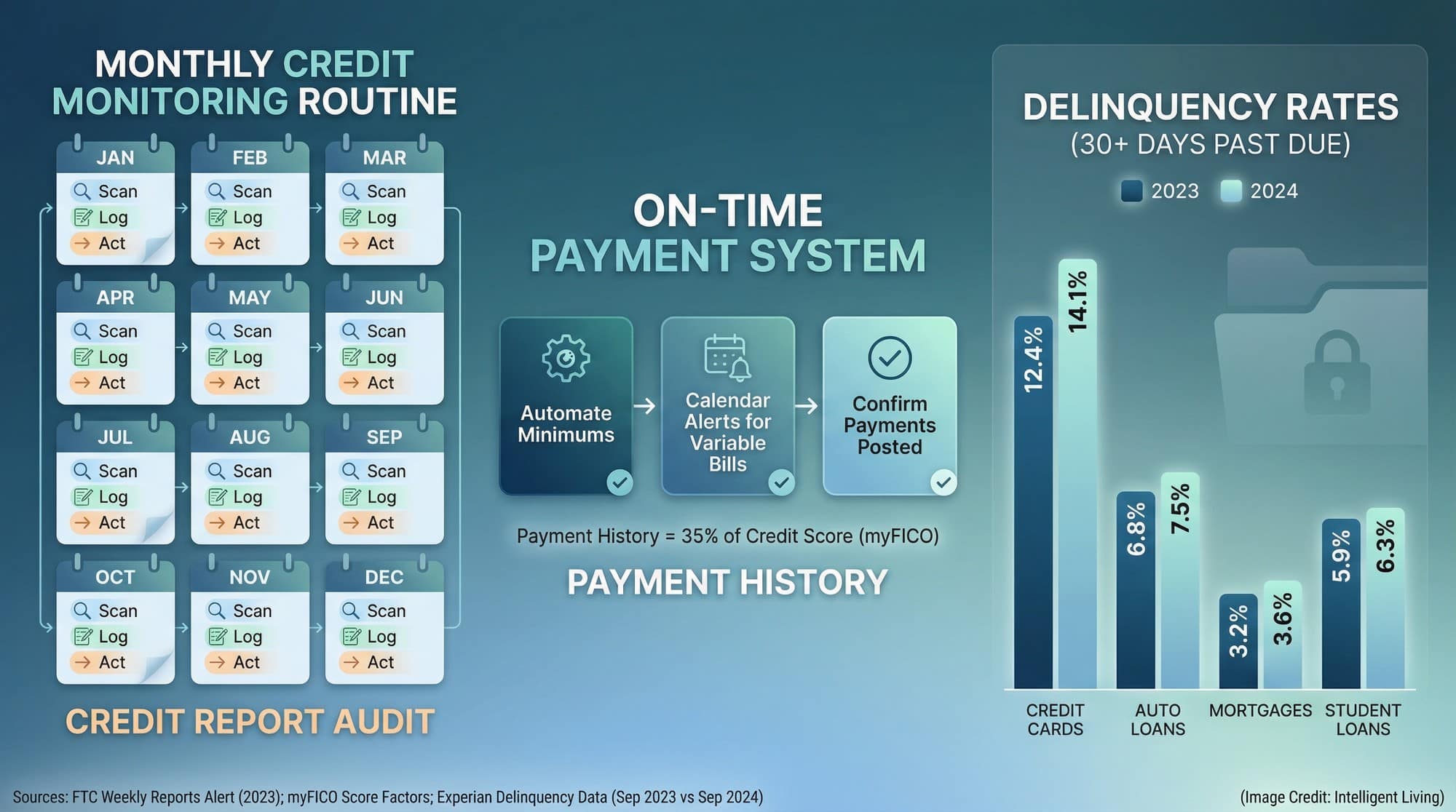
Monthly Credit Monitoring and On-Time Payment Habituation
Systematized Monthly Credit Reporting Routines
Maintain accuracy with a monthly checklist: pull official reports, scan for discrepancies, file disputes for errors, and schedule follow-up checks. Regulatory guidance recommends annual credit report reviews to minimize surprises before major financial applications. A monthly cadence limits the workload while documenting measurable progress.
When to Check More Often
Increase checking cadence when planning major financial events such as a mortgage application, job-related background checks, or rental applications. Regulatory databases include niche reporting agencies covering tenant and employment data that can quietly affect decisions.
Credit recovery functions as a vital component of broader financial wellness. Maintaining a seasonal bill budget reduces missed due dates, while a structured financial wellness plan ensures credit recovery aligns with overall cash flow.
Anecdote: A household that automated payments and set simple alerts stopped worrying about missed due dates and found the score plateaued upward while the family regained spending control.
Payment History Optimization: Protecting Your Primary Scoring Lever
Why Payment History Dominates
Payment history represents the primary scoring factor in most models. In the FICO framework, payment history weighting accounts for 35% of your score, which is why one avoidable late mark can outweigh months of small optimizations.
Build an On-Time Payment System
Establish a reliable on-time payment system using these two protocols:
- Automate Minimums: Set recurring payments for essentials to prevent human error from creating late marks.
- Calendar Alerts: Use reminders for variable bill amounts that automation might miss.
Consistent financial automation turns payment history into a background habit rather than a daily mental load. Prioritize on-time payments; a single delinquency outweighs minor debt ratio fluctuations. Late payments can stay on a credit report for years, and a 30-day late can suppress a fragile score for months.
Anecdote: A freelancer who managed irregular income set autopay for a small recurring amount and used a calendar check for the rest. The safety net prevented an accidental late payment during a chaotic month and preserved a long streak of on-time entries.
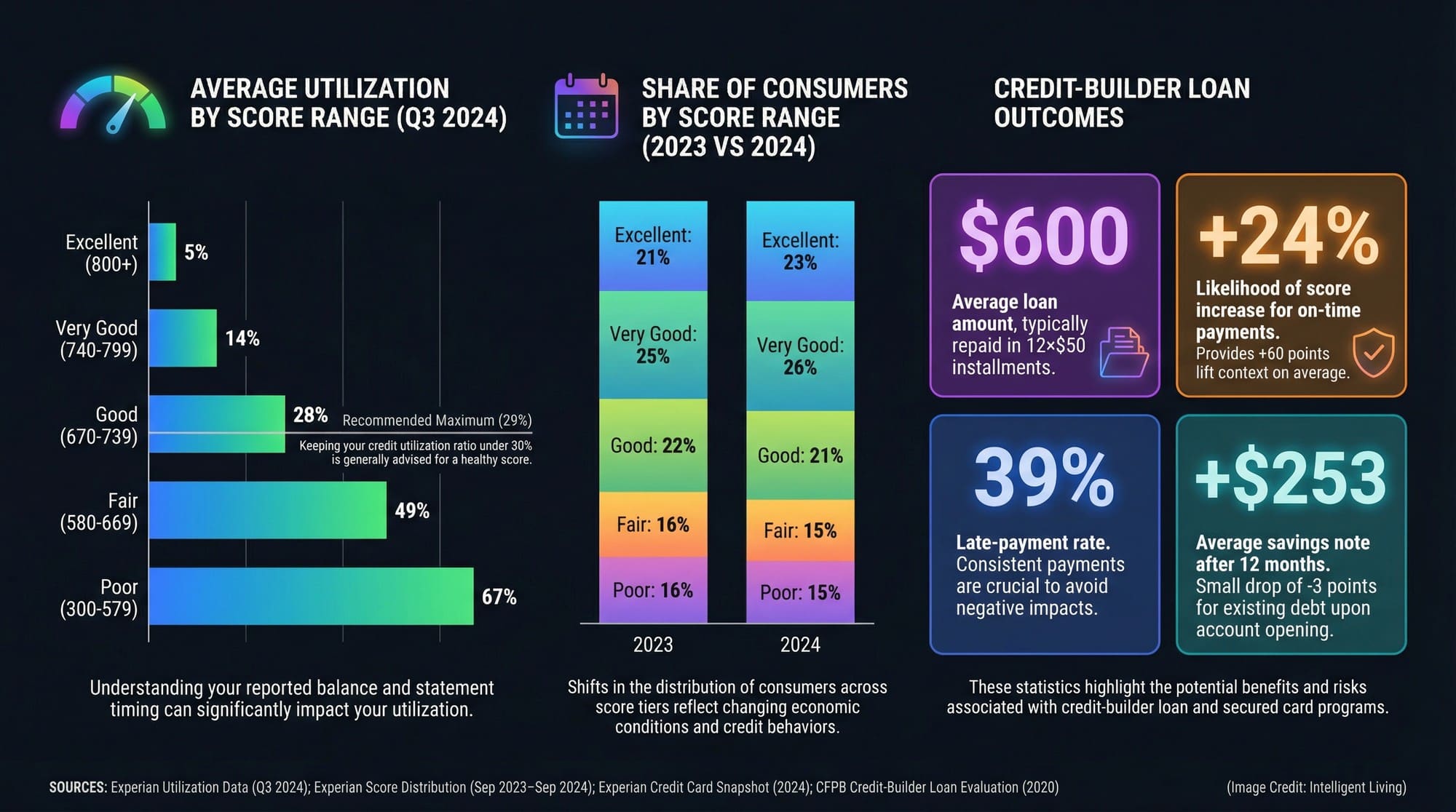
Advanced Credit Utilization Strategies and Financial Optimization Tools
Credit Utilization Formulas: Timing, Math, and Accuracy Benchmarks
What Utilization Measures
Credit utilization measures current revolving debt against available limits. Scoring models evaluate utilization based on reported statement balances rather than live balances, which is why a card can look high on a report even when a payment just posted.
How to Calculate Utilization
Monitor two primary metrics: per-card utilization and aggregate utilization. Standard utilization ratio calculations involve simple division turned into a percent.
Reporting Timing and Statement Snapshots
Most issuers report data shortly after billing cycles conclude, meaning reports reflect statement snapshots rather than live balances. Specific issuer reporting cycles explain why a score can wobble even when someone paid on time.
Practical Targets and Tradeoffs
Optimizing your score involves precise management of your revolving credit limits. Use these three utilization benchmarks to stabilize your profile:
- Reduce per-card spikes first to prevent a single maxed account from suppressing your score.
- Target a utilization rate under 30 percent as a conservative starting point.
- Verify that reported balances drop on the next cycle after paying down a balance to ensure the score reflects your progress.
Balancing these metrics creates a predictable scoring environment. Unlike personal installment loans, revolving balances require active, statement-aware monitoring to prevent accidental score dips.
Example Utilization Calculation
Example: If a card has a limit of 2,000 and the statement balance is 600, the per-card utilization is (600 / 2,000) * 100, which equals 30 percent. If total revolving limits across cards equal 10,000 and total reported balances equal 2,500, the overall utilization is (2,500 / 10,000) * 100, or 25 percent.
Anecdote: A consumer paid down a credit card mid-cycle and assumed utilization had dropped. The score did not budge until the next statement posted, highlighting why timing and reporting matter more than daily stress-checking.
Strategic Use of Secured Cards and Credit-Builder Loans
Secured cards and credit-builder loans generate positive tradelines when paired with low fees and transparent bureau reporting.
Secured Cards: Verify Reporting and Keep Balances Low
Selecting a secured card with bureau reporting and maintaining low utilization facilitates reliable score growth.
Credit-Builder Loans: Know the Fit and the Costs
Credit-builder loans secure borrowed funds in a locked account during the installment repayment period. A consumer protection analysis of credit-builder loans highlights that these products can help build scores but may be a poor fit when carrying expensive debt.
Before You Apply: A Quick Checklist
Verify these qualification criteria before applying:
- Confirm the lender reports to the credit bureaus.
- Compare fees and interest to the expected benefit.
- Prefer products with transparent reporting and low fees.
Anecdote: Someone with a very thin file opened a secured card that reported to the bureaus and built a small pattern of on-time payments. Within a year, the person qualified for a basic unsecured product with a modest limit.
When Traditional Credit Data is Thin
For readers with thin files, consent-based open finance increasingly expands credit access by incorporating cash-flow visibility into underwriting systems.

Legal Safeguards Against Predatory Credit Repair Scam Tactics
Detecting Deceptive Credit Repair Tactics and Advance Fee Scams
Predatory credit repair services often guarantee the removal of accurate negatives while demanding illegal upfront fees. Deceptive pitches frequently utilize recurring online scam indicators such as artificial urgency and vague guarantees. Regulatory agencies track recurring credit repair scam patterns that rely on unrealistic promises and pressure tactics.
Federal law draws bright lines. The Credit Repair Organizations Act ban on advance fees prohibits companies from collecting payment before performing services. The three-business-day cancellation right provides a narrow window to back out without penalty.
Look for these red flags:
- Requests for large upfront payments before work begins.
- Promises to remove accurate negative entries, which legitimate services cannot guarantee.
- Pressure to sign quickly or to disguise the work as a legal service.
Significant consumer harm exists; the CFPB recently announced the return of 1.8 billion dollars in refunds tied to illegal credit repair schemes.
Anecdote: A caller described paying a heavy upfront fee to a firm that promised removals. The contract language was vague, the results never arrived, and the money pressure arrived first, which is the exact ordering consumers should treat as a stop sign.
Final Action Plan for Credit Reputation Recovery
Follow this structured action plan to restore your credit reputation:
- Pull official credit reports and save them to a secure folder.
- Run the audit checklist and classify issues precisely.
- File targeted disputes with the bureau and the furnisher, including supporting evidence.
Once your disputes are active, focus on long-term behavioral stabilization:
- Protect payment history through automation and reminders.
- Manage utilization with statement-aware payments and focus on per-card spikes.
- Avoid services that demand upfront fees or guarantee impossible outcomes.
This tiered approach ensures you address immediate errors while building the habits necessary for permanent credit health.
Payoff routines gain sustainability through a comprehensive debt management framework and a digital debt tracking tool. Reviewing common loan terms before signing prevents avoidable damage from high borrowing costs.

Strategic Credit Maintenance for Long-Term Success
Adhering to this systematic framework creates a resilient credit history that supports your goals and facilitates sustained financial wellness. Once you have corrected visible errors and stabilized your credit utilization ratio, focus on maintaining the habits that protect your score. Automating payments and performing a monthly credit report audit ensures that new inaccuracies are identified before they can impact your borrowing power or interest rates.
Staying vigilant against credit repair scams is equally important as you build your financial profile. Legitimate credit improvement comes from documented proof and responsible usage, not from shortcuts or illegal upfront fees. A resilient credit history supports your financial objectives and ensures long-term fiscal stability.
FAQ: Expert Insights on Credit Repair and Score Optimization
How do I fix errors on my credit report for free?
Access your official reports through AnnualCreditReport.com and file specific disputes directly with the credit bureaus and the furnishing lenders.
How long do late payments stay on my credit report?
Under the FCRA, most negative items, including late payments and collections, can remain on your report for up to seven years.
Is it illegal for credit repair companies to charge upfront fees?
Yes. The Credit Repair Organizations Act (CROA) prohibits firms from collecting payment before they have fully performed the promised services.
How does a credit utilization ratio impact my score?
Utilization measures your reported balances against your limits; keeping this ratio under 30% is a key benchmark for score stability.
Can I remove accurate negative information from my report?
No. Credit bureaus are only required to remove inaccurate, incomplete, or unverifiable information; accurate negatives must age off naturally.


