
Sustainability in home improvement has become synonymous with big-ticket projects. Solar panels on the roof. Air-source heat pumps in the garden. Triple-glazed windows throughout. These are worthwhile investments, but they share a common barrier: they cost thousands of pounds, require professional installation, and take months to deliver a return.
Meanwhile, some of the most effective sustainable improvements a homeowner can make cost under thirty pounds, take less than an hour, and start reducing waste immediately. They are not glamorous. They will never feature in a magazine spread. But in terms of environmental impact per pound spent, they outperform almost everything else.
The principle is simple: repair and replace components, not entire assemblies. The greenest door is the one you already have.
The Replacement Problem
The UK replaces approximately one million external doors every year. Many of these replacements are unnecessary. The door itself — the panel, the frame, the glass unit — is structurally sound. What has failed is the hardware: a handle that no longer springs back, a lock that sticks, a hinge that has dropped, a seal that has perished.
A uPVC door panel is made from polyvinyl chloride, steel reinforcement, and insulating foam. Manufacturing one requires significant energy input and produces material that will persist in the environment for centuries. Disposing of one adds to landfill volume or requires specialist recycling. The carbon footprint of manufacturing, transporting, and installing a replacement door is substantial.
Replacing the failed handle instead of the entire door eliminates all of that environmental cost. A set of replacement door handles weighs a few hundred grams, ships in minimal packaging, and restores full function to a door that has decades of serviceable life remaining. The embodied carbon comparison is not even close.
The same logic applies across every component. A new euro cylinder instead of a new door. New friction hinges instead of a new window. A replacement letterbox instead of a new door panel. In every case, the sustainable choice is the repair, not the replacement.
Draught Seals: The Simplest Energy Saving
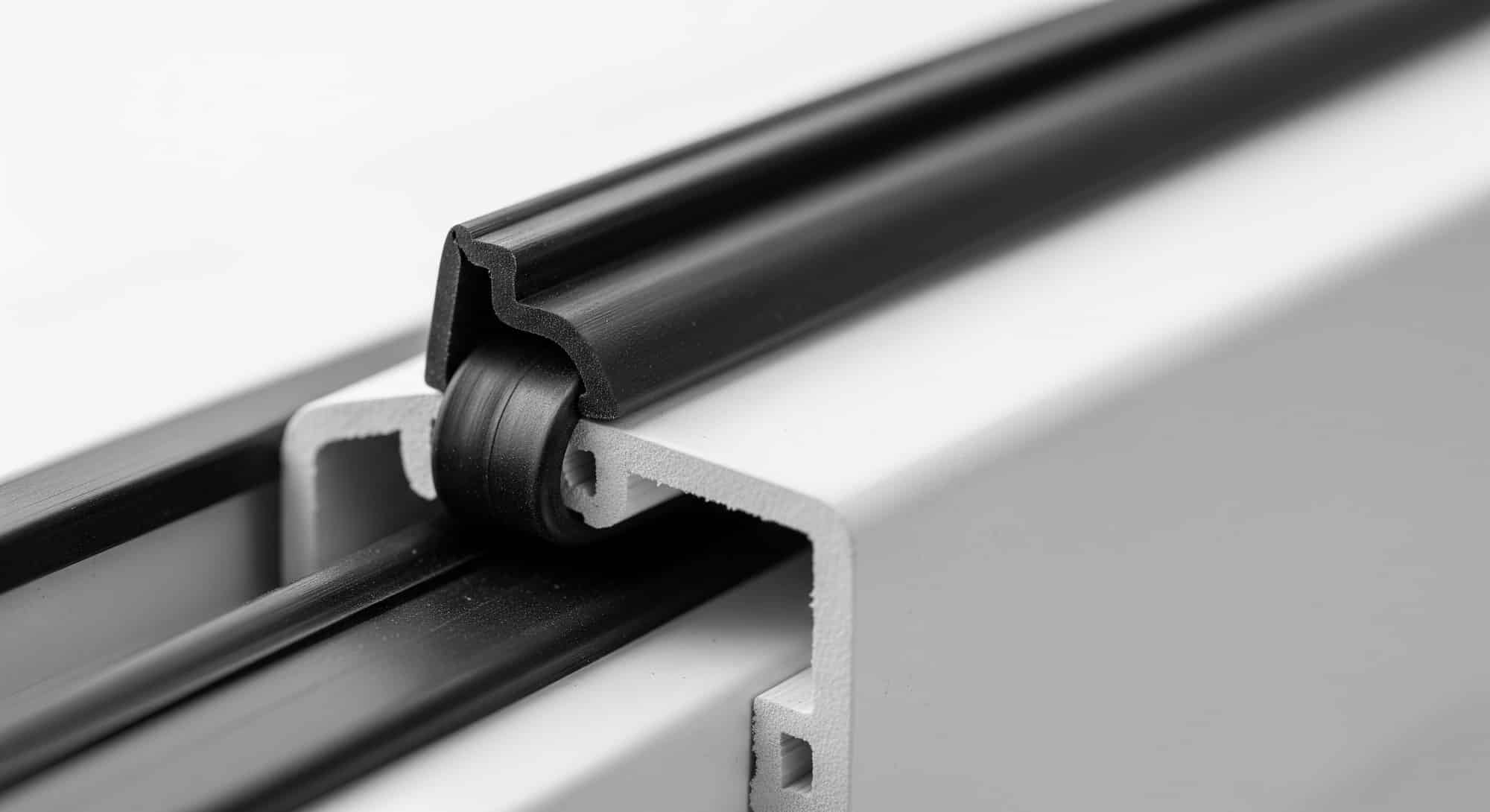
Heat loss through gaps in external doors and windows is one of the least visible and most persistent sources of energy waste in UK homes. The rubber compression seals fitted around door and window frames are designed to create an airtight barrier when the door is closed. They are also designed to degrade — rubber hardens, loses elasticity, and eventually stops forming a complete seal.
The failure is gradual. Over five to eight years, the seal becomes progressively less effective. The homeowner adapts by turning up the thermostat, adding a draught excluder to the hallway, or simply accepting that the house feels colder near the front door. The heating system works harder to compensate. Energy consumption rises. The boiler runs longer cycles. The energy bill increases.
A self-adhesive replacement seal costs under five pounds and fits in fifteen minutes. No tools beyond a pair of scissors. The immediate effect is a noticeably warmer hallway and a heating system that cycles less frequently. Over a full heating season, the cumulative energy saving is meaningful — and the carbon reduction that comes with burning less gas or drawing less electricity is real and measurable.
For a household looking to reduce its carbon footprint without major expenditure, replacing every perished door and window seal in the property is one of the highest-impact actions available. The total cost for a typical three-bedroom house is under twenty pounds. The payback period is measured in weeks, not years.

Quality Hardware Lasts Longer
Not all replacement components are equal, and this is where sustainability and quality intersect. A cheap door handle bought from a discount retailer may cost five pounds, but if the spring mechanism fails within two years, it will need replacing again — doubling the material consumption, the packaging waste, and the manufacturing energy over the same period.
A quality handle from a specialist manufacturer, built with a stronger spring cassette and a more durable finish, costs fifteen to twenty-five pounds but lasts eight to twelve years under normal use. Over a twenty-year period, the quality handle requires one or two replacements. The cheap handle requires five or six. The total cost is similar, but the environmental footprint of the quality option is less than half.
This principle extends to every piece of door and window hardware. A TS007 3-Star euro cylinder with hardened steel anti-snap protection will outlast a standard brass cylinder by years, because the materials are more resistant to wear, corrosion, and mechanical stress. Premium friction hinges with stainless steel sliding surfaces maintain their tension longer than budget alternatives with uncoated steel. A solid brass letterbox will still be functioning decades after a pressed-steel equivalent has corroded and failed.
Buying quality hardware is not just a financial decision — it is an environmental one. Every component that lasts longer is a component that does not need manufacturing, shipping, and disposing of again.
Window Hardware: Repair Before You Replace
The window replacement industry in the UK is enormous, and much of it is driven by hardware failures rather than glass or frame deterioration. A window that does not close properly, does not lock securely, or lets in draughts is often condemned as needing replacement when the actual problem is a five-pound hinge or a three-pound handle.
Friction hinges wear over time and allow the window sash to drop. This misaligns the locking points, prevents the seal from compressing evenly, and creates the impression that the window itself has failed. Replacing the hinges — a twenty-minute job with a screwdriver — restores the sash to its original position and solves all three problems simultaneously.
Espagnolette handles contain a spring mechanism that wears out, preventing the handle from engaging the locking cam properly. The window appears not to lock. A replacement handle restores full locking function without touching the window itself.
In both cases, the sustainable option is obvious: replace the component that has failed, not the entire window assembly. A uPVC window frame has an expected lifespan of thirty to forty years. The hardware fitted to it has a lifespan of eight to fifteen years. Replacing the hardware two or three times over the life of the frame is far more sustainable than replacing the frame because the hardware has worn out.
The Letterbox as Energy Leak
A letterbox with a failed spring sits permanently ajar — a rectangular opening in the middle of an otherwise insulated door. On a windy day, it functions as a vent, drawing warm air out of the hallway and pulling cold air in. On a calm day, the convective heat loss is slower but continuous.
Replacing a failed letterbox with a model that has a strong spring return, an internal brush seal, and a proper gasket around the frame transforms it from an energy liability into a sealed component. The cost is ten to twenty pounds. The fitting time is ten minutes. The draught reduction is immediately noticeable.
For homeowners who have already invested in wall insulation, loft insulation, and double glazing, the letterbox is often the last remaining weak point in the building envelope. Addressing it completes the thermal seal and ensures that the investment in larger insulation projects is not undermined by a simple component failure.
The Cumulative Effect
No single hardware replacement will transform a home’s environmental footprint. A door handle does not save the planet. A draught seal does not halt climate change. But sustainability is not about grand gestures — it is about consistent, intelligent choices that reduce waste incrementally across every aspect of daily life.
A homeowner who repairs hardware rather than replacing assemblies, who chooses quality components over disposable alternatives, who maintains seals and hinges before they fail catastrophically, and who resists the pressure to replace entire doors and windows when a simple component swap would suffice — that homeowner is making a measurable difference.
The numbers are straightforward. Replacing hardware instead of a single door saves approximately forty to sixty kilograms of uPVC and steel from entering the waste stream. Maintaining draught seals across a typical home saves hundreds of kilowatt-hours of heating energy per year. Choosing quality components that last twice as long halves the manufacturing and disposal burden over the lifetime of the property.
These are small changes that can be integrated into wider sustainable renovation projects. But they are real, they are immediate, and they are available to every homeowner regardless of budget. The most sustainable home improvement is almost always the smallest one.

