
The global relationship with sugar is undergoing a structural shift. Increasing obesity rates and a heightened focus on blood sugar management drive the demand for sugar alternatives that mimic familiar flavors without traditional metabolic costs. In a food environment dominated by ultra-processed foods and hidden sugars, rising global obesity estimates underscore the urgent necessity for more effective metabolic interventions.
Prioritizing stable energy levels allows individuals to avoid the metabolic fluctuations associated with traditional carbohydrates. Integrating natural sweeteners that behave differently in the body reduces the frequency of surprise glucose spikes found in products marketed as healthy. Evidence confirms that fats and sugars can amplify cravings. Consequently, practical strategies for taming a sweet tooth frequently anchor health discussions, alongside mint cues that can cut sugar cravings during peak late-day urges.

Metabolic Quick Facts: Allulose and Rare Sugars for Blood Sugar Management
- Definition: Allulose is a “rare sugar,” meaning it exists in nature in minute amounts. Significant advancements in industrial production methods explain why this rare sugar is now synthesized at scale for global consumption.
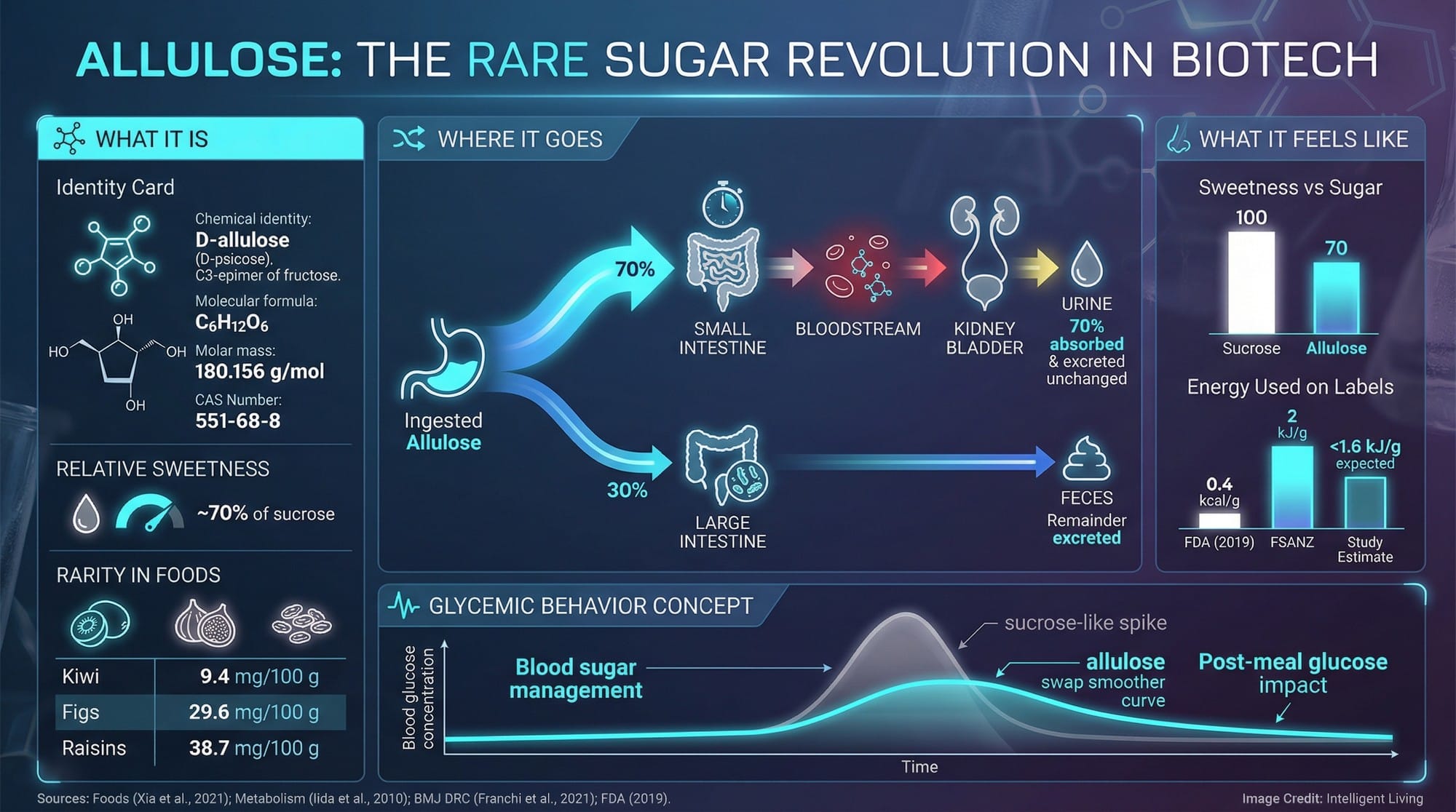
- Calories: In the U.S., the FDA’s 2019 update on how allulose is declared on Nutrition Facts labels explains why calorie and sugar lines may differ from consumer expectations.
- Human Signal: Short-term trials demonstrate reduced post-meal glucose exposure in specific clinical setups, such as studies utilizing allulose with a sucrose load. These outcomes remain contingent upon individual dosage levels and the broader dietary context.
- Practical Risk: Digestive tolerance varies. Higher intakes can trigger gastrointestinal symptoms. A controlled trial on D-allulose gastrointestinal tolerance underscores how formulation shapes comfort.
- Regulatory Status: The U.S., EU, and Australia/New Zealand describe allulose differently. Specific evaluations of international safety standards illustrate the diverging review criteria currently applied across global markets.
The Science of Allulose: Metabolic Origins and Glycemic Behavior
Understanding Rare Sugars and Natural Sweeteners
Biological classification of rare sugars includes naturally occurring carbohydrates that appear only in minute quantities within the standard food supply. While historically significant in chemical research, high isolation costs once rendered them impractical for commercial food production.
The turning point is manufacturing. Modern enzyme-based conversion methods allow producers to create rare sugars at scale. Detailed analysis of the metabolic behavior of rare sugars highlights significant physiological differences compared to conventional table sugar.
Innovative sugar alternatives offer significant culinary advantages when integrated into standard recipes:
- Partial sugar swaps preserve familiar textures while facilitating a more stable energy curve.
- Consistent browning and caramelization ensure that flavor profiles remain comparable to traditional table sugar.
- These results encourage further experimentation with modern sweetener formulations.
Metabolic Performance: Allulose Versus Low-Glycemic Sugar Alternatives
Industry experts frequently prioritize slow-digesting energy sources due to their ability to provide a consistent metabolic release.
Allulose maintains the functional properties of sugar in culinary applications without being metabolized as a primary fuel source. Current clinical data consistently highlights its role in reducing post-meal glucose exposure.
Biological Impact: Managing Postprandial Glucose With Allulose
Allulose mimics the sensory profile of table sugar while following a distinct metabolic pathway. Its primary benefit involves moderating post-meal glucose elevation, duration, and subsequent insulin requirements.
Clinical testing involves introducing allulose during carbohydrate challenges to monitor subsequent glucose response. Results from a crossover study in type 2 diabetes settings found that allulose added to an oral glucose tolerance test correlated with significantly lower postprandial glucose exposure.
Continuous glucose monitoring reveals that while typical sweeteners trigger rapid fluctuations, an allulose substitution frequently results in a gentler curve, mitigating the crashes described in diet and brain fog discussions.
Physiological Mechanisms of Reduced Post-Meal Glucose Spikes
In clinical terms, these changes are described as reductions in postprandial glucose “area under the curve” (AUC). AUC reflects the height and duration of the glucose rise after eating.
Some papers report “time above range” (TAR), which is the amount of time glucose stays above a chosen threshold. Concepts like a glucose-monitoring earring concept make this easier to visualize. Physiologically, a reduced and shorter glucose elevation is significantly less taxing on metabolic systems than a sharp, lingering peak.

Clinical Evidence: Human Study Support for Allulose Efficacy
While rare sugars show substantial efficacy in managing short-term glucose outcomes, the definitive metabolic impact on long-term weight management and disease progression requires further clinical validation. Variations in sugar quality, particularly regarding fructose load, significantly impact hepatic fat accumulation and related metabolic pathways.
Tier 1: Acute Trials for Immediate Blood Sugar Management
Isolating the immediate glycemic response allows acute trials to demonstrate a clear ‘brake pedal’ effect on blood sugar. In healthy populations, pooled reviews confirm smaller postprandial glucose rises after allulose doses.
Not all carbohydrates behave identically even when grams look similar. A practical explainer on how grains affect blood sugar and gut health illustrates this point.
Tier 2: Randomized Trials and Meta-Analyses of Rare Sugars
A 2024 meta-analysis confirms that targeted clinical trials demonstrate measurable improvements in post-meal glucose response, despite small sample sizes. Specific trials report neutral HbA1c and mixed cardiometabolic signals, indicating that acute glucose curves do not represent total metabolic health.
Clinical observations often show reduced morning glucose peaks following a sweetener swap. Long-term weight stability, however, remains dependent on aggregate diet patterns, sleep quality, and physical activity.
Tier 3: Biological Mechanisms and Appetite Hormones
Animal research suggests links to hormones that influence appetite. These signals are plausible routes rather than guaranteed human outcomes. Comprehensive reviews of ongoing metabolic research explore how complex microbiological questions continue to influence future clinical studies. Mechanistic data informs future trial design rather than establishing definitive clinical health claims.

FDA Labeling Requirements and Enzyme-Based Manufacturing
Interpreting Nutrition Facts for Sugar Alternatives
Regulatory labeling inconsistencies often obscure the varied metabolic processing of different carbohydrates. In the U.S., FDA allulose guidance explains how allulose is excluded from certain sugar declarations despite appearing in total carbohydrates.
In Europe, the nuance differs. A 2025 opinion concluded that EFSA could not establish safety for D-allulose because the application did not resolve data gaps. This is a procedural reality rather than a statement of inherent danger.
Regulators in Australia and New Zealand established structured approval pathways to evaluate these substances under rigorous safety controls.
Advancements in Enzyme-Based Manufacturing for Rare Sugars
Current industry analysis centers on the potential for allulose to serve as a high-capacity bulk sweetener. Reports from the ACS further highlight high-capacity manufacturing potential as production models move toward broader commercial application.
The ‘Izumoring’ framework and established enzymatic conversion models provided the conceptual foundation for developing these modern sugar alternatives.
South Korea has served as a proving ground for scaling. Reuters reporting on allulose expansion in South Korea captures how production capacity influences availability.
Implementation Strategies for Integrating Rare Sugars
Integrating allulose into a home diet requires incremental experimentation rather than immediate, broad substitution.
Managing Digestive Tolerance and Incremental Introduction
Managing digestive tolerance is critical when introducing new sweeteners.
- Research on gastrointestinal limits for D-allulose indicates that symptoms often correlate with higher dosages.
- Gradual introduction allows the metabolic system to adapt comfortably without triggering significant gastrointestinal distress.
Fermentation risks within the digestive tract guide the safe introduction of sugar alcohols and rare sugars. An overview of sugar alcohols as a bloating trigger sets realistic expectations for these substitutes.
Culinary Integration: Effective Sugar Alternative Blending
A realistic approach involves a blend strategy that replaces part of a recipe’s sugar. Partial swaps preserve taste and texture while lowering the overall sugar load.
Long-Term Strategies for Weight Management and Metabolic Health
WHO guidelines categorize non-sugar sweetener use as a limited strategy for weight control dependent on comprehensive nutritional integration.
Varied sweeteners interact with the digestive system uniquely, and researchers are increasingly examining the risks of gut microbiome disruption associated with long-term use. Evidence on artificial sweeteners and gut bacteria shows why mechanism matters.

Strategic Blood Sugar Management With Rare Sugars
Allulose and related rare sugars represent a significant advancement in the search for effective sugar alternatives. By reducing post-meal glucose exposure and preserving the culinary textures that make traditional sugar difficult to replace, these ingredients serve as practical interventions for modern metabolic health. While the regulatory landscape and individual digestive tolerance remain factors to monitor, the evidence points toward a growing role for these substances in a balanced, reduced-sugar lifestyle.
Integrating rare sugars into a comprehensive health strategy requires evaluating the broader biological landscape rather than focusing on a single ingredient. Modern scientific advancements, including recent pharmacological obesity treatments, demonstrate the rapid evolution of metabolic health strategies.
Essential FAQ: Rare Sugars and Allulose
1. Does allulose spike blood sugar levels?
Short-term clinical trials indicate that allulose is associated with lower postprandial glucose exposure, making it a reliable option for blood sugar management.
2. Is allulose safe for daily consumption?
Most individuals tolerate it well in moderation, though starting with small amounts is recommended to assess your specific digestive tolerance.
3. Why is allulose labeled differently in the U.S.?
FDA labeling requirements allow it to be excluded from ‘Total Sugars’ and ‘Added Sugars’ lines because it is not metabolized like traditional carbohydrates.
4. Can you use rare sugars for baking?
Yes, allulose is a highly effective sugar alternative for baking because it browns and caramelizes similarly to table sugar.
5. Is allulose approved for use in Europe?
Current EFSA data gaps have delayed approval in the EU, though it is widely available in the U.S., South Korea, and other major markets.


