
Decades after the cataclysmic 1980 eruption, a small, almost unbelievable field experiment on Mount St. Helens continues to redefine ecological resilience. In the early 1980s, scientists transported northern pocket gophers into fenced pumice plots for a mere 24 hours, testing if tiny ecosystem engineers could jump-start a stalled landscape. Researchers still detect differences in soil chemistry and root-fungal communities today, confirming that a brief biological nudge generates disproportionate benefits for the surrounding environment.
Volcanic succession depends on more than seed dispersal; it requires establishing functional infrastructure beneath the surface. Belowground life—comprising fungi, bacteria, and soil carbon—acts as the primary engine for regrowth, yet sterile mineral substrate often lacks these essential partners. By burrowing through the pumice, these gophers moved the living ingredients required to restart the nutrient cycle, essentially reconnecting the ‘network’ for struggling pioneer plants. A similar animal-led recovery is underway with bison as ecosystem engineers in Mexico, where hooves, dung, and grazing are reviving desert soil.
This brief pulse of activity shifted the entire trajectory of the Pumice Plain. While the surrounding terrain remained largely hostile, these experimental plots became microsites of thriving biodiversity. This strategy highlights a biology-first approach where the soil microbiome executes essential nutrient cycling, enabling the ecosystem to reconstruct from the mineral substrate upward.

Mount St. Helens Recovery Explained: The Eruption, the Soil, and the Stakes
Essential Insights into the One-Day Gopher Experiment Results
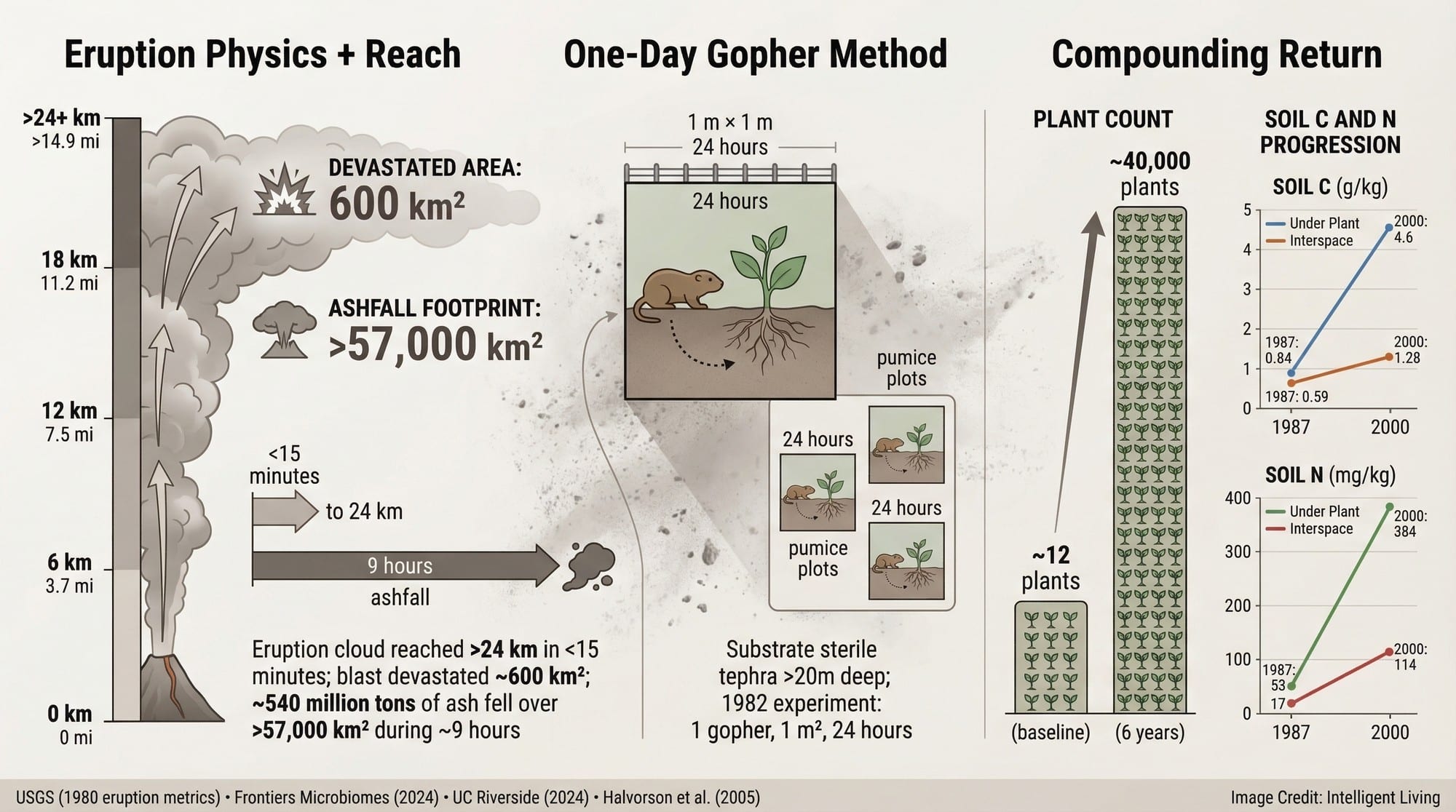
- The 1980 eruption left large areas of ash and pumice that were extremely low in organic matter and nutrients; the USGS records the ash cloud circled the Earth in about 15 days as high-altitude winds dispersed material globally.
- Researchers used fenced plots and short-term gopher releases to test whether burrowing animals could jump-start recovery by moving living soil and microbes.
- Follow-up observations reported far more plant establishment in gopher-visited plots than in nearby controls.
- Recent microbiome analysis confirms persistent differences in soil carbon, nitrogen, and fungal communities consistent with a persistent legacy effect.
Rebuilding the Soil Microbiome: The Real Battlefield of Volcanic Recovery
On May 18, 1980, Mount St. Helens erupted with an intensity that reconfigured forests, rivers, and habitats in an instant.
The most persistent ecological deficits occurred beneath the surface. The eruption covered landscapes in sterile ash and pumice that struggle to hold water, resist erosion, and support the microbial communities plants normally depend on. USGS eruption statistics illustrate how fallout spread over more than 22,000 square miles, leaving fresh mineral deposits that started out hostile to plant life.
Downwind residents still recall the sudden twilight and gritty taste of ash that showed up in window tracks and car vents for weeks. Sensory memories highlight why recovery required more than waiting for seeds to land, especially when USGS estimates that about 540 million tons of ash fell during the main cataclysm.
Stripped mineral substrates present dual obstacles for plant establishment. Plants face two primary subterranean obstacles:
- Roots struggle to anchor and locate moisture in porous mineral deposits.
- Supportive microbes that facilitate nutrient uptake are largely absent.
Focusing on these soil conditions is more critical for recovery than monitoring the visible skyline.
How the Gopher Experiment Worked: Myth, Method, and One-Day Results
The “Dropped Gophers” Headline is Not Literal, but the Experiment Was
The phrase “dropped gophers on a volcano” makes for a punchy headline, but it is not what happened. Scientists did not toss animals into lava. They transported northern pocket gophers by helicopter to small, fenced plots on pumice terrain, allowed them to dig and forage for about a day, and then removed them. The phrase resurfaced in coverage of the Mount St. Helens gopher experiment, but the underlying work was controlled field ecology.
Scientific precision validates that the experiment’s value lies in biological mechanism, not sensational headlines. Researchers investigated whether an animal’s standard behaviors could relocate the microbial partners necessary for plant establishment. These behaviors included:
- Excavating deep burrows.
- Mixing surface debris with volcanic ash.
- Transporting organic scraps and spores.
Measuring the One-Day Gopher Impact on the Pumice Plain
Pocket gophers spent roughly 24 hours excavating burrows and shifting soil. This rapid physical intervention created microsites—stable pockets where moisture and organic matter could accumulate without being dispersed by wind. Microsites and arbuscular mycorrhizae can change survival odds for pioneer plants in harsh, early-succession ground.
Initial pioneers arrived as scattered clumps, like a lupine here or a hardy seedling there. These patches gradually expanded until the landscape looked, from a distance, as though it had learned to breathe again.
UC Riverside fieldwork summaries reveal a striking contrast years later: gopher-visited plots supported far more plants than nearby areas that did not receive the same short-term animal disturbance. It is an early illustration of the “small intervention, massive return” pattern. The input was brief, but the effects compounded over time.
Documenting Long-Term Successional Patterns and Plant Establishment
- In the years after the intervention, gopher-visited plots were associated with much denser plant establishment than adjacent control areas.
- The sites retained measurable differences in soil condition and belowground biology that researchers can still detect decades later.

The Soil Microbiome Legacy: Fungal Networks and Nutrient Cycling
The Underground Supply Chain: Fungi, Bacteria, and a Shortcut Back to Function
Diverse pioneer species rely on mycorrhizal fungi, which are root-associated organisms that extend the effective reach of a plant’s root system and help it access water and nutrients in exchange for carbon. That relationship acts as an overlooked driver of resilience because those networks help stabilize growth under stress.
Gophers functioned as vectors for the biological components of the subterranean network. Burrowing and soil transport can mix fungal spores, fragments of fungal threads, and microbe-rich material from places where partners persisted. [suspicious link removed], a cornerstone of animal-assisted inoculation theory.
For everyday readers, the practical image is straightforward. A seed dropped into sterile pumice is like a phone with no signal. If digging and mixing brings in a tiny pocket of living soil, the seedling can connect to the “network.” This connectivity enables survival during drought periods and facilitates permanent establishment.
Soil biodiversity is essential for ecosystem health because it maintains nutrient cycling and stabilizes subterranean structure. These organisms buffer ecosystems against shocks and provide the foundation for long-term health.
What the New Study Says the Soil Still Remembers
Evidence from a 2024 volcanic soil microbiome analysis indicates persistent differences driven by historic gopher activity, including shifts in carbon-to-nitrogen dynamics and root-associated fungal groups.
Rather than a single event restoring the landscape, early shifts in belowground communities established vital path dependence. Once a patch supports more microbial activity and better nutrient cycling, it becomes easier for plants to establish, which adds more organic inputs, which further improves the soil. A small nudge can become a self-reinforcing loop.
Optimizing Soil Fertility: Why Carbon and Nitrogen Ratios Matter
Soil carbon and nitrogen are the foundation of fertility and microbial activity. The soil carbon-to-nitrogen ratio is a quick way to describe how those two elements balance in organic matter. On newly deposited pumice, both building blocks are often scarce, leaving plants hungry and microbes underpowered.
Data connects these findings to a broader principle: the intersection of mineral chemistry and biology dictates long-term carbon storage. This includes mechanisms such as iron minerals binding carbon in soil that can slow decomposition. In practice, recovering landscapes require both living partners and physical conditions that allow organic matter to persist.

Biology-First Restoration Strategies: Lessons From a Living Laboratory
Scaling the Living Laboratory: Applying Volcanic Lessons to Global Restoration
Succession researchers utilize Mount St. Helens as a primary natural experiment. Researchers track how plants return, how animals recolonize, and how soils rebuild function over time.
In that broader frame, the gopher intervention is a revealing chapter rather than an isolated miracle. Natural recolonization also played a role, including the later arrival and spread of gophers across parts of the Pumice Plain.
Succession patterns tracked by USGS show how survivors, pioneer plants, and belowground organisms shaped that patchwork rebound. In the experiment, gophers were moved from Butte Camp to the Pumice Plain before being released into fenced plots for a short window.
Long-term monitoring reveals the monument functions as a longitudinal observatory, where ecological data emerges across decades. That slow timeline is exactly why the case is useful in a warming world, because restoration after fires, floods, and industrial damage often unfolds on decades-long clocks.
USFS long-term recovery plots show how plants and animals recolonize as soils rebuild. The pattern echoes spontaneous rewilding and ecosystem succession, where regrowth can be rapid in some places and fragile in others.
The Practical Takeaway: Restoration That Starts With Biology, Not Just Plants
Mount St. Helens provides scalable principles rather than rigid, universal formulas. Restoration works best when it treats soil as a living system and measures whether that system is becoming functional.
Principles for Biology-First Restoration
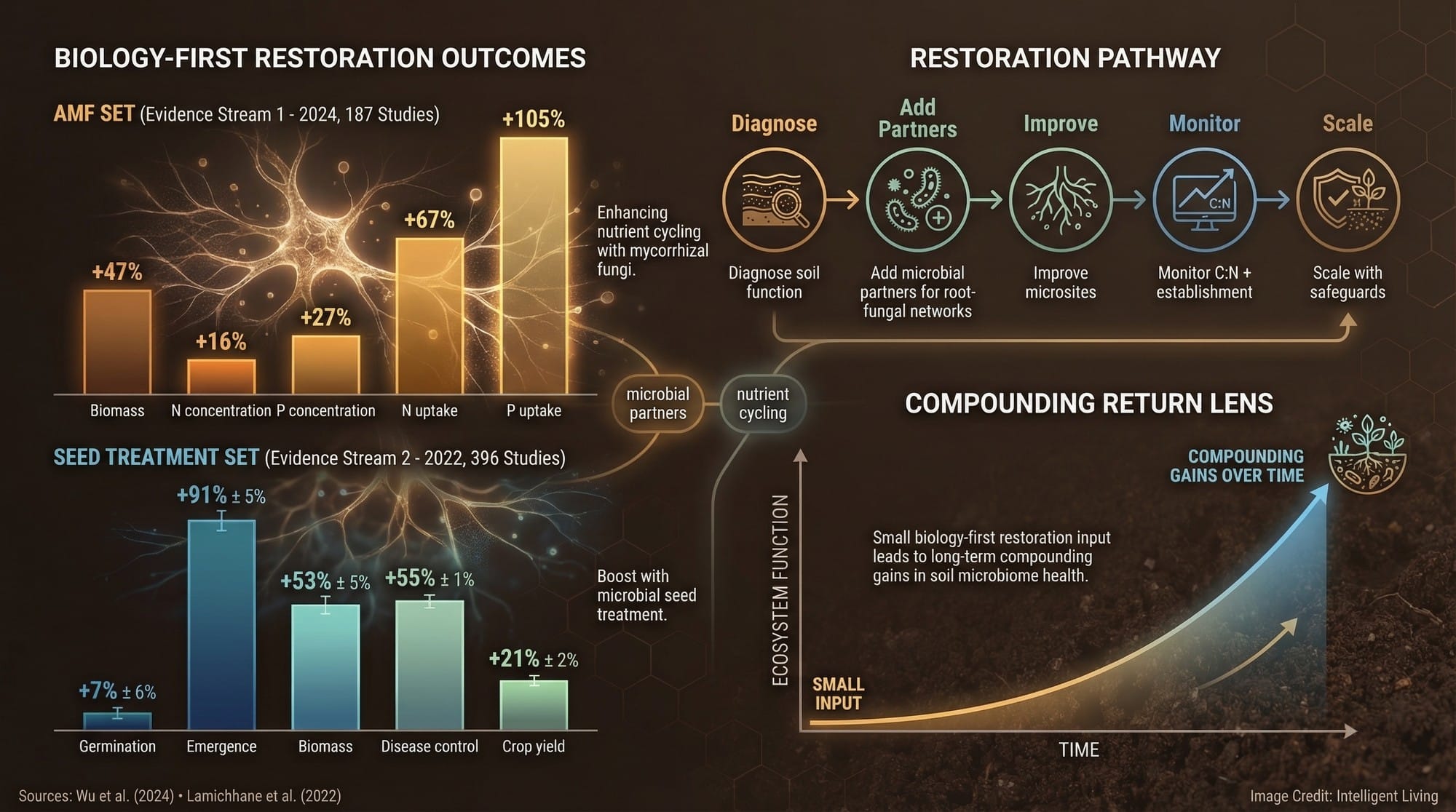
- Seed the Partners, Not Just the Plants: Introduce plants into microbe-deficient sites, and restoration projects will likely fail. Pairing seeds coated in microbes is one technique designed to introduce beneficial organisms immediately upon planting.
- Create Microsites that Favor Establishment: Small pockets of improved soil function can act as stepping stones that later spread across a site. In plain terms, a tiny patch that stays moist and microbe-rich can become the source for broader colonization.
- Track Soil Function, Not Only Plant Counts: Carbon, nitrogen, water retention, and microbial community structure often reveal whether recovery is stabilizing. Effective soil carbon drawdown strategies show how improving soil condition can stack multiple benefits, including resilience to drought and better nutrient cycling.
- Scale with Care and Governance: What works in a fenced experiment needs ethical oversight and site-specific planning at a real-world scale.
- Large programs combine peatland rewetting, native tree corridors, and long-term monitoring.
- Peatland restoration linked to forest recovery illustrates how logistics shape ecological outcomes.
- At broader scales, forest restoration remains an economically efficient climate strategy when projects prioritize biodiversity and long-term stewardship.
- Maintain Realistic Impact Assessments: While ‘small intervention, massive return’ offers a compelling framework, success remains contingent on rigorous measurement. The lesson is to design interventions that can compound, then measure whether compounding is actually happening, including impacts on biodiversity, soil chemistry, and long-term stability.
In many restoration sites, a thin layer of organic amendment or a strategically placed windbreak is the deciding factor. These small changes help seedlings survive long enough to establish their own microclimate rather than desiccating in the open sun.

Harnessing Biological Momentum for Long-Term Ecosystem Stability
The gopher experiment demonstrates that ecosystems typically reconstruct from the mineral substrate upward. A short, carefully designed disturbance can relocate the living partners plants need, fundamentally altering how nutrients cycle and shifting a landscape onto a more recoverable path. The durable legacy found in modern soil chemistry and fungal communities confirms that early interventions in the microbiome create self-reinforcing loops of fertility and growth.
Facing intensifying wildfires and prolonged droughts, ecologists now prioritize intervention impact over sheer scale. Identifying the smallest biological nudge that triggers long-term recovery is an accountable strategy for restoration. Biodiversity net gain metrics turn restoration into a verifiable and accountable strategy. This accountability sharpens when environmental economic accounting treats ecosystems as assets with measurable recovery patterns.
Answers to Common Questions on Gophers and Volcanic Recovery
Did Scientists Drop Gophers From Helicopters on Mount St. Helens?
No, the animals were transported via helicopter in containers to specific, fenced research plots. This was a controlled ecological experiment designed to measure how burrowing affects sterile volcanic pumice, not a random release.
How Do Burrowing Animals Actually Improve Sterile Soil?
Burrowing mixes subterranean mineral substrate with organic surface debris and microbial inoculum. These actions create moisture-rich microsites that help pioneer plants connect with essential fungal networks for better nutrient uptake.
Why Do Decades-Old Effects Still Show Up in the Soil?
Early biological activity creates a self-reinforcing loop where improved nutrient cycling supports more plant life, which in turn adds more organic carbon to the soil. This compounding effect stabilizes the microbiome long after the initial disturbance.
What Role Does the Soil Carbon-to-Nitrogen Ratio Play in Recovery?
This ratio measures the balance of essential nutrients required for microbial life. Gophers helped bridge the gap in nutrient-poor ash by moving nitrogen-fixing materials and microbes into the pumice, balancing the soil chemistry for future growth.
Can These Biological Methods Be Used in Modern Restoration Projects?
The principle of ‘biology-first’ restoration—pairing seedlings with beneficial microbes—is already being applied to sites damaged by fire or industry. Restorationists use mycoremediation and other biological methods to scale these lessons safely.


