
Biodiversity Net Gain (BNG) operates as a sophisticated planning framework requiring UK developments to deliver a measurable 10% increase in natural value by employing the statutory biodiversity metric to translate complex habitat variables into quantifiable units. Statutory requirements ensure that nature recovery is maintained for a minimum of 30 years and establishes a transparent template for long-term habitat connectivity within the broader planning system.
Current policy shifts are testing this framework as it scales from neighbourhood improvements to national infrastructure. Recent Planning Reform statements in Parliament explore potential exemptions for smaller sites, even as Defra prepares to extend BNG requirements to nationally significant infrastructure projects. Professional standards make ‘NSIP biodiversity net gain’ a critical focus for developers navigating real-world planning permissions.
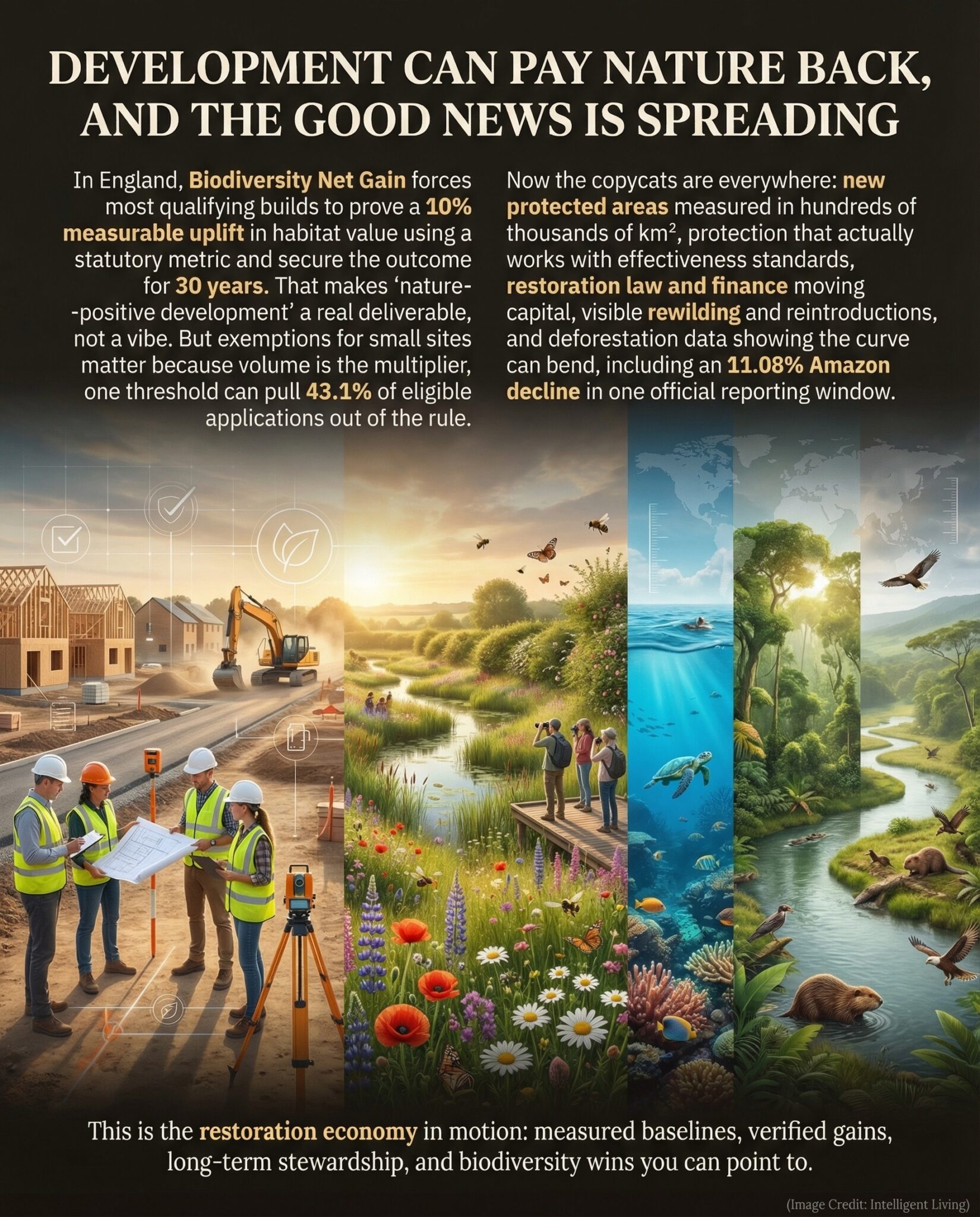
Statutory Framework Overview: Essential UK BNG Requirements
- Metric calculations utilise the statutory biodiversity metric to incorporate a simplified route tailored for qualifying small-scale developments.
- Pre-commencement conditions ensure development cannot proceed until the local authority approves a formal Biodiversity Gain Plan detailing the 10% delivery strategy.
- Legally secured land management and registration through the biodiversity gain site process facilitate off-site units when gains cannot be fully delivered on-site.
- Compliance pathways allow for government-run statutory biodiversity credits as a last-resort option to support habitat creation.
- Policy refinements are being assessed through the consultation on improving BNG implementation for minor, medium, and brownfield development, including how rules affect smaller projects.

Strategic Ecological Impact: The Role of Small Sites and Nature Dividends
The primary efficacy of BNG lies in the cumulative mathematics of diverse perceptions, where thousands of small-scale improvements define the urban landscape and determine where residents find shade and birdsong on ordinary streets. Small-scale plots, despite their perceived insignificance on mapping interfaces, significantly mitigate habitat fragmentation by facilitating connectivity through replicated improvements across diverse perceptions.
Small-scale developments influence regional biodiversity through three primary mechanisms:
- Application Volume: Small sites dominate the total count of planning applications, meaning high-threshold exemptions can exclude nearly 43% of eligible projects. Cumulative statistical data highlights the mismatch between volume and footprint in recent planning application data.
- Economic Spillover: Consistent demand supports a ‘nature dividend’ and a restoration supply chain of field surveys, habitat delivery, and stewardship contracts in eftec’s first-year BNG market assessment.
- Neighbourhood Access: Urban habitat enhancements facilitate daily nature access, establishing viable living corridors through pocket parks and the strategic implementation of Miyawaki-style mini forests.
Access to nature at a neighbourhood scale is often noticed in mundane ways, such as bee-friendly bus stop roofs that double as tiny habitat patches or the return of songbirds to a previously decorative green patch.
Defining the Nature Dividend: Economic and Ecological Yields from Restoration
The nature dividend represents the combined return from restoration exceeding simple biodiversity units. Ecological restoration yields include contracted habitat creation jobs and land-management income for farmers alongside practical co-benefits like reduced urban runoff and healthier local ecosystems.
BNG turns biodiversity improvements into a deliverable with governance and time horizons, integrating habitats as vital living infrastructure alongside national-scale peat and forest restoration efforts. Passive restoration strategies align with evidence that significant biodiversity gains are achieved through natural regeneration, allowing ecosystems to regrow under optimal conditions.
Step-by-step hierarchies prioritise on-site action before moving outward, making the “nature dividend” tangible through off-site biodiversity gains across the compliance chain.

The BNG Blueprint: International Adoptions and Global Biodiversity Standards
The BNG blueprint is straightforward: measure the baseline, require a percentage uplift, and secure outcomes long enough that nature has time to recover and stabilise. Operational implementation across England demonstrates a functional model for registered gain sites and established compliance pathways.
International jurisdictions are currently adopting comparable frameworks through biodiversity credits and nature finance pilots to ensure measurable ecological uplift. Biodiversity thinking is also showing up in procurement and product design through systems that reduce extraction pressure, including circular economy trends tied to biodiversity outcomes.
Large-Scale Habitat Security through New Protected Areas
Global administrations are expanding protected zones to secure habitat integrity, implementing stringent limits on extractive pressures across French Polynesia’s marine territories. Greece announced two Marine National Parks and a bottom-trawling ban in the Ionian and South Aegean. In the North Atlantic, the Azores established one of Europe’s largest MPA networks. Uruguay added Isla e Islote de Lobos to its protected areas system as an oceanic national park.
Large protected zones highlight the extensive volume of undocumented biodiversity, ranging from newly documented coral reef structures to deep-sea Antarctic coral gardens, which is why permanence and monitoring are not optional details.
Effectiveness and Governance in High-Quality Nature Protection
Conservation is increasingly shifting from “how much area is protected?” to “how well is it protected?” California’s network of marine protected areas was accepted to the IUCN Green List as an international gold standard. The Marine Conservation Institute also spotlights MPAs that meet rigorous effectiveness standards through the Blue Park Awards.
Strategic conservation principles are increasingly integrated into habitat-positive engineering and advanced monitoring systems that rely on satellite and drone technology to track ocean conditions. Governance and design choices determine whether nature is nearby and if the ecosystem actually supports long-term habitat growth.
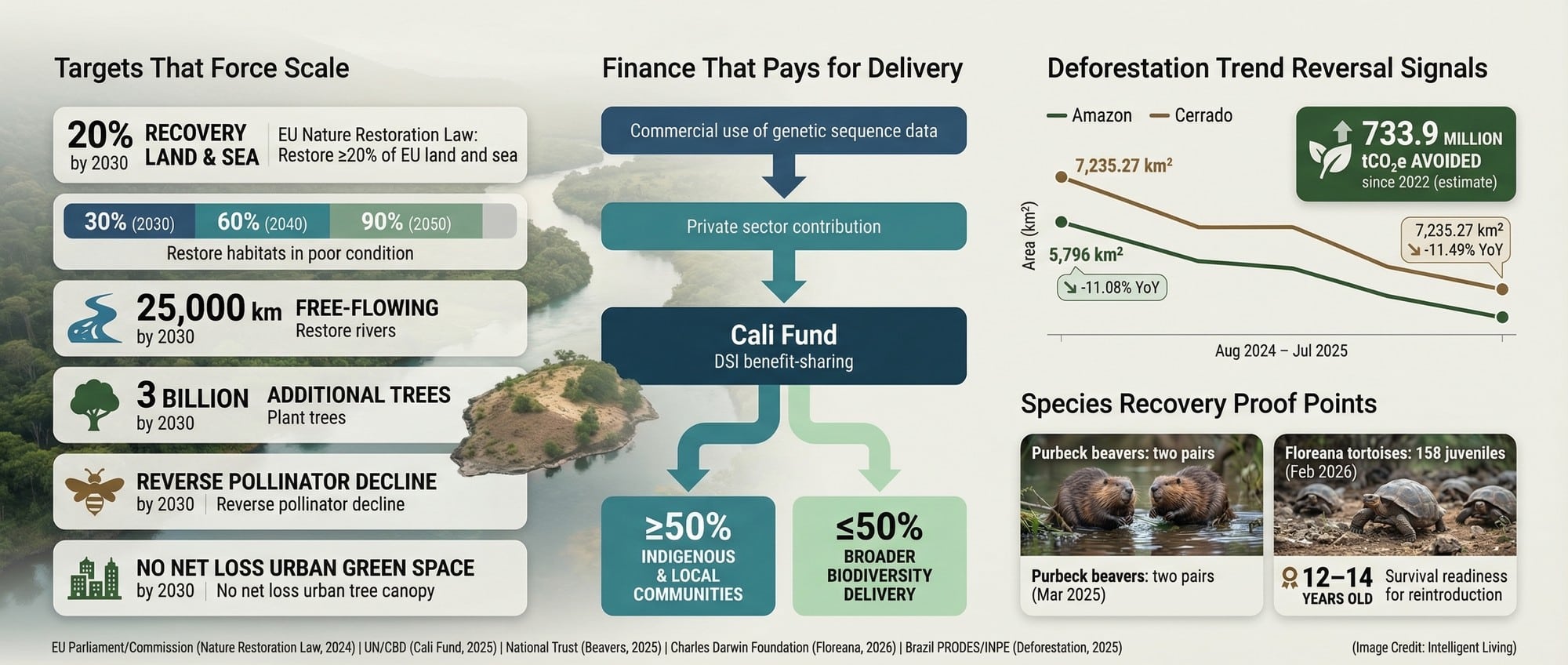
Restoration Law and Finance: Mechanisms for Large-Scale Capital Mobilisation
Nature recovery is increasingly being embedded into law and finance, not just projects. The European Union adopted a regulation aiming to restore at least 20% of EU land and sea by 2030. Globally, the Cali Fund launched as a mechanism to mobilise biodiversity funding tied to commercial use of genetic sequence information, with a major share intended to support Indigenous peoples.
Regulatory mandates and dedicated finance facilitate predictable demand for restoration work, which stabilises the monitoring systems required to verify outcomes.
Species Comebacks: Tangible Evidence of Ecosystem Restoration
Species recoveries are among the most visible outcomes of long-term habitat work. In England, the first licensed wild beaver release was framed as a milestone for nature recovery. In the Galápagos, endangered tortoises were released onto Floreana Island after more than 180 years.
Comeback stories demonstrate that restoration rebuilds functioning ecosystems rather than providing superficial aesthetic improvements. Keystone species like beavers and giant tortoises reshape habitat structure through water management, seed dispersal, and complex vegetation dynamics.
Beaver-engineered wetlands serve as a primary mechanism for improving water quality and mitigating flood peaks. Disturbed landscapes frequently demonstrate autonomous rewilding dynamics when appropriate hydrology is restored, providing a blueprint for natural ecosystem recovery.
Deforestation Trends: Measurable Reductions and Evidence of Trend Reversal
Technical recovery signals increasingly include the following:
- Satellite Monitoring: Annual deforestation rates reveal significant reductions in the Amazon through rigorous enforcement.
- Autonomous Restoration: Reforestation drones facilitate large-scale seed dispersal in remote areas.
- Infrastructure Resilience: Eco-friendly construction fixes prioritise refurbishment over demolition-first strategies to preserve existing ecological value.
Deforestation reductions demonstrate that monitoring, enforcement, and political will can bend large-scale trends, reinforcing why measurement and accountability remain the core of the BNG model.

Systemic Risks and Implementation Challenges: Ensuring Model Integrity
Successful framework execution relies upon comprehensive coverage, verifiable measurement, and durable legal security to ensure ecological reality matches reported gains.
Systemic risks include exemption creep, which threatens to hollow out demand before the market matures, and ambiguous evidence standards that may inadvertently facilitate misuse. The de minimis exemption is intended to keep the system proportionate for very small impacts, and it sits alongside specific exemption categories used in planning decisions.
Market analytics indicate that frequent exemption claims may dampen habitat investment, with recent market analysis highlighting misinterpretations of de minimis thresholds.
Compliance and Efficacy: Strategic Enhancements for Robust Habitat Recovery
The goal is not to make BNG heavier. It is to make it harder to game and easier to deliver well.
- Evidence-light, verification-heavy validation can stop weak exemptions: Requiring clear justification and habitat traceability evidence for exemption claims aligns with modern supply-chain verification standards.
- Robust local planning authority capacity is a fundamental requirement for system success: Implementation constraints and training needs are currently monitored through local planning authority guidance.
- Market transparency builds trust: Gain-site information and allocation records reduce double counting and improve auditability through the gain-site register.

The Future of Habitat Stewardship and Nature Recovery
Biodiversity Net Gain represents a fundamental shift in how the built environment interacts with the natural world, transforming ‘nature-positive development’ into a deliverable mandate. The efficacy of this model relies on the ability to support a robust restoration supply chain, where off-site biodiversity gains and long-term stewardship contracts create a predictable ‘nature dividend’ for local communities.
Success depends on how the industry navigates upcoming milestones, including the proposed May 2026 rollout for major infrastructure. As compatible systems for nature finance and nature credits gain international traction, the BNG framework serves as a proven blueprint for ensuring that development and ecological resilience can thrive in tandem.
Biodiversity Net Gain and Statutory Requirements
Defining Biodiversity Net Gain in Plain Language
It is a legal requirement ensuring that new developments measurably improve a site’s natural value by at least 10%.
Defining the Biodiversity Unit
A biodiversity unit is a proxy value generated by the statutory biodiversity metric based on habitat size, condition, and type.
Operational Timeline for BNG Habitat Improvements
All gains must be legally secured and managed for a minimum of 30 years to ensure lasting nature recovery.
Evaluating the Impact of Small-Site Exemptions
Threshold changes could remove thousands of projects from the system, potentially reducing the overall demand for biodiversity gain sites and local stewardship.
The Role of Statutory Biodiversity Credits
Statutory biodiversity credits provide a last-resort compliance option to fund habitat creation when on-site or off-site delivery is impossible.


