
Establishing a defensible regional program for pickup, reconditioning, and secure destruction converts logistical challenges into predictable operational assets. For facilities in the Mid-Atlantic region, search queries for “drum recycling near me” often connect them with providers offering comprehensive industrial container services. Companies like Kelly Drums manage drum, IBC tote, and bulk box pickup, recycling, reconditioning, and destruction for industrial container streams, allowing EHS teams to focus on safer handling routines and cleaner audit trails rather than palletized clutter.
Modern hazardous waste management standards function as the invisible infrastructure of a high-functioning plant, securing long-term operational stability. When these systems are properly tuned, the friction of staging-area bottlenecks and inspection surprises simply evaporates. Beyond mere compliance, modern industrial container management is shifting toward a circular economy model. This transition ensures that every drum or IBC—whether it’s routed for reconditioning or responsibly recycled—contributes to a sustainable lifecycle. Clearer proof that materials were handled correctly doesn’t just satisfy an auditor; it reinforces the integrity of the entire production flow.
Industrial Drum and IBC Recycling Essentials: Circular Economy and Compliance Standards
Core Definitions: Understanding RCRA-Empty, Reconditioned, and Documented States
- RCRA-Empty: Defining RCRA-Empty status relies on the federal empty container standard in 40 CFR 261.7. This regulation sets strict conditions for identifying when a container—especially one holding acute hazardous waste—is legally considered empty.
- Reconditioned: A Reconditioned container has undergone a rigorous cycle of inspection, cleaning, and testing. Adhering to the RIPA code of operating practice ensures that only truly safe, certified packaging returns to the supply chain.
- Documented: Being Documented means having a defensible paper trail of destruction certificates and pickup manifests. In practice, verifiable industrial compliance partnerships are what distinguish a routine program from an audit liability.
Circular Economy Models: Prioritizing Reuse and Recycling for Industrial Totes
Asset Management: Sustainable Reuse Cycles for Industrial Containers
Treating industrial containers as assets instead of waste shifts your facility’s sustainability profile. This approach, rooted in sustainable materials management basics, tracks the full lifecycle of every steel or poly drum. Aligning with the EPA’s standard waste management hierarchy that prioritizes source reduction and reuse ahead of recycling supports a reuse-first approach when containers can be made safe and compliant.
Environmental Impact: Maximizing Returns through Drum Reconditioning
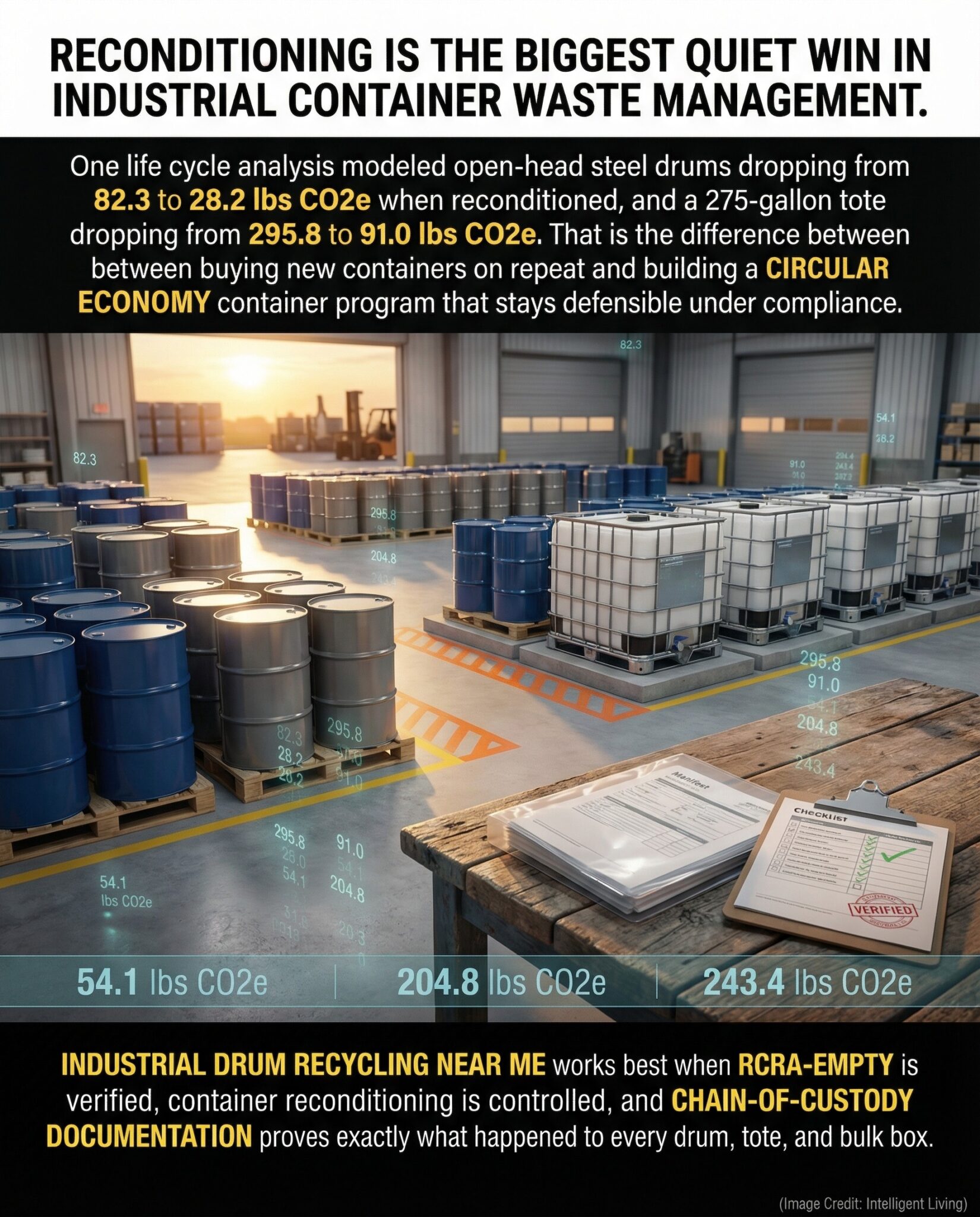
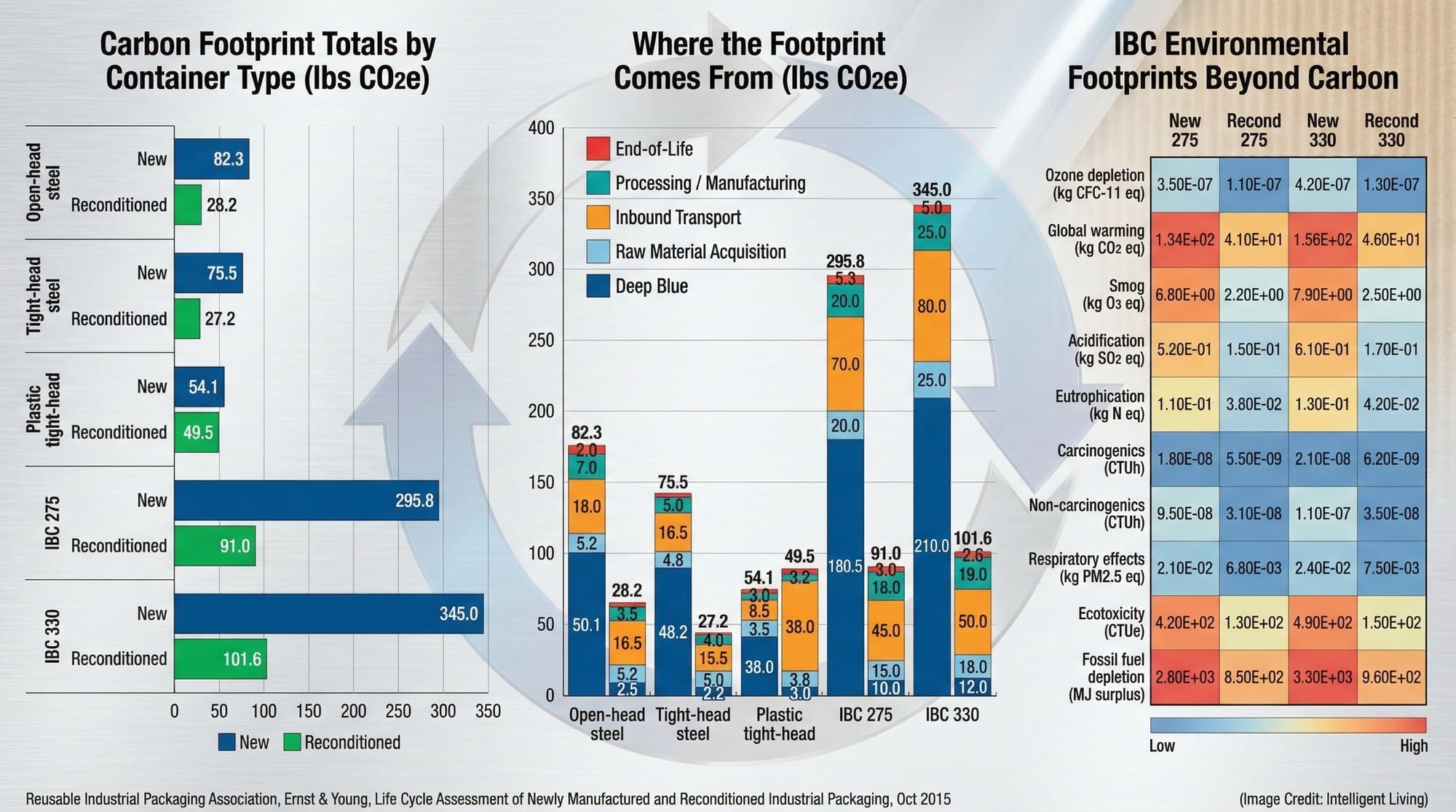
For drums and certain IBCs, reconditioning can be the highest-leverage step, including industrial drum reconditioning that returns containers to safe reuse, because it preserves a container’s embodied materials and manufacturing footprint. A life cycle analysis comparing reconditioned steel drums with newly manufactured drums supports the general direction that reuse can reduce life cycle impacts, with results that vary by assumptions like transport distances and cleaning intensity.
Recovery Limits: Determining when Recycling Replaces Reconditioning
Reconditioning is not always the appropriate pathway. Containers typically move toward recycling or destruction if they exhibit any of the following:
- Unknown or incompatible residues that prevent safe cleaning.
- Compromised structural integrity, such as heavy corrosion or deep dents.
- Specific regulatory constraints that mandate one-time use or destruction.
One operations manager described a quiet win that never made the slide deck. Their drum return and reconditioning routine for a nonhazardous solvent stream reduced new container purchases, stabilized pickup scheduling, and turned quarterly reporting into a predictable checklist.
Innovation in Recovery: Contamination Control and New Sorting Tech
Circular economy systems increasingly emphasize reducing toxic leakage and limiting virgin extraction. Implementing strategies for preventing toxic leakage through circular economy biodiversity trends focuses on these core environmental protections. Even where reuse is not possible, better sorting and lower contamination can improve recovery outcomes, including the sensor-driven routing behind IoT-powered smart recycling bins and robots and the factory-scale gains discussed in robotic sorting systems that push plastic recycling to the next level, especially as recycling innovations that broaden what can be recovered keep expanding material pathways.
Secure Container Disposal and Logistics: Drum Destruction and Pickup Continuity
Risk Management: Strategic Container Destruction and Final Disposition
Safety Protocols: Identifying Scenarios for Secure Container Destruction
Destruction is a legitimate and sometimes necessary endpoint in industrial waste management. While implementing environmentally sound waste management solutions remains the priority, secure destruction becomes essential for containers with unknown residues or proprietary formulations that must be permanently removed from circulation. Secure destruction renders a container physically unusable and is paired with documentation that supports chain-of-custody discipline.
Compliance Proof: Documenting Final Disposition and Destruction
In practice, tote and drum destruction workflows that document container disposition typically include controlled handling of residuals and certificates that confirm the container was rendered unusable.
Operational Risks: Managing Mislabeled Totes and Residue Confusion
A minimal real-world moment many EHS teams recognize: a single mislabeled tote can turn a routine pickup into a day of calls, quarantined storage, and rework. In those situations, destruction is less about optics and more about reducing operational risk.
Streamlining Plant Operations: Logistics for Reliable Container Pickup
Staging Discipline: Segregation and Workplace Safety Controls
Streamlining your container disposal starts with consistent on-site discipline. A reliable pickup program reduces internal handling, staffing burden, and the risk of cross-contamination in staging areas. Adhering to workplace environmental safety protocols ensures that on-site practices reduce staging-area friction:
- Segregate empty and non-empty containers to prevent pickup rejections and logistical delays.
- Label last contents clearly to facilitate accurate reconditioning and residue management.
- Store drums and IBCs in a covered area to avoid water intrusion and weather-driven contamination.
Implementing these small steps ensures that your pickup windows remain efficient and your staff stays protected.
Operational Timing: Scheduling Pickups to Align With Production Surges
Vendors should offer predictable pickup windows, manifesting, and recurring programs. When drums accumulate faster than expected during a production surge, IBC tote and drum pickup services that accept containers meeting RCRA-empty requirements can clear space without improvising storage.
Procedural Excellence: Using SOPs to Ensure RCRA-Empty Readiness
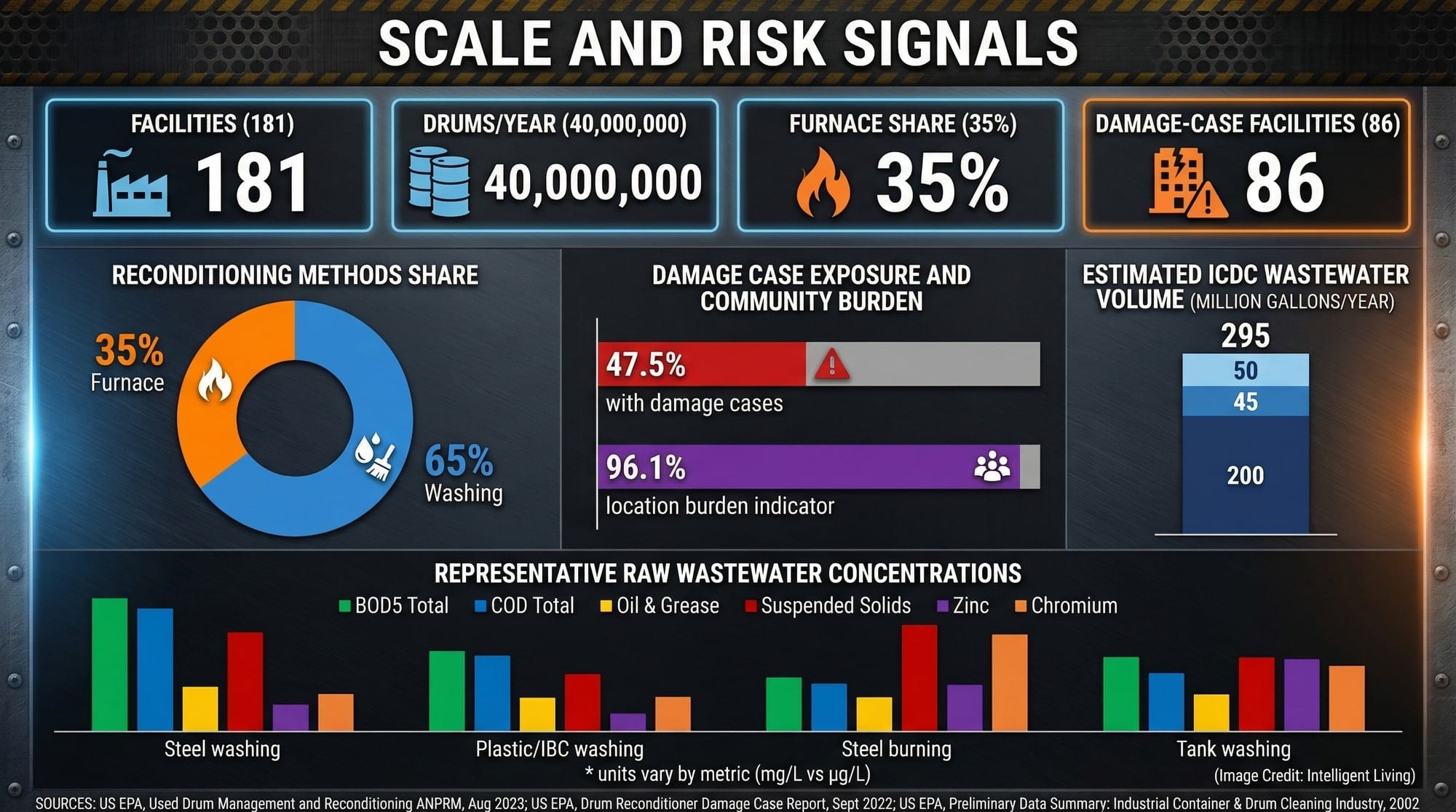
The 2023 EPA ANPRM on used drum management highlights generator-side standard operating procedures to ensure drums are RCRA-empty before shipping offsite for reconditioning, and EPA’s advance notice on used drum management and reconditioning underscores that non-empty containers still reach reconditioners in the real world. Establishing a short SOP ensures the best pickup program is the one the team can follow without debate.
Reporting Efficiency: Using Data Trails for Faster Compliance Metrics
Documentation moves faster when data trails are structured, not improvised. Utilizing real-time IoT and 5G tracking that turns logistics into measurable emissions and compliance metrics simplifies the process. Even small steps like consistent manifests and photos at pickup reduce disputes and speed reporting.

Industrial Container Regulatory Compliance: RCRA-Empty Mandates and IBC Inspections
Navigating RCRA-Empty Rules: Federal Thresholds for Industrial Containers
Audit Defensibility: The Significance of the RCRA-Empty Threshold
Regulatory definitions determine what vendors can accept from your site and what your facility can defend during an audit. This “empty” regulatory threshold is tied to how waste was removed and what residue remains, which is why the EPA assembled a resource compendium on the empty container provisions.
Rinsing Protocols: EPA Guidance for Acute and Non-Acute Waste
EPA’s used drum management and reconditioning guidance connects the empty container provision to real-world handling, including why conditions differ for non-acute versus acute hazardous waste and why the removal method matters. For acute hazardous waste containers, triple rinsing or an equivalent method can be required, and the EPA’s container management training module notes that regulations reference triple rinsing without defining one universal method that fits every residue and solvent pairing.
Regional Nuance: State Hazardous Waste Counting and Checklists
Operationally, treating “empty” as a checklist item reduces pickup rejections. Individual states often implement these rules with specific nuances. For instance, New York’s overview of hazardous waste counting rules and the empty container provision shows how exemption logic is applied to local facilities.
Audit Friction: Closing the Gap Between Operations and Documentation
A consistent gap often exists between those who empty the drum and those who answer audit questions months later. A lightweight SOP plus consistent labeling prevents that mismatch.
IBC Tote Management: Condition Assessment and Inspection Requirements
Scaling Challenges: Differentiating IBC Totes From 55-Gallon Drums
IBCs engineered for repeated transport carry strict retest intervals in hazardous materials contexts. These high-volume units demand distinct oversight compared to standard 55-gallon drums due to their specialized construction and scaling requirements.
Transport Safety: Periodic Retest and Inspection for Hazardous IBCs
The Code of Federal Regulations includes retest and inspection requirements for certain metal, rigid plastic, and composite IBCs, including internal inspection timing and defect-based removal from service.
Disposition Decisions: Routing Damaged Totes for Recycling or Destruction
Managing these large-scale assets effectively requires documenting valve and frame integrity and tracking total service life. If an IBC exhibits a damaged cage, missing valves, or internal corrosion, routing the unit for recycling or destruction is significantly safer than risking a transport failure.
Strategic Material Pathways: Vetting Local Drum and IBC Recycling Providers
Material Performance: Routing Decisions for Steel, Poly, and Fiber Drums
Material Routing: Comparing Steel, Poly, and Fiber Container Paths
Not all materials and container types behave the same on the return flow. Steel drums are often well-suited to reconditioning because they tolerate cleaning and refurbishment. Poly drums are lighter and can resist some chemistries but may retain residues differently. Conversely, fiber drums typically move through recycling channels rather than reuse loops.
Certification Markings: Standardized DOT Labels for Reconditioned Packaging
When a container is legitimately reconditioned for regulated transport use, markings matter. DOT’s marking requirements for reconditioned packaging set the expectation that reconditioned packaging is identified in a standardized way.
Fiber Recovery: Managing Gaylord Boxes and Bulk Corrugated Streams
Bulk corrugated pallet boxes, commonly called Gaylord boxes, are typically treated as a fiber recovery stream rather than a reuse stream. For alignment across teams, a Gaylord box is a large corrugated bulk container used for palletized material handling and usually moves through recycling pathways rather than reconditioning.
Extended Circularity: Pallet Management and Closed-Loop Packaging
Packaging circularity also extends beyond drums. Metal packaging loops show how design and recovery infrastructure interact in closed-loop metal packaging systems. Integrating sustainable pallet management systems that connect with yard flow also helps bulk handling systems intersect with yard practices and pallet flows.
Floor Lessons: Managing Residue Retention in Poly vs. Steel Drums
Practical experience often highlights the subtle differences in material performance. For example, a facility switching to poly drums for wash chemicals might observe higher residue retention, prompting a shift back to steel for better return predictability.
Provider Selection: A Local Checklist for Drum and IBC Recycling Partnerships
Pre-Pickup Verification: Vetting Technical Capabilities and Fit
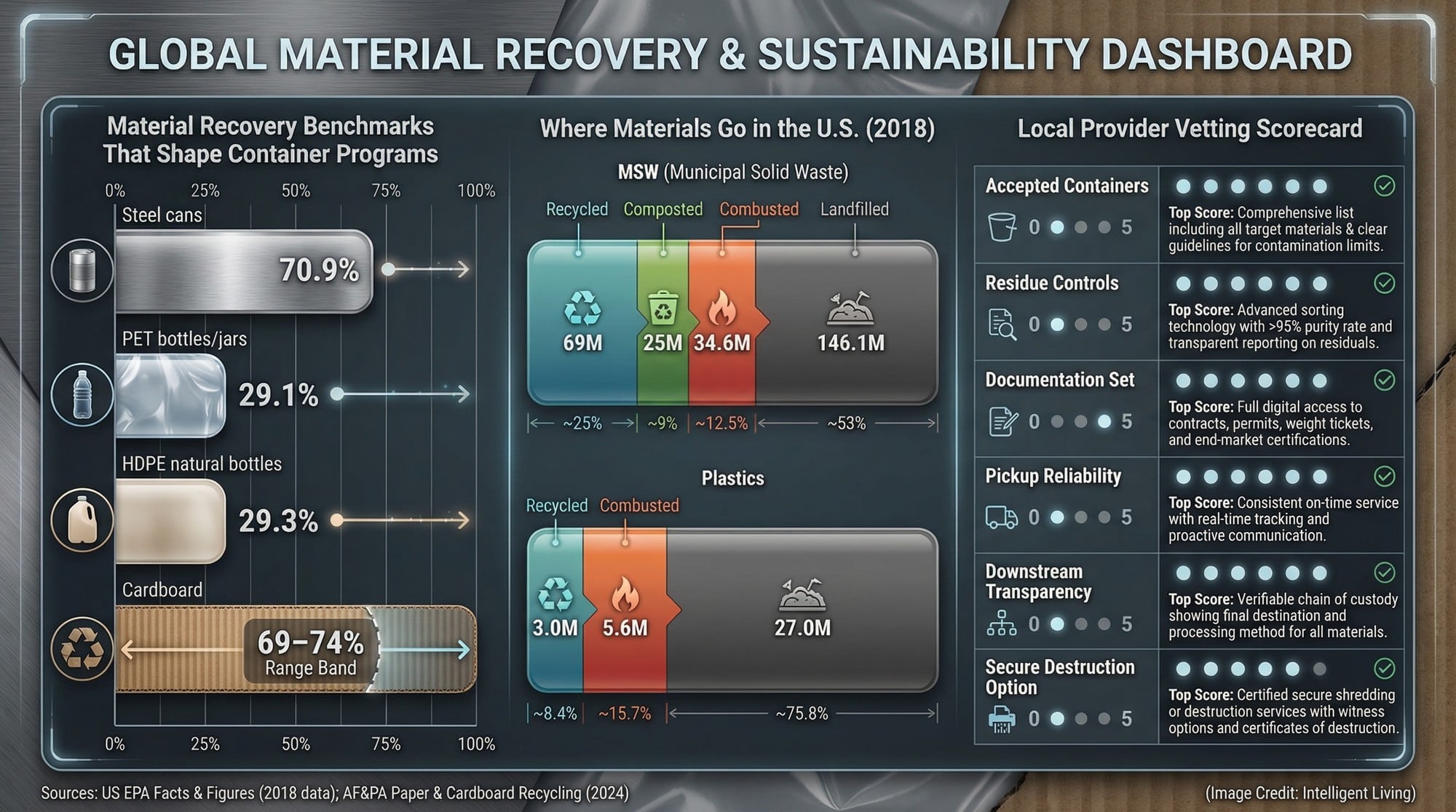
Selecting a reliable regional partner demands a rigorous look at their technical depth. Use this checklist to vet local providers for industrial drum, IBC, and bulk box processing:
- Accepted Container Types: Confirm the provider accepts the specific containers your facility generates. A reliable partner should have defined routing pathways for damaged containers, fiber drums, and bulk boxes.
- Reuse and Reconditioning Discipline: Verify their inspection process for residue compatibility and closure integrity. DOT’s reuse and reconditioning rules for packagings in 49 CFR 173.28 reflect the baseline logic that reuse depends on inspection and structural integrity.
- Documentation Provided: Confirm what records you receive and how they are retained. These should include manifests, disposition records, and certificates when destruction is used.
- Operational Fit: Evaluate pickup frequency and minimum volume requirements. Establish how exceptions are handled when containers do not actually meet the empty standard.
- Downstream Transparency: Ask where materials go for recycling or processing. Maintaining disposal accountability is the difference between a tidy paper trail and a painful follow-up.
- Sustainability Method: Prefer programs aligned with waste prevention and reuse-first systems. The EPA frames the core value in recycling basics and benefits as reduced resource extraction and lower lifecycle impacts.
Sustainability Metrics: Treating Documentation as Performance Data
Various procurement teams now treat documentation as part of sustainability performance rather than a compliance afterthought. Transitioning toward verifiable environmental accounting practices that support investor-grade reporting matches the move toward audit-ready systems.

Action Plan for Compliant Industrial Drum and IBC Recycling Success
Launching a successful program often begins with a focused pilot. By selecting one production line to document volumes and test pickup workflows, you establish a clear proof of concept for the entire facility. Evaluating three outcomes—avoided container purchases, pickup reliability, and documentation completeness—provides a baseline for success.
Expanding your success across the plant requires clear ownership. Embedding a simple SOP for emptying and verification ensures that compliance becomes a natural reflex for the floor team. Adopting systems-based trust models that turn proof into an operating habit aligns with programs that treat verification as operational value.
Structured sustainability reporting now relies on verifiable data trails. Implementing audit-ready ESG systems converts every pickup and disposition record into a measurable asset for stakeholders.
Frequently Asked Questions: Industrial Drum and IBC Recycling Compliance
What makes a drum RCRA-empty in practice?
A container is considered RCRA-empty when it is drained of all possible residue using common methods and meets specific federal volume thresholds. Stricter rules apply to acute hazardous waste.
When is destruction the preferred option?
Choose secure destruction if the container holds unknown residues, proprietary formulas, or structural damage that prevents safe reconditioning or transport.
Do IBC totes have specific inspection intervals?
Yes. Metal, rigid plastic, and composite IBCs used for hazardous materials must undergo periodic leakproofness tests and internal inspections, typically every 2.5 to 5 years.
What documentation is essential for an audit?
Maintain all pickup manifests, chain-of-custody records, and certificates of destruction. These documents provide the paper trail necessary to defend your compliance status.
Can Gaylord boxes and bulk corrugated be recycled?
Yes. Bulk corrugated boxes move through fiber recovery streams. They are typically recycled into new packaging materials rather than being reconditioned for reuse.


