
Even with the growing awareness of waste issues, the world continues to throw away more and more garbage every day. It is expected that by 2050 the global production of municipal solid waste will increase from a ridiculous 2.01 billion tons per year to an absurd 3.4 billion tons per year. As a part of this, global plastic production and consumption is also rising sharply, expected to soar from 350 million tons to 1.35 billion tons annually by 2050.
The U.N. Environment Program has made solid waste disposal a central issue to combating pollution worldwide as landfills contaminate air, water, and soil, and take up limited land and resources. The organization says:
Every year, an estimated 11.2 billion tons of solid waste are collected worldwide. The solution, in the first place, is the minimization of waste. Where waste cannot be avoided, recovery of materials and energy from waste as well as remanufacturing and recycling waste into usable products should be the second option.

As much as some people are doing their part to recycle unwanted household goods, the majority of the worlds solid waste ends up in some form of landfill. These mountains of trash cause methane gas and other damaging greenhouse gases which are released into the atmosphere. Clearly, we have a dilemma on our hands of significant concern. Fortunately, there is an Israeli company with an innovative technology that promises a solution to both worrying trends (rising waste production and plastic demands) simultaneously.
Landfill As A Goldmine
Christopher Sveen is the chief operations officer at UBQ, the company with the world-saving technology. He says the landfills are “the mines of the future.” With hopes of revolutionizing waste management worldwide and making landfills obsolete, UBQ has patented a process to convert household trash from landfills into reusable plastic.
Currently, the company operates a pilot plant and research facility at Kibbutz Zeelim, on the edge of southern Israel’s Negev Desert. There it has developed its production line which converts unsorted household waste into a sustainable, bio-based, climate-positive thermoplastic material that can be used for commercial and industrial products instead of petroleum-based plastics. Sustainability strategists Quantis International has dubbed it as “the most climate-positive material on the planet”.
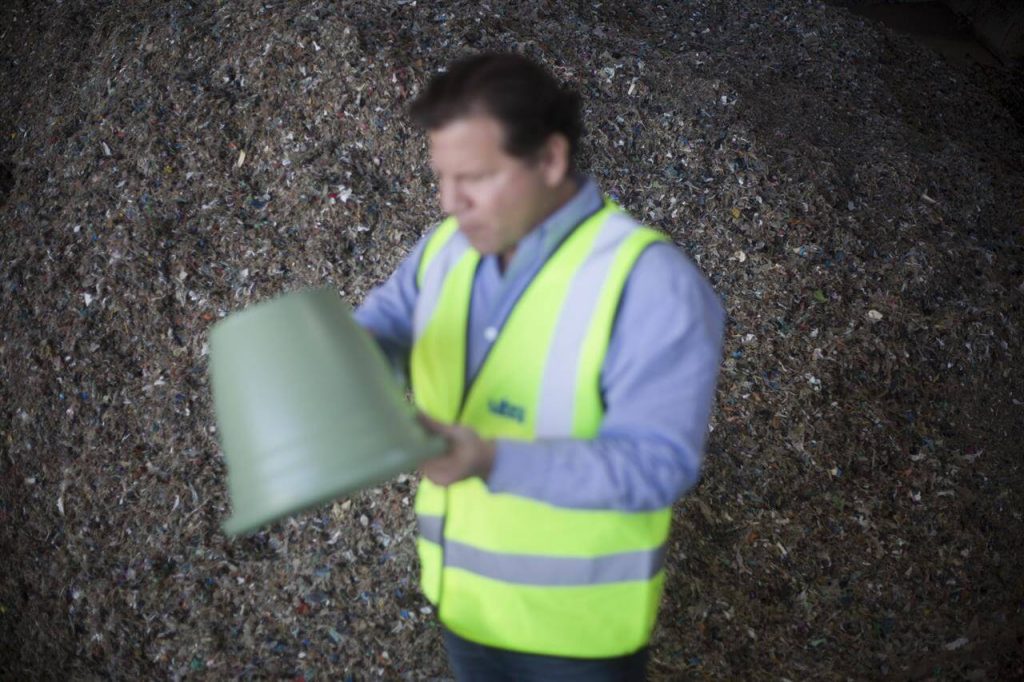
According to Albert Douer, a member of the company’s board, the UBQ’s material can be used as a substitute for conventional petrochemical plastics and wood, reducing oil consumption and deforestation. “We take something that is not only not useful, but that creates a lot of damage to our planet, and we’re able to turn it into the things we use every day,” he said.
UBQ co-founder and chief executive Jack (Tato) Bigio told The Jerusalem Post:
We have created a new natural resource from the household waste that ends up in landfills, avoiding its decomposition into harmful gases, while replacing scarce and expensive plastic materials made from oil. That’s a blessing to the industry. Many companies in the last 10 to 20 years have emerged with solutions that turn out to be flops in one way or another. Never again.
Better For The Planet
5% of global greenhouse gas emissions are produced by decomposing organic material in landfills, according to the U.N. Environment Program. Roughly half of that is methane, which is 21 times more potent for global warming as carbon dioxide, according to the World Bank.
With UBQ’s new technology, between three and 30 tons of CO2 are prevented from entering the atmosphere for every ton of material produced. The company explains the figures as follows:
Unlike the climate-negative plastics that dominate the market, such as polyethylene, PVC and polypropylene, producing 1 kg. of UBQ material saves 11.7 kg. of carbon dioxide equivalent emissions and a total replacement offset value of 14.5 kg.
In other terms, producing one ton of UBQ is equivalent to stopping the melting of 35 sq-m. of arctic ice, or the sequestration of 540 trees over 10 years old.
One industrial-level operational UBQ facility, with a capacity of producing 80,000 tons per year, is equivalent to taking over 565,000 cars off the road for a single year.
How It’s Made And Used
The company’s bio-based product is a homogeneous composite material that can be mixed with plastic resins in the end-product plastic industry. Meaning, it can be used as an additive to conventional plastics. Just 10-15% is enough to make a plastic carbon-neutral by offsetting the generation of methane and carbon dioxide in landfills.

Bigio explains how recyclable items like glass, metals, and minerals are extracted, and the remaining garbage—”banana peels, the chicken bones and the hamburger, the dirty plastics, the dirty cartons, the dirty papers”—is dried and milled into a powder. The resulting steely gray powder then enters a reaction chamber. There it is broken down and reconstituted as a plastic-like composite material.

Bigio said:
What UBQ is doing is taking all these valuable materials that are thrown away and bringing them back to life in an up-cycling way. We’re replacing a very expensive and scarce resource, and all of a sudden coming much closer to a truly circular economy. The value proposition is incredible.
According to UBQ, the process produces no carbon dioxide or toxic byproducts and uses little energy and no water. The final product can be turned into virtually anything one desires. It can even be molded into bricks, beams, planters, cans, and construction materials. To top it off, the material doesn’t degrade when it’s recycled.

Sveen said:
The modularity, scalability and adaptability of the UBQ solution really enables us to go into a market where there’s a huge amount of waste or less, if we need to tailor to particular industries. It is unique to be able to have so much flexibility on both the upstream (waste) and downstream (raw material and final product). That uniqueness will enable the company to expand to such a large scale in decades to come, to be in all areas.
Brought To You By
The company’s international and scientific advisory board is impressive. It includes Nobel Prize winner Prof. Roger Kornberg, celebrated nano-tech specialist Prof. Oded Shoseyov, leading patent practitioner Dr. Ilan Cohen, sustainability pioneer John Elkington, and former EU commissioner for climate action Connie Hedegaard. Furthermore, it has raised $30 million from private investors with big names including Sabra Dipping Co. founder Yehuda Pearl, Ajover Group CEO Albert Douer, who is the owner of 16 plastic factories in eight countries; and Battery Ventures general partner Scott Tobin.
Its first collaboration is with US authorities – the Central Virginia Waste Management Authority will distribute an initial order of 2,000 recycling bins to citizens, all made out of UBQ’s recycled material.


